Dogecoin Price Analysis: Why A Red Close Below $0.465 This Week Is A Good Thing For Price

bitcoinistPublicado a 2024-12-15Actualizado a 2024-12-15

Resumen

Dogecoin’s price action is still drawing attention with its ongoing consolidation holding up above $0.4. At the time of writing,...

Dogecoin’s price action is still drawing attention with its ongoing consolidation holding up above $0.4. At the time of writing, Dogecoin is trading around $0.409, down 14% from its recent December high of $0.4757. While this dip might appear concerning to some, crypto analyst Master Kenobi believes it is a natural and necessary phase in Dogecoin’s journey toward another bullish breakout. 

According to his analysis shared on social media platform X, Dogecoin needs to close below $0.465 in the weekly timeframe. Although it sounds bearish at the get-go, it is actually based off a very bullish price outlook for the meme coin.

Dogecoin’s Consolidation Resembles Its 2020 Post-Halving Behavior

Kenobi’s outlook is not rooted in immediate bearishness but in a broader perspective comparing Dogecoin’s current price consolidation to its behavior during late 2020, right before the crazy rally in 2021. 

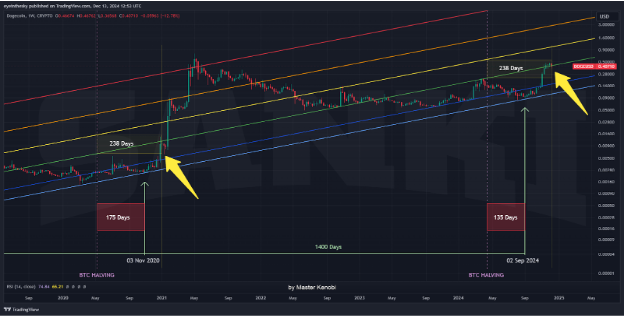
Cryptocurrencies are known to exhibit similar price performances in cycles. Interestingly, Dogecoin’s recent price performance is reminiscent of its price action in 2020 following the Bitcoin halving earlier that year. Analysis of the Dogecoin weekly candlestick price chart shows that the Dogecoin price rallied in late 2020, entered a consolidation phase, and subsequently exploded during the 2021 bull market. 

The parallels between those movements and Dogecoin’s current trajectory are very notable, with 2024’s Bitcoin halving earlier this year setting the stage for a similar cyclical pattern. As it stands, the Dogecoin price is now consolidating after a notable rally in October and November 2024, much like the 2020 movement. 
The Importance Of Closing Below $0.465 This Week

Although the current consolidation might be slowing down bullish sentiment, it might not be over yet. Crypto analyst Master Kenobi expects this consolidation to continue in order for the current Dogecoin price action to completely mirror that of the 2020/2021 movement, suggesting a repeat of 2021’s dramatic rally could occur by 2025.

DOGE now trading at $0.39. Chart: TradingView

To fully replicate its 2020-2021 cycle, Dogecoin needs to close this week in the red, with a price below $0.465. Particularly, the analyst noted that this is necessary for the Dogecoin price in order to continue healthy consolidation. At the time of writing, the Dogecoin price is trading at $0.409, meaning it is well on track to close the week below $0.465. 

If Dogecoin’s current price action continues to align with the patterns observed in 2020, it may be on track for another parabolic surge next year. In another technical analysis, Master Kenobi noted that the ongoing red week falls exactly 238 days after the last halving, perfectly aligning with the previous cycle.

Based on this pattern, he predicts that a red weekly close will be followed by two consecutive green weeks, paving the way for a significant price surge to begin in the third week, around December 30th. 

Featured image from AP News, chart from TradingView

Scott Matherson

Scott Matherson

Scott Matherson is a leading crypto writer at Bitcoinist, who possesses a sharp analytical mind and a deep understanding of the digital currency landscape. Scott has earned a reputation for delivering thought-provoking and well-researched articles that resonate with both newcomers and seasoned crypto enthusiasts. Outside of his writing, Scott is passionate about promoting crypto literacy and often works to educate the public on the potential of blockchain.

Lecturas Relacionadas

When Hyperliquid Takes Away Solana's "Internet Capital Markets" Script

The article discusses how Solana's vision of becoming the "Internet Capital Markets" is being challenged, primarily by the rise of Hyperliquid. While Solana positioned itself as a high-performance blockchain for tokenizing all global assets, its native token SOL has significantly underperformed, and its core narrative faces pressure. Hyperliquid, initially a perpetual contracts platform, has evolved into a specialized Layer 1 financial network. Its focused, trading-optimized design is attracting users and capital, suggesting a vertical L1 may be better suited for a core capital market than a general-purpose chain like Solana. This external competition was compounded by an internal $200M+ exploit on Solana's key derivatives protocol, Drift, creating a strategic vacuum. In response, Solana founder Anatoly Yakovenko heavily promoted the Phoenix protocol as a decentralized, composable alternative. However, Phoenix's trading volume remains far behind leading platforms. Solana supporters also launched critiques against Hyperliquid's decentralization, citing its limited validators and closed-source code. Critics countered that Solana's own decentralization metrics have weakened, and the foundation's overt backing of Phoenix caused friction with other ecosystem builders. The piece concludes that Solana risks losing the "Internet Capital Markets" race if it cannot regain dominance in derivatives, potentially remaining a meme coin hub rather than achieving its grand ambition of hosting all global assets.

marsbitHace 1 hora(s)

When Hyperliquid Takes Away Solana's "Internet Capital Markets" Script

marsbitHace 1 hora(s)

Trump Signs Executive Order, Kraken, Coinbase and Others May Gain Access to Fed Payment Channels

President Trump has signed an executive order, "Incorporating Financial Technology Innovation into the Regulatory Framework," pressuring the Federal Reserve to reassess its rules on granting non-bank financial companies—including crypto and fintech firms—access to its payment systems, specifically master accounts that connect to the Fedwire settlement system. Currently, such accounts are primarily reserved for depository institutions. The order mandates a review to determine if broader access is permissible and to establish an application process. This move, supported by figures like Senator Cynthia Lummis, aims to reduce barriers to innovation and lower public payment costs by fostering fairer competition. It does not grant immediate access but could pave the way for companies like Kraken, Coinbase, Ripple, and Circle to reduce reliance on intermediary banks, lowering costs and speeding up settlements. A key precedent is the Kansas City Fed granting Kraken's parent company a restricted master account in March, offering limited payment services without interest or credit privileges. This model is seen as a potential template for allowing controlled access while mitigating systemic risk. Other firms like Anchorage, Paxos, and BitGo, which hold specialized banking charters, are also well-positioned to apply. The banking industry, represented by the American Bankers Association, opposes easing access, arguing any institution handling bank-like payments must meet the same stringent regulatory, consumer protection, and risk-management standards as traditional banks. Their core concerns include potential systemic risks, compliance gaps in areas like anti-money laundering, and the diversion of liquidity from the traditional banking system. The outcome of the Fed's review will be crucial in determining whether and how crypto and fintech firms can integrate more directly into the core U.S. financial infrastructure, balancing innovation with financial stability.

marsbitHace 1 hora(s)

Trump Signs Executive Order, Kraken, Coinbase and Others May Gain Access to Fed Payment Channels

marsbitHace 1 hora(s)

The First Large-Scale Strike in the AI Era Comes from the Factories That Build AI

The article describes a potential large-scale strike at Samsung Electronics, narrowly averted in May 2026 after a temporary agreement. The strike, planned by the company's union, would have been the first major labor action in the AI era targeting a core AI supply chain player. Samsung, alongside SK Hynix, produces roughly two-thirds of the world's memory chips, critical components for AI training and data centers like HBM. An 18-day strike could have disrupted global supply, affecting prices and production for tech companies and cloud providers. For South Korea, where semiconductors constitute about 35% of exports and Samsung represents a quarter of the stock market's value, such an action threatens national economic stability. The union's demands include a 7% base wage increase and, crucially, a clear, substantial profit-sharing model. They want 15% of annual operating profit as an employee bonus pool and the removal of the existing cap (about 50% of annual salary). This frustration is amplified by seeing rival SK Hynix successfully negotiate a deal granting employees 10% of operating profit as bonuses, with reports suggesting some workers could receive bonuses equivalent to hundreds of thousands of dollars. The conflict stems from deeper issues in South Korea's chaebol (conglomerate) system, where rapid national industrialization often prioritized corporate growth over labor rights. Samsung long maintained a "no union" policy until a 2020 apology from its leader. The article argues this strike highlights a fundamental tension in the AI age: as technology advances and corporate profits soar—often driven by AI—the workers who build the infrastructure are demanding a fair share and dignity, rejecting the notion that they are mere expendable components in a machine that "must not stop." The piece concludes that the true test of the AI era isn't just computational power, but whether the people who build the future can secure a stable and valued place within it.

marsbitHace 2 hora(s)

The First Large-Scale Strike in the AI Era Comes from the Factories That Build AI

marsbitHace 2 hora(s)

Ripple’s Fed Master Account Bid Gains Momentum After Trump Order

President Donald Trump has signed an executive order directing financial regulators and the Federal Reserve to review expanding fintech and crypto firms' access to core payment infrastructure. This order significantly advances the industry's push for direct Fed connectivity, a central issue for Ripple. The company has been seeking a Federal Reserve master account as part of its strategy for its RLUSD stablecoin, which would allow it to hold reserves directly with the central bank and access its payment rails. The order, titled "Integrating Financial Technology Innovation into Regulatory Frameworks," mandates a Fed review within 120 days on allowing access for entities like uninsured depository institutions and non-bank financial companies, including those in digital assets. This creates a formal policy timeline for resolving whether crypto payment firms must rely on traditional bank intermediaries. Ripple's application for a national bank charter and a master account is part of this broader landscape. The issue gained precedent when Kraken Financial received a limited-purpose master account, while Custodia Bank's application was denied after a legal battle. The Fed has also proposed a more restricted "payment account" option. Trump's order does not guarantee approval for Ripple but forces a high-level examination of the regulatory barriers, bringing the company's long-running effort to the forefront of Washington's financial policy agenda.

bitcoinistHace 2 hora(s)

Ripple’s Fed Master Account Bid Gains Momentum After Trump Order

bitcoinistHace 2 hora(s)

Trading

Spot
Futuros
活动图片