Предложение о резерве биткоинов в США вызывает смешанные реакции в социальных сетях

cryptonews.ruPublicado a 2022-11-02Actualizado a 2024-12-02

По мере того как разговоры вокруг идеи стратегического резерва биткойнов под руководством США становятся все более активными, эта тема вызывает оживленные дебаты. Некоторые энтузиасты считают это неизбежным шагом к глобальному принятию биткойна государствами, в то время как другие осуждают эту идею как предательство основной философии криптовалюты.

Противоположные мнения о принятии США биткойнового резерва

Шум вокруг потенциального создания Соединенными Штатами стратегического резерва биткойнов (BTC) становится все громче благодаря недавним политическим изменениям и продолжающимся экономическим дебатам. То, что когда-то звучало как безумная идея, теперь превращается в горячую тему, во многом из-за обещания Дональда Трампа превратить США в «крипто-столицу мира». Подливает масла в огонь сенатор Синтия Ламмис, ставшая ярой сторонницей, активно продвигающей идею о том, чтобы нация приняла биткойн-резерв.
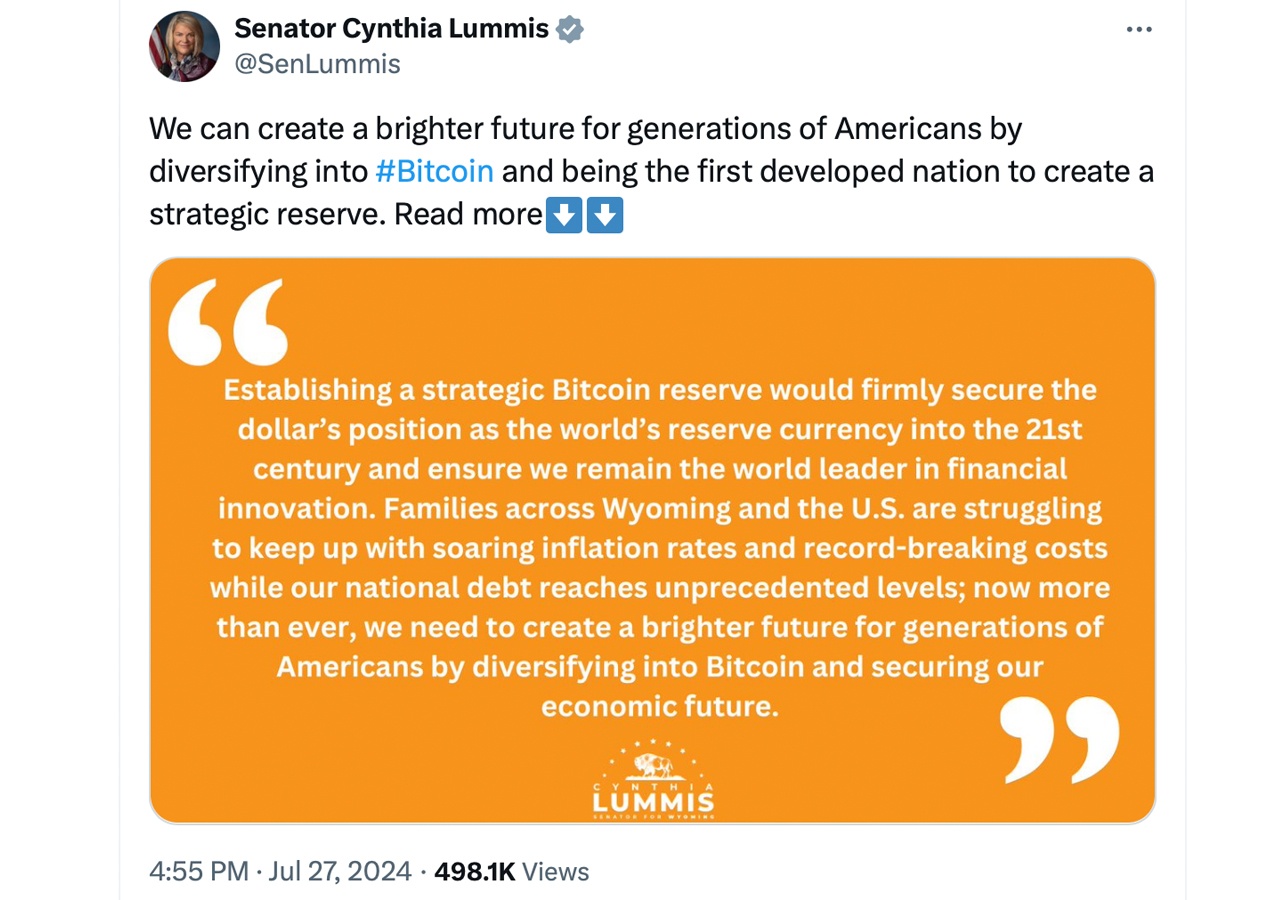
Разговоры о биткойновом резерве США начались задолго до того, как Дональд Трамп был избран.

Ламмис представила в Сенат хитро названный “Закон о стимулировании инноваций, технологий и конкурентоспособности через оптимизированные общенациональные инвестиции в биткойн (BITCOIN) Act”. Ее предложение направлено на то, чтобы позиционировать резервы BTC как средство укрепления доллара США и решения проблемы национального долга. Еще до начала избирательной кампании эта концепция уже вызвала бурные обсуждения в социальных сетях. Платформы, такие как X, Facebook и Reddit, по-прежнему переполнены мнениями, вызывающими оживленные дебаты и многочисленные новости.

Кажется, у всех—и у всей их расширенной семьи—есть, что сказать, и дискуссия демонстрирует разнообразие взглядов. 18 ноября генеральный директор Blockstream Адам Бэк высказал свои мысли. «Если стратегический биткойновый резерв США станет реальностью, готовьтесь к биткойну с семизначной стоимостью в этом цикле», — опубликовал Бэк на X. Он продолжил: «Рынок скептически относится к значимому продолжению на данный момент, поэтому это нисколько не учтено в цене». Отвечая кому-то в обсуждении, Бэк добавил, что если идея «станет реальностью», то он ожидает «быстрого перепринятия цены».

В то время как некоторые в восторге от перспективы гипербиткойнизации, не все находят эту идею такой уж замечательной. Джордж Селджин, почетный директор Центра денежных и финансовых альтернатив института Като, присоединился к разговору, поделившись своими мыслями и редакционной статьей, которую он написал по теме биткойнового резерва. Селджин опубликовал:

Американский «Стратегический биткойновый резерв» (#SBR ) будет выполнять ту же функцию, что и официальные 8 133 метрических тонны золотого запаса США — то есть _никакой функции вообще_.

В своей статье Селджин подробно рассматривает вопрос. Он отмечает, что доллар США остается непревзойденным в своем доминировании, «несмотря на снижение его доли в резервах». Статья также указывает, что золотовалютные резервы правительства США в основном находятся в состоянии простоя и считаются ненужными, как и 8 133 метрических тонны золота страны. В воскресенье Вик Шарма, основатель Cake Wallet и президент и генеральный директор Liberty Steel USA, поделился своим мнением по этому вопросу.

«Риск, который я вижу в том, что страны могут сделать биткойн стратегическим резервом, заключается в том, что некоторые страны конфискуют [биткойны] своих граждан», — сказал он. «Я параноик? Вы думаете, это произойдет только в странах, управляемых деспотами? Ну, США сделали это в 1933 году. Посмотрите указ 6102 Рузвельта, который действовал до 1974 года… Вам нужно хранить часть своего «хранилища ценности» в какой-то действительно невидимой валюте. Чертовски … это монеро-сторона меня снова изрекает теории заговора.”

Дебаты вокруг биткойнового резерва США раскрывают столкновение между старым и новым, централизованным и децентрализованным. В их основе многие видят философский вопрос: следует ли инструменту, родившемуся для освобождения людей от государственного контроля, быть захваченным правительствами для собственных целей? Ответ отражает не только экономическую стратегию, но и философию свободы нации.

Принятие BTC в качестве стратегического резерва может стать глубоким противоречием, если оно не основывается на идеологии свободы и самодостаточности. Истинные инновации не могут процветать, если государственное принуждение искажает их цель. Если Соединенные Штаты хотят лидировать, они должны принять политику, которая дает людям возможность, а не изымает их богатство под предлогом. Свободное будущее требует честности, а не лицемерия.


Lecturas Relacionadas

Former SpaceX Engineer Reconstructs Financial Execution System Using First Principles

Former SpaceX engineer Lex Li applies "First Principles Thinking" to financial infrastructure with Plan Execution Lab, recently raising angel funding at a $50M post-money valuation. The team argues that the core function of finance is capital allocation, and the critical gap is not in trading but in execution, which remains highly manual and fragmented. While assets, liquidity, and settlement have migrated on-chain, execution workflows (monitoring, risk management, liquidity coordination) are still human-native. In an era of accelerating AI agents, strategy decay is rapid, shifting the competitive edge from having the best strategy to having the most robust execution network. Plan Execution Lab introduces two core components: 1. **PlanX**: A Financial Execution Protocol designed as infrastructure for the migration from CEX to DEX, providing on-chain execution capabilities, liquidity access, risk management, and capital orchestration. 2. **Xgent**: An Autonomous Financial Runtime. Users define investment intents, risk preferences, and constraints; Xgent automatically constructs an execution graph, verifies it, and handles ongoing execution and optimization—streamlining the process from Intent to Autonomous Execution. The long-term vision is to create the "Bloomberg Terminal for Autonomous Finance"—a shared operating environment and execution network built collectively by participants like execution nodes, liquidity providers, and autonomous agents. The future of finance, they contend, belongs not to isolated algorithms but to open, collaborative execution networks.

marsbitHace 13 min(s)

Former SpaceX Engineer Reconstructs Financial Execution System Using First Principles

marsbitHace 13 min(s)

Former SpaceX Engineer Reconstructs Financial Execution System from First Principles

Plan Execution Lab, a financial infrastructure project founded by former SpaceX engineer Lex Li, has raised angel funding at a $50M post-money valuation. The startup is applying "first principles thinking" from Li's SpaceX experience to rethink financial market execution. Their analysis posits that while assets, liquidity, and settlement have moved on-chain, the execution layer remains fundamentally human-dependent and fragmented. In the era of AI Agents, strategy advantages decay rapidly, shifting the competitive edge from isolated algorithms to robust **execution networks**. Plan Execution Lab's solution is a two-part system: **PlanX**, a Financial Execution Protocol designed to facilitate the migration from centralized exchanges (CEX) to on-chain markets by providing core on-chain execution capabilities; and **Xgent**, an Autonomous Financial Runtime. Xgent allows users to define investment goals and constraints, then autonomously constructs and manages the execution logic—moving from **Intent to Execution Graph to Verification to Autonomous Execution**. The long-term vision is to create the "Bloomberg Terminal for Autonomous Finance"—an operating environment not for humans, but for agents and execution nodes. The future financial system, they argue, will be a collaborative network built by diverse participants contributing execution capabilities, not secret strategies. The core competition will shift to who builds the most powerful and adaptive execution network.

链捕手Hace 14 min(s)

Former SpaceX Engineer Reconstructs Financial Execution System from First Principles

链捕手Hace 14 min(s)

First Long-Horizon Doc2Repo Training Dataset: Code Agents Move Beyond Bug Fixing and Begin Creating Repositories

With the advancement of LLM Code Agents, the research focus is shifting towards long-horizon, real-world tasks, moving beyond simple bug fixes to full repository generation. To address this, researchers from Renmin University of China introduced the DeNovoSWE dataset. This dataset focuses on long-term software engineering tasks, specifically the "document-to-repository" challenge—generating an entire, executable code repository from a task description. The DeNovoSWE construction method employs a Divide & Conquer approach. It breaks down target repositories into core capabilities and uses a multi-agent Draft-Critic-Repair workflow to automatically generate high-quality, evaluation-aligned task documents. The dataset also implements difficulty-aware filtering to balance quality and diversity. The result is a high-quality, anti-leakage dataset of 4,818 instances. Experiments show that models trained on DeNovoSWE achieve significant improvements in long-horizon repository generation. For instance, Qwen3-30B-A3B-Instruct's performance on the BeyondSWE-Doc2Repo benchmark increased from 5.8% to 47.2%, and on NL2RepoBench from 4.3% to 23.0%. Similar gains were observed with stronger backbones, demonstrating that dedicated long-horizon training data is crucial for advancing Code Agents from maintainers to architects capable of planning and building complete software projects from scratch.

marsbitHace 29 min(s)

First Long-Horizon Doc2Repo Training Dataset: Code Agents Move Beyond Bug Fixing and Begin Creating Repositories

marsbitHace 29 min(s)

Even CZ Praised Hyperliquid as 'Awesome', But Its Biggest Moat Might Also Be Its Biggest Risk

In an episode of Galaxy Brains, Binance founder CZ praised Hyperliquid as "awesome" but clarified that while its product is strong, Binance cannot compete in its specific niche due to Hyperliquid's no-KYC, decentralized model. CZ noted he would not personally operate such a model, highlighting the inherent legal and compliance risks tied to its access advantage. The discussion underscores a core market structure conflict: on-chain perp platforms like Hyperliquid thrive on open, low-barrier access, which regulated exchanges like Binance cannot replicate without abandoning their global compliance posture. However, this very advantage makes Hyperliquid a clear target for regulatory scrutiny. The UK FCA has already issued a warning against Hyperliquid for potentially offering unauthorized services to UK users, framing it as a financial services provider rather than neutral infrastructure. Historical cases like the CFTC's action against bZeroX and Ooki DAO further illustrate that regulators may pursue decentralized structures if they facilitate leveraged trading for retail users without proper controls. Meanwhile, regulated venues like Cboe are developing US-compliant "continuous futures" that mimic perpetual exposure, narrowing the product gap. Hyperliquid's long-term edge may increasingly hinge on its access model—the very feature most exposed to regulatory pressure. The key question is whether its "access premium" can withstand escalating legal challenges as on-chain perps gain mainstream attention.

marsbitHace 47 min(s)

Even CZ Praised Hyperliquid as 'Awesome', But Its Biggest Moat Might Also Be Its Biggest Risk

marsbitHace 47 min(s)

Trading

Spot
Futuros
活动图片