Ripple Files Civil Appeal Pre-Argument Statement Against SEC: Key Takeaways

bitcoinistPublicado a 2024-10-25Actualizado a 2024-10-25

Resumen

On Thursday, October 24, Ripple Labs filed the Civil Appeal Pre-Argument Statement, known as Form C, in its case with...

On Thursday, October 24, Ripple Labs filed the Civil Appeal Pre-Argument Statement, known as Form C, in its case with the US Securities and Exchange Commission (SEC). This document outlines the critical issues the company intends to present on appeal, each subject to a de novo standard of review, meaning the appellate court will re-examine the issues without deferring to the lower court’s conclusions.

Ripple’s Four Key Issues On Appeal

The appeal focuses on four main arguments. First, the company challenges the definition of an “investment contract” under Section 5 of the Securities Act of 1933. Ripple contends that an investment contract “must have the essential ingredients of (a) a contract, (b) that imposes post-sale obligations on the seller, and (c) that gives the buyer a right to demand and receive profits from the seller’s activities.”

Second, Ripple disputes the district court’s application of the Howey Test, derived from the 1946 Supreme Court case SEC v. W.J. Howey Co. The company argues that the court erred in concluding that some of its XRP transfers met the criteria for an investment contract. Specifically, the company challenges whether there was an investment of money, a common enterprise, and a reasonable expectation of profits solely from its efforts.

Third, the appeal resurrects the “fair notice” defense. The company asserts that it lacked adequate notice that its conduct violated Section 5, citing evidence of widespread uncertainty about the application of federal securities laws to virtual currencies and other digital assets. Ripple points to the SEC’s inconsistent and deliberately vague statements as contributing to this confusion.

Finally, Ripple challenges the specificity of the injunction issued against it. The company contends that the injunction fails to meet the clarity requirements of Rule 65 of the Federal Rules of Civil Procedure, as it merely directs the company to “obey the law” without providing detailed guidance. Ripple argues that such an injunction is overly broad and leaves too much room for interpretation, potentially hindering its business operations.

Pro-XRP attorney Jeremy Hogan commented on the appeal via X, noting that Ripple’s challenge to the definition of an investment contract could have far-reaching implications for the crypto industry. “Ripple is bringing this issue to the appeals court mainly for the benefit of the crypto space in general,” he stated. Hogan added that while winning on this issue might not absolve Ripple of the $105 million judgment against it, it could “cripple the SEC enforcement regime” by requiring that an investment contract must be a legal contract.

Hogan also highlighted the reintroduction of the fair notice defense and the company’s challenge to the injunction’s specificity. He remarked, “Most interesting to me, Ripple appeals whether the injunction is specific enough when it basically says, ‘follow the law.’ This seems quite common in securities laws cases but really makes no sense as an injunction. It also indicates that Ripple would rather not have that injunction hanging over its business.”

Ripple’s Chief Legal Officer, Stuart Alderoty, provided further insight into the company’s position via X. He emphasized that the case is not about whether XRP itself is a security. “XRP is uniquely situated as having clarity (alongside BTC) in not being classified as a security,” Alderoty stated. “The SEC is not challenging that ruling, which stands as the law of the land.”

He reassured stakeholders that the appellate court would review the existing record without the SEC introducing new evidence or demanding additional documents. “As we go through this process, please remember the SEC’s broader strategy: try to create distraction and confusion for Ripple and the industry,” he added. “But honestly, it’s just background noise now. The hard part of the fight is behind us. Ripple’s business is growing and getting stronger every day even as this appeal process plays out.”

In a parallel development, the SEC has requested that the deadline for filing its principal brief be set for January 15, 2025. Additionally, pro-XRP attorney John E. Deaton filed for an appearance as amicus counsel in the Second Circuit rendition. He told FOX Business journalist Eleanor Terrett, “Senate race or not, I don’t walk away from what I started.”

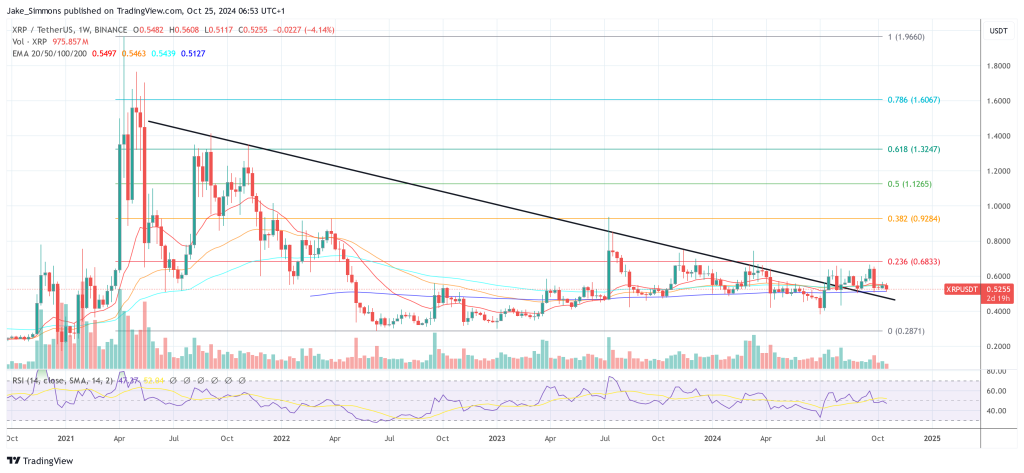
At press time, XRP traded at $0.5255.
XRP price
XRP price holds above the 200-week EMA, 1-week chart | Source: XRPUSDT on TradingView.com
Featured image created with DALL.E, chart from TradingView.com
Jake Simmons

Jake Simmons

Jake Simmons has been a Bitcoin enthusiast since 2016. Ever since he heard about Bitcoin, he has been studying the topic every day and trying to share his knowledge with others. His goal is to contribute to Bitcoin's financial revolution, which will replace the fiat money system. Besides BTC and crypto, Jake studied Business Informatics at a university. After graduation in 2017, he has been working in the blockchain and crypto sector. You can follow Jake on Twitter at @realJakeSimmons.

Lecturas Relacionadas

The Warsh Storm Approaches

The article "The Warsh Storm Approaches" analyzes the potential market impact of Kevin Warsh becoming the new Federal Reserve Chairman, succeeding Jerome Powell. It argues that the current AI-driven stock market rally, concentrated in high-valuation tech giants, relies on a crucial premise: that long-term interest rates will eventually fall. This premise is now under threat as the 30-year Treasury yield remains persistently high, exceeding 5%, due to sticky inflation, worsening U.S. fiscal deficits, and deteriorating Treasury supply-demand dynamics. The core vulnerability is that high long-term rates pressure valuations by increasing the discount rate for future earnings. The article warns that Warsh's policy stance could intensify this pressure. Unlike Powell, Warsh is seen as more tolerant of market stress, more committed to quantitative tightening (QT/shrinking the Fed's balance sheet), and less inclined to provide implicit market support. His tenure at the Fed during the 2008 crisis shaped his skepticism about prolonged quantitative easing, believing it fuels asset bubbles without sufficiently boosting the real economy. While strong AI-driven earnings growth could theoretically offset higher rates, the narrative is currently concentrated in a few firms and hasn't yet translated into broad-based productivity gains for the wider economy. Therefore, the AI boom may not be enough to counter the valuation pressures from sustained high yields. Warsh's leadership could force the market to confront a new reality where the old supports—low long-term rates and a reliably supportive Fed—are no longer guaranteed, potentially triggering a reassessment of sky-high stock valuations.

marsbitHace 10 min(s)

The Warsh Storm Approaches

marsbitHace 10 min(s)

Anthropic Founder's Handbook: How to Build an AI-Native Company!

Anthropic has released "The Founder's Playbook: How to Build an AI Native Company," a guide that reimagines the startup lifecycle (Ideation, MVP, Launch, Scale) for 2026-era AI capabilities. The core thesis is that AI is fundamentally changing how ideas become reality, shifting the founder's role from an individual contributor to an orchestrator of AI agents. This lowers execution barriers, allowing domain experts (e.g., in medicine, law, education) to build products without deep technical skills, as AI can handle prototyping, coding, research, and operations. However, the playbook warns that easier prototyping increases the risk of building products no one needs, emphasizing that validation, not just building, is critical. It highlights that AI enables small teams to possess capabilities once reserved for large organizations, compressing functions like development, marketing, and support. This challenges traditional competitive advantages based on organizational size. For AI-native companies, sustainable moats will not come from the AI model alone but from deep domain knowledge, user data flywheels (behavioral fingerprints from real usage), and workflow lock-in that makes switching costly. Ultimately, the guide signals a shift in focus from raw model capability to how AI fundamentally reshapes company structure, processes, and competitive strategy. An AI-native company is defined not by using AI tools but by embedding AI into its core operational DNA from inception.

marsbitHace 1 hora(s)

Anthropic Founder's Handbook: How to Build an AI-Native Company!

marsbitHace 1 hora(s)

Trading

Spot
Futuros
活动图片