Dogecoin, the XRP Price, and the RCO Finance Presale Token Could See Bigger Gains in Q4 2024, Here’s Why

bitcoinistPublicado a 2024-10-22Actualizado a 2024-10-23

Resumen

The crypto market is pumping again, with the XRP price gaining traction. Meanwhile, Dogecoin (DOGE) has performed exceptionally, jumping by...

The crypto market is pumping again, with the XRP price gaining traction. Meanwhile, Dogecoin (DOGE) has performed exceptionally, jumping by double digits over the past week. Despite these gains, investors increasingly flock to RCO Finance (RCOF), an upcoming presale token. 

Why are XRP and Dogecoin investors rushing to buy RCO Finance (RCOF)? Let’s find out!

XRP Price Climbs 3% in a Week: More Gains Coming?

XRP has performed decently over the past week, maintaining a green chart. On October 14, the XRP price was hovering around $0.5294. The XRP price began pumping the same day after Bitcoin (BTC) jumped past $66,000, triggering an altcoin rally. 

Also, on October 15, Ripple announced the partners of its Ripple USD (RLUSD) stablecoin. This generated massive hype, which saw the XRP price climb as high as $0.0.5626 on October 17 before backtracking. By October 21, the XRP price had stabilized at around $0.5482, marking a 3% weekly gain. 
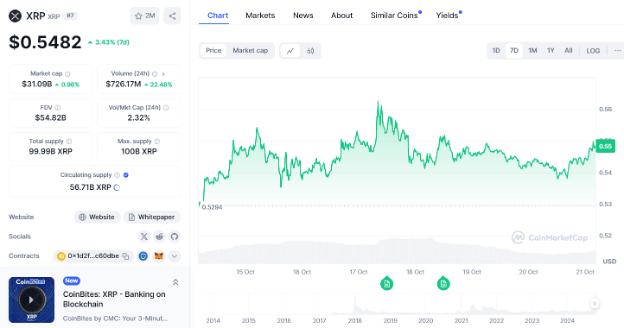
Moreover, analysts believe the XRP price will continue surging in Q4 2024, potentially hitting $0.6200. Experts base this prediction on XRP attracting more investors once RLUSD launches. It is worth mentioning that RLUSD is only awaiting regulatory approval before it launches. 

Dogecoin Pumps 32% in a Week: Will Explosive Growth Persist?

Dogecoin has performed exceptionally well over the past seven days. On October 14, DOGE was changing hands at around $0.1104. After recording marginal gains, Dogecoin gained momentum on October 15 after DogeExpress revealed that Ventura Harbor Bar in Palmas, Spain, had started accepting DOGE payments. 

The buzz about this bullish development saw Dogecoin soar as high as $0.1463 on October 20. By October 21, Dogecoin (DOGE) had stabilized at around $0.1459, which means Dogecoin has surged 32% in a week. 
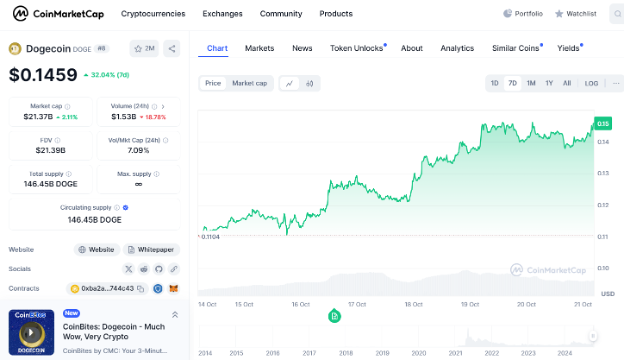
While Dogecoin faces resistance around the $0.1400 price range, analysts believe the meme coin can rise to $0.2000 if it breaches this resistance level. With Dogecoin being a favorite among speculative traders, analysts believe the token can achieve this feat if Bitcoin surges past $70,000, further fueling the ongoing altcoin season. 

RCOF Wows Investors With Huge Gains: More Growth Coming

With the XRP price showcasing slow growth, investors are moving to RCOF for better returns. Investors are purchasing this presale token because it has exhibited impressive growth thus far. As of October 21, RCOF had nearly raised $4 million in funding, making it one of the fastest-selling crypto ICOs in 2024. 

Astonishingly, RCOF has achieved this noteworthy milestone despite being in the early stages of its presale. Specifically, RCOF is currently in Stage 3 of its presale. The price of this presale token during this stage is $0.055. Once RCOF attains its projected listing price of $0.4-$0.6, Stage 2 investors will realize massive ROIs. 

Furthermore, analysts believe this presale token will soar meteorically once it launches on top  DEXs and CEXs. Also, analysts are pegging this prediction on this presale token, which is attracting hordes of investors because of its safety. This can be verified by the smart contract audit that SolidProof, a leading blockchain security firm, conducted. 

RCO Finance Wows The DeFi Space With Its Robo Advisor

As the XRP price struggles to reclaim the $0.6000 level, crypto investors adjust their portfolios to get the most out of the ongoing rally. However, this can be challenging, especially for novice investors. Luckily, RCO Finance, an upcoming DeFi platform, helps address this challenge with its unique AI and blockchain-powered tools. 

RCO Finance is quickly making inroads in the DeFi sector because of its trailblazing AI-powered robo advisor. This tool uses machine learning and algorithms to offer investors personalized investment tips. Investors can then use these suggestions to pick out high-potential opportunities from the 120,000+ assets on RCO Finance. 

In doing so, investors can easily diversify their portfolios with assets that match their risk tolerance and financial goals, increasing their profitability. Alternatively, investors can automate their accounts, enabling the robo advisor to modify their portfolios in real time. This enables investors to tap opportunities that would otherwise go unnoticed. 

The robo advisor’s data-based investment strategy also helps investors avoid emotional investing, often resulting in low profits or losses. This explains why investors are buzzing about this revolutionary tool. 

RCO Finance Offers Solid Hedging Options

With the XRP price facing resistance, a pullback might be needed. Investors are also diversifying their portfolios to hedge against potential losses. To simplify this process, RCO Finance supports tokenizing real-world assets (RWAs), exposing investors to illiquid assets like real estate and commodities.

In addition, RCO Finance boasts a pre-derivatives offering (Pre-DO), which lets investors trade decentralized derivatives like swaps, futures, and swaps. This explains why you should join RCO Finance to refine your investment experience. 

For more information about the RCO Finance Presale:

Visit RCO Finance Presale

Join The RCO Finance Community


Bitcoinist

Bitcoinist

Bitcoinist is the ultimate news and review site for the crypto currency community!

Criptos en tendencia

Lecturas Relacionadas

What Will Ethereum Look Like in 2030?

Ethereum, now in its 11th year, continues to evolve with a long-term vision centered around five "North Star" goals for 2030. First, a **Fast L1**: The consensus mechanism will be streamlined using zero-knowledge proofs to aggregate validator votes, aiming for single-slot finality. Block times are planned to decrease from 12 seconds to 4 seconds, making transactions irreversible within seconds. The staking minimum will also drop to 1 ETH, promoting greater decentralization. Second, a **1 Billion Gas L1**: Leveraging ZK proofs (L1 ZK-EVM), nodes will verify blocks without re-executing transactions, removing a key scalability bottleneck. This paves the way for the L1 to handle ~1 billion gas per second, a 200x increase, while allowing even light clients to fully verify the chain. Third, **Trillion-Gas L2s**: The roadmap focuses on massively scaling data capacity (blobs) for Layer 2 rollups, targeting 1 GB per second bandwidth. This creates a clear division: the L1 acts as a secure settlement layer, while high-throughput, application-specific L2s (like Robinhood Chain) handle execution. Fourth, a **Quantum-Resistant L1**: To counter future quantum computing threats, Ethereum plans to transition its signature schemes to hash-based cryptography, with the goal of a fully quantum-resistant L1 by 2029. Fifth, a **Privacy-Native L1**: Native privacy features, using ZK proofs to hide transaction details while proving validity, are officially on the roadmap, transforming Ethereum's transparent model. The development ecosystem is also shifting, with new organizations like Ethlabs emerging alongside a smaller Ethereum Foundation. While the "Strawmap" document outlining these goals remains a draft subject to change and delays, the core vision is clear: to make Ethereum faster, more scalable, quantum-safe, and privacy-enabled while preserving its foundational qualities of neutrality and trustlessness.

marsbitHace 6 min(s)

What Will Ethereum Look Like in 2030?

marsbitHace 6 min(s)

Ethereum Price Forecast: Ethereum Aims for $2,000 Amid Recovery in Market Activity

Ethereum has regained bullish momentum after recovering from recent lows, bringing the second-largest cryptocurrency close to the key $2,000 threshold. Currently trading near $1,968, the rally has pushed the price above its 20-day and 50-day Exponential Moving Averages (EMAs). The next significant resistance lies near the 100-day EMA at $1,934 and the psychological $2,000 level. A decisive breakout above these could propel Ethereum toward the $2,050–$2,100 range, with the 200-day EMA at $2,181 as a major technical barrier. Momentum indicators like the Bollinger Band %B suggest buyers are in control, though a strong surge could trigger profit-taking. Support levels are found at $1,934, $1,863 (20-day EMA), $1,780, and $1,728. Activity in the derivatives market is improving, with Ethereum's open interest recovering to approximately $27.77 billion, indicating renewed trader participation. However, this level remains well below the over $60 billion seen earlier in the year, suggesting a more cautious approach. Spot exchange flows also paint a constructive picture, with recent net inflows of around $34.15 million signaling gradual accumulation by investors. Ethereum's near-term outlook hinges on its ability to break and hold above $2,000. A confirmed breakout could attract momentum buyers, targeting $2,100 and eventually $2,181. Conversely, failure to overcome this resistance could lead to a pullback toward $1,934 or $1,863, where buyers must defend support to maintain the recovery. While technicals are improving and investor participation is rebounding, traders remain measured following recent volatility.

cryptonews.ruHace 8 min(s)

Ethereum Price Forecast: Ethereum Aims for $2,000 Amid Recovery in Market Activity

cryptonews.ruHace 8 min(s)

An Undercurrent of Bitcoin Civil War: BIP-110 Raises Fork Concerns

**A Summary of the Bitcoin Governance Crisis: The BIP-110 Showdown and Forking Risks** Bitcoin is facing internal division alongside a market downturn. The core of the conflict is BIP-110, the "Reduced Data Carriage Soft Fork" proposal introduced in December 2025. It aims to restrict non-financial data (like inscriptions) in future transactions, citing concerns over node costs and Bitcoin's original purpose. The controversy lies in its activation mechanism. BIP-110 requires 55% miner support within a difficulty period. However, its voting signal has remained below 1% since monitoring began. If this threshold isn't met by the August 7, 2026 deadline (block height 961,632), compatible nodes (primarily running Bitcoin Knots) are programmed to *enforce* the new rules, rejecting non-compliant blocks. Critics warn this minority-enforced activation could split the chain. Major figures like Michael Saylor, Adam Back, and Jameson Lopp strongly oppose BIP-110. Saylor argues it sets a dangerous precedent for defining "valid" transactions and could stifle future innovations. Opponents view the enforcement strategy as a risky governance overreach, contrasting it with past upgrades that achieved over 90% consensus. BIP-110 was partly a reaction to Bitcoin Core's v30 update in October 2025, which significantly increased the default data relay limit. Core developers called this a policy change, not a consensus rule, but it prompted the creation of the Bitcoin Knots branch and, subsequently, BIP-110. Compounding the pressure, Paul Sztorc plans a separate hard fork around the same time to launch a new chain (eCash) featuring his Drivechain scaling proposal. While independent, these dual forking events create operational and market uncertainty. The market, already in a corrective phase, must now price in this governance tail risk. Analysts predict the original chain, backed by the vast majority of miners and exchanges, would likely retain primary value and liquidity if a split occurs. However, the process would be disruptive, causing short-term chaos with replay attacks, exchange confusion, and widened spreads. August 2026 presents a critical test of Bitcoin's ability to resolve deep governance disputes without fracturing.

Foresight NewsHace 12 min(s)

An Undercurrent of Bitcoin Civil War: BIP-110 Raises Fork Concerns

Foresight NewsHace 12 min(s)

Stripe in Talks to Acquire OpenRouter: Is AI the New Focus of Future Payment Landscape?

Payment giant Stripe is reportedly in talks to acquire AI model routing platform OpenRouter, potentially valuing the startup at around $10 billion, according to The Wall Street Journal. This move follows Stripe's recent strategic push into AI and crypto infrastructure over the past 18 months, including the acquisitions of stablecoin company Bridge, wallet infrastructure provider Privy, and the launch of its Tempo blockchain with a Machine Payments Protocol. These steps aim to enable AI agents to autonomously handle payments and transactions. OpenRouter, founded by OpenSea co-founder Alex Atallah, aggregates over 300 models from more than 60 providers, handling billions of inference requests. Its integration would complement Stripe's existing AI agent infrastructure—covering ordering, payment, and settlement—creating a comprehensive pipeline for AI-driven commerce. Stripe's goal appears to be positioning itself as the default infrastructure layer for AI-to-user interactions, akin to "AWS for money." The deal is not yet finalized and faces potential competition or disruption. However, it highlights a broader trend where major players like Circle and Google are also developing payment protocols for AI agents. While current on-chain AI agent payment volume remains a tiny fraction of overall stablecoin settlements, the industry is betting on this nascent market to drive future growth and validate the synergy between AI and blockchain.

Foresight NewsHace 13 min(s)

Stripe in Talks to Acquire OpenRouter: Is AI the New Focus of Future Payment Landscape?

Foresight NewsHace 13 min(s)

Trading

Spot

Artículos destacados

Qué es XRP 2.0

XRP 2.0: Una Nueva Frontera en el Panorama de las Criptomonedas Introducción a XRP 2.0 En el siempre cambiante ámbito de las criptomonedas, nuevos proyectos surgen continuamente, compitiendo por atención y adopción. Una de estas iniciativas prometedoras es XRP 2.0, un nuevo proyecto de criptomoneda diseñado para aprovechar la tecnología blockchain avanzada y metodologías de encriptación robustas. Aunque el nombre establece paralelismos con el XRP de Ripple, es crucial señalar que XRP 2.0 opera de manera independiente, enfocándose en mejorar la seguridad de las transacciones, la privacidad y la escalabilidad. A medida que el panorama financiero digital abraza cada vez más soluciones descentralizadas, XRP 2.0 busca contribuir de manera significativa a web3 y a la expansión general de los proyectos de criptomonedas. ¿Qué es XRP 2.0? En esencia, XRP 2.0 es un proyecto de criptomoneda que busca crear un ecosistema de moneda digital seguro y descentralizado. Su tecnología fundamental integra principios avanzados de blockchain con técnicas de encriptación de vanguardia. El objetivo principal de XRP 2.0 es establecerse como una plataforma confiable y eficiente que permita la ejecución rápida de transacciones mientras prioriza la protección de la privacidad de sus usuarios. El proyecto se promociona como una solución a muchas limitaciones enfrentadas por las criptomonedas existentes, proponiendo un sistema que puede manejar un mayor volumen de transacciones con mejor velocidad y privacidad. Esta versatilidad posiciona a XRP 2.0 como un competidor significativo en un mercado plagado de diversas monedas digitales. ¿Quién es el Creador de XRP 2.0? La identidad del creador detrás de XRP 2.0 ha sido señalada como 'Wilbur.' Sin embargo, los detalles completos sobre Wilbur o su entidad asociada siguen siendo elusivos. La anonimidad de muchos creadores de criptomonedas no es un fenómeno poco común en la industria, a menudo diseñado para mantener un grado de privacidad y seguridad. ¿Quiénes son los Inversores de XRP 2.0? Hasta ahora, la información específica relacionada con las fundaciones o organizaciones de inversión que apoyan a XRP 2.0 no está disponible públicamente. En el sector de las criptomonedas, el respaldo de inversores respetables puede influir significativamente en la credibilidad y el éxito de un proyecto, sin embargo, la transparencia sobre los patrocinadores financieros de XRP 2.0 no se ha establecido. ¿Cómo Funciona XRP 2.0? XRP 2.0 se destaca al emplear una combinación de tecnología blockchain y algoritmos de encriptación avanzados que aseguran transacciones seguras y descentralizadas. Su estructura innovadora incluye características únicas diseñadas para fomentar el compromiso del usuario y ampliar las funcionalidades más allá de las transacciones convencionales de criptomonedas. Entre estas características, XRP 2.0 incorpora capacidades impulsadas por IA, como funcionalidades de texto a imagen y de texto a voz. Estas adiciones están diseñadas para mejorar la experiencia interactiva de los usuarios, promoviendo una mayor aplicabilidad en diversos sectores. Al unir avances tecnológicos con un diseño centrado en el usuario, XRP 2.0 busca captar la atención de una amplia gama de individuos y empresas que buscan integrar soluciones de criptomonedas en sus marcos operativos. Cronología de XRP 2.0 Entender XRP 2.0 requiere examinar los hitos que han definido su viaje hasta ahora: 23 de julio de 2023: Se presenta XRP 2.0 como un nuevo proyecto de criptomonedas, con el objetivo de revolucionar las capacidades de transacciones seguras y descentralizadas en el ámbito de blockchain. 8 de septiembre de 2023: Se lanza otro proyecto, XRP20, marcando la aparición de un token ERC-20 en la blockchain de Ethereum que no guarda relación con XRP 2.0. 13 de noviembre de 2023: El Libro Mayor de XRP experimenta una actualización significativa con el lanzamiento de la versión 2.0.0 del software del servidor rippled. Es esencial señalar que este desarrollo está desconectado del proyecto de criptomonedas XRP 2.0. Puntos Clave sobre XRP 2.0 Para destilar la esencia de XRP 2.0, surgen varios factores críticos: Características Únicas: La inclusión de características como texto a imagen y texto a voz impulsadas por IA diversifica aún más las aplicaciones potenciales de XRP 2.0. Tecnología Blockchain: El marco utiliza mecanismos avanzados de blockchain y protocolos de encriptación, asegurando un entorno seguro y descentralizado para las transacciones. Escalabilidad y Privacidad: XRP 2.0 prioriza la protección mejorada de la privacidad en los procesos de transacción y la escalabilidad necesaria para acomodar una base de usuarios creciente. No Afiliación con Ripple: Es importante destacar que, a pesar de su nombre, XRP 2.0 no tiene ninguna lealtad ni colaboración con el XRP de Ripple, diferenciando su marco operativo y objetivos dentro del ecosistema de criptomonedas. Conclusión XRP 2.0 representa una ambiciosa aventura en la esfera de las criptomonedas, buscando ofrecer una combinación de seguridad, privacidad y eficiencia en las transacciones digitales. Al integrar tecnologías sofisticadas y características amigables para el usuario, el proyecto se propone ampliar los horizontes de lo que la criptomoneda puede lograr en la economía digital de hoy. Si bien la anonimidad de su creador y la falta de inversores revelados pueden generar cuestionamientos para algunos, el enfoque de XRP 2.0 en funcionalidades avanzadas y descentralización realza su atractivo en un mercado de criptomonedas cada vez más abarrotado. A medida que el paisaje de las criptomonedas sigue evolucionando, XRP 2.0 podría emerger como un jugador crucial en la expansión de soluciones blockchain seguras y escalables.

230 Vistas totalesPublicado en 2024.04.05Actualizado en 2024.12.03

Qué es XRP 2.0

Cómo comprar XRP

¡Bienvenido a HTX.com! Hemos hecho que comprar XRP (XRP) sea simple y conveniente. Sigue nuestra guía paso a paso para iniciar tu viaje de criptos.Paso 1: crea tu cuenta HTXUtiliza tu correo electrónico o número de teléfono para registrarte y obtener una cuenta gratuita en HTX. Experimenta un proceso de registro sin complicaciones y desbloquea todas las funciones.Obtener mi cuentaPaso 2: ve a Comprar cripto y elige tu método de pagoTarjeta de crédito/débito: usa tu Visa o Mastercard para comprar XRP (XRP) al instante.Saldo: utiliza fondos del saldo de tu cuenta HTX para tradear sin problemas.Terceros: hemos agregado métodos de pago populares como Google Pay y Apple Pay para mejorar la comodidad.P2P: tradear directamente con otros usuarios en HTX.Over-the-Counter (OTC): ofrecemos servicios personalizados y tipos de cambio competitivos para los traders.Paso 3: guarda tu XRP (XRP)Después de comprar tu XRP (XRP), guárdalo en tu cuenta HTX. Alternativamente, puedes enviarlo a otro lugar mediante transferencia blockchain o utilizarlo para tradear otras criptomonedas.Paso 4: tradear XRP (XRP)Tradear fácilmente con XRP (XRP) en HTX's mercado spot. Simplemente accede a tu cuenta, selecciona tu par de trading, ejecuta tus trades y monitorea en tiempo real. Ofrecemos una experiencia fácil de usar tanto para principiantes como para traders experimentados.

1.5k Vistas totalesPublicado en 2024.12.10Actualizado en 2026.06.02

Cómo comprar XRP

Discusiones

Bienvenido a la comunidad de HTX. Aquí puedes mantenerte informado sobre los últimos desarrollos de la plataforma y acceder a análisis profesionales del mercado. A continuación se presentan las opiniones de los usuarios sobre el precio de XRP (XRP).

活动图片