Cardano Development And Research Are ‘Dramatically Speeding Up,’ Says Hoskinson

bitcoinistPublicado a 2024-10-15Actualizado a 2024-10-15

Resumen

Charles Hoskinson, the founder of Cardano, has revealed substantial progress in the development and research of new protocols. Via X,...

Charles Hoskinson, the founder of Cardano, has revealed substantial progress in the development and research of new protocols. Via X, Hoskinson stated: “Ouroboros Peras is one of the best prototyped protocols we have—a literate Agda specification, a CIP, simulations, and a working prototype prior to the final paper being published. Already negotiating implementation SoW.”

Moreover, Hoskinson made public that human resources are now allocated to Ouroboros Leios. “Research and innovation are dramatically speeding up. The team is now moving all resources to Leios, and 6.8 FTEs are already working on rapid innovation,” he remarked.

The mention of “implementation SoW” refers to the negotiation of an Implementation Statement of Work, a formal document that outlines the specific tasks, deliverables, timelines, and resources required to implement Ouroboros Peras into the Cardano network. Thus, Hoskinson indicates that the protocol is moving beyond theoretical research and into practical application stages.

Cardano’s Next Leap: Ouroboros Peras

Ouroboros Peras represents an enhancement to the existing Ouroboros Praos protocol, introducing a voting layer designed to achieve fast settlement of transactions. According to the project’s GitHub repository: “We propose Ouroboros Peras, an enhancement to the Ouroboros Praos protocol that introduces a voting layer for fast settlement. It is adaptively secure, supports dynamic participation, and integrates self-healing.”

The primary motivation behind Ouroboros Peras is to address the probabilistic nature of block settlement in the current Ouroboros Praos protocol. Under Praos, the probability that a Cardano block will be rolled back decreases exponentially as the blockchain grows beyond that block. However, this can lead to potentially lengthy wait times before a transaction is considered settled or finalized, which is less than ideal for certain use cases that require rapid confirmation.

Peras introduces a mechanism where blocks can receive a “boost” through a quorum of votes, dramatically reducing the likelihood of those blocks and their predecessors being rolled back. This enhancement is particularly significant for scenarios that demand high assurance in a brief period, such as partner chains, bridges, and centralized exchanges that currently require multiple confirmations before considering a transaction settled.

The protocol is designed to be adaptively secure, supporting dynamic participation and integrating self-healing capabilities. It operates effectively even when adversaries control up to one-quarter of the network’s stake. In cases where adversaries prevent voting quorums, the protocol gracefully falls back to Praos-like behavior, entering a “cool-down period” until the chain heals and achieves chain quality and a common prefix.

For realistic settings of the Peras protocol parameters, blocks can be identified post facto as being settled versus rolled back after as little as two minutes, with overwhelming probability. This post facto settlement probability is crucial for use cases where entities can monitor the ledger for a fixed time to ascertain the permanence of transactions.

Ouroboros Leios

Building on the momentum from Ouroboros Peras, Hoskinson announced that the development team is reallocating all resources to focus on Ouroboros Leios, with 6.8 Full-Time Equivalents (FTEs) dedicated to rapid innovation in this new project.

Ouroboros Leios is a new variant within the Ouroboros family of protocols and is currently in an experimental and exploratory phase. The motivation for developing Leios is to substantially increase throughput—both in terms of data and CPU processing—while maintaining or enhancing the security properties of previous Ouroboros variants.

Existing Ouroboros protocols, including Praos and Genesis, are limited in the throughput they can achieve due to inherent data and communication dependencies within the distributed algorithm. Leios aims to overcome these limitations by redesigning the algorithm to reduce these dependencies, thereby enabling higher data throughput and more efficient CPU processing.

Additionally, Leios presents an opportunity to incorporate modern features into the Cardano blockchain, such as tiered transaction fees with corresponding levels of service priority and faster chain synchronization by eliminating the need to execute every smart contract during synchronization.

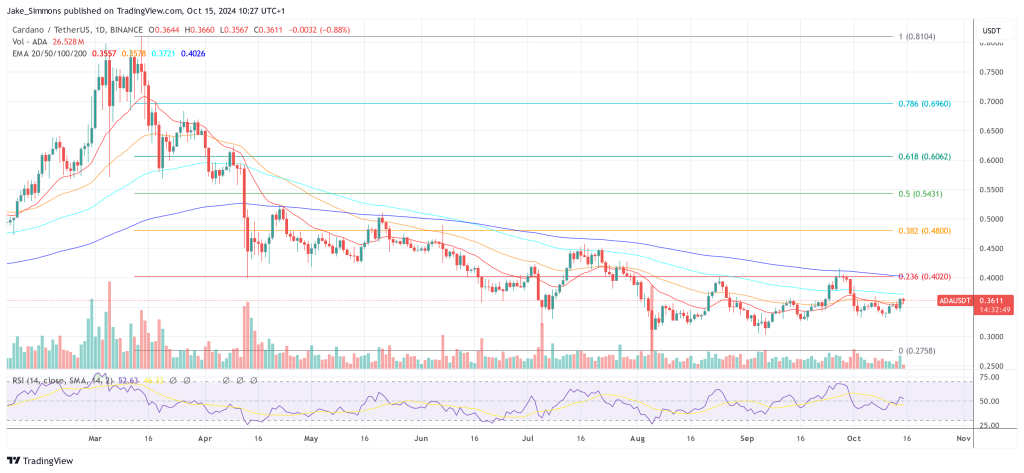
At press time, ADA traded at $0.3611.
Cardano price
Cardano price, 1-day chart | Source: ADAUSDT on TradingView.com
Featured image from YouTube, chart from TradingView.com
Jake Simmons

Jake Simmons

Jake Simmons has been a Bitcoin enthusiast since 2016. Ever since he heard about Bitcoin, he has been studying the topic every day and trying to share his knowledge with others. His goal is to contribute to Bitcoin's financial revolution, which will replace the fiat money system. Besides BTC and crypto, Jake studied Business Informatics at a university. After graduation in 2017, he has been working in the blockchain and crypto sector. You can follow Jake on Twitter at @realJakeSimmons.

Lecturas Relacionadas

DeFi Has Reached Its Most Dangerous Moment: The Real Vulnerabilities Are Not in the Code

DeFi in Peril: The Real Vulnerability Isn't in the Code April 2026 marked a paradigm shift in DeFi security, with over $625 million lost across 30 incidents—the worst month in crypto history by event count. Crucially, none of the major exploits (Drift Protocol: $285M, KelpDAO: $292M, Wasabi Protocol: $4.5M) resulted from smart contract vulnerabilities. Instead, failures occurred in the operational "plumbing": social engineering to compromise multi-signature councils, a single-point-of-failure 1-of-1 bridge validator, and stolen admin private keys. These events expose a fundamental misalignment: the industry's security model has long focused on code audits, while the actual attack surface has shifted to privileged access points and off-chain infrastructure. The article introduces the term "OpenFi" to describe this reality: permissionless, on-chain, yet operationally dependent on trusted third parties (admins, validators, oracles) at key junctures. The KelpDAO exploit vividly demonstrated asymmetric "contagion risk." A configuration error in a smaller protocol triggered a panic, causing approximately $13.2 billion in outflows from larger, unaffected protocols like Aave within 48 hours, as users fled uncertain collateral. The core dilemma is the double-edged sword of centralization. Operational levers like emergency councils (e.g., Arbitrum freezing stolen funds post-KelpDAO) enable crisis response but also create catastrophic attack surfaces if compromised (e.g., Drift). The path forward demands radical honesty: protocols must clearly disclose their trust assumptions, operational levers, and failure modes. The industry must treat operational security (key management, configurations, incident response) with the same rigor as code security. Survival depends on building systems whose risks can be understood, priced, and insured, moving beyond the outdated "code is law" mantra to a mature model of disclosed and managed trust.

链捕手Hace 5 hora(s)

DeFi Has Reached Its Most Dangerous Moment: The Real Vulnerabilities Are Not in the Code

链捕手Hace 5 hora(s)

Vitalik's Article Emphasizes Ethereum Must Be 'Amazing', But Foundation Is Not the Center

Vitalik Buterin has published a lengthy response to recent community criticism directed at the Ethereum Foundation (EF). Acknowledging a sense of "unease," he addresses concerns about the EF's strategic direction, its perceived disconnect from ETH's price performance, and calls for its reduced central role. Vitalik rejects the notion that the EF should be the central governing body of Ethereum, framing it instead as one "node with a clear mandate" among many within the ecosystem. He highlights the EF's limited ETH holdings (≈0.16% of supply) compared to other blockchain foundations and states it will no longer sell significant amounts of ETH. Its future focus will be on long-term, critical projects that align with Ethereum's core values of censorship-resistance and decentralization, which might not otherwise happen. A core argument is that Ethereum must be "amazing," but not by merely chasing higher transaction speeds at the cost of decentralization. He proposes focusing on the "CROPS" dimensions: creating a Cryptographically provable, Reliable, Open, Private, and Secure network. This includes pursuing goals like a formally verifiable, bug-free Ethereum client and minimizing protocol-level reliance on intermediaries. The article concludes by noting that while Vitalik clarifies the EF's refocused role, he does not directly address community suggestions for creating a new organization explicitly aligned with ETH's economic interests. This "alignment gap" is presented as a key challenge for Ethereum's future.

链捕手Hace 5 hora(s)

Vitalik's Article Emphasizes Ethereum Must Be 'Amazing', But Foundation Is Not the Center

链捕手Hace 5 hora(s)

Galxe: How a Quest Platform Evolved into Web3's Growth Infrastructure

Galxe, once perceived as a simple Web3 quest platform, has evolved into a core growth infrastructure within the Web3 ecosystem. It addresses a fundamental Web3 growth dilemma: the lack of a mature, systematic user acquisition and retention system akin to Web2's advertising and analytics platforms. While users complete quests (social tasks, on-chain interactions) for rewards, Galxe's true innovation lies in transforming these fragmented, one-off actions into lasting, verifiable identity credentials. This process of *behavioral assetization* creates a persistent record of a user's activities across projects and chains. For users, their wallet accumulates a valuable history that can unlock future access and rewards, fostering a "profile-building" mentality. For projects, Galxe provides a pre-screened user pool with rich behavioral data, enabling targeted outreach to users based on their specific on-chain history and community engagement. Galxe employs a gamefied growth path, guiding users from low-friction social tasks into deeper, valuable on-chain interactions through a structured progression of quests. This solves the incentive-behavior mismatch common in Web3, filtering users by their willingness to engage. Beyond quests, products like Passport (identity verification) and Starboard (community analytics) position Galxe as a comprehensive growth operating system. The platform's defensible advantage is its self-reinforcing data and network flywheel: more projects attract more users, enriching behavioral data; richer data enables better user targeting, attracting more projects. Ultimately, Galxe is shifting Web3's growth logic from short-term "reward-driven" traffic towards a long-term "identity-driven" relationship model, where a user's accumulated on-chain履历 becomes a core asset.

marsbitHace 6 hora(s)

Galxe: How a Quest Platform Evolved into Web3's Growth Infrastructure

marsbitHace 6 hora(s)

Trading

Spot
Futuros

Artículos destacados

Cómo comprar ADA

¡Bienvenido a HTX.com! Hemos hecho que comprar Cardano (ADA) sea simple y conveniente. Sigue nuestra guía paso a paso para iniciar tu viaje de criptos.Paso 1: crea tu cuenta HTXUtiliza tu correo electrónico o número de teléfono para registrarte y obtener una cuenta gratuita en HTX. Experimenta un proceso de registro sin complicaciones y desbloquea todas las funciones.Obtener mi cuentaPaso 2: ve a Comprar cripto y elige tu método de pagoTarjeta de crédito/débito: usa tu Visa o Mastercard para comprar Cardano (ADA) al instante.Saldo: utiliza fondos del saldo de tu cuenta HTX para tradear sin problemas.Terceros: hemos agregado métodos de pago populares como Google Pay y Apple Pay para mejorar la comodidad.P2P: tradear directamente con otros usuarios en HTX.Over-the-Counter (OTC): ofrecemos servicios personalizados y tipos de cambio competitivos para los traders.Paso 3: guarda tu Cardano (ADA)Después de comprar tu Cardano (ADA), guárdalo en tu cuenta HTX. Alternativamente, puedes enviarlo a otro lugar mediante transferencia blockchain o utilizarlo para tradear otras criptomonedas.Paso 4: tradear Cardano (ADA)Tradear fácilmente con Cardano (ADA) en HTX's mercado spot. Simplemente accede a tu cuenta, selecciona tu par de trading, ejecuta tus trades y monitorea en tiempo real. Ofrecemos una experiencia fácil de usar tanto para principiantes como para traders experimentados.

1.4k Vistas totalesPublicado en 2024.12.10Actualizado en 2025.03.21

Cómo comprar ADA

Discusiones

Bienvenido a la comunidad de HTX. Aquí puedes mantenerte informado sobre los últimos desarrollos de la plataforma y acceder a análisis profesionales del mercado. A continuación se presentan las opiniones de los usuarios sobre el precio de ADA (ADA).

活动图片