IMF Suggests CBDCs To Include Compliance And User-Friendly Payment Features

BitcoinistPublicado a 2022-06-10Actualizado a 2022-06-10

Resumen

International Monetary Fund (IMF) took a broad step in recommending creating a payment system with eco-friendly practices. It undertook a...

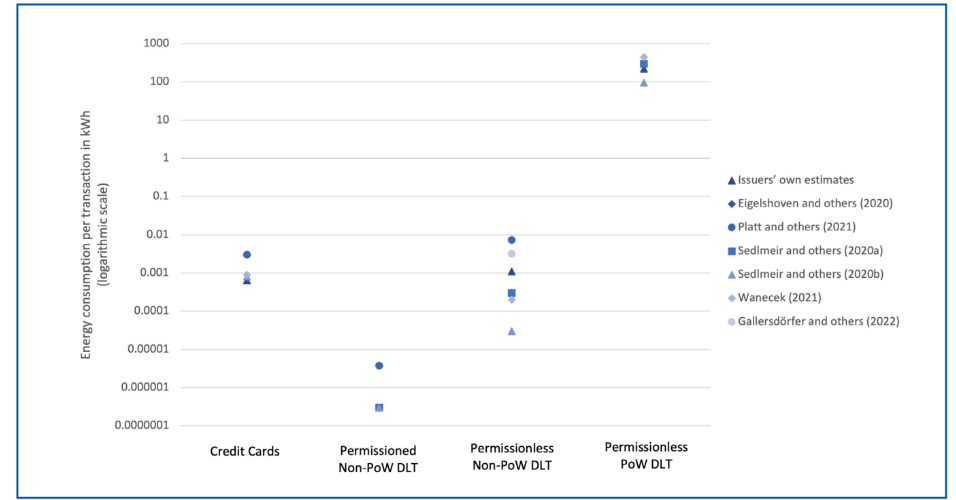
International Monetary Fund (IMF) took a broad step in recommending creating a payment system with eco-friendly practices. It undertook a study on energy consumption based on the consensus mechanisms of different cryptocurrencies in the ecosystem.
The high energy consumption from cryptocurrencies using Proof-of-Work (PoW) consensus mechanism is no longer a hidden fact.
Moreover, the mechanism poses high environmental threats due to the emission of fumes containing carbon. So, the health implications surrounding token mining have raised the preference for crypto assets using the non-PoW mechanism.
 IMF Suggests CBDCs To Include Compliance And User-Friendly Payment Features

Image Source: IMF
IMF elaborated that each crypto token has its design elements that determine its energy consumption. Therefore, IMF intends to use the study tagged Digital Currencies and Energy Consumption to map out the best mechanism suitable for the design of CBDCs (Central Bank Digital Currencies).
Additionally, IMF discussed the notable policy concerning the influence of digital currencies on the environment. It suggested that developers should lay aside the PoW protocols.
The fund compared the energy efficiency of the several non-PoW protocols with what exists in the traditional financial system. It rated the former higher, stating that the core design structures and payment systems of non-PoW crypto applications make them suitable for users.

 IMF Suggests CBDCs To Include Compliance And User-Friendly Payment Features

Cryptocurrency market stands firm on the daily chart | Source: Crypto Total Market Cap on TradingView.com The organization pointed out that Bitcoin is a popular protocol using the PoW mechanism. However, BTC has an estimated yearly energy consumption of about 144 terawatt-hours (TWh). The protocol could cut its energy cost for each transaction through its scalability solution. However, its total energy consumption would still be high.
IMF Suggestions About CBDCs Could Bring Best Functionality
In the summary of its study, the IMF suggested that central banks focus on developing eco-friendly CBDCs. The process of actualizing this goal involves several steps that could integrate the experimentation phase. So, they must choose suitable platforms and hardware. Also, their design options should maintain a carbon footprint lower than legacy systems available in central banks.
The study from IMF included an estimation of yearly energy usage through the world’s payment system. It gave a value of 47.3 TWh which could equate to the annual consumption of some regions like Bangladesh and Portugal. The organization stressed that the possibilities of policymakers in embarking on crypto mainstreaming might be based on the environmental impact of their mechanisms.
The IMF also recommends that the CBDCs from the apex banks inculcate some outstanding features. It pointed out features like higher resilience, offline capacities, and compliance.
In another development concerning climate change control, Iota Foundation collaborated with Dell Technologies to create a real-time tracking carbon footprint system. The aim would rely on composting facility and the sustainable energy of BioE. In its operations, it would track carbon emissions in near real-time values.

Lecturas Relacionadas

$9.4 Billion: The Largest Robotics Funding This Year Has Emerged

Munich-based humanoid robotics company Neura has completed a $1.4 billion (approximately RMB 94.9 billion) Series C funding round, valuing the company at around $7 billion and positioning it among the global leaders in the sector. The investment round is notable not just for its size—reportedly the largest in robotics this year—but also for its strategic backers, which include tech giants like NVIDIA and Amazon, alongside established industrial players such as German engineering firms Bosch and Schaeffler. This mix of investors signals a significant shift in the industry's focus from technological demonstrations and general-purpose narratives toward practical, industrial deployment and commercialization. Neura's approach centers on developing humanoid robots for defined, high-value industrial tasks rather than pursuing a general-purpose model. Its early validation comes from a partnership with BMW, where its robots are being tested on actual production lines. The involvement of Bosch and Schaeffler, companies deeply embedded in global manufacturing, underscores a growing belief that humanoid robots are transitioning from labs to viable factory-floor solutions. The article highlights two converging trends driving investment: advancements in AI and large language models, which enhance robots' perception and decision-making in unstructured environments, and mounting pressure from labor shortages and rising costs in major manufacturing regions. The funding landscape is now bifurcating between companies like Figure AI, focusing on versatile general-purpose robots, and firms like Neura, targeting specific vertical industrial applications with clearer, shorter paths to ROI. While technical hurdles remain, the core challenges for widespread adoption are increasingly seen as engineering and commercial in nature: managing the high integration and customization costs for different factory environments and establishing robust, localized maintenance and service networks. The record investment in Neura, particularly from industrial capital, indicates the industry's growing confidence in moving from proving feasibility to solving the practical problems of scalability, reliability, and building sustainable business models around humanoid robots in real-world settings like automotive manufacturing and hazardous labor environments.

marsbitHace 3 hora(s)

$9.4 Billion: The Largest Robotics Funding This Year Has Emerged

marsbitHace 3 hora(s)

"119 to 176 Dollars": Behind SpaceX's Listing, MSX Once Again Successfully Executes the Pre-IPO Closed Loop

Following May's 300% gain on Cerebras, MSX delivered another outstanding performance during SpaceX's listing night. On June 12, SpaceX (SPCX) launched on Nasdaq, reaching a high of $176. This marked the successful culmination of MSX's Pre-IPO project launched in March, where users subscribed at $119, achieving gains of approximately 40-48%. This event validated MSX's complete Pre-IPO mechanism, a crucial advantage in a market where access to top-tier private company equity is typically limited to institutions. MSX's model provides a full cycle for users: subscription (at $119 for SpaceX), real-time on-chain portfolio tracking, optional early redemption, seamless conversion to tradable spot assets (SPCX.M) upon IPO, and final settlement in stablecoins. This end-to-end process distinguishes MSX from platforms that faced settlement issues during the SpaceX IPO, highlighting that the core challenge of Pre-IPO is not just access, but a clear exit and conversion path post-listing. This success with SpaceX is MSX's second major Pre-IPO verification, following the Cerebras listing in May, which yielded ~300% returns for early participants. These back-to-back achievements demonstrate MSX's capability to source, structure, and deliver real assets through a replicable on-chain model. The true barrier for Pre-IPO products lies not in providing an entry point, but in ensuring reliable fulfillment from subscription through to post-IPO liquidity. MSX's proven闭环 (closed-loop) process addresses this, offering Web3 users a structured way to access high-growth, pre-public companies in sectors like AI and frontier tech. MSX plans to continue expanding its Pre-IPO portfolio with this focus on authenticity, transparency, and post-listing execution.

Odaily星球日报Hace 16 hora(s)

"119 to 176 Dollars": Behind SpaceX's Listing, MSX Once Again Successfully Executes the Pre-IPO Closed Loop

Odaily星球日报Hace 16 hora(s)

Trading

Spot
Futuros
活动图片