Cardano Joins Ripple, Hedera, And Other Crypto Giants In New Alliance

bitcoinistPublicado a 2024-09-06Actualizado a 2024-09-06

Resumen

Input | Output, the research and engineering entity behind Cardano, along with Hedera, have been named the final founding members...

Input | Output, the research and engineering entity behind Cardano, along with Hedera, have been named the final founding members of the Decentralized Recovery (DeRec) Alliance, a new coalition aimed at fostering interoperability and enhanced security across the crypto industry. The alliance, established by leaders within the Hedera and Algorand ecosystems and formalized in January 2024, already includes prominent crypto organizations such as Algorand Foundation, Hashgraph (formerly Swirlds Labs), Ripple, and XRPL Labs as foundational pillars.

Cardano, Ripple, And Hedera Lead The Charge

The alliance was launched by Hedera co-Founder Dr. Leemon Baird, who highlighted the collaborative effort spanning multiple ecosystems in a press release on Thursday. “We are happy to welcome Input Output as a founding member. Their deep expertise and insight will be a great asset to the DeRec Alliance,” Dr. Baird remarked.

Charles Hoskinson, the founder of Cardano and CEO of Input | Output emphasized the alignment with the company’s foundational principles. “Input Output has always been committed to open-source principles, cross-industry collaboration, and blockchain interoperability. As an industry seeking to drive wider adoption, we should all be committed to the relentless pursuit of security, accessibility, and improving the user experience,” the Cardano founder explained.

The DeRec Alliance introduces an open-source, industry-standard protocol that simplifies the recovery of digital assets, which is critical for everyday users and developers within the blockchain ecosystem. John Woods, CTO of the Algorand Foundation, pointed out the broader implications of inadequate user experience in Web3. “Web3 has fallen short in delivering a great UX for securing and recovering key material,” Woods stated.

The DeRec Alliance aims to address these shortcomings by providing streamlined key recovery processes and further decentralizing other important infrastructures, which are essential for the security and accessibility of digital assets. The founding members of the DeRec Alliance, including Input | Output and Hedera, will hold two-year terms on the Technical Oversight Committee (TOC), contributing their expertise to the governance structure and core policies of the alliance.

Their leadership is expected to maintain the strategic focus of the alliance and effectively address the evolving needs of its growing community. Charles Adkins, President of Hedera, expressed pride in joining the alliance and contributing to the enhancement of asset protection.

“From the very beginning, Hedera has been at the forefront of digital asset security. The DeRec Alliance takes this one step further by introducing an open-source protocol that simplifies asset recovery, aligning closely with our mission to enable a new era of trust and transparency,” Adkins commented.

Alliance members also play a crucial role in shaping the direction of the DeRec Alliance by providing policy input and overseeing the development of DeRec-based solutions. They engage in quarterly meetings and contribute to policy discussions, nominating candidates for and voting in TOC elections. This diverse group includes new members like DLT Science Foundation, Hashpack, Oasis Protocol Foundation, and Palisade, each bringing unique capabilities and perspectives to the alliance.

“The DeRec Alliance is a group of forward-thinking companies from across Web2 and Web3 that are committed to making the process of securing and recovering digital assets, accounts, and other secrets as simple as existing Web2 experiences. […] IO will hold a two-year term on the Technical Oversight Committee (TOC), offering critical input on the Alliance’s governance structure and core policies,” the Cardano developer added via X.

The DeRec protocol itself is designed around a secret-sharing approach among a set of helpers, such as friends or businesses, who assist in the recovery of secrets when needed. This approach ensures that no individual helper can access the complete secret, enhancing security and reducing the risks associated with centralized points of failure.

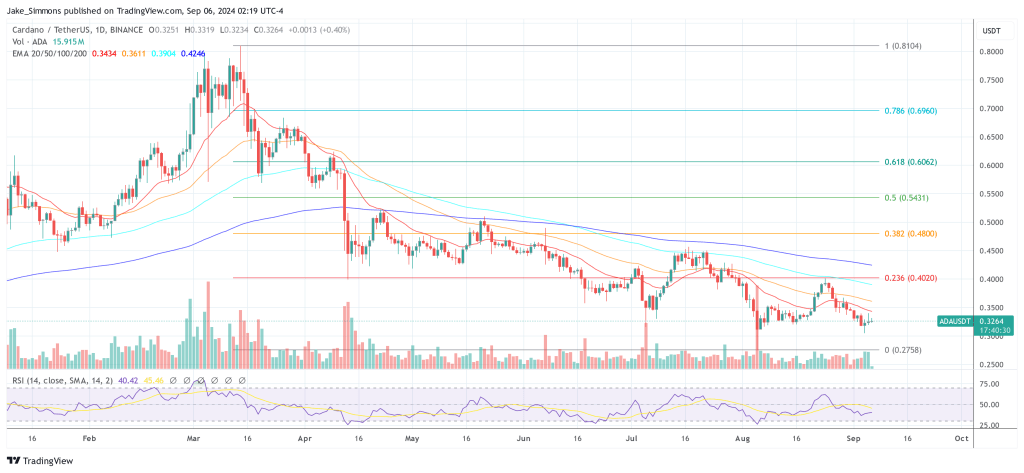
At press time, ADA traded at $0.3264.
Cardano price
ADA hovers below the 20-day EMA, 1-day chart | Source: ADAUSDT on TradingView.com
Featured image from Shutterstock, chart from TradingView.com
Jake Simmons

Jake Simmons

Jake Simmons has been a Bitcoin enthusiast since 2016. Ever since he heard about Bitcoin, he has been studying the topic every day and trying to share his knowledge with others. His goal is to contribute to Bitcoin's financial revolution, which will replace the fiat money system. Besides BTC and crypto, Jake studied Business Informatics at a university. After graduation in 2017, he has been working in the blockchain and crypto sector. You can follow Jake on Twitter at @realJakeSimmons.

Lecturas Relacionadas

US Government Lifts Ban on Crypto Perpetual Contracts for the First Time: What Does It Mean for the Market?

The U.S. Commodity Futures Trading Commission (CFTC) has issued guidance permitting 24/7 trading and clearing for crypto asset derivatives, effectively opening the U.S. market to crypto perpetual contracts for the first time. This move ends the previous ban and allows American individuals and institutions to trade these instruments around the clock. Direct beneficiaries include Kalshi, which received approval to list a Bitcoin perpetual contract; Coinbase, now the first CFTC-regulated futures commission merchant for U.S. clients to access global crypto derivatives; and CME, which will transition its Bitcoin futures and options to 24/7 trading. The CFTC emphasized this is a specific allowance for crypto assets, noting that traditional commodities like agriculture may not be suitable for non-stop trading. It also requires platforms to undergo case-by-case reviews for compliance and risk management. Industry leaders like Michael Saylor and Brian Armstrong praised the decision for integrating Bitcoin into capital markets and granting U.S. users access to a major global market segment. However, consumer advocacy group Better Markets criticized the CFTC for allegedly neglecting investor protection and favoring the industry it regulates. Other platforms like Kraken have announced plans to launch regulated perpetual futures for the U.S. market. The policy shift is expected to redirect significant liquidity and institutional participation to the newly accessible U.S. crypto derivatives landscape.

Odaily星球日报Hace 1 hora(s)

US Government Lifts Ban on Crypto Perpetual Contracts for the First Time: What Does It Mean for the Market?

Odaily星球日报Hace 1 hora(s)

How the CLARITY Act Reshapes the Stablecoin Yield Economy

The CLARITY Act, recently advanced by the U.S. Senate Banking Committee, fundamentally reshapes the stablecoin yield economy by closing loopholes left by the earlier GENIUS Act. Its Section 404 expands the ban on "hold-to-earn" rewards to all Digital Asset Service Providers (DASPs) and their affiliates, prohibiting any passive, interest-like yield. Crucially, it introduces a legal distinction, permitting "use-to-earn" rewards based on actual activities like spending, trading, or staking. In anticipation of this regulatory shift, major Wall Street asset managers—Morgan Stanley, BlackRock, and JPMorgan—have launched a series of tokenized money market funds (e.g., BlackRock's BRSRV, JPMorgan's JLTXX) designed explicitly for stablecoin reserve assets. These products represent a new, compliant yield layer: the stablecoin issuer earns interest from the underlying tokenized fund, which can then be passed to users through redesigned activity-based rewards. This marks a paradigm shift from a "hold-to-earn" to a "use-to-earn" market. While pathways remain for exchanges to redesign rewards (Path A) and for DeFi protocols to offer yield (Path B), the tokenized reserve asset layer (Path C) emerges as the most robust and strategically positioned infrastructure. However, this concentration—exemplified by BlackRock's BUIDL fund backing over 90% of USDtb's reserves—introduces new systemic risks. The final outcome hinges on regulatory decisions, particularly the OCC's proposed 20% cap on tokenized assets in reserves, which will determine the scalability of this new financial infrastructure layer.

marsbitHace 3 hora(s)

How the CLARITY Act Reshapes the Stablecoin Yield Economy

marsbitHace 3 hora(s)

Kalshi and Coinbase Receive CFTC Approval, Ushering in the Most Regulation-Friendly Era for the Crypto Industry?

The U.S. Commodity Futures Trading Commission (CFTC) took two landmark actions on May 29. It approved Kalshi's application to list a Bitcoin perpetual futures contract and issued a no-action letter to Coinbase Financial Markets. This allows Coinbase to offer certain perpetual futures products to U.S. customers through a subsidiary, with digital assets permitted as collateral. These moves, coupled with a new CFTC policy statement, provide a clearer regulatory pathway for perpetual contracts in the U.S., moving them from a regulatory gray area. CFTC Chair Mike Selig stated this is a key step for U.S. crypto leadership but noted the policy is not yet permanent. The article explains that CFTC's previous reluctance stemmed from legal ambiguities, as perpetual contracts lack an expiration date. However, such contracts dominate global crypto derivatives, accounting for ~78% of centralized exchange volume in 2025, forcing U.S. regulators to adapt to competition from offshore platforms like Hyperliquid. The approvals offer two compliance paths: Kalshi's direct listing and Coinbase's model using foreign futures. This is expected to attract institutional capital back to regulated U.S. venues, stimulate the launch of more products like ETH perpetuals, and enhance U.S. competitiveness in the global crypto derivatives market. The author suggests this may signal a "regulatorily friendly" era for crypto.

marsbitHace 6 hora(s)

Kalshi and Coinbase Receive CFTC Approval, Ushering in the Most Regulation-Friendly Era for the Crypto Industry?

marsbitHace 6 hora(s)

Trading

Spot
Futuros

Artículos destacados

Cómo comprar ADA

¡Bienvenido a HTX.com! Hemos hecho que comprar Cardano (ADA) sea simple y conveniente. Sigue nuestra guía paso a paso para iniciar tu viaje de criptos.Paso 1: crea tu cuenta HTXUtiliza tu correo electrónico o número de teléfono para registrarte y obtener una cuenta gratuita en HTX. Experimenta un proceso de registro sin complicaciones y desbloquea todas las funciones.Obtener mi cuentaPaso 2: ve a Comprar cripto y elige tu método de pagoTarjeta de crédito/débito: usa tu Visa o Mastercard para comprar Cardano (ADA) al instante.Saldo: utiliza fondos del saldo de tu cuenta HTX para tradear sin problemas.Terceros: hemos agregado métodos de pago populares como Google Pay y Apple Pay para mejorar la comodidad.P2P: tradear directamente con otros usuarios en HTX.Over-the-Counter (OTC): ofrecemos servicios personalizados y tipos de cambio competitivos para los traders.Paso 3: guarda tu Cardano (ADA)Después de comprar tu Cardano (ADA), guárdalo en tu cuenta HTX. Alternativamente, puedes enviarlo a otro lugar mediante transferencia blockchain o utilizarlo para tradear otras criptomonedas.Paso 4: tradear Cardano (ADA)Tradear fácilmente con Cardano (ADA) en HTX's mercado spot. Simplemente accede a tu cuenta, selecciona tu par de trading, ejecuta tus trades y monitorea en tiempo real. Ofrecemos una experiencia fácil de usar tanto para principiantes como para traders experimentados.

1.5k Vistas totalesPublicado en 2024.12.10Actualizado en 2025.03.21

Cómo comprar ADA

Discusiones

Bienvenido a la comunidad de HTX. Aquí puedes mantenerte informado sobre los últimos desarrollos de la plataforma y acceder a análisis profesionales del mercado. A continuación se presentan las opiniones de los usuarios sobre el precio de ADA (ADA).

活动图片