Центральные банки покупают золото на рекордных уровнях, но биткоин растет быстрее

cryptonews.ruPublicado a 2024-02-02Actualizado a 2024-09-02

Центральные банки по всему миру запасали свои золотые резервы на рекордных уровнях в 2024 году, переходя на активы сбережения.

В сообщении от 2 сентября, макроэкономическое издание Kobeissi Letter сообщило, что мировые чистые покупки золота центральными банками достигли 483 тонн в первой половине 2024 года, что является рекордным показателем.

Он добавил, что эта цифра на 5% выше предыдущего рекорда в 460 тонн, который был установлен в первой половине 2023 года. Во втором квартале 2024 года центральные банки купили 183 тонны золота, что на 6% больше, чем в предыдущем году.

Национальный банк Польши, Резервный банк Индии и Центральный банк Турции были крупнейшими центральными банками, покупавшими драгоценный металл в этот период.

В конце августа сообщалось, что президент Национального банка Польши Адам Глапински сообщил, что банк продолжит покупать золото, поскольку он стремится к тому, чтобы оно составляло 20% его резервов.
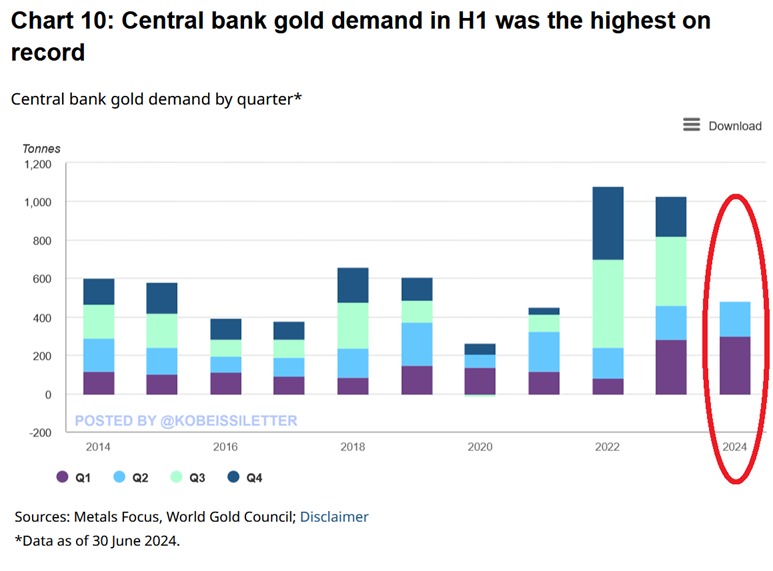

Спрос на золото со стороны центральных банков в первой половине 2024 года. Источник: Kobeissi Letter

Основатель Tolou Capital Management Спенсер Хакимян прокомментировал, что Китай, Индия, Россия и Саудовская Аравия «больше не доверяют владению западными резервными активами», добавив:

«Золото является единственным нейтральным и неволатильным резервным активом».
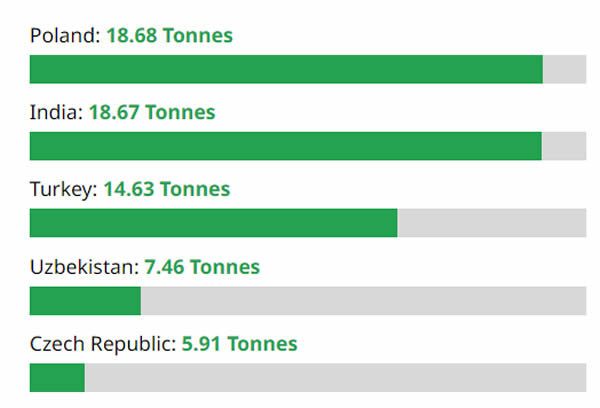

Крупнейшее увеличение золотого запаса центробанками, 2 квартал 2024 года. Источник: World Gold Council.

В сообщении от 1 сентября предприниматель в сфере технологий Ким Дотком заявил, что новый стейблкоин с золотым обеспечением из стран БРИКС (Бразилия, Россия, Индия, Китай, Южная Африка, Иран, Египет, Эфиопия и Объединенные Арабские Эмираты) увеличит спрос на актив и приведет к нестабильности доллара:

«Когда выйдет стейблкоин с золотым обеспечением БРИКС, торговля в долларах США резко упадет, центральные банки выйдут из долларов США, а финансовая пирамида США, печатающая деньги, сгорит. 14% мирового ВВП перейдет из США в другие страны к 2030 году».

Между тем, «Global Markets Investor» прокомментировал, что «золото пережило один из лучших скачков в истории», добавив, что с начала года оно выросло на 23%, превзойдя рост индекса S&P 500 на 18%.

Для сравнения, биткоин вырос на 37% в 2024 году, несмотря на падение на 22% по сравнению с историческим максимумом в марте.

Тем не менее, это не помешало золотому жуку и критику криптовалют Питеру Шиффу прокомментировать, что рост биткоина произошел только в первые два месяца 2024 года, и с тех пор он упал, несмотря на запуск биржевых фондов BTC в Соединенных Штатах.

Цены на золото достигли исторического максимума в 2525 долларов за унцию 27 августа, и Шифф заявил, что «импульс изменился». Однако суть в том, что BTC все еще превосходит золото в этом году по темпам роста.

Однако центральные банки пока по-прежнему с опаской относятся к относительно новому классу активов.


Lecturas Relacionadas

Bitwise Chief Investment Officer: STRC Plunge is a Bottom Signal, Bull Market to Start in Autumn

Bitwise CIO: STRC's Plunge Signals Market Bottom, Bull Run Likely This Fall Bitwise CIO Matt Hougan analyzes the recent sharp decline of Strategy's perpetual preferred shares (STRC) and its implications for the bitcoin market. STRC, a product designed for stable, high-yield income, fell dramatically from its $100 target to $75 amid concerns about Strategy's ability to maintain dividends as bitcoin prices dropped. While Strategy's overall balance sheet remains strong, with ample assets to cover liabilities, market panic stemmed from its right to suspend STRC dividends. In response, Strategy introduced a new framework, committing to sell bitcoin as needed to fund dividends and allowing STRC to float freely, abandoning the $100 peg mechanism. This shift marks a change in Strategy's role from a consistent net buyer to a more dynamic participant in the bitcoin market. Hougan views the STRC volatility and related sell-off in MicroStrategy (MSTR) stock as classic late-cycle behavior, where mismatched leverage is being purged from the system. He draws parallels to the GBTC premium unwind after the 2021 bull market. This necessary deleveraging, he argues, is a precursor to finding a market bottom. Key bottoming signals to watch include MSTR trading at a discount to its net asset value (NAV), crypto fear & greed indices hitting extreme lows, and sustained negative bitcoin funding rates. Hougan concludes that as excess leverage is cleared, the market is nearing its bottom, setting the stage for a new bull cycle to begin in the autumn. The next major wave of buyers, he believes, will be institutional investors like banks, asset managers, and pension funds.

marsbitHace 18 min(s)

Bitwise Chief Investment Officer: STRC Plunge is a Bottom Signal, Bull Market to Start in Autumn

marsbitHace 18 min(s)

The Largest Upgrade Since The Merge? How Glamsterdam Will Affect Ethereum?

Ethereum's next major upgrade, Glamsterdam (combining consensus layer "Gloas" and execution layer "Amsterdam"), is scheduled for late 2026 and considered the most significant overhaul since The Merge. It aims to fundamentally enhance L1 performance and architecture to prepare for substantial capacity increases. The upgrade centers on three core changes: 1. **Enshrined PBS (ePBS - EIP-7732):** Integrates the Proposer-Builder Separation directly into the protocol, eliminating reliance on external relays. This extends the window for processing execution payloads, allowing nodes more time to handle larger blocks and more data, paving the way for a higher Gas Limit. 2. **Block-Level Access Lists (BALs - EIP-7928):** Provides a pre-declared "map" in the block header of all state data (accounts, storage) that transactions will access and modify. This enables potential parallel transaction processing and faster state synchronization for nodes. 3. **Gas Repricing (EIP-8037):** Overhauls the gas model to more accurately reflect the real resource costs for nodes. It separates computation costs from state storage costs, making operations that create permanent state data (like new accounts) more expensive, while computation-heavy operations become relatively cheaper. These changes work together to solve the trilemma of scaling: giving nodes more time to process larger blocks (ePBS), reducing execution bottlenecks (BALs), and controlling unsustainable state growth (Gas Repricing). The goal is a credible path to a higher Gas Limit (e.g., 200M gas) without compromising decentralization by overburdening node hardware. For users: * Transaction fees for simple transfers may decrease and become more stable due to increased block space, but state-intensive operations (contract deployment) may cost more. * Gas estimation by wallets will improve in accuracy. * L2 data posting costs could become more stable long-term due to increased Blob capacity. * EIP-7708 will standardize logs for ETH transfers, improving tracking for wallets and exchanges. Node operators must upgrade clients, but ETH holders need take no action. In essence, Glamsterdam doesn't just raise the block size limit; it re-engineers Ethereum's core block production, execution, and economic models to enable sustainable, decentralized scaling.

marsbitHace 1 hora(s)

The Largest Upgrade Since The Merge? How Glamsterdam Will Affect Ethereum?

marsbitHace 1 hora(s)

Trading

Spot
活动图片