九月份将有17.3亿美元的代币解锁

marsbitPublicado a 2024-08-31Actualizado a 2024-09-01

简要内容

  • 九月份将有17.3亿美元的代币解锁,其中4.1853亿美元为悬崖式解锁。
  • Sui、Aptos、Arbitrum和Optimism等主要项目将释放大量代币。
  • 加密交易者和投资者应密切关注这些代币涌入市场后对市场的影响。

代币

九月份,加密市场将迎来重大活动,预计约有价值17.3亿美元的代币将被解锁。

据BeInCrypto报道,五大代币解锁将向市场引入大量资产。

九月的代币解锁:加密市场将有哪些期待?

根据TokenUnlocks的数据,本月约有4.1853亿美元的代币解锁被归类为悬崖式解锁。在代币解锁事件中,悬崖式解锁指的是代币按非日常频率(如每周、每月或每年)定期释放。

由于代币解锁将之前不可用的代币引入流通,投资者和交易者会密切关注这些事件,因为它们会影响市场环境。尽管一些人将这些事件视为增长机会,但也存在增加卖压的风险。TokenUnlocks的分析师警告说,“解锁事件利好”这一观点并不总是正确的。

“需要认识到,吸收如此大规模的供应量需要大量的流动性。更广泛的市场将需要介入以吸收这些涌入的代币,这可能会导致这些代币寻找流动性时增加卖压。”他们写道。

本月最重要的悬崖式代币解锁包括Sui (SUI)、Immutable (IMX)、Aptos (APT)、Arbitrum (ARB)和Optimism (OP)。

Sui (SUI)

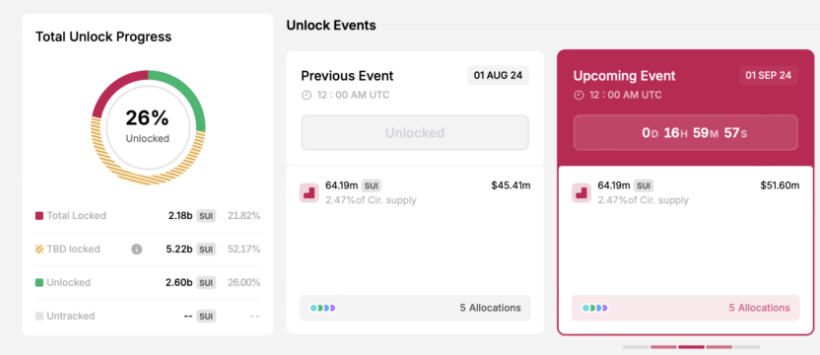
9月1日,Sui将解锁6419万枚代币,这些代币价值约5160万美元,占其流通供应量的2.47%。这些代币的分配如下:

  • A轮:1984万枚SUI(1595万美元)
  • B轮:1932万枚SUI(1553万美元)
  • 早期贡献者:1034万枚SUI(831万美元)
  • Mysten Labs国库:207万枚SUI(166万美元)
  • 社区储备:1263万枚SUI(1015万美元)

代币

SUI Unlock. Source: TokenUnlocks

Immutable (IMX)

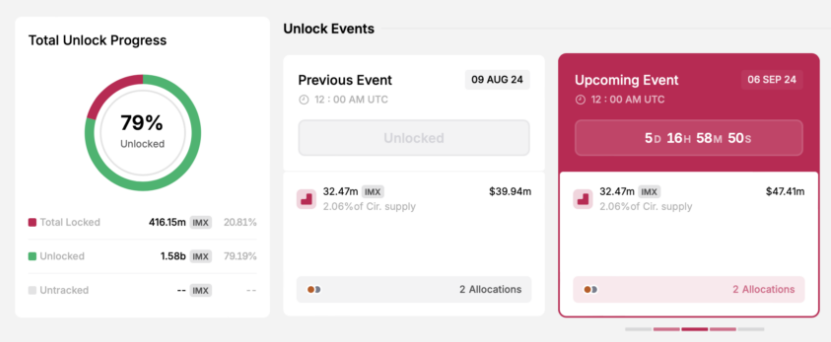
继Sui之后,Immutable将于9月6日释放3247万枚IMX代币。这些代币价值约4741万美元,相当于IMX流通供应量的2.06%。它们将用于生态系统和项目开发,具体分配如下:

  • 生态系统开发:1591万枚IMX(2324万美元)
  • 项目开发:1656万枚IMX(2418万美元)

代币

IMX Unlock. Source: TokenUnlocks

Aptos (APT)

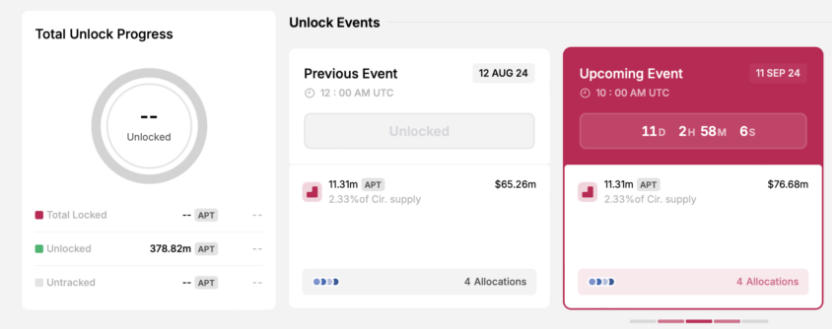
Aptos将于9月11日解锁1131万枚APT代币进入市场。这一数量相当于APT总供应量的2.33%,总价值约为7668万美元。

这些代币的分配如下:

  • 基金会:133万枚APT(904万美元)
  • 社区:321万枚APT(2176万美元)
  • 核心贡献者:396万枚APT(2684万美元)
  • 投资者:281万枚APT(1904万美元)

代币

APT Unlock. Source: TokenUnlocks

Arbitrum (ARB)

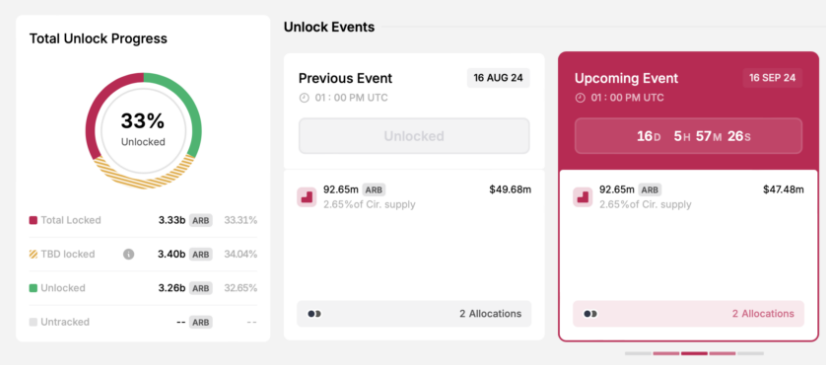
Arbitrum将于9月16日解锁9265万枚ARB代币,价值4748万美元。此次大规模解锁占ARB流通供应量的2.65%。这些代币的分配如下:

  • 团队、未来团队及顾问:5613万枚ARB(2377万美元)
  • 投资者:3652万枚ARB(1872万美元)

代币

ARB Unlock. Source: TokenUnlocks

Optimism (OP)

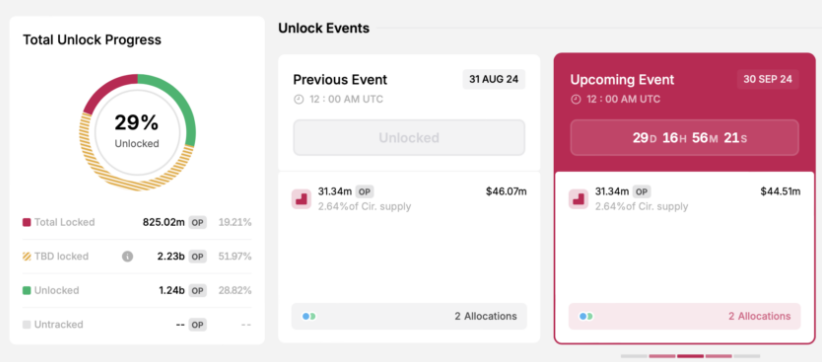
最后,Optimism将于9月30日解锁3134万枚OP代币,价值4451万美元。这些代币将分配给核心贡献者和投资者,以支持项目的长期可持续性。此次代币解锁的分配如下:

  • 核心贡献者:1654万枚OP(2349万美元)
  • 投资者:1480万枚OP(2102万美元)

代币

OP Unlock. Source: TokenUnlocks

除了这些主要的解锁之外,市场还将在九月份看到其他知名项目的悬崖式代币解锁,包括dYdX (DYDX)、ZetaChain (ZETA) 和 ApeCoin (APE)。此外,Xai (XAI)、Stark (STRK)、ApeCoin (APE)、Pixels (PIXEL) 和 Yield Guild Games (YGG) 也将成为焦点。

Lecturas Relacionadas

The First Large-Scale Strike in the AI Era Comes from the Factories That Build AI

The article describes a potential large-scale strike at Samsung Electronics, narrowly averted in May 2026 after a temporary agreement. The strike, planned by the company's union, would have been the first major labor action in the AI era targeting a core AI supply chain player. Samsung, alongside SK Hynix, produces roughly two-thirds of the world's memory chips, critical components for AI training and data centers like HBM. An 18-day strike could have disrupted global supply, affecting prices and production for tech companies and cloud providers. For South Korea, where semiconductors constitute about 35% of exports and Samsung represents a quarter of the stock market's value, such an action threatens national economic stability. The union's demands include a 7% base wage increase and, crucially, a clear, substantial profit-sharing model. They want 15% of annual operating profit as an employee bonus pool and the removal of the existing cap (about 50% of annual salary). This frustration is amplified by seeing rival SK Hynix successfully negotiate a deal granting employees 10% of operating profit as bonuses, with reports suggesting some workers could receive bonuses equivalent to hundreds of thousands of dollars. The conflict stems from deeper issues in South Korea's chaebol (conglomerate) system, where rapid national industrialization often prioritized corporate growth over labor rights. Samsung long maintained a "no union" policy until a 2020 apology from its leader. The article argues this strike highlights a fundamental tension in the AI age: as technology advances and corporate profits soar—often driven by AI—the workers who build the infrastructure are demanding a fair share and dignity, rejecting the notion that they are mere expendable components in a machine that "must not stop." The piece concludes that the true test of the AI era isn't just computational power, but whether the people who build the future can secure a stable and valued place within it.

marsbitHace 15 min(s)

The First Large-Scale Strike in the AI Era Comes from the Factories That Build AI

marsbitHace 15 min(s)

Ripple’s Fed Master Account Bid Gains Momentum After Trump Order

President Donald Trump has signed an executive order directing financial regulators and the Federal Reserve to review expanding fintech and crypto firms' access to core payment infrastructure. This order significantly advances the industry's push for direct Fed connectivity, a central issue for Ripple. The company has been seeking a Federal Reserve master account as part of its strategy for its RLUSD stablecoin, which would allow it to hold reserves directly with the central bank and access its payment rails. The order, titled "Integrating Financial Technology Innovation into Regulatory Frameworks," mandates a Fed review within 120 days on allowing access for entities like uninsured depository institutions and non-bank financial companies, including those in digital assets. This creates a formal policy timeline for resolving whether crypto payment firms must rely on traditional bank intermediaries. Ripple's application for a national bank charter and a master account is part of this broader landscape. The issue gained precedent when Kraken Financial received a limited-purpose master account, while Custodia Bank's application was denied after a legal battle. The Fed has also proposed a more restricted "payment account" option. Trump's order does not guarantee approval for Ripple but forces a high-level examination of the regulatory barriers, bringing the company's long-running effort to the forefront of Washington's financial policy agenda.

bitcoinistHace 29 min(s)

Ripple’s Fed Master Account Bid Gains Momentum After Trump Order

bitcoinistHace 29 min(s)

Google's 2026 Roadmap is Hidden in This Keynote Speech

Google I/O 2026 was not merely a product launch, but a strategic unveiling of the company's decade-long roadmap. The core signal is that Google is evolving its AI, Gemini, from a feature within products into a foundational operating layer that integrates and reshapes its entire ecosystem—Search, Android, Chrome, YouTube, Workspace, XR, and developer tools. The traditional paradigms of digital interaction are being redefined. Search is shifting from finding links to understanding intent and completing tasks. Android is transforming from an app-centric OS into an AI-native platform that orchestrates workflows across services. Chrome is becoming an AI reasoning layer over the web, while YouTube is evolving into a conversational knowledge engine. Google is heavily investing in Agentic AI, aiming for AI to act as a digital operator that executes tasks autonomously. Underlying this vision is the integration of Gemini across all products, making it the central nervous system. Key developments include Gemini Omni for multimodal generation, deeper product integrations, and a push into XR glasses for contextual, ambient computing. Google is positioning AI not as an optional feature but as essential infrastructure, akin to electricity. The broader implication is a competition for the next computing interface. Google's goal is not just to win in chatbots or models, but to become the operating system for the AI era by controlling the primary entry points—search, assistant, OS, and browser—and weaving them into a unified, intelligent layer. This represents a fundamental shift in computing paradigms that will impact creators, developers, businesses, and how all users interact with technology.

marsbitHace 1 hora(s)

Google's 2026 Roadmap is Hidden in This Keynote Speech

marsbitHace 1 hora(s)

‘Withdraw Insurance to Buy Stocks’: South Koreans Over 60 Are Borrowing to Bet on Samsung

South Korea's stock market has seen a frenzy, with the KOSPI nearly doubling in six months. This boom is fueled by a surge in retail investors borrowing to buy stocks, with outstanding margin loans hitting a record high. A significant portion of this debt is held by people over 50, with the 60+ age group seeing the fastest growth. Many are reportedly cashing out savings-type life insurance policies—even at a loss—to fund their stock investments. They are heavily concentrated in major semiconductor stocks like Samsung Electronics and SK Hynix, which have driven most of the market's gains. This trend is particularly risky for older investors, who are leveraging their limited retirement savings. While a market correction in March caused significant losses for leveraged accounts, the swift recovery and continued rally have reinforced risky behavior. Stories of quick profits on platforms like Blind further fuel the speculative rush. The phenomenon is partly driven by economic anxiety. With South Korea having a high elderly poverty rate and a low public pension replacement rate, some seniors see the booming market as a last chance to improve their finances. This "FOMO" (fear of missing out) sentiment is palpable, even in public parks where retirees gather and now discuss stock tips alongside their usual activities. Despite regulatory warnings and the inherent risks of leverage—especially for those with little time to recover from losses—the borrowing binge continues. The market's heavy reliance on a few tech stocks and its cyclical nature pose a substantial threat to these elderly investors, for whom a downturn could be catastrophic.

marsbitHace 1 hora(s)

‘Withdraw Insurance to Buy Stocks’: South Koreans Over 60 Are Borrowing to Bet on Samsung

marsbitHace 1 hora(s)

Trading

Spot
Futuros

Artículos destacados

Cómo comprar SUI

¡Bienvenido a HTX.com! Hemos hecho que comprar SUI Network (SUI) sea simple y conveniente. Sigue nuestra guía paso a paso para iniciar tu viaje de criptos.Paso 1: crea tu cuenta HTXUtiliza tu correo electrónico o número de teléfono para registrarte y obtener una cuenta gratuita en HTX. Experimenta un proceso de registro sin complicaciones y desbloquea todas las funciones.Obtener mi cuentaPaso 2: ve a Comprar cripto y elige tu método de pagoTarjeta de crédito/débito: usa tu Visa o Mastercard para comprar SUI Network (SUI) al instante.Saldo: utiliza fondos del saldo de tu cuenta HTX para tradear sin problemas.Terceros: hemos agregado métodos de pago populares como Google Pay y Apple Pay para mejorar la comodidad.P2P: tradear directamente con otros usuarios en HTX.Over-the-Counter (OTC): ofrecemos servicios personalizados y tipos de cambio competitivos para los traders.Paso 3: guarda tu SUI Network (SUI)Después de comprar tu SUI Network (SUI), guárdalo en tu cuenta HTX. Alternativamente, puedes enviarlo a otro lugar mediante transferencia blockchain o utilizarlo para tradear otras criptomonedas.Paso 4: tradear SUI Network (SUI)Tradear fácilmente con SUI Network (SUI) en HTX's mercado spot. Simplemente accede a tu cuenta, selecciona tu par de trading, ejecuta tus trades y monitorea en tiempo real. Ofrecemos una experiencia fácil de usar tanto para principiantes como para traders experimentados.

464 Vistas totalesPublicado en 2024.12.12Actualizado en 2025.03.21

Cómo comprar SUI

Discusiones

Bienvenido a la comunidad de HTX. Aquí puedes mantenerte informado sobre los últimos desarrollos de la plataforma y acceder a análisis profesionales del mercado. A continuación se presentan las opiniones de los usuarios sobre el precio de SUI (SUI).

活动图片