Messari:Memcoins 杀死散户

深潮Publicado a 2024-08-20Actualizado a 2024-08-20

Memecoins 是一场零和游戏,价值不仅被重新分配,而且被摧毁。

撰文:Mike Kremer,Messari 数据工程师

编译:0xjs,金色财经

自 ICO 热潮以来,Meme 币热潮可能是最具掠夺性的加密现象。与过去的周期不同,过去的周期中,代币通常由具有有形价值的真正项目支持,而模 Meme 币的兴起标志着向更具破坏性的动态的转变。为了理解这一点,让我们将 DeFi Summer 期间的价值流与今天看到的情况进行比较。
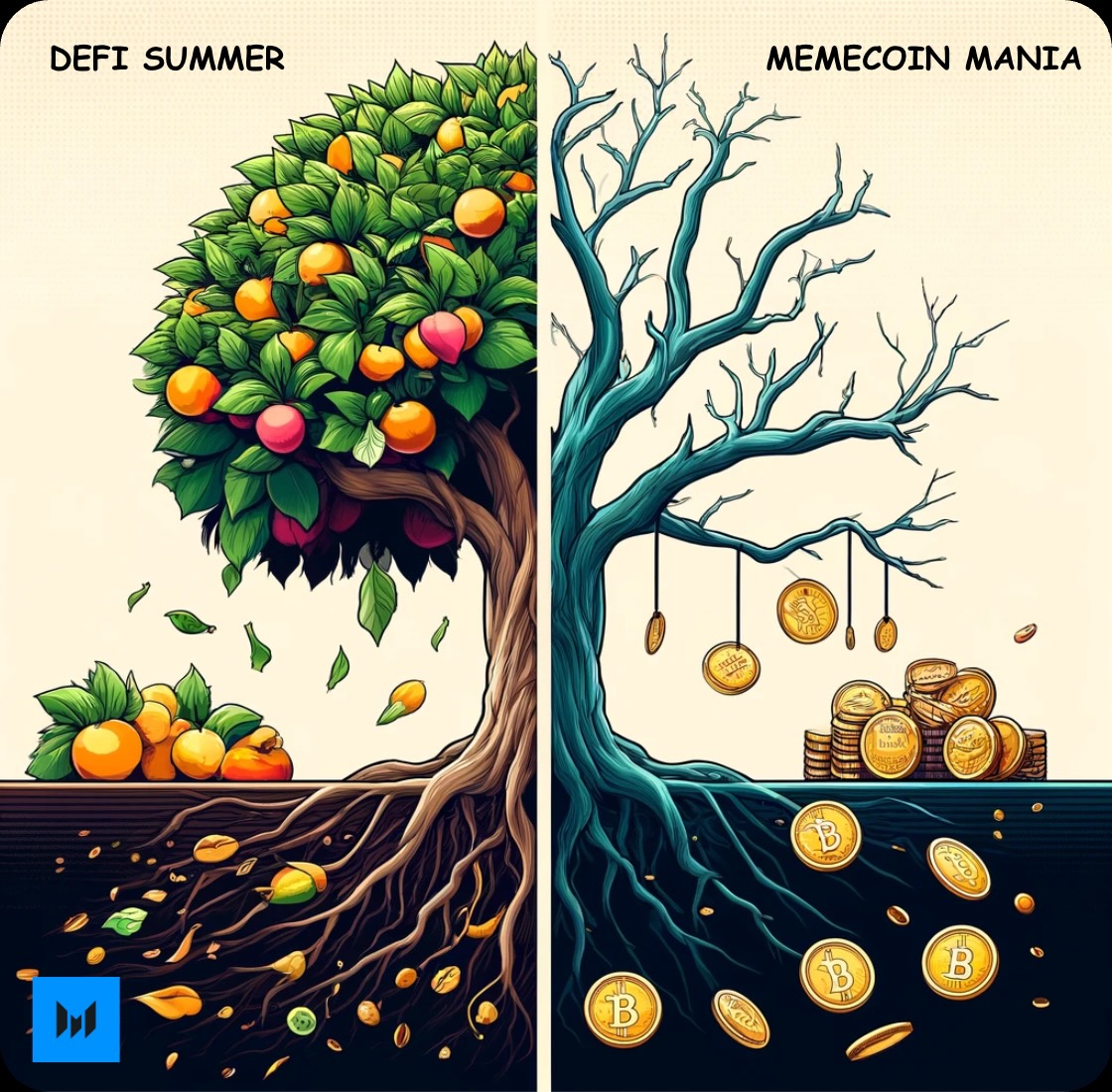
在 DeFi Summer 期间,Uniswap Labs 等项目推出了为加密经济提供真正效用的协议。

参与这些平台的用户通常会获得代币奖励——这些代币代表了协议所创造价值的一部分。当投机狂潮消退时,这些代币仍然具有潜在价值,因为它们与功能齐全、有价值的服务挂钩。

将此与 Meme 币趋势进行对比。

在这里,内部人员或卡特尔会创建像 supercumrocket69 这样的代币,对其进行炒作,并诱使散户投资者竞购这些「革命性」的新资产。一旦价格上涨,内部人员就会抛售其持有的资产,从而有效地从散 户参与者手中榨取财富,留下没有实际价值或效用的代币。整个过程是一场零和游戏,价值不仅被重新分配,而且被摧毁。

对散户投资者的影响是显而易见的。看看像 Friend.Tech 和 Ore Supply 这样的项目。

尽管实施了有利于散户投资者的分配机制——FRIEND 完全空投给其社区,ORE 是使用公平的基于 CPU 的算法开采的——但这两种代币的价格都大幅贬值。

这表明散户买家被 Meme 币无情地榨干了,不再有资本来支撑那些更真实的项目的市值。与此同时,memecoin 最多只能靠可疑的市场活动和散户的天真来维持。

可悲的事实是,尽管投机泡沫一直是加密货币领域的一部分,但它们之前以合法项目的形式留下了一些剩余价值。然而,Meme 币泡沫纯粹是投机性的,正在耗尽生态系统的价值,让散户投资者的境况比以前更糟。

信息披露:本文作者在 FRIEND 上遭受了巨额损失,现在持有和开采 ORE 也遭受了巨大损失。本文的灵感来源于财富的损失以及 memecoin 卖家和买家的普遍沮丧。

Lecturas Relacionadas

a16z Crypto Partner: Cryptocurrency is Being Repackaged by Financial Institutions, Its Potential Far Exceeds Imagination

"Digital Assets" and the Real Digital Transformation of Finance The term "digital assets" puzzles many in crypto, as most assets today are already digital. Yet, the financial industry's core infrastructure has largely escaped the profound digital transformation seen in other sectors like media and retail. Beneath modern interfaces, finance still relies on fragmented systems, manual reconciliation, and paper-based processes. The true driver for blockchain adoption by large financial institutions is not ideology but a practical need to solve coordination problems. It provides a neutral system for multiple parties to collaborate without ceding control to a single entity. Asset ownership is encoded directly into the software, eliminating separate ledgers and disputes over records. The asset *is* the record. While crypto's adoption by Wall Street involves compromises and compliance, it inherits a key capability: *composability*. When financial assets exist on shared, programmable infrastructure, they can be combined, extended, and integrated seamlessly. The immediate benefits are faster settlement and lower costs, but the deeper, structural change is the newfound ease of building applications on top of this system. In essence, crypto technology is not disappearing into financial institutions but being repackaged as foundational infrastructure. As Wall Street adopts it, the industry may ultimately inherit more of crypto's transformative potential than it initially anticipated.

链捕手Hace 48 min(s)

a16z Crypto Partner: Cryptocurrency is Being Repackaged by Financial Institutions, Its Potential Far Exceeds Imagination

链捕手Hace 48 min(s)

Berkshire Hathaway and SoftBank: One Must Die

Berkshire and SoftBank: A Tale of Two Extremes The article presents a speculative future (set in 2026) contrasting the investment philosophies and potential fates of Berkshire Hathaway and SoftBank Group. Under new CEO Greg Abel, Berkshire sits on a massive cash pile of nearly $400 billion, built by selling assets like Apple stock over many quarters. Buffett and now Abel deem the market overvalued and refuse to invest, leading to significant underperformance. The "disease" of too much cash poses an existential threat to Berkshire's identity as a capital allocator, potentially forcing a future breakup or special dividend if the bull market persists. Its "death" would be a slow, dignified fading of its legendary investment narrative. In stark contrast, SoftBank's Masayoshi Son is all-in on a high-stakes gamble. To fund a colossal $64.6 billion (and growing) investment in OpenAI, SoftBank has aggressively leveraged itself. It has sold core holdings like Nvidia, T-Mobile, and Alibaba, taken on over $100 billion in parent-level debt, and secured a record $40 billion bridge loan. The survival strategy hinges on a successful OpenAI IPO and the high valuation of its Arm holdings. However, this creates multiple interconnected risks: an OpenAI IPO delay, a correction in Arm's lofty valuation, or a credit market freeze. Any of these could trigger a liquidity crisis. SoftBank's potential "death" would be swift and dramatic. The core thesis is that in this speculative market, one extreme strategy—Berkshire's paralyzing caution or SoftBank's all-or-nothing leverage—will likely prove unsustainable. One may lose its soul, the other may face financial rupture.

链捕手Hace 1 hora(s)

Berkshire Hathaway and SoftBank: One Must Die

链捕手Hace 1 hora(s)

The AI Economy I Saw at Stripe Sessions 2026

"At Stripe Sessions 2026, the AI economy's impact is undeniable, echoing the delayed productivity recognition seen with computers in the '90s. Stripe's data shows an AI boom: new business formation has surged vertically since early 2026, with companies generating revenue 5x faster than a year ago. AI firms like Lovable and Cursor scale to billions in months. Two key features define this economy: unprecedented speed and being 'global by default,' with companies reaching 55+ countries in their first year. Stripe's global financial infrastructure is critical for this instant international commerce. The conference's central theme was 'Agentic Commerce'—a future where AI agents become economic participants. Demos showed agents autonomously purchasing data, generating reports, and selling them. This shift introduces micro-payments and continuous 'strategic' spending, as agents lack human cognitive friction. New challenges like fraud targeting AI's real inference costs are met with systems like Stripe's Radar. The transition requires an ecosystem. Stripe is collaborating on protocols like the Machine Payments Protocol (MPP) and joining the Universal Commerce Protocol (UCP) to enable seamless agent-to-agent transactions. Underpinning this vision is Stripe's philosophy: 'money is data,' programmable and operable by agents. Thus, Stripe is not just powering the AI economy but acting as its 'heart-rate monitor,' capturing its rapid pulse through transactions equating to nearly 2% of global GDP."

marsbitHace 1 hora(s)

The AI Economy I Saw at Stripe Sessions 2026

marsbitHace 1 hora(s)

Three Months of Raising $6 Billion in Funding: What Are the Leading Crypto VCs Betting On?

While the crypto bear market persists, top-tier venture capital firms are making significant moves by raising massive new funds, signaling a strategic bet on the industry's future. Haun Ventures and a16z recently announced funds totaling $1 billion and $2.2 billion, respectively. This follows other major raises from firms like Dragonfly, Paradigm, ParaFi, and Blockchain Capital. In under three months, these six VCs have amassed over $6 billion in fresh capital, a clear example of counter-cyclical investing during a quiet market phase. The fundraising landscape highlights a sharp divergence between large and small VCs. Many mid-sized and smaller funds are struggling with poor returns, limited exit options, and difficulty raising new capital, leading some to scale back or exit. In contrast, leading firms are strengthening their dominance due to structural advantages: superior access to high-quality deals, the ability to invest across all stages, greater capacity for long-term bets and risk, and stronger negotiation power. These new funds are largely converging on key investment themes. The strongest consensus centers on next-generation on-chain financial infrastructure, including stablecoins, real-world asset (RWA) tokenization, prediction markets, and on-chain payments. VCs are focusing on projects with validated demand that can attract traditional finance flows. Another major focus is artificial intelligence (AI), particularly AI agents, as crypto seeks to position its open, composable networks as foundational infrastructure for the emerging AI economy. Ultimately, this wave of bear-market fundraising is a strategic wager on the next cycle. By deploying capital when valuations are lower and market noise is reduced, these top VCs aim to identify and back the foundational projects that will define the industry's future, betting on which companies will become the next generation of leaders.

marsbitHace 1 hora(s)

Three Months of Raising $6 Billion in Funding: What Are the Leading Crypto VCs Betting On?

marsbitHace 1 hora(s)

Trading

Spot
Futuros
活动图片