元宇宙泡沫破灭?以下是几个“数据真相”

币界网Publicado a 2024-08-19Actualizado a 2024-08-19

币界网报道:

‍‍‍编译:元宇宙之心MetaverseHub

近年来,科技界对“元宇宙”(metaverse)这一概念表现出了极大的热情。这一概念有望改变在线体验,提供身临其境的虚拟世界,我们可以在其中以前所未有的方式工作、娱乐和社交。

科技巨头和投资者为这一愿景投入了数十亿美元,Meta(前身为Facebook)是其中的佼佼者。然而,最近的数据表明,元宇宙泡沫可能已经破裂,让许多人对其未来产生了怀疑

要了解目前的情况,我们需要退一步看看当初元宇宙承诺了什么。

Meta公司首席执行官Mark Zuckerberg成为这场运动的代言人,他重新打造了自己的公司,并在虚拟现实技术上投入巨资。

花旗银行的研究人员甚至预测,元宇宙可能吸引50亿用户,并发展成为一个13万亿美元的市场

这些豪言壮语引发了一场淘金热,公司和个人争先恐后地在这一数字前沿领域抢占地盘。

01.元宇宙的急剧衰落

时至今日,情况已截然不同。

Meta雄心勃勃的元宇宙部门RealityLabs一直在大出血。仅在上一季度,它就亏损了45亿美元,自成立以来的总亏损额超过了460亿美元。这些数字与曾经设想的盈利未来相去甚远。

更能说明问题的是Horizon Worlds的命运,它是Meta面向成人的旗舰元宇宙平台。尽管在市场营销方面做了大量努力,但该平台仍难以吸引其目标受众。具有讽刺意味的是,它却意外地受到了儿童的欢迎,而这并不是它的设计初衷。

02.Crypto元宇宙的崩溃

元宇宙概念并不局限于传统的科技公司。

基于Crypto的虚拟世界出现了一个完整的生态系统,承诺提供去中心化的所有权和独特的数字资产。

这些建立在区块链技术基础上的平台被炒得沸沸扬扬,估值也达到了天文数字。然而,它们也经历了急剧下滑。

以The Sandbox为例,估值一度超过70亿美元的虚拟世界,但其日交易量却暴跌了99.9%。巅峰时期,它的交易额曾达到1.17亿美元,而现在平均每天的交易额仅能达到8000美元。
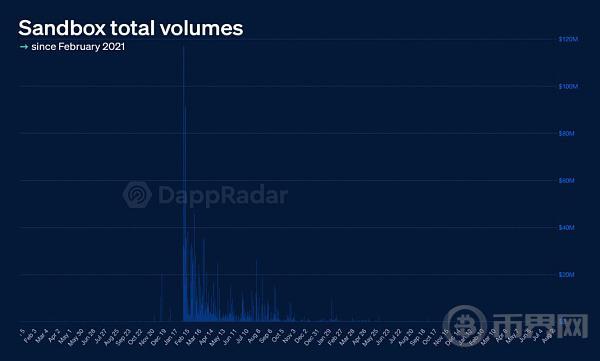
这并非个案。另一个开创性的Crypto元宇宙平台Decentraland的日交易量也出现了类似的99.9%的下降,从高峰时期的250万美元下降到现在的不足5000美元。

03.数字资产的衰落

在这些虚拟世界中,最引人注目的一点是可以拥有和交易数字资产,通常采用非同质化通证(NFT)的形式。这些通证可以代表任何东西,从虚拟房地产到游戏中的物品。

在元宇宙热潮的顶峰时期,这些资产的价格令人瞠目。现在,它们的价值几乎蒸发殆尽

在Sandbox中,NFT的单日销售额曾达到1020万美元,而现在却很难超过10000美元。

这种模式在其他平台上也在重演,曾经是“边玩边赚”游戏典范的AxieInfinity的交易量从近10亿美元骤降至不足200万美元。

与这些“元宇宙”项目相关联的Crypto的表现也不尽如人意。MANA(Decentraland)、SAND(The Sandbox)和AXS(AxieInfinity)等通证的价值都比2021年11月的峰值暴跌了90%以上。
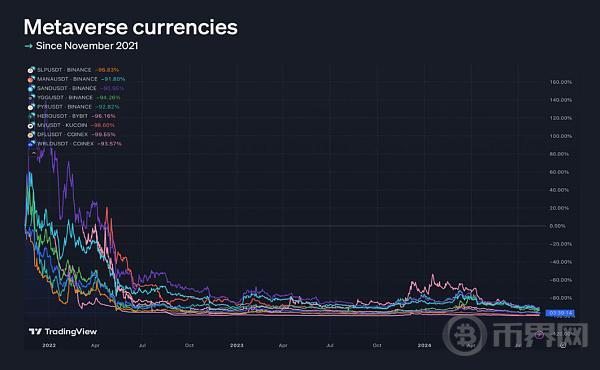
这种衰退并不只是个别项目的问题,整个元宇宙Crypto领域都大幅缩水,其总市值从500亿美元降至160亿美元

04.哪些因素导致了这一崩溃?

有几个因素导致了这一迅速衰落。

首先,最初的炒作造成了不切实际的期望。提供真正身临其境的无缝虚拟体验所需的技术仍处于起步阶段。许多用户发现,与所承诺的愿景相比,目前的产品显得笨拙和令人失望。

此外,这一概念本身可能过于抽象,难以被主流采用。虽然技术爱好者们兴奋不已,但普通互联网用户却很难理解元宇宙将如何有意义地改善他们的数字生活。高昂的入门成本,无论是硬件还是学习曲线,都进一步限制了其采用

更广泛的经济衰退和Crypto市场崩溃也起到了重要作用。随着投资资本越来越稀缺,风险偏好降低,许多元宇宙项目发现自己难以维持开发和用户增长。

尽管存在这些挫折,但现在就完全否定元宇宙概念还为时过早。

技术往往会经历炒作、幻灭和最终实际应用的循环。像Mark Zuckerberg这样的一些支持者,相信元宇宙的长期潜力,继续在元宇宙开发上投入巨资。

历史证明,即使在市场大幅调整之后,创新理念也会以更实用的形式重新出现

正如亚马逊(Amazon)和易趣(eBay)等公司从网络泡沫中脱颖而出,成为科技巨头一样,一些元宇宙项目可能会找到自己的立足点,并以我们尚未想象到的方式实现价值。

Lecturas Relacionadas

Just now, DeepSeek V4 updates with DSpark, improving inference speed by 80%

DeepSeek has updated its DeepSeek V4 model with the DSpark speculative decoding framework, achieving a significant 60-85% speedup in generation for Flash models and 57-78% for Pro models while maintaining the same overall throughput. This engineering-focused update, rather than a core architectural change, introduces DSpark to address latency and throughput bottlenecks in high-concurrency production environments. DSpark combines high-throughput parallel generation with adaptive load-aware verification. Its key innovations include a semi-autoregressive generation architecture to model dependencies within token blocks and a hardware-aware confidence-scheduled verification system. This system uses a confidence head to predict token acceptance probabilities, allowing it to dynamically optimize verification length per request and allocate compute only to tokens with the highest expected payoff. The asynchronous scheduler is designed for real-world deployment, ensuring zero-overhead scheduling and continuous CUDA graph replay while preserving the target model's output distribution. In tests across mathematical reasoning, code generation, and daily dialogue, DSpark outperformed state-of-the-art models like Eagle3 and DFlash, increasing average acceptance length by 26.7%-30.9% and 16.3%-18.4% respectively on Qwen3 target models. DeepSeek also open-sourced DeepSpec, a full-stack codebase for training and evaluating speculative decoding draft models, providing a standardized toolkit that includes data preparation tools, model implementations, training code, and evaluation scripts.

marsbitHace 4 hora(s)

Just now, DeepSeek V4 updates with DSpark, improving inference speed by 80%

marsbitHace 4 hora(s)

BIT Research: The 2028 Halving Is Not the End, the Real Shake-Up of the Bitcoin Mining Industry Is Just Beginning

The Bitcoin mining industry is undergoing its most complex structural adjustment since inception. Despite Bitcoin's price holding near $61,000 and the network hash rate approaching a record 1 ZH/s, miner profitability is deteriorating. The industry is operating close to its breakeven point, with the 2028 halving expected to accelerate consolidation. The challenges extend beyond the halving's subsidy reduction; the industry's revenue model has yet to successfully transition towards a fee-driven structure. Increasingly, mining companies are evolving from simple Bitcoin producers into infrastructure and energy operators, including providers of AI/HPC computing power. Competition is shifting from pure hash rate expansion to business model upgrades. Economic pressure is evident. The theoretical daily mining revenue at current prices is around $78 million, yet the actual figure is only about $33 million—a 136% gap. Transaction fees remain low at roughly $220k daily, far below historical implied levels. With a current estimated industry-wide breakeven price near $65,000, mining alone is struggling to generate ideal profits. The 2028 halving is projected to push the fundamental production cost floor to approximately $93,289. This will likely accelerate a shift towards consolidation among larger, well-capitalized miners with diversified revenue streams. Competitive advantage will belong to institutionalized players with access to low-cost energy, AI/HPC hosting operations, and stronger balance sheets. In essence, Bitcoin mining is transitioning from a "mining business" to an "infrastructure business." Future profitability and resilience will depend less on block rewards and more on diversified income sources like energy management and computational infrastructure services. For investors, the key question is not the halving itself, but which miners can successfully navigate this business model transformation.

marsbitHace 5 hora(s)

BIT Research: The 2028 Halving Is Not the End, the Real Shake-Up of the Bitcoin Mining Industry Is Just Beginning

marsbitHace 5 hora(s)

This is How God Karpathy Uses Claude?

Andrej Karpathy, a prominent figure in AI, has reportedly joined Anthropic, leading to a noticeable decrease in his open-source contributions and social media activity. A document claiming to be his personal "CLAUDE.md" file—a set of instructions for the Claude AI to follow within a specific codebase—has been circulating online. While its authenticity is unverified, the content aligns closely with Karpathy's publicly shared principles on effective AI-assisted programming. The document outlines key rules for AI coding assistants, emphasizing the importance of reading existing code thoroughly before writing new code to maintain consistency. It advises against over-engineering, advocating for simple, surgical modifications that match the project's existing style. Other guidelines include clarifying assumptions upfront, writing meaningful tests, thoughtful debugging, and carefully considering dependencies. The core message is that these principles help prevent common AI coding failures, such as introducing unnecessary abstractions, style drift, or making invisible architectural decisions. The community has noted that even experts like Karpathy require detailed instructions to guide AI effectively, akin to managing a junior developer. A related GitHub repository, "andrej-karpathy-skills," which encapsulates these ideas, is reported to significantly reduce Claude's code error rate. Ultimately, the advice stresses that the best CLAUDE.md is tailored to one's own tech stack and coding practices.

marsbitHace 5 hora(s)

This is How God Karpathy Uses Claude?

marsbitHace 5 hora(s)

Trading

Spot
活动图片