灰度发布新闻后、MKR活跃地址数量增加、未来前景如何?

币界网Publicado a 2024-08-15Actualizado a 2024-08-15

币界网报道:

Maker(MKR)近期价格上涨6%,市值达到19.64亿美元,现货交易量大幅上涨95%。这一增长得益于Grayscale推出的MakerDAO Trust,旨在增强投资者对MKR的接触,促进了链上用户活跃度的显著提升。此外,MKR价格在反弹至2,097美元后,面临着进一步上涨的潜力,预计目标位可能达到2,390美元和2,590美元。这标志着市场对MKR的关注度和信心正在加强。

同时,MKR 的交易量/市值为 6.21%。总供应量为 9.776 亿 MKR。流通供应量为 930.33 万 MKR,占最大供应量的 92.5%。最大供应量为 10.055 亿 MKR,FDV 为 21.2 亿美元,现货市值为 19.64 亿美元。其市值占比为 0.09%。

可能使 MKR 受益的灰度新闻

8 月 13 日,Grayscale 推出了他们的新产品 MakerDAO Trust。这是继最近投资另外两种山寨币之后,他们在 8 月份连续第二次发布新产品。

新信托旨在让投资者更好地接触 MKR。这将使投资者能够访问 MakerDAO 的链上信用协议和其生态系统中的现实世界资产 (RWA)。

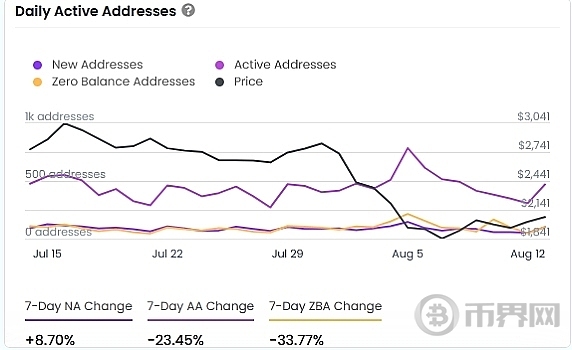
有趣的是,这一发展的影响不仅限于 MKR 的价格。研究网站的链上数据显示,网络上的活跃地址数量从 307 个显著增加到 470 个。这表明网络上代币交易中的用户活动有所增加。
Fvhj82aKWFz2JdCR0IZ8mRGdXciLLjapobtGXkVC.jpeg

因此,这表明 MKR 的价格飙升是由 Grayscale 的投资和日益增长的市场兴趣推动的。如果这种趋势继续下去,MKR 可能会进一步上涨。

Maker(MKR)的下一个目标会是 2,500 美元吗?

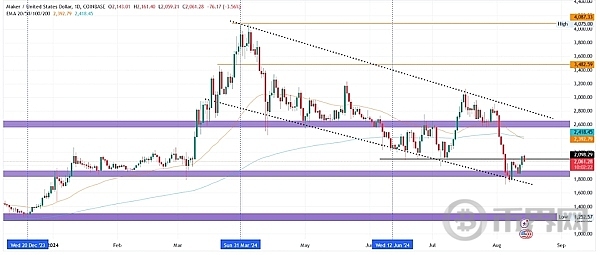
在 MKR 反弹至 2,097 美元之前,价格曾下跌约 40% 至 1,714 美元。在过去几周持续下跌之后,K线走势图上出现了较低的低点波动。
QRkZk5JaVlHBvrLWUFyBPLdnRRrBhAJ0suF6HI47.jpeg

根据之前的价格结构,价格从第二季度开始持续下跌。下跌形成了通道模式。继K线走势图上最近的价格走势之后,该资产从楔形的下边界获得支撑。

根据买家的情绪,如果形成进一步强劲的看涨蜡烛,随后出现更高的高点波动,则可能出现反弹。

同样,上涨可能导致通道上边界。同样,如果 MKR 继续上涨并突破楔形的上边界,我们可能会看到价格趋势转向看涨趋势。

从指标来看,价格有望从下方突破 EMA 带(50 天和 200 天)。直方图已经下跌,表明熊市压力正在减弱;牛市交叉可能很快就会出现。与此同时,RSI 一直显示正在从超卖区域恢复,最近它闪现于 43.08。

因此,目标位在 2390 美元和 2590 美元,其次是 1880 美元和 1690 美元的支撑位。

Lecturas Relacionadas

a16z: AI's 'Amnesia', Can Continuous Learning Cure It?

The article "a16z: AI's 'Amnesia' – Can Continual Learning Cure It?" explores the limitations of current large language models (LLMs), which, like the protagonist in the film *Memento*, are trapped in a perpetual present—unable to form new memories after training. While methods like in-context learning (ICL), retrieval-augmented generation (RAG), and external scaffolding (e.g., chat history, prompts) provide temporary solutions, they fail to enable true internalization of new knowledge. The authors argue that compression—the core of learning during training—is halted at deployment, preventing models from generalizing, discovering novel solutions (e.g., mathematical proofs), or handling adversarial scenarios. The piece introduces *continual learning* as a critical research direction to address this, categorizing approaches into three paths: 1. **Context**: Scaling external memory via longer context windows, multi-agent systems, and smarter retrieval. 2. **Modules**: Using pluggable adapters or external memory layers for specialization without full retraining. 3. **Weights**: Enabling parameter updates through sparse training, test-time training, meta-learning, distillation, and reinforcement learning from feedback. Challenges include catastrophic forgetting, safety risks, and auditability, but overcoming these could unlock models that learn iteratively from experience. The conclusion emphasizes that while context-based methods are effective, true breakthroughs require models to compress new information into weights post-deployment, moving from mere retrieval to genuine learning.

marsbitHace 1 hora(s)

a16z: AI's 'Amnesia', Can Continuous Learning Cure It?

marsbitHace 1 hora(s)

Can a Hair Dryer Earn $34,000? Deciphering the Reflexivity Paradox in Prediction Markets

An individual manipulated a weather sensor at Paris Charles de Gaulle Airport with a portable heat source, causing a Polymarket weather market to settle at 22°C and earning $34,000. This incident highlights a fundamental issue in prediction markets: when a market aims to reflect reality, it also incentivizes participants to influence that reality. Prediction markets operate on two layers: platform rules (what outcome counts as a win) and data sources (what actually happened). While most focus on rules, the real vulnerability lies in the data source. If reality is recorded through a specific source, influencing that source directly affects market settlement. The article categorizes markets by their vulnerability: 1. **Single-point physical data sources** (e.g., weather stations): Easily manipulated through physical interference. 2. **Insider information markets** (e.g., MrBeast video details): Insiders like team members use non-public information to trade. Kalshi fined a剪辑师 $20,000 for insider trading. 3. **Actor-manipulated markets** (e.g., Andrew Tate’s tweet counts): The subject of the market can control the outcome. Evidence suggests Tate’sociated accounts coordinated to profit. 4. **Individual-action markets** (e.g., WNBA disruptions): A single person can execute an event to profit from their pre-placed bets. Kalshi and Polymarket handle these issues differently. Kalshi enforces strict KYC, publicly penalizes insider trading, and reports to regulators. Polymarket, with its anonymous wallet-based system, has historically been more permissive, arguing that insider information improves market accuracy. However, it cooperated with authorities in the "Van Dyke case," where a user traded on classified government information. The core paradox is reflexivity: prediction markets are designed to discover truth, but their financial incentives can distort reality. The more valuable a prediction becomes, the more likely participants are to influence the event itself. The market ceases to be a mirror of reality and instead shapes it.

marsbitHace 2 hora(s)

Can a Hair Dryer Earn $34,000? Deciphering the Reflexivity Paradox in Prediction Markets

marsbitHace 2 hora(s)

Trading

Spot
Futuros
活动图片