$2.5 Billion Liquidated: Crypto Market Cursed with Following Declines but Not Rallies

Odaily星球日报Publicado a 2026-02-01Actualizado a 2026-02-01

Resumen

A massive crypto market crash on January 31 led to $2.522 billion in liquidations, with Bitcoin falling below $78,000 (a 7.6% drop) and Ethereum plunging over 12% to under $2,400, erasing gains from mid-2025. Solana also dropped sharply, falling below $100. The sell-off was triggered by broader financial turmoil, beginning with escalating geopolitical tensions and accelerated by a severe crash in precious metals. Gold and silver saw dramatic drops—15.7% and 37%, respectively—after reports suggested former Fed official Kevin Warsh, perceived as hawkish, might be nominated as the next Fed chair. This sparked a repricing of expectations around U.S. monetary policy and a stronger dollar. The crypto market, positioned at the bottom of the risk asset hierarchy, suffered disproportionately—falling more sharply than traditional markets during downturns without matching their rallies. Major players were heavily impacted: trader Garrett Bullish saw over $700 million liquidated in a single position on Hyperliquid, while institutional entity Trend Research faces nearly $500 million in unrealized losses on its Ethereum holdings. Despite Bitcoin’s price relative to gold hitting historic lows—a signal some interpret as a potential long-term buying opportunity—the event underscores crypto’s current role as a high-risk asset vulnerable to macro shocks, lacking the stable store-of-value status of traditional safe havens. The market is now questioning what will sustain long-term holding thro...

Original | Odaily Planet Daily (@OdailyChina)

Author | Ding Dang (@XiaMiPP)
A flash crash has happened again.

On the night of January 31, Bitcoin briefly fell below $78,000, hitting a low of $75,700, with a 24-hour drop of 7.6%. This decline was not only extremely rapid but, more critically, it directly broke through the price range where BTC had been consolidating for nearly three months, retreating to lows not seen since April 2025.

The situation for ETH is even more concerning, with its price falling below the $2,400 mark, a 24-hour plunge of 12.28%, almost completely erasing all gains since July 2025. Solana was not spared either, with its price dropping below $100, a single-day decline of 13.74%, returning to levels last seen in February 2025.

The collective downturn of mainstream assets seems to be approaching a new critical point.

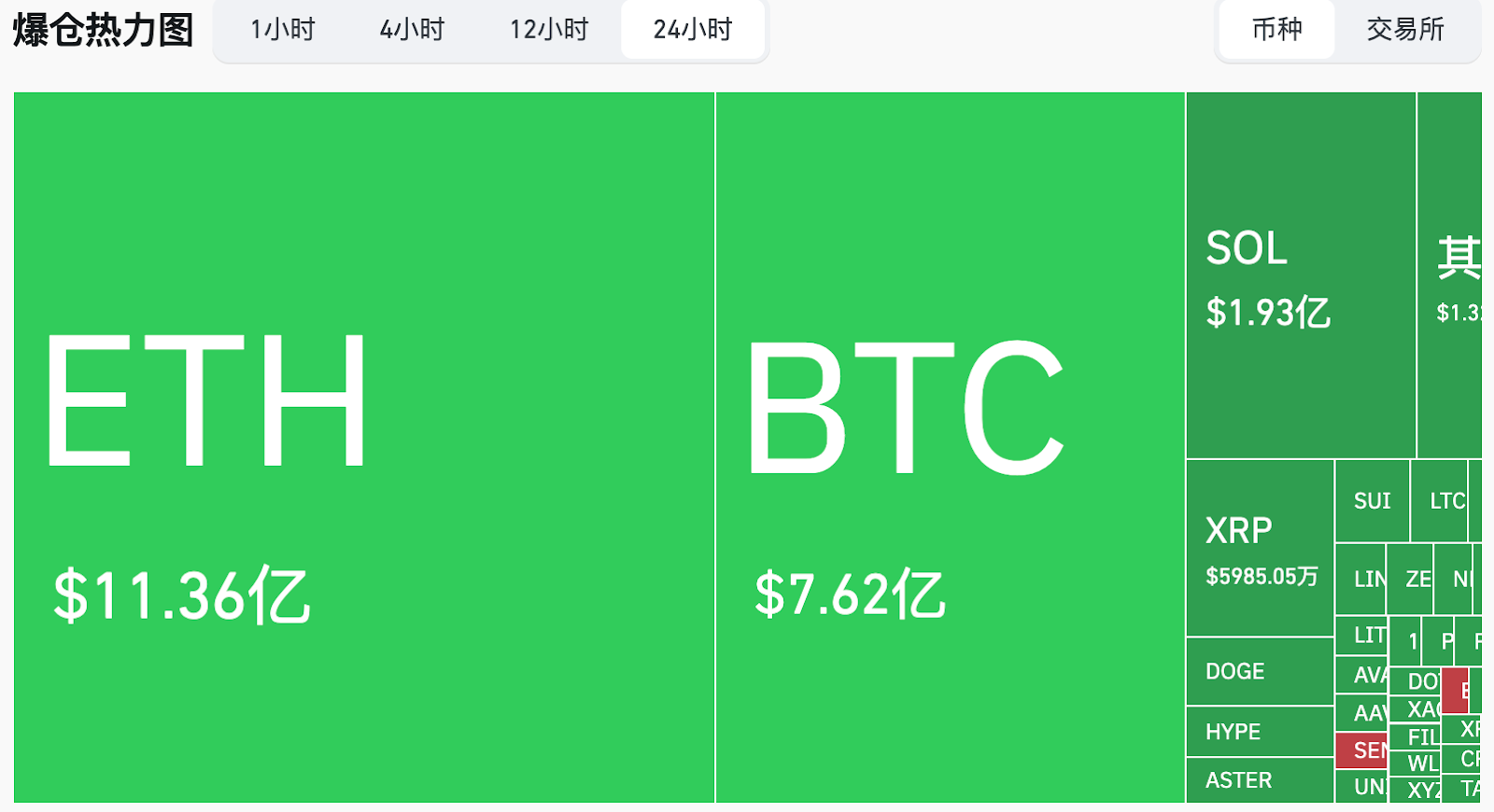
In derivatives, over the past 24 hours, $2.522 billion was liquidated, with long positions accounting for $2.411 billion and short positions $115 million. The largest single liquidation occurred on Hyperliquid - ETH-USD, worth approximately $222 million. Notably, in just the past hour, liquidation amounts reached as high as $1.14 billion.
The Starting Point of the Decline Lies Not Only Within the Crypto Market

The first domino of this round of market movement was not on-chain.

Looking at the timeline, market tension began to noticeably intensify from January 29. The sudden escalation of geopolitical risk was one of the earliest triggering factors captured by the market. The U.S. aircraft carrier USS Abraham Lincoln and its strike group entered a "lights-out" status with communications cut off, while statements from Iran also clearly shifted to a combat-ready posture. Odaily Planet Daily had previously provided a detailed analysis in From Geopolitical Tension to Liquidity Tightening, BTC Dragged into Uncontrolled Market Conditions.

Even so, the speed of this crypto market decline far exceeded expectations. What truly caused the risk to spill over rapidly was the simultaneous crash in the precious metals market.

After Gold and Silver Fell, Crypto's Uncontrolled Decline Accelerated

On January 29, gold turned downward sharply after briefly breaking above $5,600, falling to a low of around $4,740, a maximum drop of 15.7%. The adjustment in silver was even more severe, plummeting after breaking above $120 to a low of $76.6, a maximum drop of 37%.

Dirk Malakie, Managing Director of SLC Management, pointed out that the plunge in gold and silver began with the market's reaction to reports that Trump would nominate Kevin Warsh as Fed Chair. Warsh's resume carries distinct hawkish tones, which somewhat weakened the expectation of a "long-term comprehensive devaluation of the U.S. dollar." The market is re-anchoring towards a more orderly monetary policy path. Related reading: "Estée Lauder Son-in-Law" Kevin Warsh Takes Helm at the Fed, Hawkish Bigwig Turns Out to Be a Crypto Ally?

Seth R. Freeman, Senior Managing Director at GlassRatner Advisory & Capital Group, also believes that the "good news" in this nomination is that the market might not have to repeatedly deal with the uncertainty and emotional disturbance caused by Trump's continuous pressure on the Fed. The sharp fall in gold and silver already reflects the market's repricing for a stronger dollar environment. In his view, it would not be surprising if metal prices fail to show a significant rebound in this context. On the contrary, traders heavily long precious metals without effective hedging may face continued pressure, especially silver bulls. By next Monday, some trading accounts might suffer severe losses.

Additionally, analysts mentioned that month-end concentrated profit-taking trading behavior, and hedging operations by banks to guard against sudden declines, may have amplified the selling pressure in a short period.

Adrian Ash, Head of Research at BullionVault, stated that he has been involved in the precious metals market for 20 years and has never seen a similar行情. However, he downplayed the theory of "retail concentrated withdrawal," pointing out that abnormal fluctuations also occurred in basic metal markets like copper—for example, copper futures fell 4.5% on Friday. If it were only gold and silver, it could be attributed to retail sentiment, but the basic metals market has almost no retail participation.

Bitcoin Fell to a Historical Low Relative to Gold

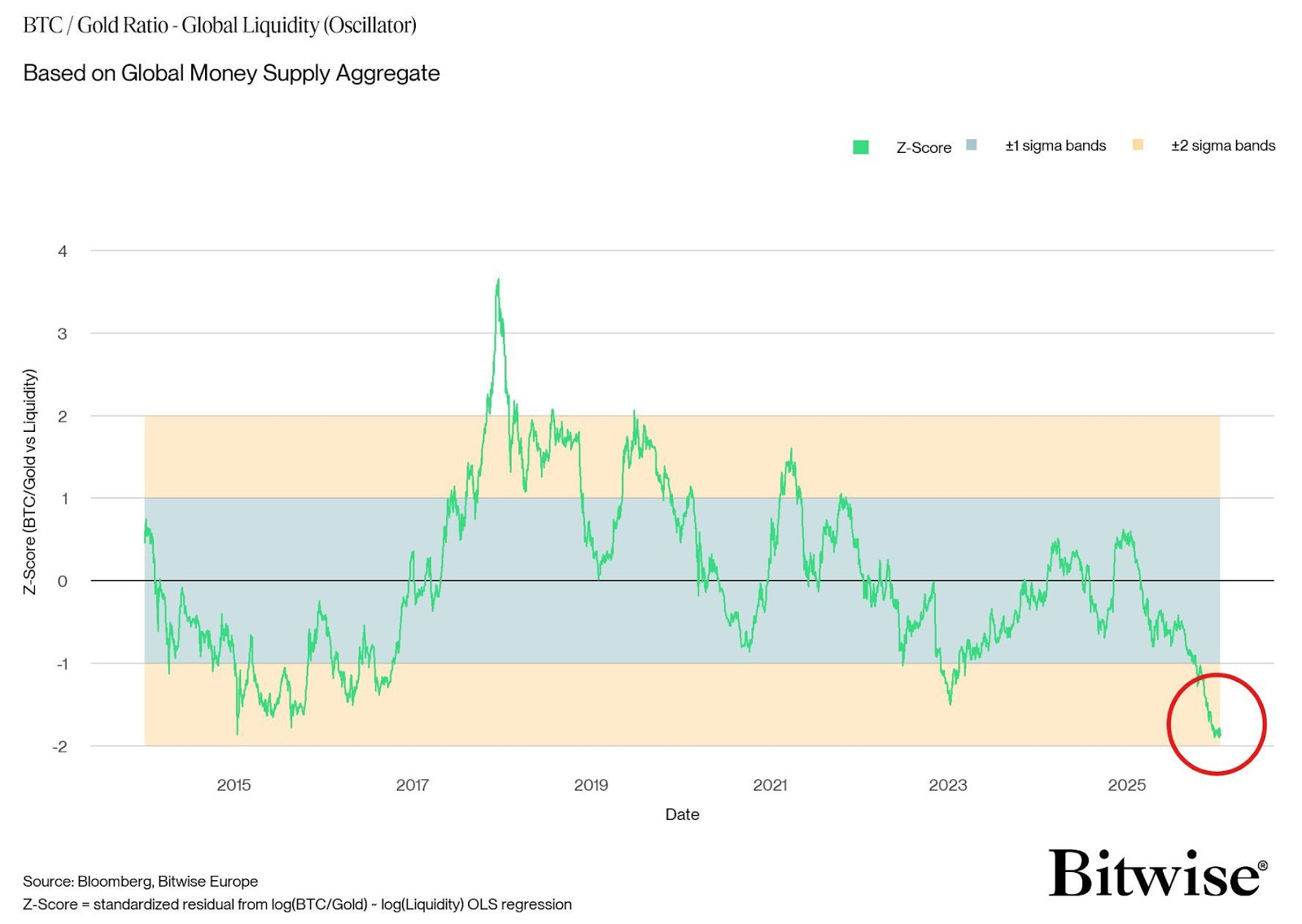
Data from Bitwise Europe shows that the price ratio of Bitcoin relative to gold has fallen to a historical low. This indicator has appeared multiple times in the past near the阶段性 bottoms of Bitcoin.

This implies two coexisting realities: on one hand, Bitcoin is currently weak relative to gold; on the other hand, this extreme weakness also leads some analysts to view the current environment as a potential accumulation zone similar to the pre-bull market launch period of 2015-2017.

The market widely observes that long-term holders are gradually absorbing recent selling pressure. As funds rotate between safe-haven assets and risk assets, some traders anticipate that a阶段性回流 from gold to Bitcoin may occur starting in February.

However, more cautious views point out that fund rotation is not inevitable and requires continuous observation of macro policy, dollar trends, and overall risk appetite changes.
Risk Transmission, Redistribution of Chips

The暴跌 in gold and silver ultimately transmitted to the crypto market. It must be said that the crypto market is now at the bottom of the food chain: when U.S. stocks rise, crypto may not rise; when U.S. stocks fall, crypto often falls deeper; and now, as precious metals fall, crypto cannot escape either. The crypto market seems to have fallen into a "follow declines but not rallies" curse.

In this situation, the "believers" long on crypto assets also seem to be losing their chips in this flood.

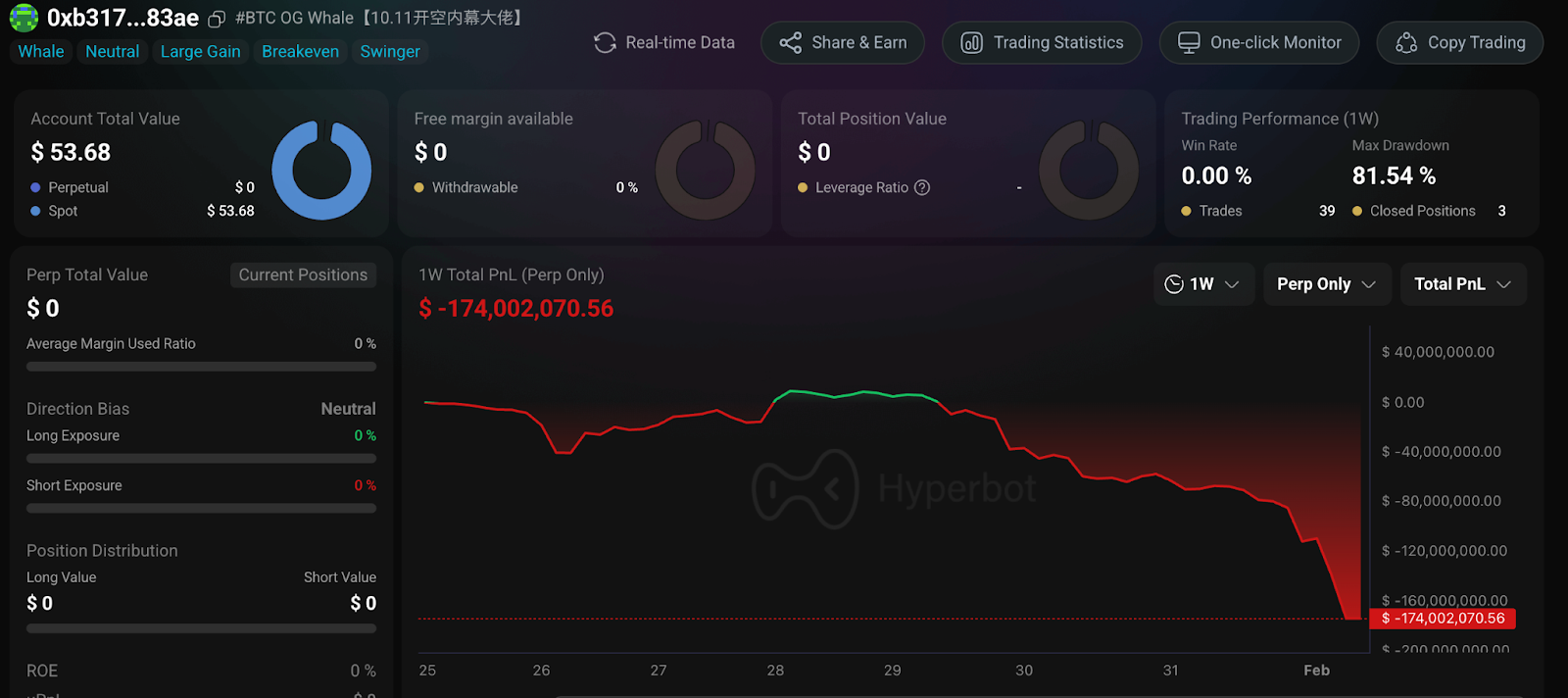
Garrett Bullish (@GarrettBullish), the lucky one who made the most profit in the 1011 flash crash, failed to escape this disaster. His position on Hyperliquid was fully liquidated, with a single liquidation规模 exceeding $700 million, leaving his account balance at just $53.68. This was also the largest single liquidation in this event. Data shows that his cumulative loss on Hyperliquid over the past two weeks was approximately $270 million.

On-chain records also show that since starting to use this account for trading in early October 2025, Garrett Bullish's historical cumulative PnL has lost over $128 million.
Behind the liquidations is protocol revenue. After Garrett Bullish's liquidation was completed, the Hyperliquid ecosystem treasury HLP gained approximately $15 million in收益. This single event brought HLP depositors a return of about 5.8%, translating to an annualized yield of about 110%. Data shows that HLP still holds an ETH long position worth approximately $230 million.

The whale高调做多 ETH also seems to be having a hard time. According to on-chain data monitoring, the secondary fund Trend Research under Yi Lihua has currently抵押 175,800 WETH on Aave V3, worth approximately $445 million, and borrowed about 274 million USDT. The liquidation price for the ETH position is $1,558, with a loan position health factor of 1.34. During the market decline, Trend Research continued to add margin. Yesterday, it withdrew approximately 109 million USDT from Binance and deposited it into Aave to reduce the liquidation risk of its Ethereum position.

As of January 29, Trend Research held approximately 651,300 ETH, with an average holding price of around $3,180. Calculated at the current price of $2,400, the floating loss is nearly $500 million.

Conclusion

From the升温 of geopolitical risks to the collapse of precious metals, crypto assets have become the first to be abandoned in this process. Does this indicate that it is not a safe-haven asset and has not yet truly gained the consensus support of a "value anchor,"只能 passively bearing pressure amidst the fluctuations of macro sentiment?

This round of market conditions is forcing the market to re-examine a question: In a deleveraging cycle, what justifies crypto assets being held long-term?


Preguntas relacionadas

QWhat was the total amount of liquidation in the crypto market over the past 24 hours, and what was the breakdown between long and short positions?

AThe total liquidation amount was $2.522 billion. Of this, long positions accounted for $2.411 billion, while short positions accounted for $115 million.

QWhat external event, outside of the crypto market, is cited as the initial trigger for the market's downturn?

AThe initial trigger was a sharp escalation in geopolitical risk, marked by the US aircraft carrier USS Abraham Lincoln and its strike group entering a 'lights out' and communications blackout status, coupled with Iran shifting to a more combat-ready posture.

QAccording to the article, why did the prices of gold and silver crash, and how did this affect the crypto market?

AGold and silver prices crashed due to market reactions to reports that former President Trump would nominate the perceived hawkish Kevin Warsh as Federal Reserve Chair, which led to a repricing for a stronger dollar environment. This暴跌 (crash) in precious metals subsequently accelerated the失控 (loss of control) in the crypto market.

QWho was the individual trader that suffered the largest single liquidation in this event, and what was the approximate size of that liquidation?

AThe individual trader was Garrett Bullish (@GarrettBullish). The approximate size of his single liquidation on Hyperliquid was over $700 million.

QWhat does the article suggest about the current status of Bitcoin as an asset class based on its reaction to the broader market sell-off?

AThe article suggests that Bitcoin is not seen as a safe-haven asset and has not yet gained consensus as a 'store of value.' It is positioned at the 'bottom of the food chain,' often falling more deeply when other markets decline and failing to rise when they do, indicating it is passively bearing the pressure of macro sentiment shifts.

Lecturas Relacionadas

human.tech Launches Clean SDK for Privacy-First Web3 Apps

human.tech has launched the Clean SDK, a toolkit enabling developers to build privacy-first Web3 applications with transparent accountability. Released alongside Aztec's version 5, the SDK provides components for integrating zero-knowledge identity verification, sanctions screening, and private transactions, without developers handling sensitive user data or building compliance infrastructure from scratch. It uses zero-knowledge proofs and programmable verification to allow apps to confirm user legitimacy and sanctions compliance while keeping identities confidential. The first application built on the SDK, Shield, a privacy bridge to Aztec, also launched. It allows users to transfer assets privately while proving a unique human is behind each transfer and that funds have passed sanctions checks, as verified by a May 2026 audit. The SDK offers three core verification techniques: Proof of Innocence (sanctions screening against 23 sources), Proof of Personhood (simpler verification via Human Passport), and Proof of Clean Hands (higher-assurance zero-knowledge government ID checks). This allows apps to authenticate users and transactions without exposing personal data. Designed for Aztec builders, the SDK lets developers add programmable privacy to decentralized apps, eliminating the need to create their own verification and ZK infrastructure. Shield demonstrates its practical use for private bridges, but the SDK aims to enable a wider ecosystem of private, accountable financial apps and services. The launch addresses growing demand for infrastructure that balances privacy and accountability. The SDK avoids traditional identity databases, storing encrypted data off-chain, screening at both entry and exit points, and including a gated disclosure mechanism for legal requests. human.tech's products, including the Clean SDK, focus on using zero-knowledge technology to enable verifiable personhood and privacy in digital systems.

TheNewsCryptoHace 3 min(s)

human.tech Launches Clean SDK for Privacy-First Web3 Apps

TheNewsCryptoHace 3 min(s)

Unlocking $100 Million in Liquidity? Pump.fun's New Policy Tests the 5-Minute Pump Technique

Pump.fun, a popular meme coin launchpad, has introduced a new standard mechanism called BOOST. It aims to address a significant capital efficiency issue: when a newly launched token graduates from its initial bonding curve to a liquidity pool (LP), roughly 20% of its liquidity becomes permanently locked as "dead liquidity," estimated to waste over $100 million annually. Instead of locking these funds permanently, BOOST repurposes them. Upon a token's migration, approximately 20% of the settlement funds (e.g., 17.6 SOL or ~$2516 USDC) are used to buy back the token on the open market over a 5-minute period via a Time-Weighted Average Price (TWAP) mechanism. All purchased tokens are immediately burned. This creates a brief, systematic buy pressure immediately after migration, potentially generating a short-term price surge ("pump") while permanently reducing the token's circulating supply. The goal is to enhance the immediate post-launch trading experience, potentially increasing trader retention and sustainable protocol revenue, which funds ongoing token buybacks. However, concerns exist that this artificial 5-minute boost could lower the barrier for launching low-quality tokens and lead to steeper price crashes once the buy pressure stops, if followed by large sell-offs. The feature automatically applies to tokens migrating after July 21, 2024, but not to previously migrated tokens or those launched via the Mayhem AI Agent lab.

marsbitHace 11 min(s)

Unlocking $100 Million in Liquidity? Pump.fun's New Policy Tests the 5-Minute Pump Technique

marsbitHace 11 min(s)

Podcast Notes | Conversation with GSR Asset Management Head: To Determine if This Crypto Rally is Real, Just Watch the Lending Rates on Aave

Podcast Summary: Dialogue with GSR's Head of Asset Management: To Determine if This Crypto Rally is Real, Just Check Lending Rates on Aave Andy Baehr, Managing Director of Asset Management at GSR, discusses the current crypto market, characterizing it as stuck in a state of "ambivalence" with short-lived, unsustainable rallies. He outlines a simple framework: the market moves between "ambivalence" and "conviction" (sustained upward momentum). Currently, every rally resembles a single-stage rocket booster that quickly fizzles out. Baehr identifies three key signals to watch: 1) DeFi lending rates, 2) the potential passage of the CLARITY Act, and 3) the market forming a consensus on the "Fed hawkish peak." He emphasizes that the most immediate indicator for the sustainability of the recent CPI-triggered rally is the USDC borrowing rate on Aave, currently around 3.75%—close to U.S. Treasury yields. The absence of a credit spread indicates low leverage demand and a lack of market energy. He explains that a healthy, sustained rally requires layered buying pressure. Last year's rally progressed from an ETH short squeeze to crypto-native trader influx and finally to ETF inflows. Currently, this structure is missing. Other potential structural buyers like Digital Asset Treasury (DAT) companies are absent, and ETF flows have proven transient. Baehr notes that while small-cap crypto tokens outperformed large caps in Q2—a potential sign of capitation in major assets—capital is also flowing to more exciting opportunities like AI stocks and tech IPOs, leaving crypto sidelined. Regarding DeFi, he highlights that platforms like Aave provide a clear, real-time signal of leverage demand through their supply/demand-driven interest rates. A significant, sustained rate increase would signal genuine market conviction. He also observes the quiet emergence of fixed-income-like products and vaults in DeFi. On regulation, the probability of the CLARITY Act passing before the August 7th deadline has dropped linearly from 75% to below 40% on Polymarket. Baehr suggests its passage would be treated as a bullish surprise, a potent driver for price movement. However, political hurdles, including ethical clause debates and disclosures about the First Family's crypto profits, remain significant obstacles. Ultimately, the market awaits clarity on the Fed's terminal rate under Chair Warsh. Until the "Fed Solstice"—the point where the market collectively understands the peak of hawkish policy—sustained conviction will be difficult to achieve.

marsbitHace 42 min(s)

Podcast Notes | Conversation with GSR Asset Management Head: To Determine if This Crypto Rally is Real, Just Watch the Lending Rates on Aave

marsbitHace 42 min(s)

Trading

Spot
活动图片