非洲联盟批准大陆人工智能战略,以促进采用和发展

币界网Publicado a 2024-08-11Actualizado a 2024-08-11

币界网报道:

非洲联盟(AU)批准了一项新的“大陆人工智能战略”,旨在加快人工智能在成员国的整合。该战略于8月9日制定,概述了将人工智能纳入公共和私营部门的具体措施。

在加纳阿克拉举行的非盟执行理事会第45届常会上,非盟的人工智能战略得到了认可。它试图利用人工智能促进非洲大陆的发展和人民的福祉。

非盟将人工智能与2063年议程和联合国可持续发展目标相结合

大陆人工智能战略提出了以下几项关键建议。它建议建立新的硬件软件基础设施,以支持人工智能和机器学习过程的执行。这使得非洲能够进行适当的管理和数据共享。

该战略还考虑了加强适当的人工智能治理框架。因此,必须确保将人工智能纳入非盟2063年议程和联合国可持续发展目标的优先领域。另一个领域是公共部门人工智能应用的进一步发展,以及与人工智能相关的初创公司出现的条件。

人工智能战略的重点领域和行动领域

人工智能战略提出了2025-2030年未来五年行动的路线图,描述了两个阶段。第一阶段将从2025年持续到2026年,重点是建立治理结构和制定国家人工智能计划。它还将包括确定非盟和成员国的需求及其能力建设。

第二阶段,即2027年至2030年,将侧重于执行战略中确定的战略优先事项和举措。这一阶段将涉及在现实生活中实施人工智能技术和实现战略目标。

六个非洲国家在现有的人工智能战略方面处于领先地位

迄今为止,六个非洲国家已经制定了独立的人工智能战略,即阿尔及利亚、贝宁、埃及、毛里求斯、卢旺达和塞内加尔。另一方面,肯尼亚、南非和乌干达等国正在试行人工智能与区块链等其他创新的结合使用。

埃塞俄比亚、加纳、肯尼亚、毛里塔尼亚、摩洛哥、尼日利亚、南非、坦桑尼亚、突尼斯和乌干达等几个国家正在制定人工智能政策,并建立促进人工智能发展的机构。这一进展突显了人工智能在该地区日益重要的作用,以及非盟将这项技术应用于其他发展目标的决心。

Lecturas Relacionadas

Vitalik Updates Ethereum Roadmap: From Merge to 'Lean Refactoring', with STARK, AI, and Privacy Reshaping the Technical Foundation

Vitalik Buterin has updated Ethereum's long-term roadmap, outlining a major shift from the post-Merge evolution toward a "Lean Ethereum" vision. The update builds on the 2023 framework but reorders priorities and introduces new concepts. Key continuations include improving consensus (single-slot finality), scaling data availability (larger blobs), simplifying light client verification with SNARKs/STARKs, and protocol simplification. Major adjustments involve significantly prioritizing quantum resistance due to heightened perceived threats, while deprioritizing items like VDFs and some EVM improvements. Technical replacements are planned, such as moving from Verkle trees to a unified Binary Tree and eventually PBTs, and rethinking state management with "New State Types." Notable new additions are: 1. Making **privacy a top-tier priority**, aiming to build it natively into the protocol. 2. **Radical scaling under post-quantum conditions**, using techniques like leanSPHINCS signatures and zkzk frames. 3. **Protocol "Lean-ification" and formal verification**, leveraging modern AI tools to make full formal verification feasible. 4. Exploring **Blob and Gas futures** for future capacity. 5. Developing **Native Rollups**, deeply integrating rollup capabilities into the protocol. 6. **Reimagining the EVM's future**, potentially exposing a simpler, modern instruction set (e.g., leanISA or RISC-V), with EVM becoming a compatibility layer. The core philosophy shifts toward specializing mechanisms for high-load activities (transfers, swaps, privacy) to gain scalability, rather than attempting to infinitely scale all activities. It also elevates **recursive STARKs and AI-assisted formal verification** as foundational infrastructure. In summary, Ethereum is embarking on a systemic "third-generation" redesign—Lean Ethereum—involving replacements or rewrites of major components. The goal is to achieve a quantum-safe, privacy-first, secure, decentralized, and highly scalable network while maintaining a lean and verifiable protocol.

marsbitHace 10 min(s)
Vitalik Updates Ethereum Roadmap: From Merge to 'Lean Refactoring', with STARK, AI, and Privacy Reshaping the Technical Foundation

marsbitHace 10 min(s)

China Monopolizes the Humanoid Market: The U.S. Is Forced to Defend Itself

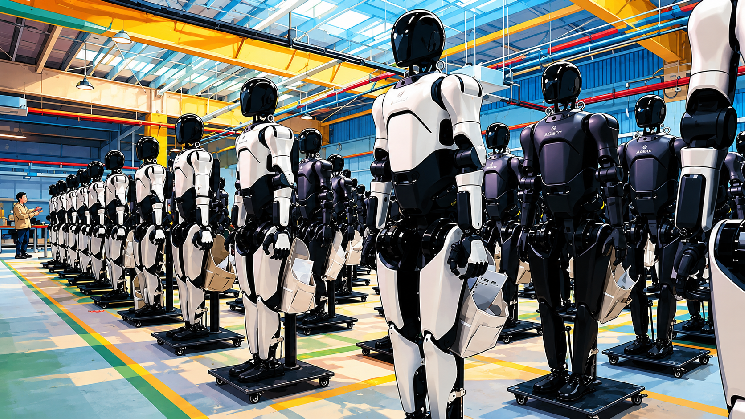
China's Humanoid Robot Market Domination and US Response According to a report by Smart Analytics Global (SAG), Chinese manufacturers supplied over 97% of the global humanoid robot shipments (approximately 19,100 units) in the first half of 2026, a 272% year-on-year increase. Shanghai-based AGIBOT led with a 44% market share, followed by Unitree Robotics with 31%. Together, these two firms accounted for about 75% of global shipments. China itself represented over 85% of global demand for these devices, with industrial and commercial applications now comprising more than 70% of shipments. Key factors driving China's leadership include strong state support, abundant funding, expanding production capacity, IPO waves for developers, and a vast manufacturing ecosystem for rapid testing and deployment. Furthermore, over 90% of key components for humanoid robots are now sourced domestically. In response, the US Federal Communications Commission (FCC) banned federal agencies and subsidy recipients from purchasing or using foreign "advanced robotic devices," including humanoid and quadruped robots, citing national security concerns in July 2026. SAG forecasts global shipments to approach 60,000 units for full-year 2026, with industry revenue around $1.6 billion, projecting 500,000 units by 2030. The analysis notes potential challenges for Chinese expansion, such as reputational risks from alleged ties to China's defense sector and the precedent of trade disputes seen in solar panels and batteries, potentially triggered by the current low average robot price.

cryptonews.ruHace 29 min(s)

China Monopolizes the Humanoid Market: The U.S. Is Forced to Defend Itself

cryptonews.ruHace 29 min(s)

What's New in Ethereum's Roadmap: Privacy, Quantum Security, Native Rollup?

On August 10, 2024, Ethereum co-founder Vitalik Buterin revealed an updated technical roadmap, highlighting significant changes in priorities and new focus areas. Key new additions include: - **Strong Privacy Protection**: Elevated to a top-tier protocol concern. Proposals like EIP-8250 (keyed nonces for concurrency), EIP-8272 (recent roots for verification), and EIP-8182 (shared protocol-level privacy pools) aim to enable private transfers of ETH and ERC-20s, moving toward default private accounts. - **Quantum Resilience**: Priority increased. The plan addresses risks to ECDSA/BLS signatures, KZG commitments, and ZK systems, exploring solutions like leanSPHINCS signatures, STARK proofs (considered quantum-resistant), and streamlined verification processes. A full L1 upgrade is tentatively targeted for ~2029. - **Native Rollups**: A novel concept where rollups could reuse Ethereum's core validation infrastructure via a new EXECUTE precompile (EIP-8079 draft). This aims to reduce custom code and enhance security for certain L2s, while specialized chains will continue to exist. - **Protocol Simplification & Formal Verification**: Leveraging AI tools to make full-protocol formal verification feasible, aiming for more rigorous and machine-verifiable specifications. Other notable shifts: - State storage is evolving from Verkle trees to a Partitioned Binary Tree (PBT, EIP-8347 draft). - Some 2023 items like VDFs and certain EVM improvements were deprioritized. - Long-term discussions include blob/gas futures and non-EVM instruction sets (e.g., RISC-V). The "Strawmap" outlines potential upgrades through ~2029 but is a directional guide, not a firm timeline. Key milestones to watch include the Glamsterdam (Q4 2026) and Hegotá (2027) forks. Many proposals remain in draft or research phases.

marsbitHace 50 min(s)

What's New in Ethereum's Roadmap: Privacy, Quantum Security, Native Rollup?

marsbitHace 50 min(s)

Hyperliquid Trading Volume Soars, So Why Are Profits Falling?

Hyperliquid, a leading decentralized perpetuals trading platform, has seen its open interest surge to a record high above $11 billion, capturing roughly 9% of the global market share. Trading volume remains robust, nearing $178 billion over 30 days, driven largely by the explosive growth of third-party markets offering tokenized real-world assets (RWAs) like stocks and commodities. Despite this growth, the platform's protocol revenue has declined for four consecutive quarters, falling 43% from its Q3 2025 peak of $357 million to approximately $202 million in Q2 2026. This divergence is primarily attributed to the HIP-3 governance proposal, which allows external developers to launch their own markets and keep up to half of the generated fees. These third-party markets now account for nearly 50% of total volume. Consequently, the share of revenue redistributed to developers, market makers, and the treasury has tripled from 6% to 18% in a year. This directly reduces the funds allocated to the platform's buyback-and-burn mechanism for its native HYPE token, weakening a key price support. HYPE's price has fallen 28% from its all-time high. The platform's growth is also heavily concentrated, with a single entity, Trade.xyz, responsible for over 90% of HIP-3 open interest, introducing systemic risk. Additionally, the ecosystem lacks diversity beyond HYPE, faces ongoing token unlocks adding sell pressure, and is encountering increased regulatory scrutiny and new competition from platforms like Robinhood Chain. While still a major revenue generator in crypto, Hyperliquid's model of sharing fees to fuel expansion is currently compressing its own earnings and token economics.

marsbitHace 50 min(s)

Hyperliquid Trading Volume Soars, So Why Are Profits Falling?

marsbitHace 50 min(s)

Trading

Spot
活动图片