AR飙升40%,看好本轮牛市上一百

金色财经Publicado a 2024-08-08Actualizado a 2024-08-08

Arweave (AR) 似乎受到 BTC 飙升的极大影响,其市场本周上涨了 40%,最新盘中涨幅为 5%。BTC 的价格已超过 65,500 美元,市场大部分呈现绿色。

全球市值飙升2.21%,达到2.41万亿美元。
YgzK3jK8TYuujaCwDzSypOilMSSxWifs5YNRxBrf.jpeg

随着 AR 价格上涨,其市值也大幅上涨,跻身全球加密货币前 50 名。其市值排名第 49 位。在过去 24 小时内,Arweave 代币的市值飙升 13.77%,达到 20.82 亿美元。

所有可交易平台的 24 小时交易量为 1.4191 亿美元,增长 43.44%。

同时,AR crypto 的交易量与市值比率突出了低至中等流动性,比率为 6.92%。其代币经济学表明,在总共 6600 万 AR 中,有 6565 万 AR(99.47%)在人们手中流通。

根据 TradingView 平台,AR 代币在 2020 年 5 月 1 日创下了历史最低价 (ATL) 0.4860 美元。从这个低点开始,目前的价格已经上涨了 4300%。同样,在日线图上,2021 年 11 月 1 日创下了历史最高价 (新高) 90.94 美元。

Aweave 的总锁定价值 (TVL) 正在上涨

在 2023 年 10 月结束 TVL 的长期下滑之后,出现了复苏。随着时间的推移,这反映了对 Arweave项目的需求增加和市场参与动态的变化。

根据其数据,AR 的 TVL 为 1067.8 亿美元,2023 年 10 月 14 日从 407.8 亿美元大幅上涨,增长了近 2.5 倍。

这表明 AR 加密的增长规模令人印象深刻。这反映出更高的 TVL 使得 Arweave 加密货币资产更加可靠且风险更低。

衍生品数据分析对 Arweave(AR)价格有何亮点?

根据数据,Arweave (AR) 衍生品数据分析显示,其 24 小时内未平仓合约 (OI) 达到 7057 万美元,合约数量比前期增加 10.74%。与此同时,衍生品交易量增加了 48.28%,达到 2.3469 亿美元。
1lXYutok1AvSWpgs41MMvfabhDi89njJPtvOLd4E.jpeg

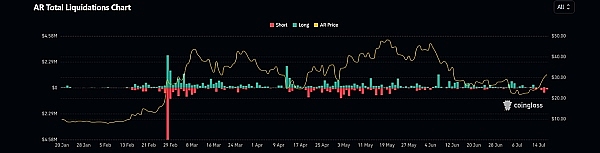
此外,其 24 小时多空比率为 0.9635,表明加密的空头多于多头。在长期看跌主导之后,清算的空头多于多头。

空头头寸为 347.18 万美元,多头头寸为 54.34 万美元。总体而言,衍生品数据分析表明 AR 呈向上增长趋势。

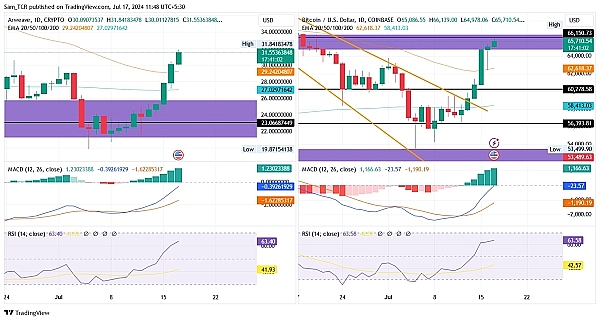
在经历了令人着迷的 500% 以上的涨幅(从 2 月 7 日的 7.68 美元涨至 3 月 9 日的 47.11 美元)之后,价格最终处于略微向下倾斜的区间。AR 价格已在楔形中移动了近 140 天。

价格曾四次试图突破楔形的上边界和楔形中 46-49 美元的阻力区。然而,它失败了,跌至楔形的下边界,即 25-20 美元的支撑区。

自 7 月 5 日以来,价格表现出持续性,与 BTC 相比,过去 12 天内上涨了 58%。与此同时,BTC 在过去 12 天内小幅上涨了 23%。

截至发稿时,Arweave (AR) 可能从楔形的下边界走向上边界,交易价为 31.39 美元,盘中上涨 4.36%。

EMA 带在价格经过时为其提供支撑。MACD 显示直方图为 1.22,RSI 为 63.26。撰写本文时,这些指标呈看涨趋势。

因此,如果这种势头持续下去,价格可能会延续涨势,而中断可能分别出现在 35.0 美元和 40.0 美元。

然而,涨幅的下滑将使控制权重新回到空头手中,这可能分别推向 25.0 美元和 20.0 美元的支撑位。

结论

Arweave (AR) 本周飙升 40%,可能是受到比特币上涨的影响。AR 市值飙升,在全球排名第 49 位。

撰写本文时,我的情绪还是很乐观的,但有些人预测会出现突破性反弹。AR 价格目前比其历史最低价高出 4300%。AR 的技术指标看起来看涨。

Criptos en tendencia

Lecturas Relacionadas

U.S. Stock Market Trend (August 11): Oil Prices Surge, Treasury Yields Rise, Tech Stocks Under Pressure, Optical Communication Plummets

U.S. Stock Market Trends (August 11): Oil Surge and Rising Bond Yields Pressure Tech; Optical Communication Stocks Plunge. U.S. stock indices closed slightly lower on Monday, with the S&P 500 and Dow Jones retreating from recent record highs. The primary market pressures were a significant oil price jump of over 5% amid unresolved negotiations to reopen the Strait of Hormuz and a consequent rise in U.S. Treasury yields, which weighed on growth stock valuations. The technology sector faced pressure, with Nvidia falling nearly 3% despite news of its pursuit of a $500 billion AI infrastructure financing consortium with major Wall Street firms. The optical communication sector saw a sharp sell-off, with Coherent dropping over 14%. In contrast, Chinese stocks listed in the U.S. were a notable bright spot, as the Nasdaq Golden Dragon China Index rose nearly 2%. Gold prices advanced for a second consecutive session on inflation hedging demand, while Bitcoin fell below $64,000. Key market movers included surging oil prices (WTI and Brent up ~5%) due to stalled Strait of Hormuz talks and heightened supply concerns, pushing the 10-year Treasury yield near 4.71%. Major tech stocks were mixed. Beyond Nvidia's decline, Intel fell over 4% on a new share offering plan. The Philadelphia Semiconductor Index dropped approximately 1.2%. Market attention remains on oil price dynamics, the impact of rising yields, and the forthcoming U.S. CPI data.

marsbitHace 11 min(s)

U.S. Stock Market Trend (August 11): Oil Prices Surge, Treasury Yields Rise, Tech Stocks Under Pressure, Optical Communication Plummets

marsbitHace 11 min(s)

JP Morgan Research Report Analysis: SK Hynix Fell 15% Last Week, Concerns Over HBM Pricing Overblown and Shareholder Returns to Land Ahead of Schedule

JPMorgan Research Report Interpretation: Addressing Concerns on SK Hynix's Recent Share Price Decline SK Hynix's stock fell 15% last week, underperforming the KOSPI (-5%) and Samsung (-9%). Key investor concerns centered on HBM pricing uncertainty, unclear shareholder return timelines, and a recently disclosed ₩54 trillion capital expenditure plan. JPMorgan's August 9 report addresses each point. Regarding HBM, JPMorgan refutes inaccurate media reports suggesting potential 50% price discounts for HBM4 in 2027. The firm's conservative model assumes <40% average HBM price growth by 2027, based on factors including memory suppliers prioritizing high-margin DDR5/LPDDR5/NAND in LTA allocations and the long-term partnership with key customer NVIDIA. The most significant near-term catalyst is shareholder returns. SK Hynix has committed to announcing additional shareholder return measures before the end of Q3 (September), earlier than its prior "year-end" guidance. JPMorgan anticipates a progressive policy, supported by an estimated cumulative free cash flow exceeding ₩800 trillion over three years and proceeds from the Kioxia stake sale. The substantial ₩54 trillion capex plan is for two new memory fabs to support its 2030 roadmap, not short-term aggressive expansion. The Yongin Y2 DRAM fab (₩35.2tn) and Cheongju M17 NAND fab (₩19.1tn) have construction starts scheduled for 2027, with clean room completion and investments stretching to 2028-2031. JPMorgan sees limited strategic value in a potential IPO for subsidiary Solidigm, noting SK Hynix's strong internal cash flow can fund capex without dilution, and an IPO might trigger dual-listing rule constraints in Korea. The report concludes last week's sell-off was an overreaction. JPMorgan maintains its Overweight rating and ₩2.75 million price target (~7x avg. 2026-2027 EPS), asserting the memory super-cycle thesis and SK Hynix's fundamentals remain intact.

marsbitHace 15 min(s)

JP Morgan Research Report Analysis: SK Hynix Fell 15% Last Week, Concerns Over HBM Pricing Overblown and Shareholder Returns to Land Ahead of Schedule

marsbitHace 15 min(s)

The Post-Crypto Era Outlook: Asset Valuation Returns to Fundamentals, What to Watch for the Next Decade?

Cryptoeconomy at a Turning Point: Valuations Reset, Focus Shifts to Real Value The cryptoeconomy is undergoing its most significant transformation yet, moving from speculative excess to a focus on sustainable, value-generating applications. After the 2021 hype cycle, which saw unsustainable valuations, the market has experienced a prolonged "reversion to the mean." Structural issues like cyclical revenues, regulatory uncertainty, and misaligned incentives between equity and token holders led to widespread fatigue. However, these problems are now widely recognized and are being addressed. A key shift is the emergence of applications demonstrating real, compounding growth independent of token prices. These include peer-to-peer internet platforms, global digital dollars, permissionless exchanges, novel derivatives, global collateral markets, and open financing platforms. Leading blockchains like Ethereum and Solana are solidifying their positions as foundational monetary and financial layers for the internet. Simultaneously, traditional financial and tech institutions are accelerating their blockchain integration with production-grade products, moving beyond mere experiments. Clearer regulations are enabling a shift from compliance concerns to exploring new business models. While the broader cryptoeconomy's emergence appears inevitable—driven by declining institutional trust, monetary devaluation, and a desire for fairer systems—intense competition means only a few native projects will become the dominant winners. The current phase offers a unique opportunity for investors, as leading projects are potentially undervalued after years of consolidation. The task is no longer to debate the technology's viability but to identify and capitalize on the real value being built for the next decade.

marsbitHace 15 min(s)

The Post-Crypto Era Outlook: Asset Valuation Returns to Fundamentals, What to Watch for the Next Decade?

marsbitHace 15 min(s)

Outlook for the Post-Encryption Era: Asset Valuation Returns, What to Watch in the Next Decade?

The crypto economy is undergoing its most significant transformation in eight years, characterized by a shift from speculative frenzy to fundamental-driven growth. After the extreme overvaluation and unrealistic expectations of 2021, asset prices, including Bitcoin relative to gold, have corrected significantly. This reset has exposed structural industry weaknesses such as cyclical revenues, regulatory uncertainty, misaligned incentives between equity and token holders, poor disclosure, and a lack of common valuation frameworks, leading to widespread investor fatigue. However, this correction is healthy and has set the stage for a more mature phase. Numerous real-world use cases have emerged and are exhibiting compound growth, independent of token prices. These include peer-to-peer internet platforms, global digital dollars, permissionless exchanges, novel derivatives, global collateral markets, democratized asset creation, open fundraising platforms, and decentralized physical infrastructure networks. Key issues like dual-token models are being resolved, disclosure is improving, and a consensus is forming that most assets must generate cash flow. The leading blockchains (e.g., Ethereum, Solana) are becoming the monetary and financial base layer of the internet, with entrenched network effects. Established Wall Street and Silicon Valley institutions are now launching production-grade products on public chains, a shift accelerated by clearer regulations. While valuations have reset and growth models remain conservative, the potential for exponential growth remains. The broader macro environment—declining institutional trust, unsustainable sovereign debt, currency debasement, deglobalization, and a generational wealth transfer—is uniquely favorable for crypto's adoption. The market is not uniformly maturing; it consists of various products at different adoption stages where speculation will persist in cycles. The core opportunity lies in identifying the few native projects that will become foundational winners as the world rebuilds its economic systems. The current period of disillusionment conceals a generational opportunity for those betting on the new paradigm rather than mourning the old one.

Odaily星球日报Hace 49 min(s)

Outlook for the Post-Encryption Era: Asset Valuation Returns, What to Watch in the Next Decade?

Odaily星球日报Hace 49 min(s)

Trading

Spot

Artículos destacados

Cómo comprar AR

¡Bienvenido a HTX.com! Hemos hecho que comprar Arweave (AR) sea simple y conveniente. Sigue nuestra guía paso a paso para iniciar tu viaje de criptos.Paso 1: crea tu cuenta HTXUtiliza tu correo electrónico o número de teléfono para registrarte y obtener una cuenta gratuita en HTX. Experimenta un proceso de registro sin complicaciones y desbloquea todas las funciones.Obtener mi cuentaPaso 2: ve a Comprar cripto y elige tu método de pagoTarjeta de crédito/débito: usa tu Visa o Mastercard para comprar Arweave (AR) al instante.Saldo: utiliza fondos del saldo de tu cuenta HTX para tradear sin problemas.Terceros: hemos agregado métodos de pago populares como Google Pay y Apple Pay para mejorar la comodidad.P2P: tradear directamente con otros usuarios en HTX.Over-the-Counter (OTC): ofrecemos servicios personalizados y tipos de cambio competitivos para los traders.Paso 3: guarda tu Arweave (AR)Después de comprar tu Arweave (AR), guárdalo en tu cuenta HTX. Alternativamente, puedes enviarlo a otro lugar mediante transferencia blockchain o utilizarlo para tradear otras criptomonedas.Paso 4: tradear Arweave (AR)Tradear fácilmente con Arweave (AR) en HTX's mercado spot. Simplemente accede a tu cuenta, selecciona tu par de trading, ejecuta tus trades y monitorea en tiempo real. Ofrecemos una experiencia fácil de usar tanto para principiantes como para traders experimentados.

756 Vistas totalesPublicado en 2024.12.11Actualizado en 2026.06.02

Cómo comprar AR

Discusiones

Bienvenido a la comunidad de HTX. Aquí puedes mantenerte informado sobre los últimos desarrollos de la plataforma y acceder a análisis profesionales del mercado. A continuación se presentan las opiniones de los usuarios sobre el precio de AR (AR).

活动图片