哈里斯在大选民调中与特朗普势均力敌

链捕手Publicado a 2024-07-31Actualizado a 2024-07-31

作者:约翰•伯恩-默多克,奥利弗•罗德

来源:FT中文网


美国副总统卡玛拉•哈里斯(左)和唐纳德•特朗普。自乔•拜登总统退出大选以来,哈里斯在几乎所有人口群体中都取得了进展

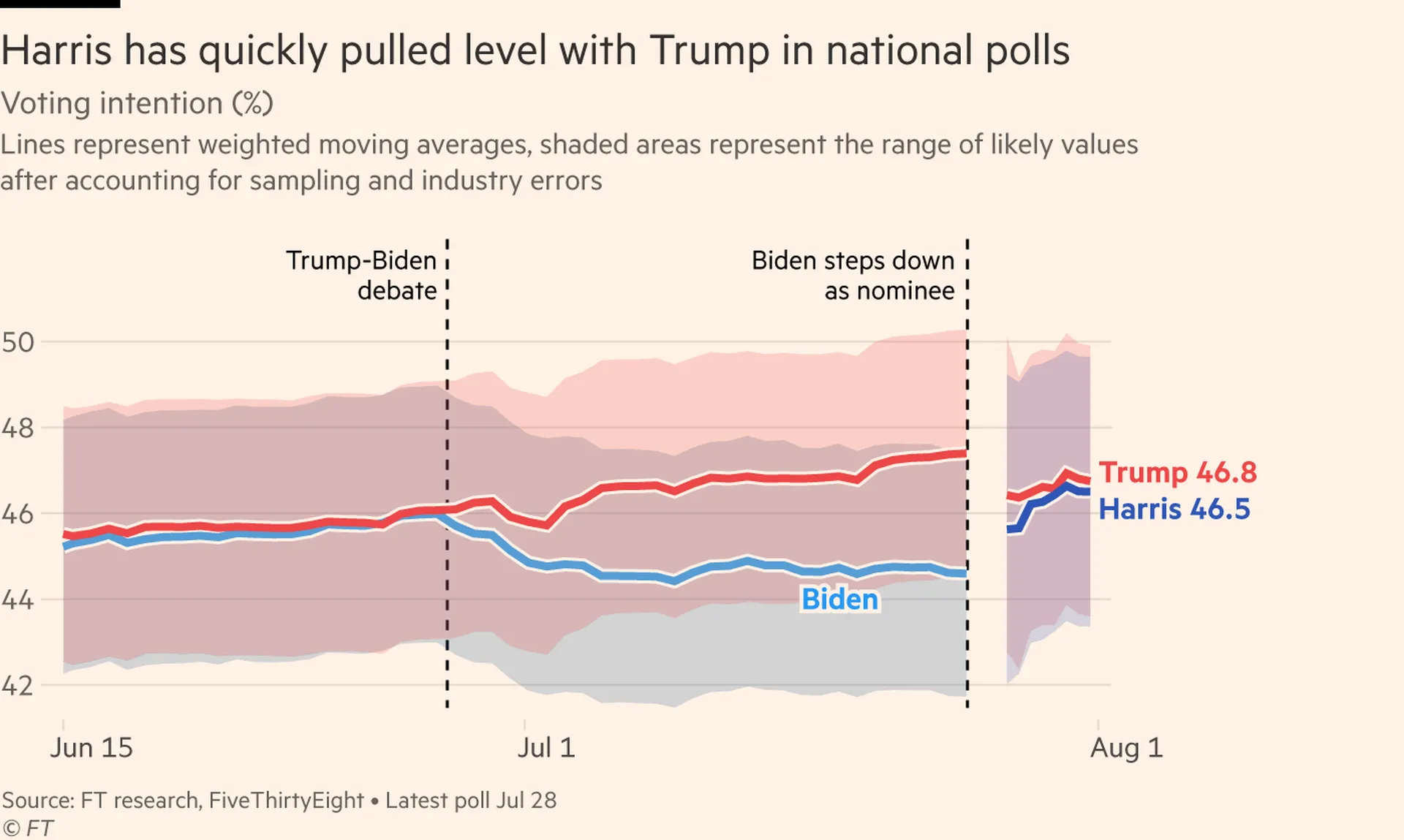
根据英国《金融时报》对最新数据的分析,美国副总统卡玛拉•哈里斯(Kamala Harris)在开始总统竞选不到一周的时间里,在民调中就追平了前总统唐纳德•特朗普(Donald Trump)。

乔•拜登(Joe Biden)总统在几周前与特朗普的辩论中表现糟糕,于7月21日退出竞选,并立即表示支持哈里斯。根据英国《金融时报》对民调结果的平均统计,自那以来,她几乎抹平了民主党在全国民调中相对于竞争对手的劣势。

虽然拜登在退出总统竞选当天落后特朗普3个百分点,但哈里斯和这位前总统目前在全国的支持率不分上下。
美国大选最终由选举人团决定,因此也可以说是由一小部分赢者通吃的“战场”州决定的,包括亚利桑那州、佐治亚州、密歇根州、内华达州、宾夕法尼亚州和威斯康星州。

在所有六个关键战场上,哈里斯最近的民调都比拜登一周多前退出竞选前高出1到3个百分点。拜登退出竞选时,在这六个州都落后两个百分点或更多,而哈里斯现在在密歇根州和威斯康星州与特朗普50比50,在内华达州、宾夕法尼亚州和亚利桑那州与特朗普的差距在一个百分点以内。从统计数据来看,所有州都处于僵持状态。

根据众多民调机构的同类比较,自拜登退选以来,哈里斯在几乎所有人口群体中都取得了进展。特别是,她在黑人、拉丁裔、年轻选民和女性选民以及无党派人士中的支持率有所上升。只有一个群体——50岁以上的选民——的支持率略有下降。

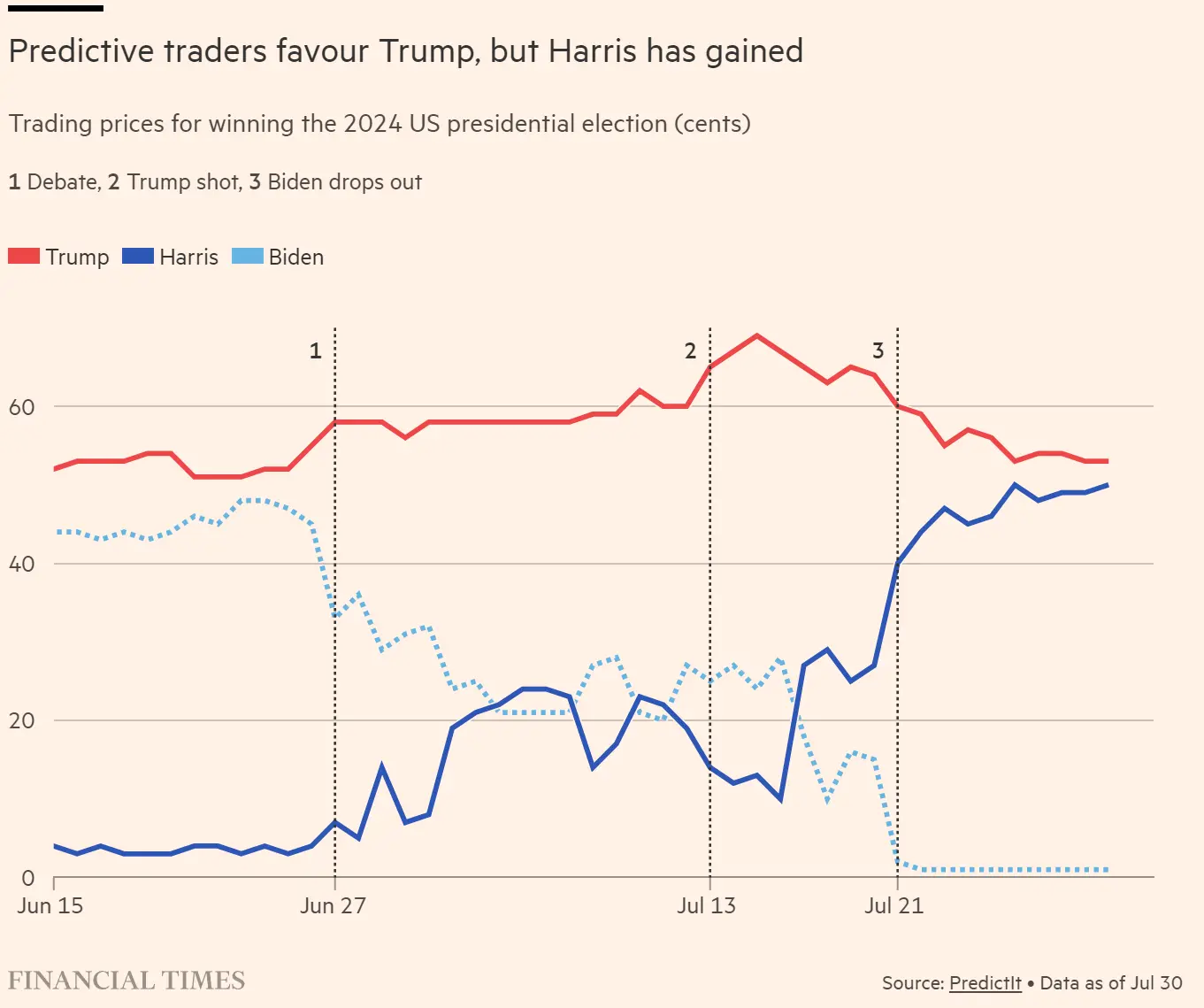
密切跟踪这场竞争的预测交易员注意到了这些变化。哈里斯在Polymarket和PredictIt这两个预测市场上的价格已经超过了拜登辩论前的价格,尽管它们仍然认为她比特朗普略逊一筹,特朗普的价格在7月13日暗杀未遂后飙升。
距离大选还有不到100天的时间,哈里斯为此前士气低落的民主党注入了显著的热情。

在这场投票率至关重要的竞选中,哈里斯的参选也重振了民主党选民的热情。英国《金融时报》对民调的分析显示,在2020年投票给拜登的人中,有73%表示对投票给哈里斯感到“兴奋”,而只有37%表示对再次投票给拜登感到兴奋。此外,2020年投票给拜登的选民中计划此次不投票的比例从10%降至3%。

伴随着重新燃起的热情而来的是慷慨的筹款。哈里斯的竞选团队上周日宣布,他们在不到一周的时间里筹集了2亿美元,其中三分之二来自首次捐款。


Lecturas Relacionadas

Citrini Research: Taking Stock of 5 Major Investment Themes Overshadowed by the AI Trade

Citrini Research identifies five under-the-radar investment themes potentially overshadowed by the dominant AI trade. With capital and analyst attention overwhelmingly focused on AI infrastructure, these overlooked areas present alpha opportunities as market dynamics shift. **Theme 1: Airlines** – Despite strong fundamentals, stocks like Delta and United have been penalized for 18 months due to macro concerns (tariff-inflation, oil prices), not profitability. A rebound is expected as these headwinds fade, aided by trends like premiumization and the 2026 World Cup. **Theme 2: Senior Housing** – A pure demographic play. The U.S. population over 80 is projected to grow 56% in the next decade, drastically outpacing supply. This creates a compelling need for facilities, benefiting REITs like Welltower and operators like Brookdale. **Theme 3: Live Events & Entertainment** – "Being there" is becoming a luxury. This sector has outperformed even tech over the past decade. Companies like TKO Group (WWE/UFC), Cinemark, and IMAX are capitalizing on demand for premium, in-person experiences. **Theme 4: Exchange Competition** – CME Group's ~98% monopoly in U.S. interest rate derivatives faces its first real challenge from FMX Futures Exchange. Backed by major Wall Street banks, FMX offers lower fees and margin savings. While CME's deep liquidity remains an advantage, FMX provides a competitive alternative. **Theme 5: Fintech Recovery** – Heavily sold off in 2026, fintech stocks like SoFi, Robinhood, and Upstart are showing signs of a rebound based on improving fundamentals—SoFi's stablecoin launch, Robinhood's transformation into a "financial super app," and Upstart's renewed AI lending narrative—rather than a change in sector outlook. The report advises maintaining some AI exposure but diversifying into these neglected "small themes" where mispricing exists due to a simple shortage of investor attention.

marsbitHace 18 min(s)

Citrini Research: Taking Stock of 5 Major Investment Themes Overshadowed by the AI Trade

marsbitHace 18 min(s)

21Shares Mid-Year Key Report: Bitcoin's Four-Year Cycle Remains Intact, Stablecoins and Tokenization Emerge as New Growth Engines

21Shares Mid-Year Report 2026: Bitcoin Cycle Intact, Stablecoins & Tokenization Emerge as New Engines This mid-year review assesses progress against 21Shares' ten predictions for 2026. While the overarching shift from narrative to fundamentals holds, performance varies. Key findings show Bitcoin's four-year cycle remains evident despite market maturation. Global crypto ETP AUM has declined to ~$140B, lagging the $400B target, though product innovation continues. Stablecoin supply surpassed $320B, demonstrating non-cyclical demand but falling short of the $1T forecast due to slower regulatory clarity. DeFi TVL, stalled at ~$140B, was hindered by major security incidents. Corporate crypto treasuries hold ~1.28M BTC ($100B), with consolidation pressuring weaker players. Prediction markets are on track, with $57.5B volume already surpassing half the $100B annual target. AI agent infrastructure is ready, but adoption is early. Ethereum L2 consolidation is underway, with the top 5 capturing nearly 90% of activity. Compliant token launches have a platform but lack mainstream volume. Tokenized RWAs total ~$31B on public chains, but institutional pipeline growth is strong. In summary, fundamentals like stablecoins, tokenization, and prediction markets are advancing, but targets require faster adoption or price appreciation. The market is maturing, yet cyclical patterns persist.

marsbitHace 27 min(s)

21Shares Mid-Year Key Report: Bitcoin's Four-Year Cycle Remains Intact, Stablecoins and Tokenization Emerge as New Growth Engines

marsbitHace 27 min(s)

Super Spiral Mega-Boom, Micron's Earnings Report Rekindles the Semiconductor Bull Run

On June 25, 2026, Micron Technology released its blockbuster Q3 FY2026 results, significantly exceeding market expectations and reigniting confidence in the semiconductor bull market. Revenue soared to $41.456 billion (vs. ~$35.4B expected), up 346% year-over-year, while GAAP net profit surged nearly 15 times to $28.243 billion. Guidance for Q4 was even more striking, with projected revenue of approximately $50 billion, far surpassing prior estimates. The report highlighted that the AI boom is now fueling growth across Micron's entire product stack, not just HBM. Cloud memory, core data center, SSD, mobile, and automotive businesses all saw revenue growth exceeding 250-600%, with margins hovering around 80%. While HBM4 is already in volume shipment and 2026 capacity is sold out, AI-driven demand is also tightening supply for traditional DRAM and NAND, sustaining a strong pricing cycle. A pivotal development is Micron's shift toward a "demand-first" model. The company disclosed 16 long-term strategic customer agreements (SCAs), most spanning 5 years to 2030, covering about 20% of DRAM and one-third of NAND shipments. These are take-or-pay contracts, with 14 agreements already securing roughly $100 billion in guaranteed future revenue and $22 billion in customer performance assurances. To fulfill this locked-in demand, Micron plans substantial capacity expansion, with Q4 capital expenditure projected at ~$10 billion. This investment, backed by concrete long-term orders rather than cyclical speculation, marks a historic change for the memory industry. Following the earnings release, Micron's stock surged 16% after-hours, lifting the broader semiconductor sector globally. The report served as a powerful signal that AI infrastructure build-out is accelerating, with memory positioned as a central protagonist in the ongoing narrative.

Odaily星球日报Hace 1 hora(s)

Super Spiral Mega-Boom, Micron's Earnings Report Rekindles the Semiconductor Bull Run

Odaily星球日报Hace 1 hora(s)

Trading

Spot
Futuros
活动图片