链上流动性游戏:开发者、狙击者与交易者的层层猎杀

Odaily星球日报Publicado a 2024-06-05Actualizado a 2024-06-05

Resumen

金字塔顶端的那些人收获了大部分的回报。

原文作者:post-goa

原文编译:深潮 TechFlow

根据我的研究,以下是对玩链上流动性游戏的角色的简要总结。
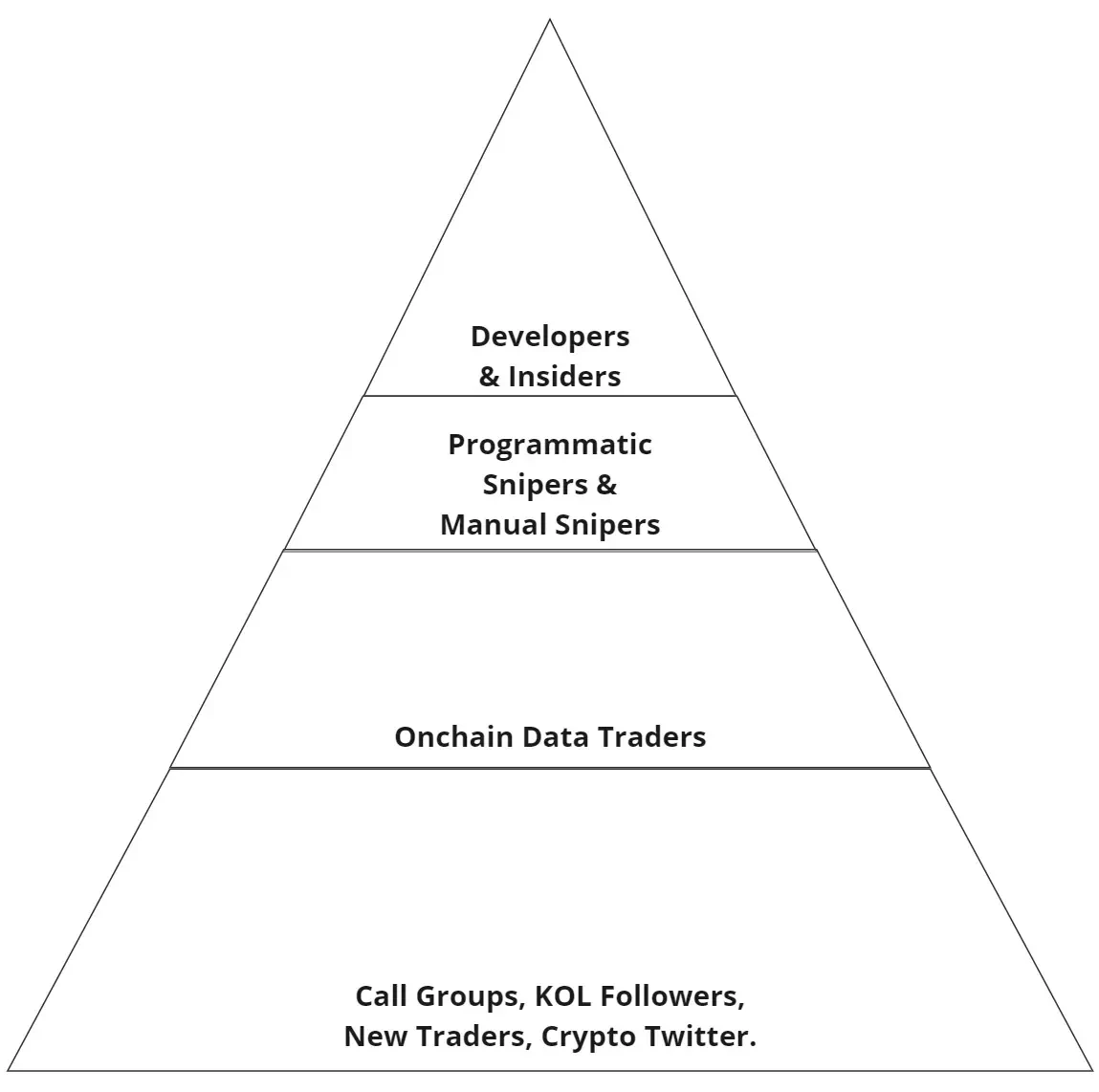
链上流动性游戏:开发者、狙击者与交易者的层层猎杀

开发者和内部人士

虚假实用性缓慢拉盘或“被利用”:

  • 这些在初期的 AI 热潮中非常流行,因为当时没有人真正理解 AI,但每个人都希望早期接触。

  • 他们从未完成超过 1% 的路线图,通常由意见领袖(KOLs)炒作。

  • 团队通常在合约启动时分配大量供应给自己,然后在其他人之前进行分配。这些代币随后被隐藏在多个钱包中,然后卖出。

  • 在初始拉升后缓慢拉盘或在几周的拉盘后遭遇漏洞,并在积累了大规模市值(20-100 百万)后迅速跑路。

  • 牵涉到反复发布跟随当前热门叙事的虚假项目的团伙。这些项目通常是由更成功的大型风险投资支持的项目衍生而来。

程序化狙击者

定制机器人:

  • 系统性狙击多个 ETH 项目的定制机器人。

  • 机器人根据智能合约和交易量遵循特定参数。

  • 目标是从许多失败或跑路的狙击中在少数几个项目上实现 10-100 倍的收益,几乎像是一种收益形式。

手动狙击者(ETH)

最赚钱的链上交易者之一:

  • 搜索发现新的合约地址,或通过内部消息获得合约地址。

  • 模拟合约以检查其安全性和确定潜力的其他指标,或者了解团队背景。

  • 在有前景的合约启动时超出其他狙击者出价。

  • 在没有反狙击防御或未使用 Fjord 等预启动平台的有前途的链上项目或隐秘项目启动时,抢购大量供应。

  • 使用多个钱包狙击以持有大量供应,超过 1% 。

  • 在很多情况下,项目受制于狙击者,狙击者可以在早期阶段将项目砸到零。

  • 许多狙击者进入项目后彼此博弈,希望“愚蠢的钱”进入,并在市值达到 500 k-1 百万时抛售,然后项目死亡。这种情况每天都发生在 ETH 主网上。

  • 结合一些基本分析和机器学习,确定哪些合约可能带来超过 5 百万市值或更多的盈利启动的狙击者在过去一年表现显著优于其他人。

  • 大多数狙击者持有代币的时间不到几个小时。

链上数据交易者

跟踪狙击者和内部人士的行动:

  • 跟踪盈利(最高 PNL)钱包的动作。

  • 跟踪交易量和持有者警报。

  • 通常在狙击者抛售后购买强势项目;或者,即使知道狙击者持有大量供应,如果启动非常有前途,他们也会购买。

  • 通常会对新启动项目进行一些基本分析或叙事分析。

  • 长期持有者。

  • 由于链上交易成为该领域日益增长的内容板块,并且更多链上服务可供零售使用,因此其受欢迎程度有所稀释并增加。

  • 是上述参与者的退出流动性。

  • 这些交易者经常在新启动项目上相互博弈,这些项目最终将归零。只是看谁更早介入。

  • 依赖于愚蠢的加密推特(CT)、意见领袖(KOLs)或其他后来的链上交易者作为退出流动性。

其他交易者

尚未学会使用 Etherscan 或如何检查代币的基本数据指标:

  • 从呼叫群组、意见领袖(KOLs)和加密推特(CT)获取信息。

  • 速度较慢的交易者,倾向于购买炒作。

  • 相信加密货币在投机之外具有实用性。

  • 在叙事上落后一步。

  • 可能只在该领域待了不到一年。

  • 这些交易者很可能已经放弃购买新的实用性项目或迷因币。或者他们慢慢开始学习链上交易并逐渐升级到上述类别。

总结

链上交易是一场开发者、狙击者、链上数据交易者和其他人的流动性游戏。随着链上领域进入的流动性减少,参与者之间的竞争变得更加激烈,结果是金字塔顶端的那些人收获了大部分的回报。

Lecturas Relacionadas

Bitcoin Falls Below $60,000 Again; After 20 Months, We've Reached a New Low

Bitcoin Drops Below $60,000, Hitting a 20-Month Low Bitcoin fell below the key $60,000 psychological level again, reaching a low of $59,023—its lowest point in approximately 20 months, dating back to October 2024. While it later recovered slightly to around $60,600, this marks its third significant breach of $60,000 this year. The downturn is attributed to two primary factors. First, U.S. spot Bitcoin ETFs are experiencing their longest streak of net outflows since launch, with nearly $5.94 billion withdrawn over 30 days. This creates sustained selling pressure as Authorized Participants sell Bitcoin to meet redemptions. Second, shifting macroeconomic expectations are adding pressure. Strong U.S. job data and hawkish remarks from Fed officials have increased market pricing for potential rate hikes, reversing the earlier liquidity-driven bullish sentiment and prompting a shift away from risk assets like Bitcoin. Analyst views are mixed. 21Shares maintains a bullish long-term outlook, expecting prices to recover towards $100,000, citing historical post-halving cycles and substantial ETF holdings as a base. In contrast, Arthur Hayes predicts a potential bottom around $40,000 within six months due to persistent Fed hawkishness. CryptoQuant suggests, based on on-chain data, that the market may not find a bottom until prices fall below the average investor cost basis around $53,000, potentially extending the bearish phase into late 2026 or early 2027. The immediate focus is on upcoming U.S. inflation data and Fed signals. Lower-than-expected CPI could offer relief, but confirmation of sticky inflation or continued ETF outflows may lead to further downside pressure. Bitcoin's ability to hold above $60,000 remains a critical test for the near-term market direction.

Odaily星球日报Hace 21 min(s)

Bitcoin Falls Below $60,000 Again; After 20 Months, We've Reached a New Low

Odaily星球日报Hace 21 min(s)

When Billions Begin to Operate Everything by Voice, How Far is ‘All Assets on Chain’?

In June 2026, WeChat began a limited rollout of "Xiaowei," its native AI assistant. This move is more than an upgrade to a smarter chatbot; it signals a crucial step from "universal internet access" toward the broader vision of "full asset tokenization." Xiaowei, powered primarily by WeChat's in-house WeLM model, demonstrates four key capabilities: 1) direct voice/web chat control of app functions, 2) automated access to mini-programs for services, 3) instant comprehension and summarization of complex documents like PDFs, and 4) generating functional mini-program prototypes from simple natural language requests. This represents a fundamental shift from GUI (Graphical User Interface) to LUI (Language User Interface), eliminating friction in human-digital interaction. The rollout is pivotal because it brings AI Agents to China's massive user base with zero friction—no new app downloads or accounts needed. This "seamless access" mirrors past platform revolutions like the App Store or WeChat Mini-Programs, potentially unlocking a global AI Agent market projected to grow from $7.92 billion in 2025 to nearly $295 billion by 2035. The article argues that China's internet evolution has moved from "connecting everyone" to "putting all services online." The next phase is "tokenizing all assets"—a concept broader than just Real World Assets (RWA) like real estate. It encompasses tokenizing personal assets like social influence, attention, and credit history. RWA tokenization itself is forecast to explode from $35 billion in 2025 to over $500 billion in 2026. The convergence of ubiquitous AI Agents and rapidly tokenizing assets points to a future paradigm for wealth management. Your AI Agent could autonomously manage a globally diversified, tokenized portfolio based on your preferences. Initiatives like EXIO Group's full-stack RWA services aim to lower investment barriers, paralleling WeChat's democratization of AI access. In conclusion, the launch of Xiaowei is not merely a technical upgrade but a historic inflection point. It marks AI Agents' transition from niche tools to essential utilities and accelerates the movement toward a future where voice commands seamlessly interact with tokenized value, redefining humanity's relationship with the digital and financial worlds.

marsbitHace 1 hora(s)

When Billions Begin to Operate Everything by Voice, How Far is ‘All Assets on Chain’?

marsbitHace 1 hora(s)

SoftBank CEO Masayoshi Son's New Trillion-Dollar "Gamble"

SoftBank founder Masayoshi Son is embroiled in a new trillion-dollar "bet" on Physical AI and humanoid robotics, even as his massive wager on OpenAI faces uncertainty ahead of its potential IPO. Recent reports reveal OpenAI's steep losses—$85 billion net loss by Q1 2026 and a $38.5 billion loss in 2025—casting doubt on its path to a trillion-dollar valuation. SoftBank, OpenAI's second-largest external shareholder with a planned 13% stake, stands to gain hugely if OpenAI succeeds. Undeterred, Son is already pushing forward with his next ambitious venture: consolidating SoftBank's AI and robotics assets into a new U.S.-based company named "Roze," targeting a $100 billion IPO as early as late 2026. This move aligns with his belief that Physical AI, merging AI cognition with robotic physical execution, is the next trillion-dollar frontier. Son's confidence stems from recent AI wins; SoftBank's stock surged and he briefly regained the title of Asia's richest person, largely due to OpenAI's soaring valuation. However, his aggressive strategy has raised internal concerns about over-reliance on OpenAI and strained finances. With competitors like Anthropic advancing rapidly and OpenAI's IPO timing uncertain, Son is racing to capitalize on the AI boom. His long-term vision for Physical AI includes a decade of investments in robotics, from Boston Dynamics to recent acquisitions like ABB's robotics unit, and a planned $1 trillion investment in U.S.-based AI robotics industrial parks. Yet, challenges remain: humanoid robotics firms like Figure AI lack the clear revenue paths of AI software companies, and Roze's lofty valuation faces skepticism. For Son, these bets are also driven by an unfulfilled promise of massive returns to key investors like Saudi Arabia's PIF. Despite risks, he continues to double down, betting that the fusion of AI and physical machines will define the next technological era.

marsbitHace 1 hora(s)

SoftBank CEO Masayoshi Son's New Trillion-Dollar "Gamble"

marsbitHace 1 hora(s)

Trading

Spot
Futuros
活动图片