Solana系代币增速续创历史新高的推手,解读增长发动机Pump.fun

Odaily星球日报Publicado a 2024-05-06Actualizado a 2024-05-06

Resumen

公平叙事将贯穿整轮牛市,而Meme成为公链增长的终极利器。

原创 | Odaily星球日报

作者 | 南枳

Solana系代币增速续创历史新高的推手,解读增长发动机Pump.fun

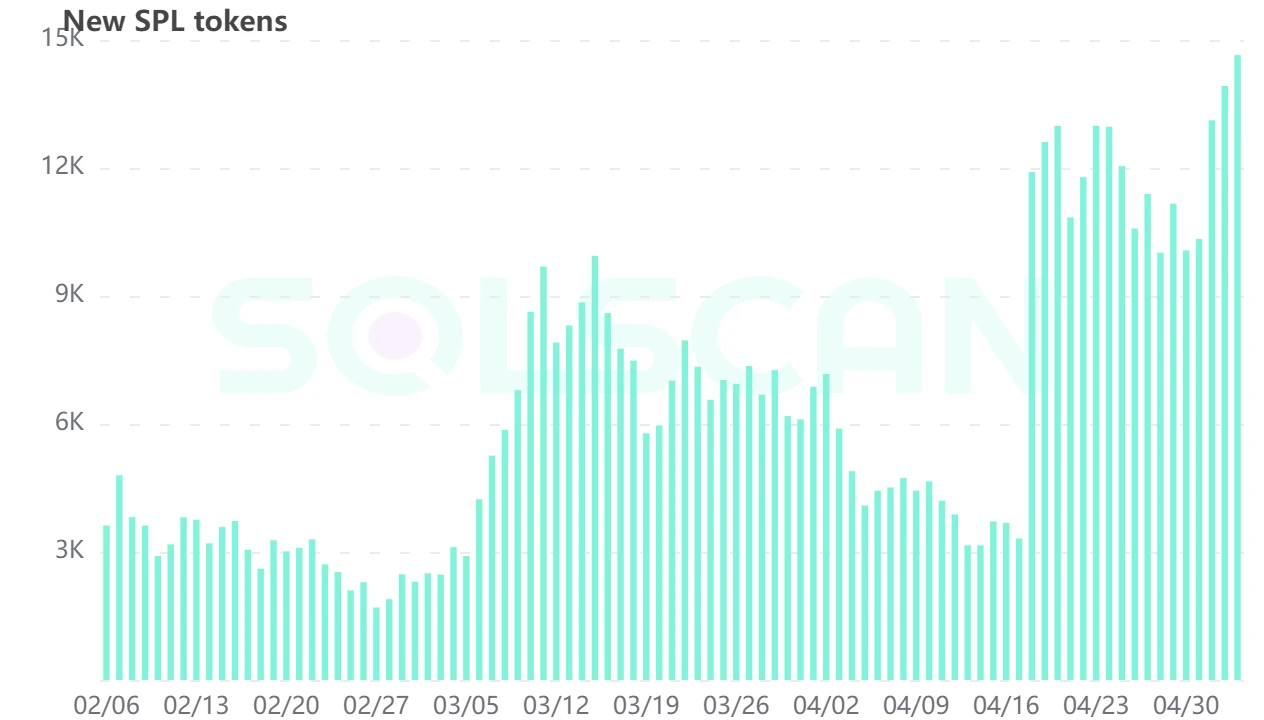
4 月,市场经历了一轮大幅回调,然而 Solana 市场却愈发火热, 5 月 4 日新发行 SPL 代币续创历史新高达 14648 个。而新发行代币过半数来自 pump.fun,Odaily星球日报将对该平台的功能、数据和这一现象进行解读。
Solana系代币增速续创历史新高的推手,解读增长发动机Pump.fun

Pump.fun 简介

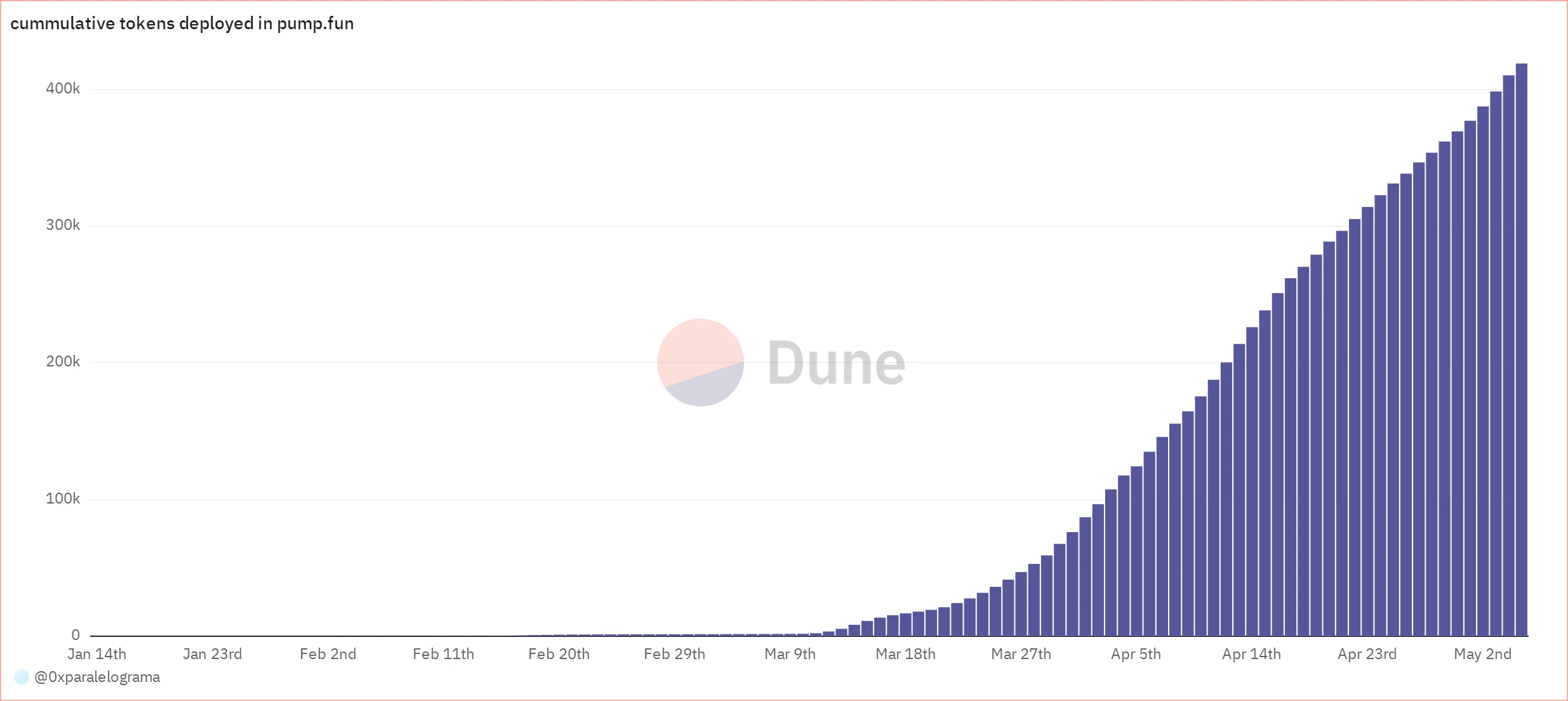
Pump.fun 于 2024 年 2 月推出,为 Meme 代币的一键发行平台, 2 月推出时并没有多少用户关注和使用,至 3 月中旬用户数和使用量开始飙升。
Solana系代币增速续创历史新高的推手,解读增长发动机Pump.fun

运行流程

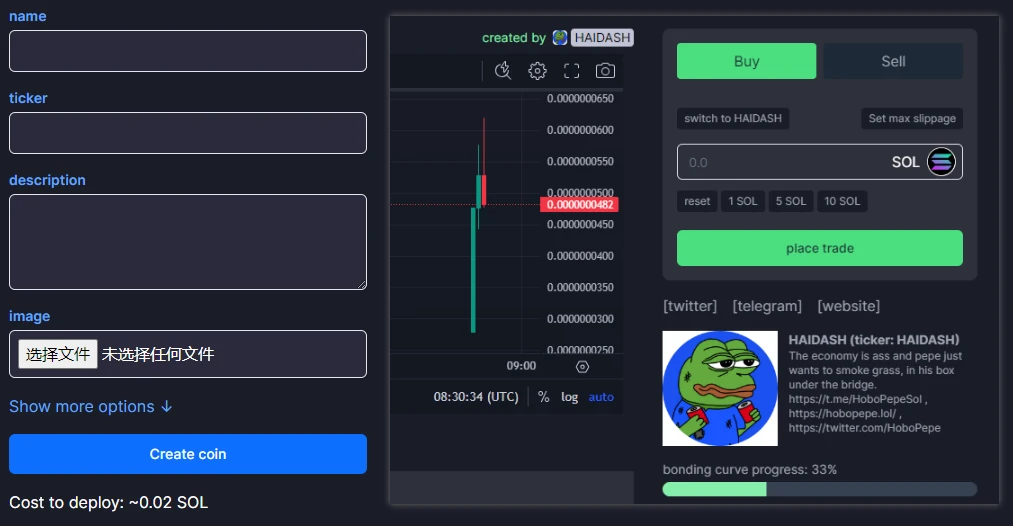
  • 创建代币:发币者只需输入代币的名称、代币描述和配图,并支付约 0.02 SOL,即可开启一个代币的“募资”发行流程。

  • 盘内募资:对于用户而言,选择想要参与的代币,然后输入想要购买的代币数量即相当于参与了代币发行募资,并能够在发行前售出对应的份额,Pump.fun 将收取 1% 费用。

  • 价格曲线:但需要注意的是,Pump.fun 的代币正式上线前阶段价格并非均匀分布,而是根据 Bonding curve(联合曲线)进行计算。简单理解,即代币价格将随着募资的进行而上升,随着盘内售出的下降。

  • 发币:当用户购入了足够的代币,市值达到 69000 美元时,Pump.fun 将把 12000 美元的流动性添加进入 Raydium(Solana 头部 DEX)并销毁 LP。
Solana系代币增速续创历史新高的推手,解读增长发动机Pump.fun

Pump.fun 何以脱颖而出

截止 5 月 5 日,Pump.fun 发行代币数量已达 418936 个,累计收入 690 万美元。其中 4 月 1 日至 5 月 1 日,Pump.fun 收入达 499 万美元,相当于年化收入约 6000 万美元,并且增长趋势仍未有下降迹象。那么 Pump.fun 何以达成此成就?

公平叙事的延续

答案仍在于“公平”这一叙事,Meme 代币自 21 年兴起后,先后在以太坊和 BSC 上蓬勃发展,但随着老鼠仓、RUG、科学家抢跑等问题的出现,用户对 Meme 的热情遭到严重打击,因此 Pinksale 等一系列发射平台也应运而生。

而在 Solana 上,其实 23 年及更早期间充满了 Rug 代币,为避免因 Rug 损失过多很多用户成为了“ 10 U 战神”,仅以极小金额参与交易,阻碍了各生态的发展。

而 Pump 的自动添加 LP 和销毁功能,正契合了用户的根本需求,来自 Pump 的代币没有名义上的项目方和管理者,因此也不会出现因为超级权限 Rug 的问题。

Meme 与社交属性

除了代币本身的名称,Pump.fun 的代币还需要附上图片和简介,并具备评论功能,这赋予了其快速、直观传播其背后故事和风格的能力。

此前 Meme 代币、项目网站、官方媒体多数需要通过互相引用实现信息链接,而在 Pump.fun 相当于完成了一键聚合,一方面对于用户能够快速得到大部分信息,对于代币本身而言赋予了社交和有效传播的能力。

“收割”新途径?

虽为了追求“公平”而生,但 Pump.fun 的部分机制却仍成为了一些用户的收割利器。前文提到,Pump.fun 发币极快,因此每日新增代币数量极多,多数用户只能根据其“社交”属性进行项目好坏的判断。

另一方面 Pump.fun 价格并非平均分布,最后进入的用户相对于最早期用户成本通常相差五倍以上,因此出现一些恶意用户购入高粉丝量 X 账户,虚构高关注度的假象,在底部购入大量筹码,待用户受高关注度假象蒙蔽进入后,在发币前快速退出。同样地,也有一些大 V 通过自身影响力创建新的代币,然后利用极端的价格曲线完成快速的影响力变现(收割)。

结论

自 BRC-20 开始,追求公平,反对高 FDV 的 VC 代币的声浪愈演愈烈,PEPE 和 WIF 冲刺前十的势头也是这一趋势的首要代表,而 Pump.fun 也秉承了这一故事而生,不难预见公平二字将贯穿本轮牛市,成为许多颠覆性项目的起爆点。

另一方面 Pump.fun 对于 Solana 生态而言也具有重大意义,不止在于六千万美元的年收入,而在于六千万美元背后数十亿乃至百亿美元的交易量,对于 DEX 和节点都是可观的增长,更是 Solana 引入用户的终极利器。

Criptos en tendencia

Lecturas Relacionadas

Chip Stocks Lead U.S. Market Decline: Is AI Trading Being Hit by Both Interest Rates and Returns?

Chip stocks led a broad decline in US markets, with the Nasdaq dropping 2.2% and the S&P 500 falling 1.4%. This selloff reflects a dual challenge for the once-high-flying AI hardware trade: rising interest rate expectations and growing investor impatience for clear returns from massive AI capital expenditures. The pressure was most acute on hardware leaders. Nvidia fell about 4%, dipping below a $5 trillion market cap, while Micron plunged 13.2% ahead of its earnings report. Declines across memory, storage, AI, and mobile chips indicated a sector-wide retreat. The selloff spread globally, with South Korea's KOSPI index dropping nearly 10% as key suppliers SK Hynix and Samsung recorded double-digit losses. Investors appeared to be taking profits from the most crowded trades first. Macro headwinds intensified as market expectations shifted toward a more aggressive Federal Reserve. Forecasts for multiple rate hikes in 2026 pressured high-valuation tech stocks, which rely on long-term growth projections that become less attractive as discount rates rise. Concurrently, investors are scrutinizing the profit potential of the immense AI spending by cloud giants like Alphabet, Amazon, and Meta. While these expenditures drive demand for chips and hardware, the market is now questioning whether AI services will generate sufficient returns to justify the ongoing costs. This adjustment is not necessarily a bubble burst but a recalibration. AI demand fundamentals remain, but the narrative of endless growth can no longer fully offset concerns over higher interest rates and a longer path to profitability. Near-term direction may hinge on Micron's upcoming earnings guidance and incoming inflation data, which will influence both the AI demand outlook and the Fed's policy path. The market is transitioning from blindly buying growth to demanding clearer visibility on returns.

marsbitHace 1 hora(s)

Chip Stocks Lead U.S. Market Decline: Is AI Trading Being Hit by Both Interest Rates and Returns?

marsbitHace 1 hora(s)

OpenAI's New Paper: How to Train an AI that "Doesn't Deteriorate Under Pressure"?

OpenAI's new paper "Reinforcement Learning Towards Broadly and Persistently Beneficial Models" explores training AI to maintain safe, helpful, and honest behavior even under pressure, in unseen scenarios, or after being fine-tuned for harmful purposes. Moving beyond simple rule-based "don'ts," the research focuses on cultivating "beneficial traits" like honesty, risk-awareness, corrigibility, and transparency. It investigates if reinforcement learning (RL), often prone to "reward hacking" where models exploit loopholes, can instead be used to instill robust, generalized positive behaviors. Researchers created a multi-domain synthetic dialogue dataset covering areas like healthcare and law. They trained a model by replacing 5% of standard RL data with "beneficial trait" data. This model outperformed the baseline in 83% of 53 evaluations, showing average gains of 9.1% in alignment, safety, and helpfulness. Crucially, improvements generalized: a model trained only on healthcare "good behavior" data also performed better in 17 out of 19 non-healthcare alignment tests. The paper also tests "alignment persistence." When subjected to adversarial prompts or harmful fine-tuning, the beneficial trait model showed greater resilience, with smaller performance drops and less "spillover" of bad behavior to unrelated tasks. While not a complete solution, this work suggests a shift from post-hoc correction to proactively shaping robust, principled AI behavior, a critical step for deploying models in high-stakes, complex decision-making scenarios.

marsbitHace 1 hora(s)

OpenAI's New Paper: How to Train an AI that "Doesn't Deteriorate Under Pressure"?

marsbitHace 1 hora(s)

Semiconductor Stock Rebound: Is the Technical Correction Over or a Trend Reversal?

The core of recent semiconductor stock volatility is not about daily price swings, but rather the market questioning whether AI-driven semiconductor pricing has entered a new phase. Following a sharp sell-off in Korean stocks on June 23rd, led by Samsung and SK Hynix, a subsequent rebound is seen more as a technical positioning adjustment rather than a confirmed trend reversal. The key variable is HBM (High Bandwidth Memory), essential for AI chips. Its supply-demand imbalance granted memory makers significant pricing power. The current market focus is on whether this dynamic remains strong enough to justify elevated valuations. All eyes are on Micron's upcoming earnings report. The critical factor is not whether results meet already high expectations, but whether the company's guidance confirms that AI memory pricing power, order visibility, and future margins are still expanding. Micron's outlook will serve as a crucial test for the broader AI semiconductor chain, including Samsung, SK Hynix, and other infrastructure players. The recent bounce appears to be a pre-earnings positioning repair. For it to evolve into a sustained uptrend, concrete evidence is needed that the AI infrastructure expansion cycle's fundamentals—particularly for high-end memory—remain robust and can continue to surpass elevated market expectations. The risk is that strong demand alone may not be sufficient if future guidance hints at peaking momentum or increasing supply-side pressures.

marsbitHace 1 hora(s)

Semiconductor Stock Rebound: Is the Technical Correction Over or a Trend Reversal?

marsbitHace 1 hora(s)

Trading

Spot
Futuros

Artículos destacados

Cómo comprar PUMP

¡Bienvenido a HTX.com! Hemos hecho que comprar Pump.fun (PUMP) sea simple y conveniente. Sigue nuestra guía paso a paso para iniciar tu viaje de criptos.Paso 1: crea tu cuenta HTXUtiliza tu correo electrónico o número de teléfono para registrarte y obtener una cuenta gratuita en HTX. Experimenta un proceso de registro sin complicaciones y desbloquea todas las funciones.Obtener mi cuentaPaso 2: ve a Comprar cripto y elige tu método de pagoTarjeta de crédito/débito: usa tu Visa o Mastercard para comprar Pump.fun (PUMP) al instante.Saldo: utiliza fondos del saldo de tu cuenta HTX para tradear sin problemas.Terceros: hemos agregado métodos de pago populares como Google Pay y Apple Pay para mejorar la comodidad.P2P: tradear directamente con otros usuarios en HTX.Over-the-Counter (OTC): ofrecemos servicios personalizados y tipos de cambio competitivos para los traders.Paso 3: guarda tu Pump.fun (PUMP)Después de comprar tu Pump.fun (PUMP), guárdalo en tu cuenta HTX. Alternativamente, puedes enviarlo a otro lugar mediante transferencia blockchain o utilizarlo para tradear otras criptomonedas.Paso 4: tradear Pump.fun (PUMP)Tradear fácilmente con Pump.fun (PUMP) en HTX's mercado spot. Simplemente accede a tu cuenta, selecciona tu par de trading, ejecuta tus trades y monitorea en tiempo real. Ofrecemos una experiencia fácil de usar tanto para principiantes como para traders experimentados.

235 Vistas totalesPublicado en 2024.12.12Actualizado en 2026.06.02

Cómo comprar PUMP

Discusiones

Bienvenido a la comunidad de HTX. Aquí puedes mantenerte informado sobre los últimos desarrollos de la plataforma y acceder a análisis profesionales del mercado. A continuación se presentan las opiniones de los usuarios sobre el precio de PUMP (PUMP).

活动图片