2026 Neo Bank Outlook: Superform, Veera, Tria - The Three Titans Compete, Who Will Become the Alipay of the Crypto World?

marsbitPublicado a 2026-01-08Actualizado a 2026-01-08

Resumen

By 2026, the onchain neobanking sector is rapidly evolving, with Superform, Veera, and Tria emerging as key players. These platforms combine DeFi functionality with traditional banking UX, enabling users to spend crypto seamlessly without CEXs while retaining self-custody. Superform focuses on yield optimization, automating cross-chain deposits to vaults across 7+ chains, boasting $144M TVL and 300% growth in six months. Veera, with 4M users across 108 countries, targets emerging markets with a browser-to-bank model, offering staking, rewards, and upcoming debit cards. Tria excels in chain abstraction, enabling frictionless spending with $1M daily transaction volume and $20M ARR, abstracting gas fees and cross-chain complexities. Risks include unsustainable yield subsidies, regulatory uncertainty (e.g., KYC requirements), and competition from MetaMask. Tria is poised for mainstream adoption due to its UX, Veera for emerging market dominance, and Superform for sustainable institutional growth. Together, they represent a new category of non-custodial financial super apps, driving crypto toward everyday usability.

Author:Mesh

Compiled by: Deep Tide TechFlow

January 6, 2026

I've been tracking the "wallet to bank" development trend for several months now, and honestly, the pace of progress is astonishing.

By the end of 2025, three projects reached significant transaction volume milestones, achieving what Metamask could not: converting your cryptocurrency into real spending power without touching a centralized exchange (CEX). Superform, Veera, and Tria are no longer just crypto wallets; they are building actual banks.

The data speaks for itself. By last November, Tria's daily transaction volume had reached $1 million, with over 150,000 users and an Annualized Run Rate (ARR) of approximately $20 million. Veera expanded to 108 countries, reaching 4 million users. And Superform's Total Value Locked (TVL) surged 300% in just six months, reaching $144 million.

This isn't the so-called DeFi 2.0 hype. This is an infrastructure shift that everyone saw coming, but no one expected it to arrive this quickly.

Let's dive into an analysis of these three projects, along with other potential challengers worth watching.

What is an Onchain Neobank?

Let me break it down for you, as this term is often used loosely.

An Onchain Neobank combines three elements that have traditionally been difficult to merge:

  1. The Power of DeFi: Includes yield optimization, staking, and cross-chain swaps.
  2. The User Experience of Traditional Banking: Such as a card you can use at Starbucks, instant payments, and cashback rewards.
  3. Blockchain Abstraction: Users don't need to deal with Gas fees, cross-chain bridge interfaces, or network switching complexities.

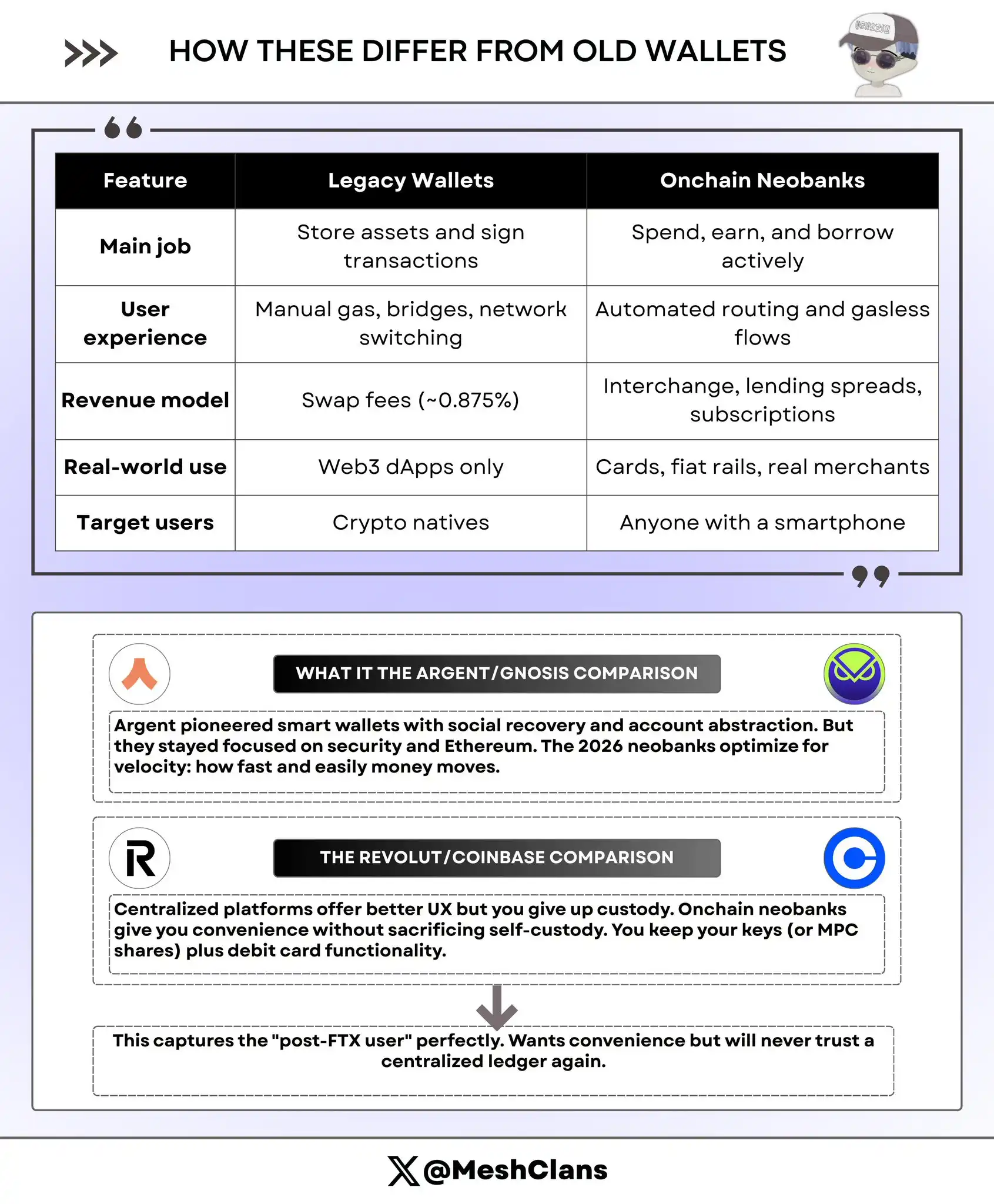
How is it different from Revolut or Coinbase? You control your private keys! How is it different from Metamask? You can spend crypto as easily as fiat, without worrying about which chain your USDC is on.

Simply put, this is the change that comes when DeFi protocols realize that average users don't want to manually bridge assets across chains or calculate Gas fees. They just want a card they can swipe.

One of the Three Titans

@superformxyz caught my attention around mid-2025, when their primary target users were still institutional investors. Now, they position themselves as the "savings account" for onchain finance.

What are they doing?

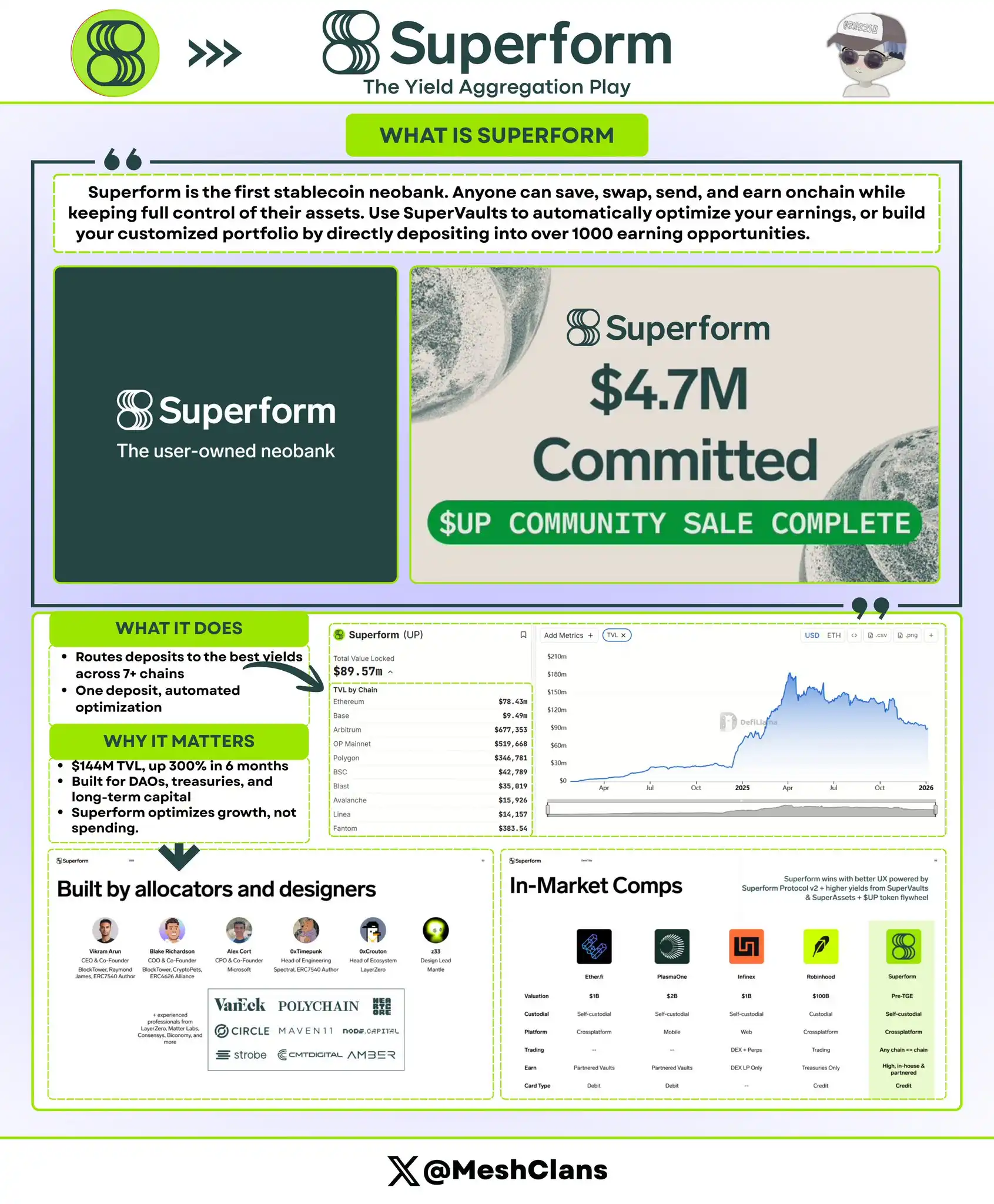
Superform's core function is to automatically route your funds to high-yield vaults across 7+ chains. You simply deposit USDC, and Superform finds the best Annual Percentage Yield (APY) for you, whether it's from Aave, Curve, or some protocol-specific yield farm you've never even heard of.

Data Performance (as of end-2025):

  • Total Value Locked (TVL): $144 million (300% growth in 6 months)
  • Funding: $12.9 million total across Seed, Strategic, and Public rounds
  • Fully Diluted Valuation (FDV): ~$90 million

Why is it important?

Superform's SuperVaults v2 launch in Q4 2025 was a game-changer. The "Cross-Chain Instant Deposit" feature allows users to deposit funds on Base, and Superform deploys them to a vault on Arbitrum in the background. No manual bridging, no waiting for confirmations, everything happens automatically.

Previously, yield optimization required significant expertise—tracking APYs, calculating Gas fees, timing bridges. Superform simplifies this to a "one-click" operation.
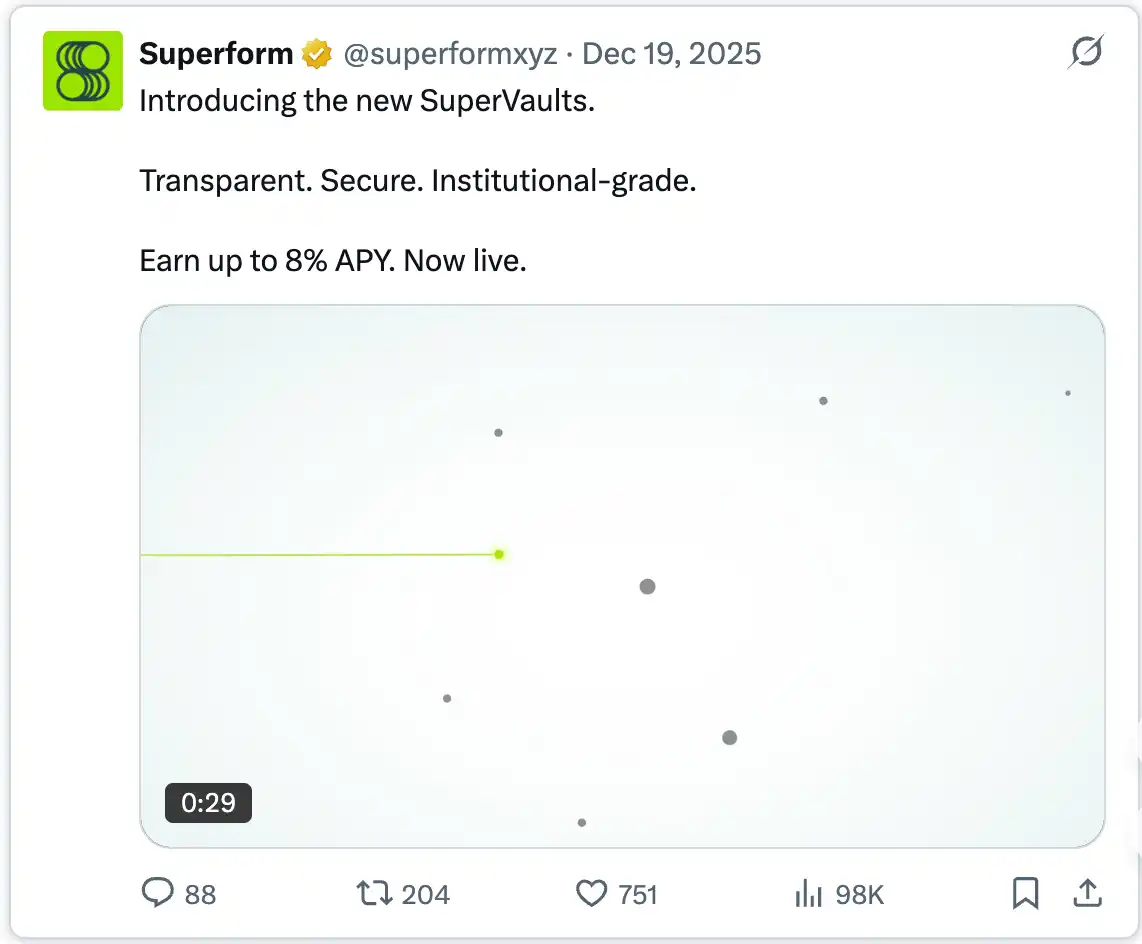
What makes it different?

Superform isn't trying to be your spending app; it's positioned as the savings backend layer for onchain finance. Unlike Tria's focus on capital flow efficiency, Superform is more concerned with efficient capital growth.

Additionally, Superform offers institutional-grade security (audited by Zellic and Omniscia), making it a "safe money" option. Many DAOs and protocol treasuries park capital here, which speaks volumes about the market's trust.
Veera's Trajectory is Fascinating

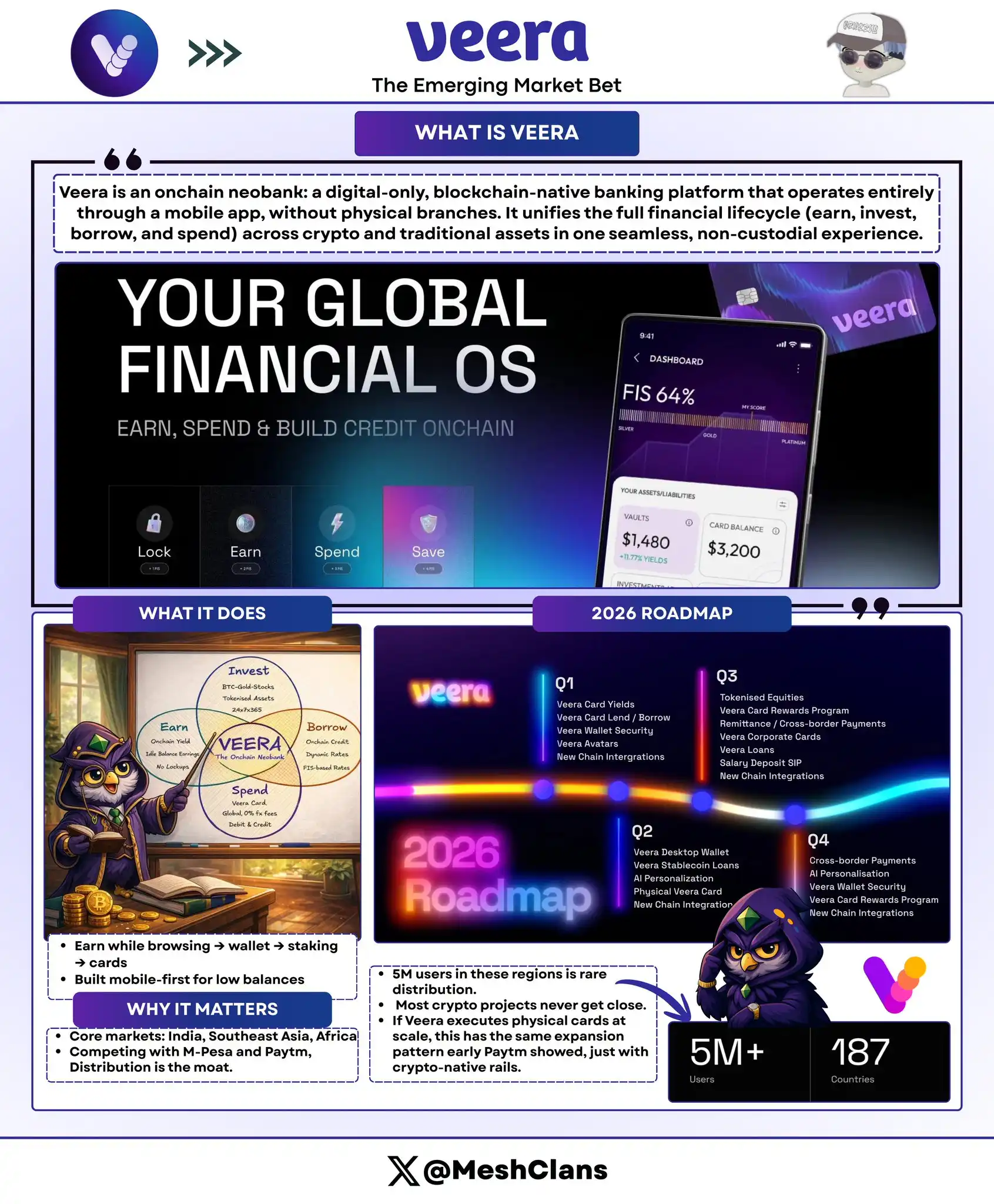
@On_Veera's growth path is very interesting. Starting as a rewards browser (similar to the Brave model), it evolved into a full financial operating system. It now boasts over 4 million users, active in emerging markets largely overlooked by Western VCs.

Basic Info:

  • User Base: Over 4 million users across 108 countries
  • Funding: $6 million Seed round from Ayon Capital in February 2024
  • Core Markets: India, Southeast Asia, Africa

Product Evolution:

The initial Veera was just a "browse-to-earn crypto" rewards browser. It has now developed into:

  • Browser RewardsWalletStaking/YieldPayment Card (Q1 2026)Credit Features (Q1 2026)

Their Q2 2026 roadmap also includes a physical debit card and desktop wallet. Their product iteration speed is rapid.

Why does Veera have the makings of a giant?

Traditional banks won't serve users in remote India with only $50 in savings, and companies like Revolut rarely enter most of Africa. Veera solves the distribution problem by meeting user needs: mobile-first, low-balance friendly, and deeply integrated into the daily browsing experience.

Their growth logic is clever: users earn small crypto rewards for normal browsing, then discover they can earn yield through staking or spend via a payment card. The onboarding has almost no friction because users immediately perceive value.

Competitive Angle:

Veera isn't competing with Coinbase; it's competing with local fintechs like Paytm, MTN Mobile Money, and M-Pesa in markets where crypto adoption is rapidly growing but infrastructure is weak.
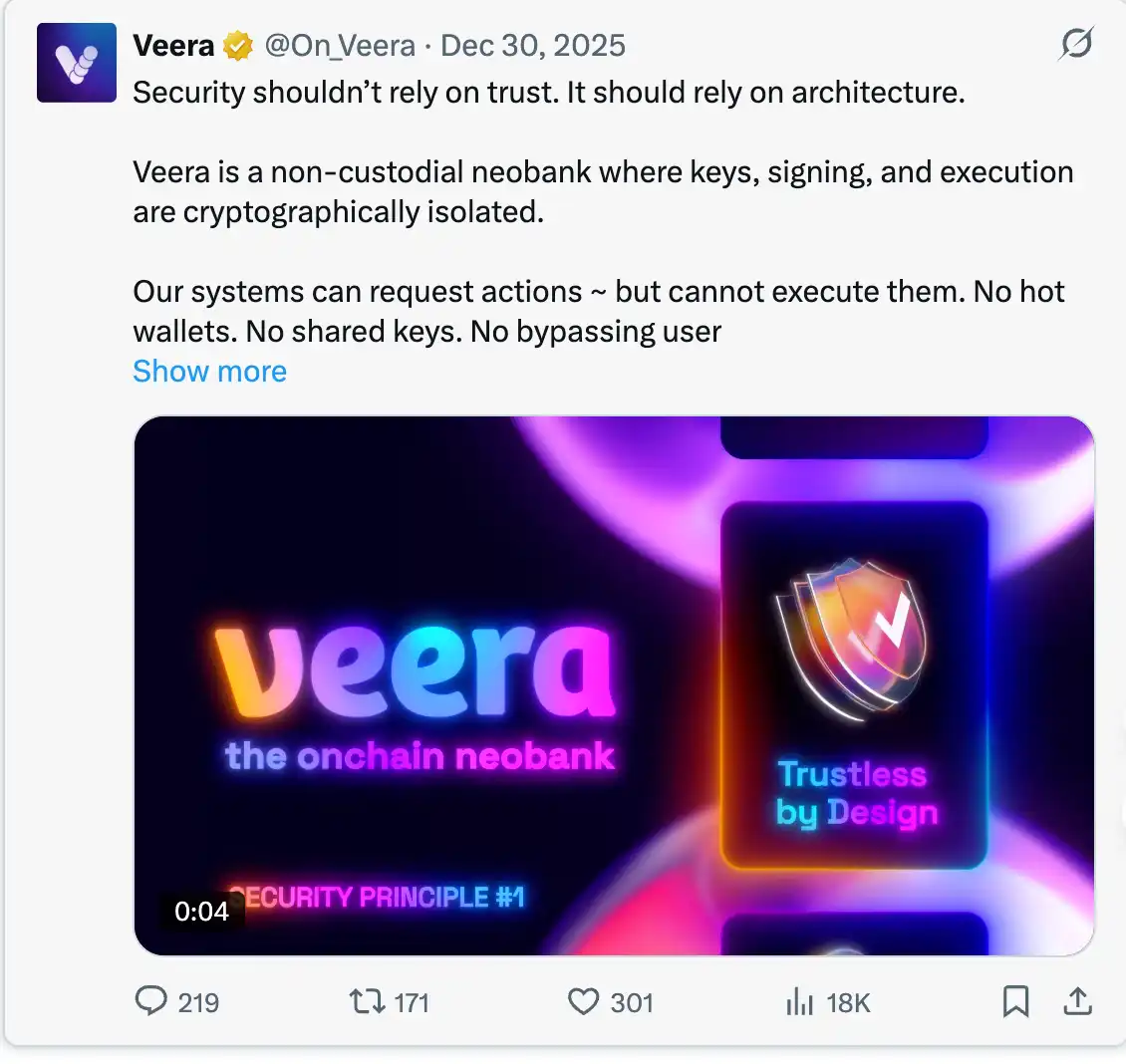
4 million users in these markets is what most crypto projects dream of. If they execute the physical card launch in Q2, they could scale like Paytm did.
Tria: The Winner in Chain Abstraction

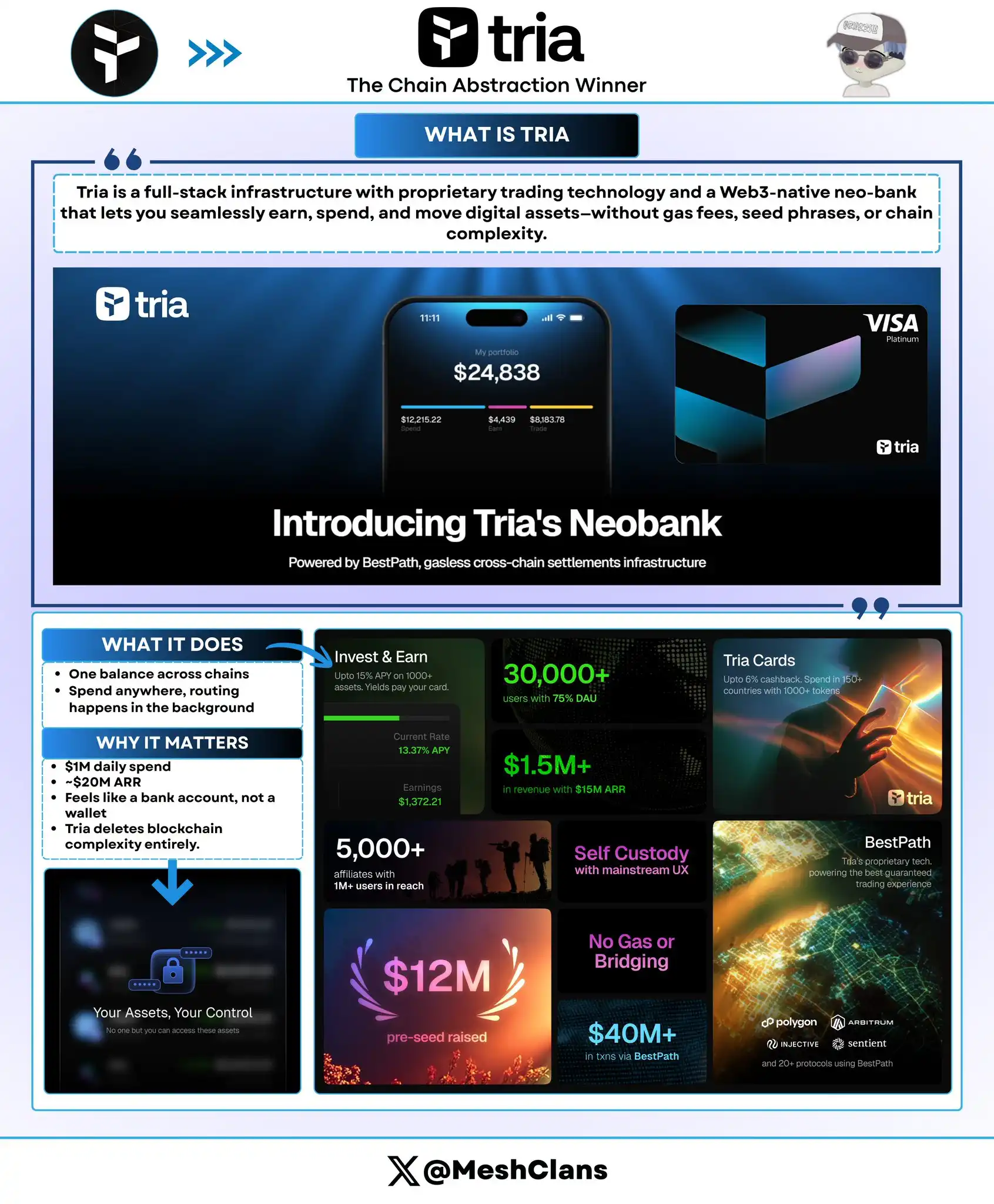
@useTria is one project I actually downloaded and tested in Beta. Its user experience is different and refreshing.

Current Data (Early 2026):

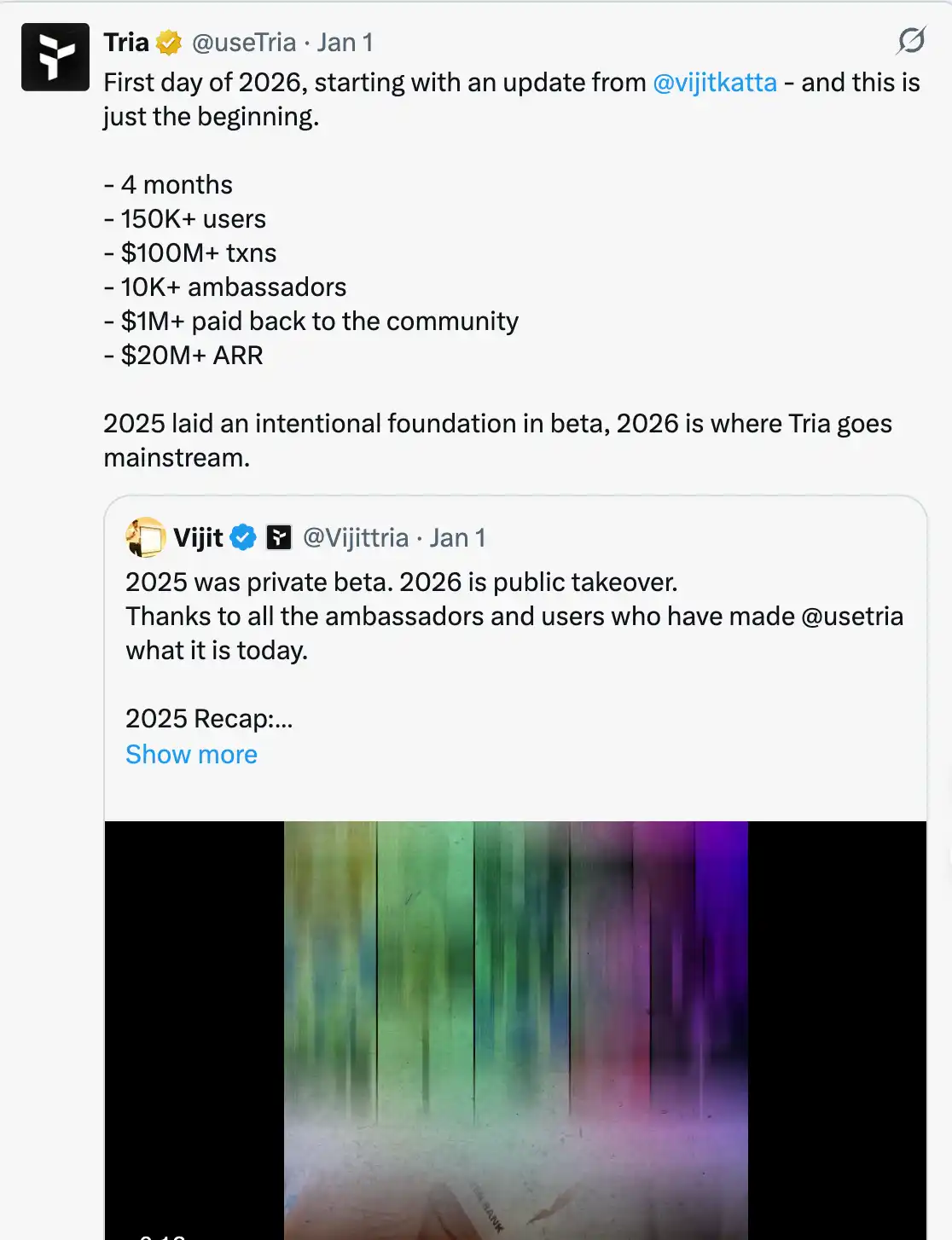
  • Active Users: Over 150,000
  • Beta Transaction Volume: Over $20 million
  • Daily Spending: Broke $1 million in November 2025
  • Annualized Run Rate (ARR): ~$20 million
  • Funding: $12 million raised in October 2025
  • Fully Diluted Valuation (FDV): Valuation between $100M - $200M

How does it work?

Tria's "Unchained" infrastructure makes blockchain complexity completely invisible. Users maintain one unified balance across multiple chains. When you spend, Tria's "BestPath" engine:

  1. Checks your assets on various chains;
  2. Finds the best liquidity path;
  3. Executes the swap or cross-chain operation in the background;
  4. Completes the payment in seconds.

The user experience is seamless: open the app, tap to pay, done. All blockchain complexity is automated away.

Tria's Christmas campaign, Triasmas (their holiday loyalty program), proved that native crypto rewards can rival traditional credit card points. People actually used it for daily spending and got cashback. This shows Tria has found product-market fit.

Why is it important?

Chain abstraction is key to making crypto usable for normal people. Other solutions always make users think about networks, Gas fees, bridges. Tria removes that friction entirely.

$1 million in daily spending validates real consumer demand. This isn't yield farming or speculation; it's real spending—coffee, groceries, bills. Over 150k users and $20M ARR suggest this is more than just beta hype.
Positioning:

In the current crypto landscape, Tria is the closest thing to a traditional bank account. It wins on speed and simplicity, not by flaunting blockchain complexity. This makes it the best candidate for mainstream users, though power users might want more control.
Comparison with Argent and Gnosis:

Argent pioneered smart wallets with social recovery and account abstraction. However, Argent has remained security-focused and Ethereum-centric. The 2026 onchain neobanks focus on the speed and ease of moving money—how to make capital flow faster and easier.

Comparison with Revolut and Coinbase:

Centralized platforms (like Revolut, Coinbase) offer better UX but require sacrificing custody. Onchain neobanks offer the same convenience without sacrificing self-custody. Users keep their keys (or MPC shares) while having debit card functionality.
Beyond the Three Titans

ether.fi: The Titan's Pivot

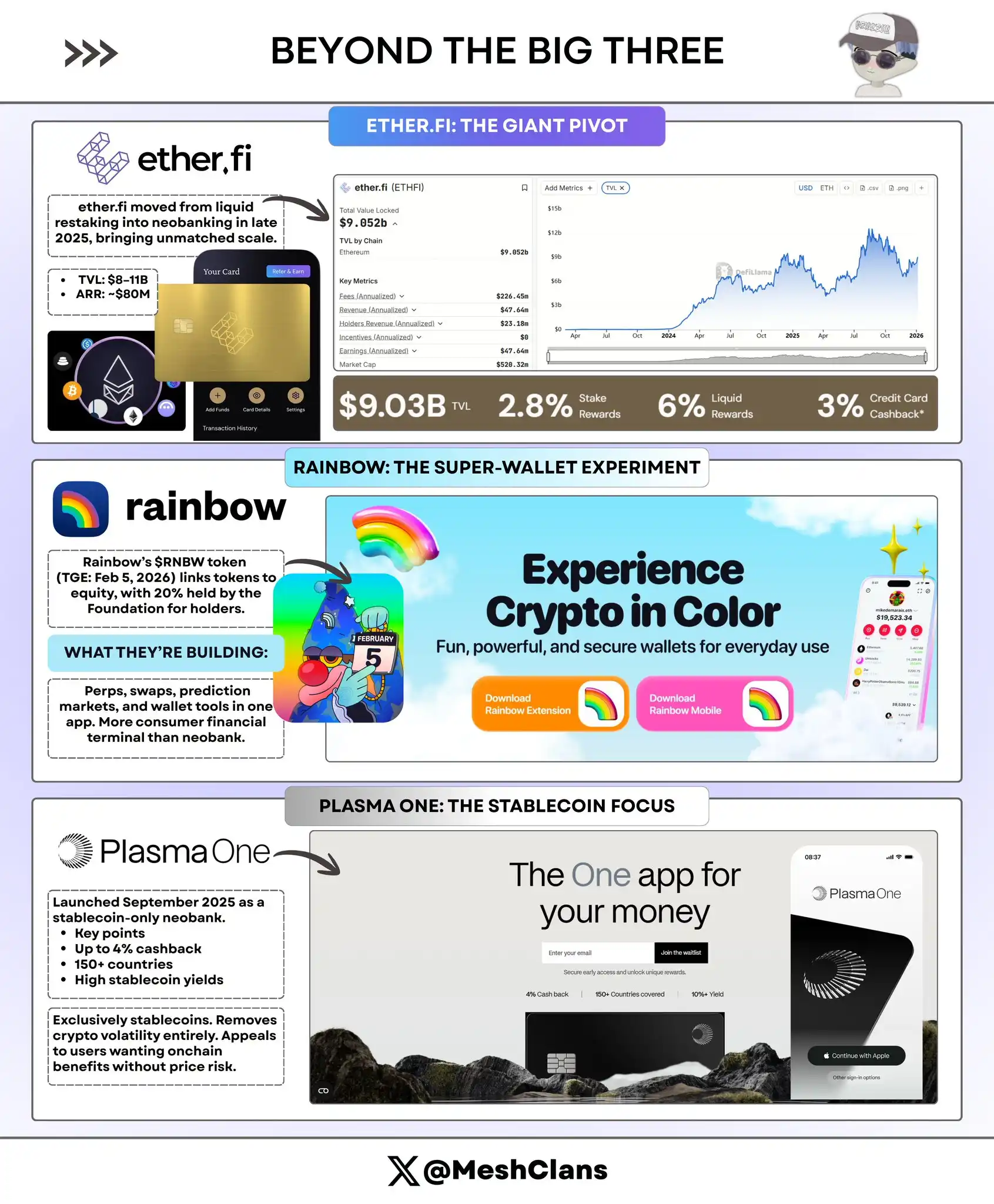
@ether_fi started as a liquid restaking protocol, but by late 2025, it pivoted heavily into the onchain banking space, on a completely different scale.

Data Performance (Late 2025 / Early 2026):

  • Total Value Locked (TVL): $8B - $11B
  • Annualized Run Rate (ARR): $80 million
  • Product: Cash Card, 3% crypto cashback

Innovation Highlight:

ether.fi's Cash Card lets users borrow against their restaked ETH (eETH) at ~4% APR without unlocking staked assets. This means users continue earning restaking rewards while accessing liquidity for spending.

This model cleanly solves the liquidity problem for yield farmers.

With $8B-$11B TVL, ether.fi is the "Chase Bank" of onchain neobanks. Its scale and liquidity can support serious consumer lending, making it a force in the industry.

Challenge:

Pivoting from DeFi infra to consumer banking isn't easy. ether.fi has capital but lacks Tria's UX polish or Veera's distribution. Execution matters more than TVL here.

Rainbow: The Super-App Experiment

Rainbow is launching its $RNBW token (TGE) on February 5, 2026, with an interesting structure: the Rainbow Foundation will hold 20% of the company's equity to reward token holders.

What are they building?

Rainbow is developing an all-in-one mobile interface including Perps, Swaps, Prediction Markets, and wallet functions. It's more of a consumer "Bloomberg Terminal" than a traditional neobank.

Equity-Token Link:

This equity-linked token structure is an experiment. If successful, other projects may rush to copy it. If it fails, it could be a classic case of over-promising.

Risk:

The risk of feature bloat is high. Trying to do everything might make the product unfocused, struggling to compete with best-in-class single-function apps. The upcoming February TGE will reveal if the market values the equity-link model or sees it as a marketing gimmick.

Plasma One: The Stablecoin-First Contender

Plasma One launched in September 2025, positioning itself as the "first stablecoin-native neobank".

Product Features:

  • 4% cashback
  • Available in 150+ countries
  • High yield on stablecoin balances

Unique Positioning:

Plasma One focuses solely on stablecoins, removing crypto price volatility entirely. This appeals to users who want onchain benefits without price risk.

Core Issue:

The "first stablecoin-native" positioning is more of a marketing angle than a real moat. Any competitor can easily add a stablecoin-only mode. Success will come down to execution, not positioning.
Risks Worth Watching

Sustainability of Yields

Let's be real. High returns like Veera's browser rewards and 15% APYs are mostly subsidized by VC funding and token emissions.

Remember the 20% UST rates from Anchor? We all know how that ended—with the collapse of the entire Terra ecosystem.

The 2026 onchain neobank space faces a core question: what happens when the subsidies run out?

Sustainable onchain banks need real revenue sources: card transaction fees, lending spreads, subscription models. Projects inflating APY by burning token reserves might not survive until the next funding round.

Tria's $20M ARR provides a template: real revenue from real transactions, not token incentives.

Watch for: Projects being transparent about revenue sources, clearly distinguishing organic income from token subsidies. If they aren't transparent, that says something.

Regulatory Uncertainty

2025 discussions around the Stablecoin Act created much uncertainty. If US regulations require self-custody "banks" to implement KYC, the industry could see a major split:

  • Compliant Hybrids (with institutional backing and regulatory infrastructure) will thrive in the US market.
  • Pure Self-Custody Apps (like Tria, Superform) might be forced to geo-block US users or add compliance layers, potentially breaking their core value proposition.

Europe's MiCA regulations in 2024-2025 provided some clarity. Clear rules help legitimate projects but raise the barrier to entry.

Key Question: Can these protocols adapt to regulation while keeping their decentralized core intact?

The Metamask Threat

Metamask has 30 million MAUs and immense brand recognition. For Veera or Tria to reach 10 million users, they need to be significantly better than Metamask, not just marginally.

Chain abstraction is a feature, not a moat. Metamask could launch gasless transactions and unified balances within six months. If that happens, the competitive edge of onchain banks shrinks to payment cards and yield optimization.

Defenses:

  • Tria's Play: Payment networks (hard to copy quickly).
  • Superform's Play: Yield optimization algorithms (more sustainable).
  • Veera's Play: Focus on markets Metamask ignores (geographic moat).

Time will tell who wins.

2026 Outlook

Most Likely to Hit 1M DAU First: Tria

Tria's UX is already polished. $1M daily spending and 150k+ users show strong consumer demand. If the rumored Q1 Mastercard payment network integration happens, Tria could run away with it.

Chain abstraction matters most to mainstream users who don't care about blockchain. They just want to buy coffee with crypto, not understand the tech.

$20M ARR suggests Tria has found real product-market fit, not just beta hype.

Safest for Sustained Growth: Superform

Yield optimization survives every market cycle. Even if consumer-facing neobanks struggle, institutional users (DAOs, protocols, treasuries) will still park capital in optimized vaults.

Superform's focus on "safe money" means lower volatility and more stable growth. Less "sexy," but highly sustainable.

Most Likely Dark Horse: Veera

4 million users in India and Southeast Asia is a distribution most crypto projects can't touch. If Veera executes the physical card launch in Q2, it could become the "Paytm" of crypto.

It achieved massive scale in markets Western VCs largely ignore. The upside is huge.

Most Likely Acquisition Target: ether.fi

$8B-$11B TVL and $80M ARR make ether.fi a prime acquisition target for Coinbase, Kraken, or TradFi banks looking to enter crypto. Expect consolidation by end-2026, as giants choose to buy proven infrastructure rather than build from scratch.

What These Onchain Banks Share

These three projects are essentially building a new kind of financial super-app: combining DeFi's power with everyday banking UX, all self-custodied and onchain.

Common DNA:

  1. Non-Custodial Core: Users control keys and assets, avoiding freeze/confiscation risks of centralized platforms.
  2. Unified Operating System: Yield, spend, trade across chains in one app, vs. traditional wallets requiring constant dApp switching.
  3. Focus on Mass Adoption: Replaced "read 47 docs on liquidity pools" with "earn more, do less".
  4. Timing is Right: These projects emerged in late 2025, marking the next phase post-"DeFi 2.0". Better L2s, account abstraction, and real-world spending needs converged.

Different Paths, Same Goal

  • Superform: Yield optimization & institutional-grade infra
  • Veera: Global credit & yield OS
  • Tria: Consumer payments & spending

Together, these projects are building a new category. People are starting to see "onchain neobanks" as an industry, not just individual projects. This narrative momentum matters for funding, partnerships, and market mindshare.

Final Take

Self-custody is becoming convenient. These three projects represent different paths to solving the same problem: making crypto as easy as traditional banking, while keeping self-custody at the core.

Who will dominate?

Likely, all three will thrive, serving different user segments. The crypto economy is vast enough for multiple financial operating systems.

The real challenge: can they cross the chasm from crypto-natives to mainstream adoption?

Late 2025 data suggests yes:

  • Tria: $20M ARR
  • Veera: 4M users
  • Superform: $1.44B TVL

These numbers suggest sustainable growth, not just speculative hype.

2026 will be the year this space proves its potential.

Criptos en tendencia

Preguntas relacionadas

QWhat are the three leading on-chain neobanks mentioned in the article, and what are their core focuses?

AThe three leading on-chain neobanks are Superform, Veera, and Tria. Superform focuses on yield optimization and institutional-grade infrastructure, acting as a 'savings account' for on-chain finance. Veera is building a global credit and yield operating system, targeting emerging markets. Tria is a consumer-facing platform for payments and spending, prioritizing chain abstraction for a seamless user experience.

QAccording to the article, what key metric suggests Tria has found genuine product-market fit?

AThe key metric is Tria's Annual Recurring Revenue (ARR) of approximately $20 million. This revenue, derived from real transactions rather than token incentives, indicates strong consumer demand and validates that the platform has moved beyond beta hype to achieve sustainable product-market fit.

QWhat major risk do on-chain neobanks face regarding the sustainability of their high yields, as highlighted in the article?

AThe major risk is that high yields, like Veera's 15% APY, are often subsidized by venture capital funding and token emissions. The article compares this to the unsustainable 20% UST yield offered by Anchor Protocol before the Terra collapse. Sustainable neobanks need real revenue sources like card transaction fees, lending spreads, and subscription models instead of relying on burning token reserves.

QHow does the article differentiate the target market and growth strategy of Veera from its competitors?

AVeera's strategy focuses on growth in emerging markets (India, Southeast Asia, Africa) that are often overlooked by Western VCs and underserved by traditional banks and fintechs like Revolut. It acquired over 4 million users through a low-friction, mobile-first onboarding process that starts with a 'browse-to-earn' rewards model, gradually introducing users to staking, yield, and eventually payment cards.

QWhat is the core technological innovation that Tria's 'Unchained' infrastructure provides, and why is it important for mainstream adoption?

ATria's core innovation is chain abstraction, which makes blockchain complexity completely invisible to the user. Its 'BestPath' engine automatically checks assets across multiple chains, finds the best liquidity path, and executes swaps or cross-chain operations in the background within seconds for a payment. This is crucial for mainstream adoption because it allows users to spend crypto as easily as fiat without needing to understand gas fees, bridges, or network switching.

Lecturas Relacionadas

He Just Raised 2.7 Billion, and Li Fei-Fei Also Invested

Pete Florence, a former senior research scientist at Google DeepMind and a key contributor to the Vision-Language-Action (VLA) model architecture, is deliberately distancing his startup, Generalist AI, from the trendy "world model" label. He argues that the industry should prioritize concrete goals over buzzwords. His goal is to create robots that can perform a vast range of unseen tasks with high speed and success rates, without needing task-specific training data. Recently, his company raised $400 million (¥2.7 billion) at a $2 billion valuation. Notable investors include NVIDIA's NVentures, Bezos Expeditions, NFDG, as well as Xiaomi co-founder Lin Bin, Zoom founder Eric Yuan, and renowned AI scientist Fei-Fei Li. Florence's approach stems from his academic background at MIT under Professor Russ Tedrake, focusing on understanding the physical world. After joining DeepMind, he developed models like Transporter Network and co-created the VLA framework. He left in 2025 to found Generalist AI. The company has launched two models: GEN-0, which demonstrated that scaling laws apply to physical motion, and GEN-1. GEN-1 was trained on over 500,000 hours of physical interaction data collected via a specialized wearable device. It achieves a 99% success rate on precise mechanical tasks like folding boxes and maintains performance three times faster than its predecessor. Florence believes GEN-1 is reaching a commercial utility threshold similar to the GPT-3 inflection point. The substantial funding round, following GEN-1's release, signifies strong investor confidence in Generalist AI's practical, goal-driven path to creating versatile, useful robots, regardless of the "world model" terminology.

marsbitHace 1 min(s)

He Just Raised 2.7 Billion, and Li Fei-Fei Also Invested

marsbitHace 1 min(s)

Two Legends Lost in Three Days: Is Google's AI Talent Dam Cracking?

In three days, Google lost two AI legends. On June 18, Noam Shazeer, co-author of the seminal "Attention is All You Need" paper and Gemini co-lead, left for OpenAI. Just 48 hours later, John Jumper, 2024 Nobel laureate and AlphaFold lead, departed DeepMind for Anthropic. This follows Andrej Karpathy joining Anthropic in May. These moves highlight a structural trend: top AI talent is concentrating at mission-driven, pre-IPO firms like OpenAI and Anthropic, while Google becomes a primary source. The exodus stems from a core mission mismatch. Google's ad-centric model often subordinates AI research to product and revenue goals, creating friction for pioneers like Shazeer, who returned in 2024 only to leave again. In contrast, OpenAI and Anthropic offer singular focus on pushing AI boundaries, whether towards AGI or safety-aligned models, which deeply appeals to top researchers like Jumper. Financial incentives amplify the pull. With both OpenAI and Anthropic nearing IPO, employees stand to gain immensely from equity, an upside Google's mature stock cannot match. Furthermore, the 2023 merger of Google Brain and DeepMind, intended to consolidate strength, has instead created cultural tension and slowed the path from research to product, as evidenced by Gemini's pace. This talent redistribution is reshaping the AI landscape. While Google retains vast data and compute resources, its true crisis is the quiet, continuous loss of the people who define the field's future. The real moat in AI is not infrastructure, but the concentration of brilliant minds—a battle Google is currently losing.

marsbitHace 2 hora(s)

Two Legends Lost in Three Days: Is Google's AI Talent Dam Cracking?

marsbitHace 2 hora(s)

Behind the AI Report Card, Lies a Chinese 'Exam Setter'

Beyond the familiar performance charts like MMLU-Pro and MMMU, which major AI models strive to ace, stands a key "examiner": Chinese-Canadian researcher Wenhu Chen. An assistant professor at the University of Waterloo and founder of TIGERLab, Chen addresses the crucial need for more rigorous AI evaluation. As models like GPT-4 began scoring near-perfect results on older benchmarks like MMLU, it became difficult to distinguish their true capabilities. In response, Chen introduced MMLU-Pro in 2024, featuring harder, more reasoning-focused questions with more answer choices, successfully reintroducing meaningful performance gaps. His work extends to multi-modal evaluation with MMMU and its enhanced version, MMMU-Pro. These benchmarks test a model's ability to understand and reason with complex information from images, charts, and text across diverse academic subjects, exposing the significant challenges even top models face in genuine comprehension. Chen's background in complex QA, table reasoning, and his experience at Google DeepMind on projects like Gemini inform his approach. He understands that effective benchmarks must anticipate how models might "cheat" by memorizing data or avoiding visual analysis. His lab also actively researches video understanding and generation models (e.g., UniVideo, Vamba), ensuring his evaluation work is grounded in practical model-building challenges. Now at Meta's Super Intelligence Lab, Chen continues his focus on multi-modal data and evaluation, representing the deep yet often unseen contributions of Chinese talent in shaping the fundamental tools of the AI industry.

marsbitHace 2 hora(s)

Behind the AI Report Card, Lies a Chinese 'Exam Setter'

marsbitHace 2 hora(s)

Alliance Co-founder's Letter to Entrepreneurs: Written at the Moment Cursor Sold for $600 Billion

Alliance Co-founder's Letter to Entrepreneurs: On Cursor's $60 Billion Sale Many aspiring founders see massive exits like Cursor's $60B sale and wonder why they can't achieve the same, often concluding opportunities are exhausted. But great companies aren't built in obvious, crowded spaces. Cursor, like Stripe, Figma, and Shopify before it, started with a non-consensus belief about the future. Before ChatGPT, they believed AI would transform knowledge work. They focused on a genuinely exciting domain, became their own customer, and obsessed over power users. Their journey involved years of "glass-chewing" effort before the market was ready. The pattern is consistent: identify a long-term technological shift, find a missed entry point, and execute for years before the trend becomes obvious. First-generation products (PayPal, Adobe, Amazon) prove a market exists. Second-generation winners (Stripe, Figma, Shopify) rebuild that market around new insights, technology, or changing customer behaviors. Founders must identify their phase in the cycle. Early entrants like Coinbase or Cursor focus on making new technology usable for power users. Later entrants find the "yin" to the established "yang"—the blind spots incumbents miss as they grow distant from individual users. The key is deep market immersion. Use every product in your space. Talk to users. Build an audience. Stop looking for ideas and start *seeing* them everywhere. Then, choose one. The idea must offer a 10x improvement or solve a "hair-on-fire" pain point—something severe enough that users are already crafting workarounds. When building, avoid feature bloat. Ask: why would someone switch? Great startups rarely force new behaviors; they improve familiar workflows with drastically lower friction (e.g., Cursor forked VS Code instead of creating a new editor). Distribution is the underestimated moat. Before product-market fit, achieve distribution-market fit. How do customers discover new tools? Founders like those at Airbnb, Stripe, and Cursor did unscalable, manual work to recruit early users. The final, unteachable ingredient is resilience. Cursor built for years pre-market, faced rejection, and persisted. So did Airbnb, Nvidia, and Rain (which launched post-FTX collapse). The lesson isn't that these founders were smarter, but that they stayed in the game long enough for their insights to compound. Framework: Spot technological cycles. Cultivate unique insight. Obsess over your market. Talk to customers. Find a hair-on-fire problem. Build the simplest wedge. Win your distribution channel. Above all, don't quit when it gets hard. Most people won't do these things consistently. The few who do build the next generation of great companies. Go build.

marsbitHace 2 hora(s)

Alliance Co-founder's Letter to Entrepreneurs: Written at the Moment Cursor Sold for $600 Billion

marsbitHace 2 hora(s)

Trading

Spot
Futuros

Artículos destacados

Qué es $BANK

Banco AI: Un Paso Revolucionario en el Futuro de la Banca Introducción En una era marcada por avances rápidos en tecnología, Banco AI se sitúa en la intersección de la inteligencia artificial (IA) y los servicios bancarios. Este proyecto innovador busca redefinir el panorama financiero, mejorando la eficiencia operativa, las medidas de seguridad y las experiencias del cliente a través del poder de la IA. Al embarcarnos en esta exploración de Banco AI, profundizaremos en lo que implica el proyecto, sus dinámicas operativas, su contexto histórico y hitos significativos. ¿Qué es Banco AI? En su esencia, Banco AI representa una iniciativa transformadora destinada a integrar la inteligencia artificial en varias operaciones bancarias. Este proyecto aprovecha las capacidades de la IA para automatizar procesos, mejorar los protocolos de gestión de riesgos y mejorar la interacción con los clientes a través de servicios personalizados. Los objetivos principales de Banco AI incluyen: Automatización de Funciones Bancarias: Al aprovechar las tecnologías de IA, Banco AI tiene como objetivo automatizar tareas rutinarias, reduciendo la carga sobre los recursos humanos y mejorando la eficiencia. Mejora en la Gestión de Riesgos: El proyecto utiliza algoritmos de IA para predecir e identificar riesgos, fortaleciendo así las medidas de seguridad contra fraudes y otras amenazas. Personalización de Servicios Bancarios: Banco AI se centra en ofrecer productos y servicios financieros a medida al analizar datos y comportamientos de los clientes. Mejoramiento de la Experiencia del Cliente: La implementación de soluciones impulsadas por IA, como chatbots y asistentes virtuales, tiene como objetivo proporcionar a los usuarios interacciones más humanas, revolucionando la forma en que los clientes se relacionan con los bancos. Con estos objetivos, Banco AI se posiciona como un jugador crucial para hacer que la banca sea más eficiente, segura y centrada en el usuario. ¿Quién es el Creador de Banco AI? Los detalles sobre el creador de Banco AI siguen siendo desconocidos. Como tal, no se ha identificado a ninguna persona u organización específica en la información disponible. El anonimato que rodea el inicio del proyecto plantea preguntas, pero no resta valor a su ambiciosa visión y objetivos. ¿Quiénes Son los Inversores de Banco AI? Al igual que con el creador del proyecto, no se ha divulgado información específica sobre los inversores u organizaciones que apoyan a Banco AI. Sin esta información, es un desafío delinear el respaldo financiero y el apoyo institucional que podrían estar impulsando el proyecto hacia adelante. No obstante, la importancia de contar con una sólida base de inversión es fundamental para sostener el desarrollo en un campo tan innovador. ¿Cómo Funciona Banco AI? Banco AI opera en múltiples frentes innovadores, centrándose en factores únicos que lo diferencian de los marcos bancarios tradicionales. A continuación, se presentan las características operativas clave: Automatización: Al aplicar algoritmos de aprendizaje automático, Banco AI automatiza varios procesos manuales dentro de los bancos. Esto resulta en la reducción de costos operativos y permite que los trabajadores humanos redirijan sus esfuerzos hacia actividades más estratégicas. Gestión Avanzada de Riesgos: La integración de la IA en las prácticas de gestión de riesgos equipa a los bancos con herramientas para predecir con precisión amenazas potenciales como el fraude, garantizando que la información y los activos de los clientes permanezcan seguros. Recomendaciones Financieras Personalizadas: A través del aprendizaje continuo a partir de las interacciones con los clientes, los sistemas de IA desarrollan una comprensión matizada de las necesidades del usuario, lo que les permite ofrecer consejos adaptados sobre decisiones financieras. Interacciones Mejoradas con los Clientes: Al utilizar chatbots y asistentes virtuales impulsados por IA, Banco AI permite una experiencia más atractiva para el cliente, permitiendo a los usuarios resolver sus consultas rápidamente, reduciendo así los tiempos de espera y mejorando los niveles de satisfacción. En conjunto, estas características operativas posicionan a Banco AI como un pionero en el sector bancario, estableciendo nuevos parámetros para la entrega de servicios y la excelencia operativa. Línea de Tiempo de Banco AI Entender la trayectoria de Banco AI requiere mirar su contexto histórico. A continuación, se presenta una línea de tiempo que destaca hitos y desarrollos importantes: Inicios de 2010: La conceptualización de la integración de la IA en los servicios bancarios comenzó a ganar atención a medida que las instituciones bancarias reconocieron los posibles beneficios. 2018: Se produjo un aumento notable en la implementación de tecnologías de IA cuando los bancos comenzaron a utilizar herramientas de IA como chatbots para el servicio al cliente básico y sistemas de gestión de riesgos para mejorar la seguridad. 2023: La sofisticación de la IA continuó avanzando, con la introducción de IA generativa para tareas más complejas como el procesamiento de documentos y análisis de inversiones en tiempo real. Este año marcó un salto significativo en las capacidades que la tecnología de IA otorgó a los bancos. 2024-Estatus Actual: A partir de este año, Banco AI se encuentra en una trayectoria ascendente, con investigaciones y desarrollos en curso que pronto mejorarán las capacidades en las operaciones bancarias. La continua exploración de las aplicaciones de IA sugiere emocionantes desarrollos aún por venir. Puntos Clave Sobre Banco AI Integración de la IA en la Banca: Banco AI se centra en adoptar inteligencia artificial para optimizar los procesos bancarios y mejorar la experiencia del usuario. Enfoque en Automatización y Gestión de Riesgos: El proyecto enfatiza fuertemente estas áreas, con el objetivo de desplazar la carga de tareas rutinarias mientras mejora los marcos de seguridad a través de análisis predictivos. Soluciones Bancarias Personalizadas: Al aprovechar los datos de los clientes, Banco AI permite servicios bancarios adaptados a las necesidades individuales de los usuarios. Compromiso con el Desarrollo: Banco AI se mantiene comprometido con esfuerzos de investigación y desarrollo continuos, asegurando su adaptabilidad y relevancia continua a medida que la tecnología sigue evolucionando. Conclusión En resumen, Banco AI ejemplifica un paso crucial hacia adelante en la industria bancaria, aprovechando la inteligencia artificial para redefinir los paradigmas operativos, mejorar la seguridad y promover la satisfacción del cliente. A pesar de las lagunas en la información sobre el creador y los inversores, los objetivos claros y los mecanismos funcionales de Banco AI proporcionan una sólida base para su evolución continua. A medida que la tecnología de IA sigue avanzando y fusionándose con el sector bancario, Banco AI está bien posicionado para impactar significativamente el futuro de los servicios financieros, mejorando la forma en que entendemos e interactuamos con la banca.

150 Vistas totalesPublicado en 2024.04.06Actualizado en 2024.12.03

Qué es $BANK

Cómo comprar BANK

¡Bienvenido a HTX.com! Hemos hecho que comprar Lorenzo Protocol (BANK) sea simple y conveniente. Sigue nuestra guía paso a paso para iniciar tu viaje de criptos.Paso 1: crea tu cuenta HTXUtiliza tu correo electrónico o número de teléfono para registrarte y obtener una cuenta gratuita en HTX. Experimenta un proceso de registro sin complicaciones y desbloquea todas las funciones.Obtener mi cuentaPaso 2: ve a Comprar cripto y elige tu método de pagoTarjeta de crédito/débito: usa tu Visa o Mastercard para comprar Lorenzo Protocol (BANK) al instante.Saldo: utiliza fondos del saldo de tu cuenta HTX para tradear sin problemas.Terceros: hemos agregado métodos de pago populares como Google Pay y Apple Pay para mejorar la comodidad.P2P: tradear directamente con otros usuarios en HTX.Over-the-Counter (OTC): ofrecemos servicios personalizados y tipos de cambio competitivos para los traders.Paso 3: guarda tu Lorenzo Protocol (BANK)Después de comprar tu Lorenzo Protocol (BANK), guárdalo en tu cuenta HTX. Alternativamente, puedes enviarlo a otro lugar mediante transferencia blockchain o utilizarlo para tradear otras criptomonedas.Paso 4: tradear Lorenzo Protocol (BANK)Tradear fácilmente con Lorenzo Protocol (BANK) en HTX's mercado spot. Simplemente accede a tu cuenta, selecciona tu par de trading, ejecuta tus trades y monitorea en tiempo real. Ofrecemos una experiencia fácil de usar tanto para principiantes como para traders experimentados.

785 Vistas totalesPublicado en 2025.05.09Actualizado en 2026.06.02

Cómo comprar BANK

Discusiones

Bienvenido a la comunidad de HTX. Aquí puedes mantenerte informado sobre los últimos desarrollos de la plataforma y acceder a análisis profesionales del mercado. A continuación se presentan las opiniones de los usuarios sobre el precio de BANK (BANK).

活动图片