2026 Cryptocurrency Exchange Listing Decision Questionnaire Survey Report

marsbitPublicado a 2026-01-21Actualizado a 2026-01-21

Resumen

The 2026 Cryptocurrency Exchange Listing Decision Survey Report, conducted by RootData, gathered 313 valid responses from professionals including Listing BD personnel, researchers, and listing committee members. Key findings reveal that over 69% of respondents are directly involved in or responsible for listing decisions, with many handling over 50 projects annually, leading to significant information overload. Major pain points in the decision-making process include fragmented and outdated data, with approximately 50% of respondents citing these issues. High "hidden costs of trust" and data inaccuracy often prolong the review process. Over 30% of respondents noted that data delays significantly impact decisions, potentially causing missed opportunities or errors. Transparency of project information—such as details about institutional investors, valuation, team, and product roadmap—is critical. More than half of the respondents rely on third-party data platforms like RootData (used by 88.9% of participants) for verification. Projects listed on authoritative platforms with detailed information can improve listing efficiency by at least 30%. Conversely, low transparency often triggers extended defensive reviews, with 16.7% of respondents likely rejecting such projects outright. The report concludes that data transparency is vital in listing approvals, significantly affecting both the efficiency and outcome of a project’s capitalization efforts.

Source: RootData

Recently, RootData initiated a survey questionnaire focusing on cryptocurrency exchange listing decisions, collecting a total of 313 valid responses. Participants included Listing BD personnel, researchers, and listing committee members, among others. The survey results are now compiled into this research report for reference.

Respondent Profile: Covering Frontline Practitioners and Decision-Makers in Listing
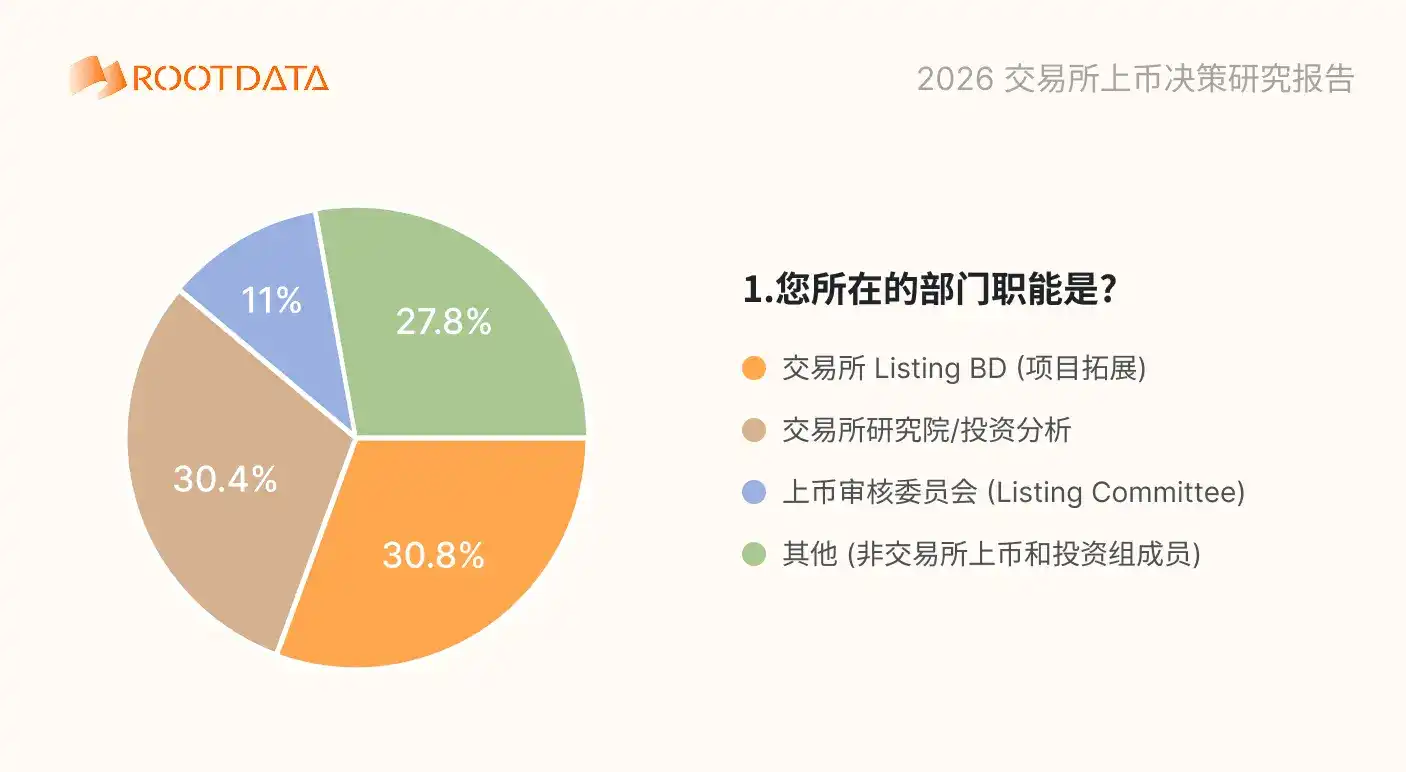
Over 69% of respondents are involved in or directly decision-makers for Listing work. Survey participants were primarily from exchange Listing BD and research institute/investment analysis roles. They are the "value discovery" and "access control" departments of exchanges, and decision-makers face immense information processing pressure.

Decision-Making Pain Points: Fragmented Data and Delayed Updates
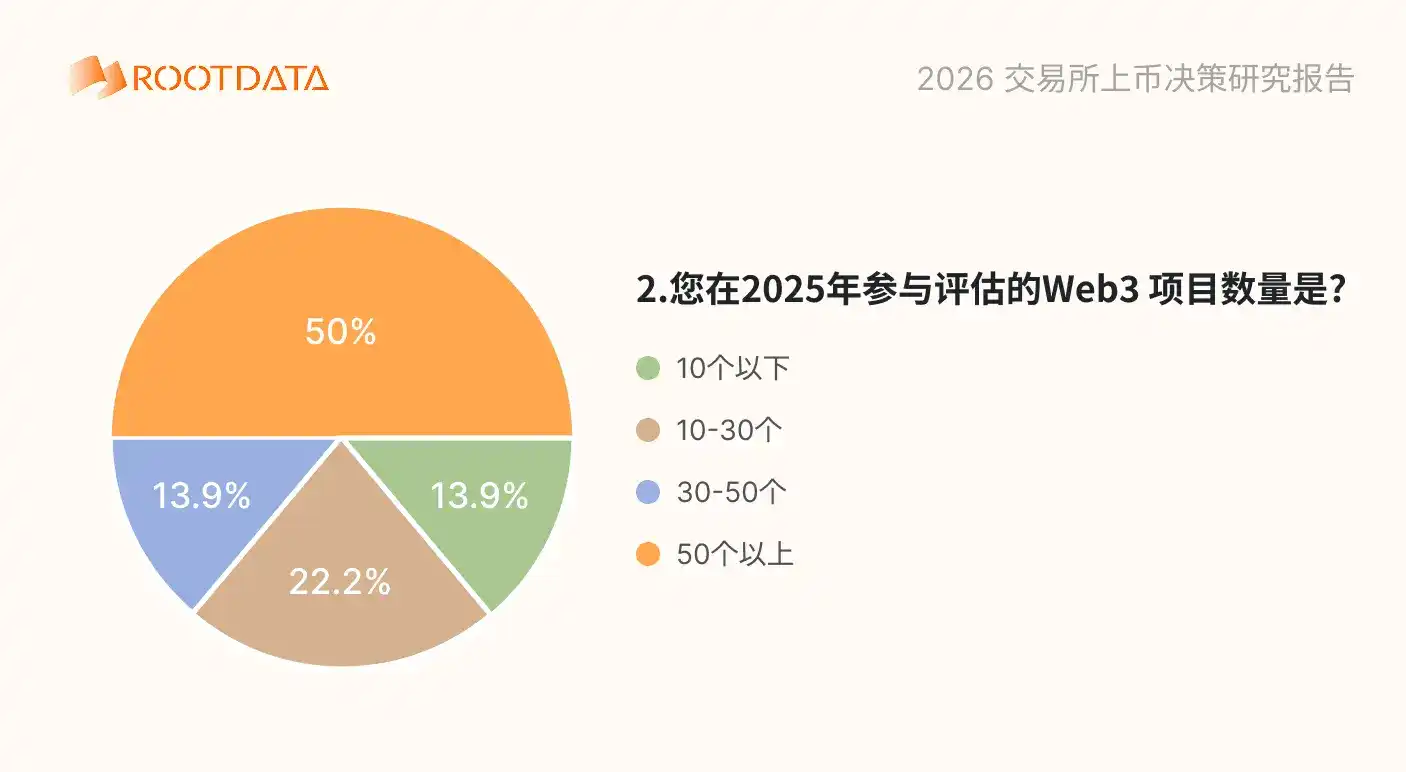
Approximately 50% of respondents evaluate over 50 projects annually. Decision-makers are in a state of severe "information overload." Among the vast number of projects, those that can provide structured and transparent data significantly reduce the cognitive cost for decision-makers. This also indicates that "transparency" has become one of the important metrics for projects to stand out within the extremely short evaluation window.

Distribution of Core Work Responsibilities
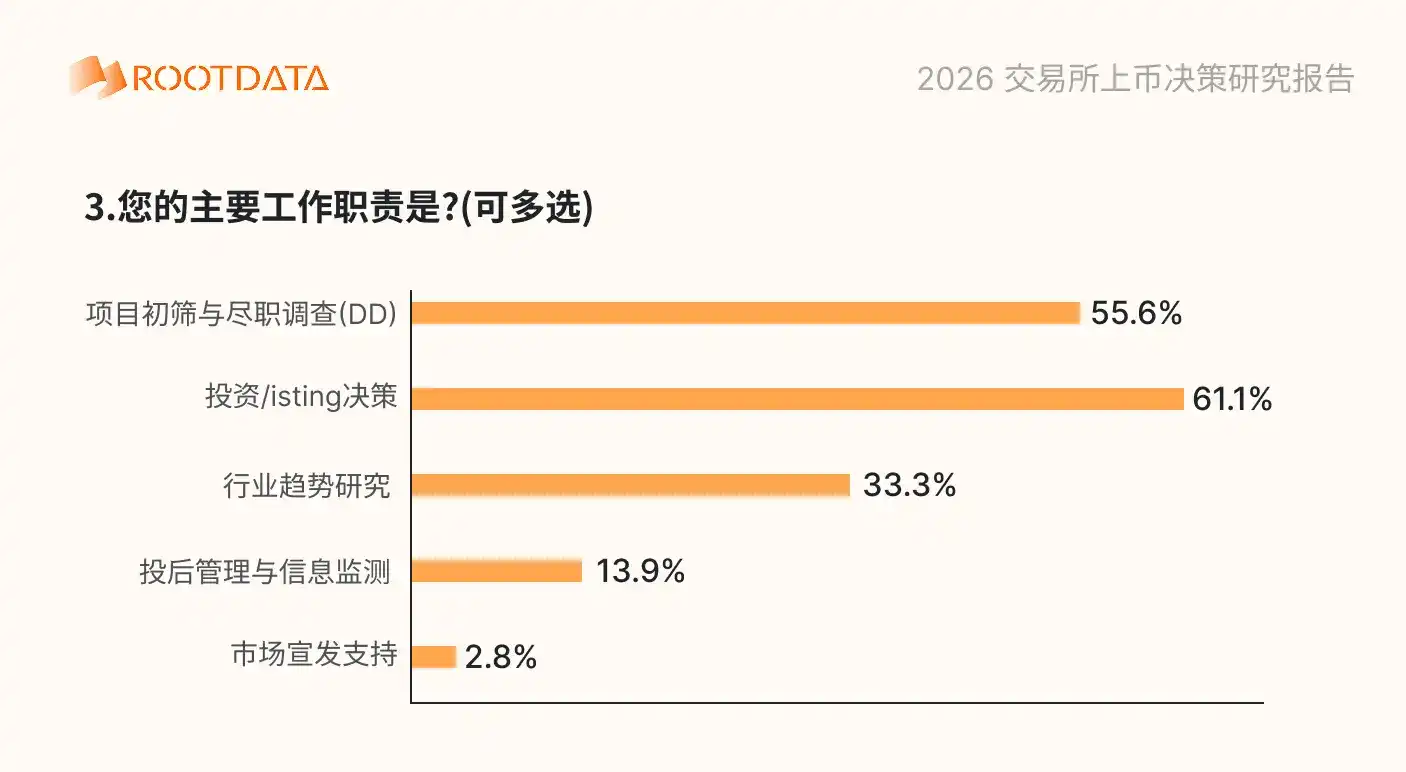
Due diligence and decision-making are highly overlapping functions. This means that data platforms are no longer just auxiliary tools but are integrated into the decision-making chain.

The "Stumbling Block" to Decision-Making Efficiency

"Trust cost" is the most expensive hidden cost for exchanges. Uncertainty in data can cause the decision-making process to repeatedly backtrack. As the compliance trend further intensifies, the accuracy and effectiveness of asset information disclosure will become important factors affecting the exchange listing cycle.

The "Hidden Penalty" of Data Delay
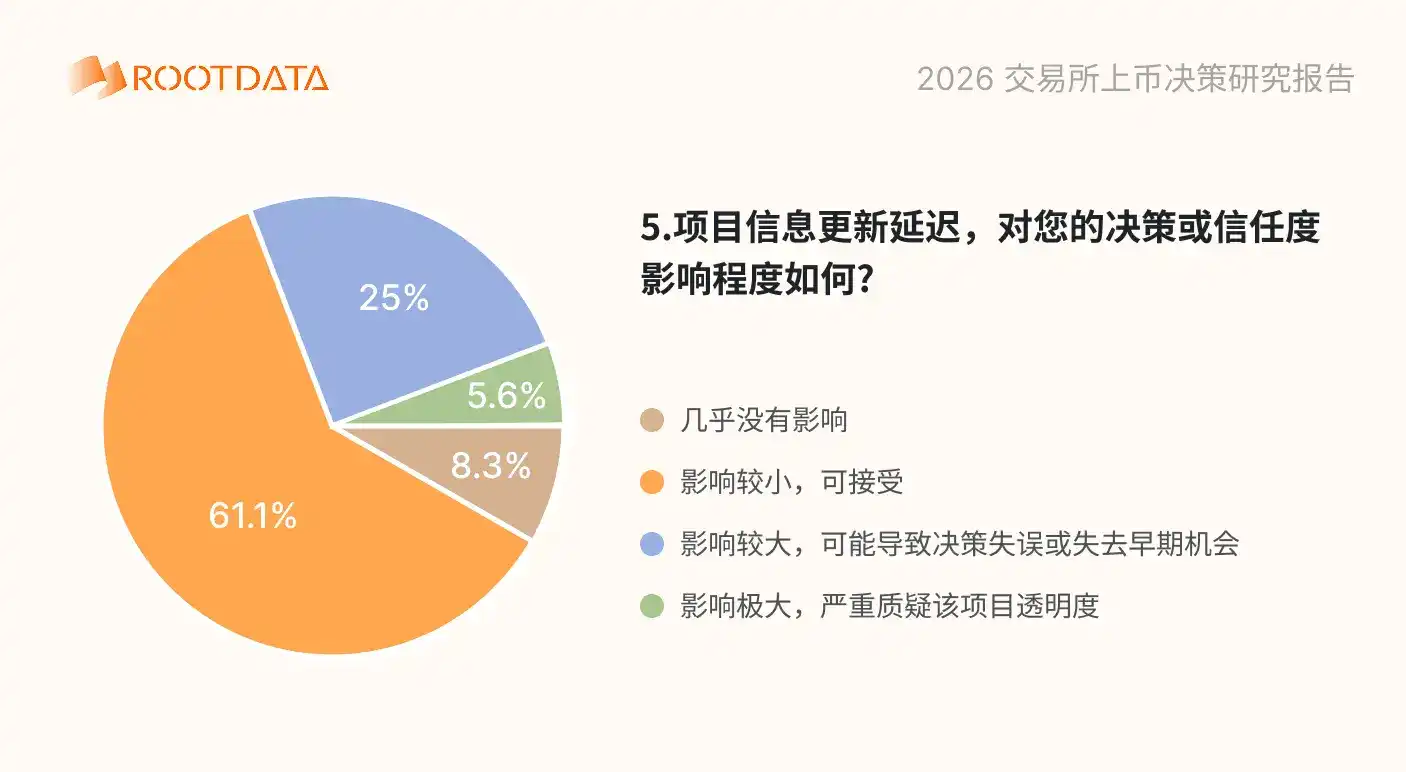
Over 30% of respondents believe delays have a significant or极大 impact, potentially leading to decision-making errors, missed opportunities, or even质疑 project transparency. Even though 60% of respondents表面 "can accept it," delayed information updates from projects may result in a hidden penalty during the Listing evaluation.

Handling of Outdated Information
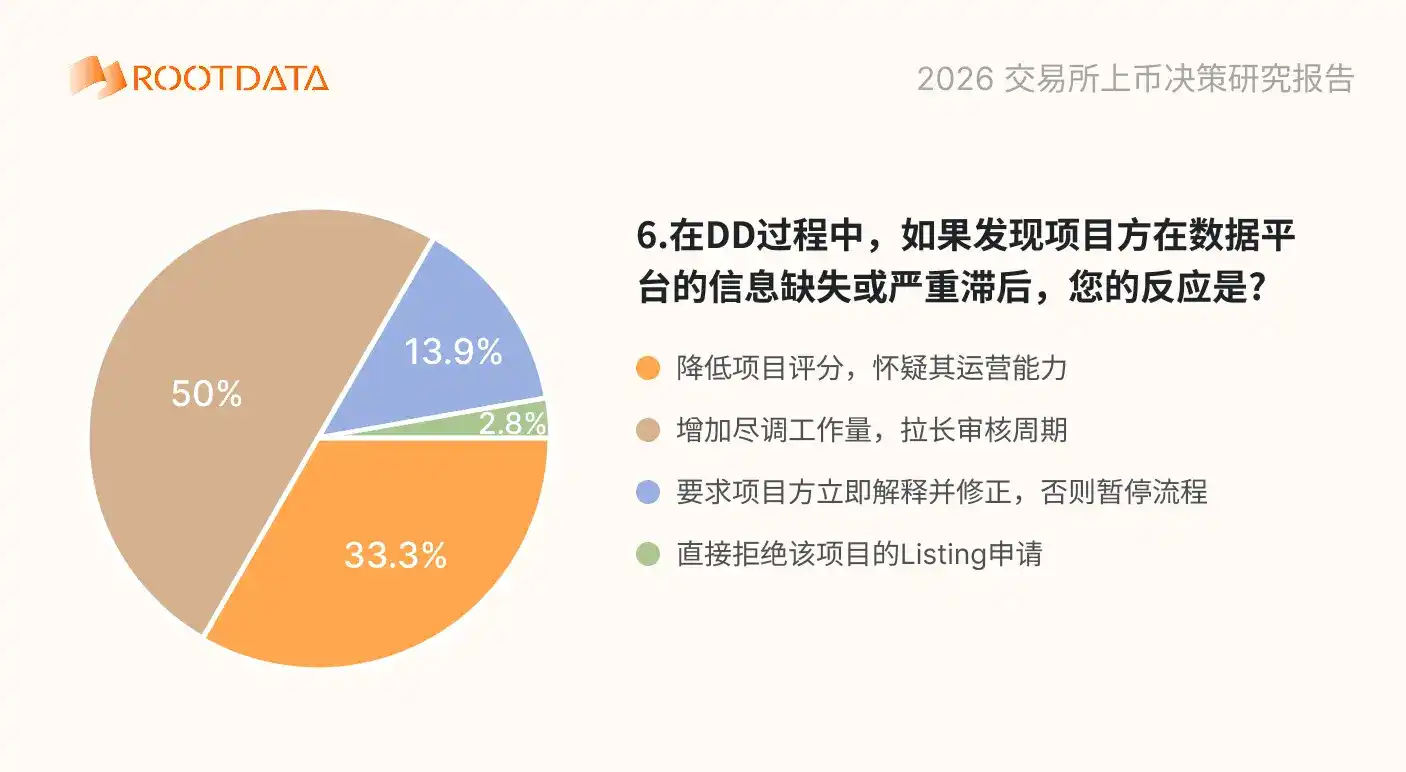
50% of respondents indicated that if project data is not transparent, it will trigger the exchange's "defensive due diligence," prolonging the review time. 16.7% of respondents explicitly stated they would stop the review process or even directly reject the project's Listing application.

The "Required Course" for Listing Review
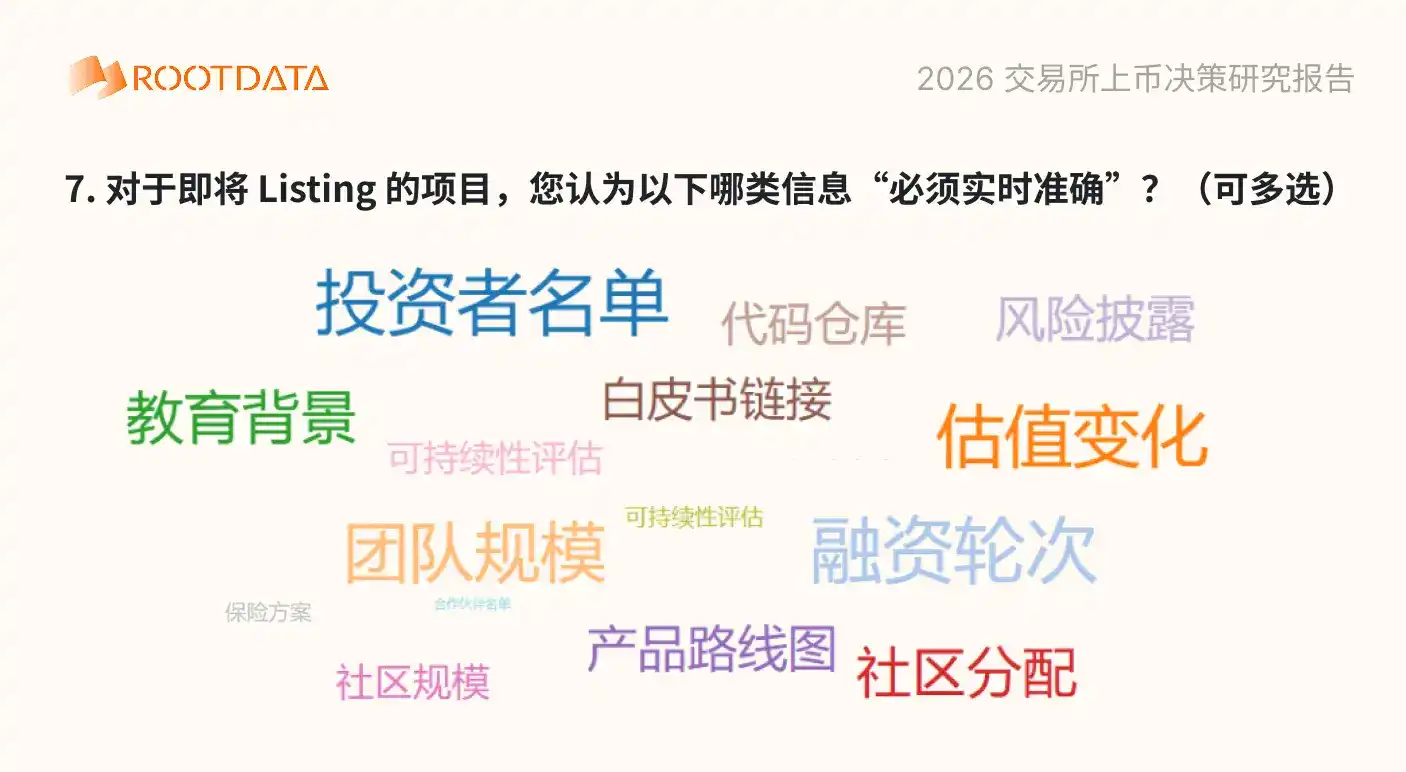
The historical track record of institutional investors, valuation, team, product roadmap, and other asset-related "essential dimensions" constitute the credit cornerstone of Web3 projects. In reality, this information is also very easy to falsify. Therefore, over half of the respondents indicated a strong need for third-party data platforms to help them cross-verify information.

Preferred Commonly Used Data Platforms
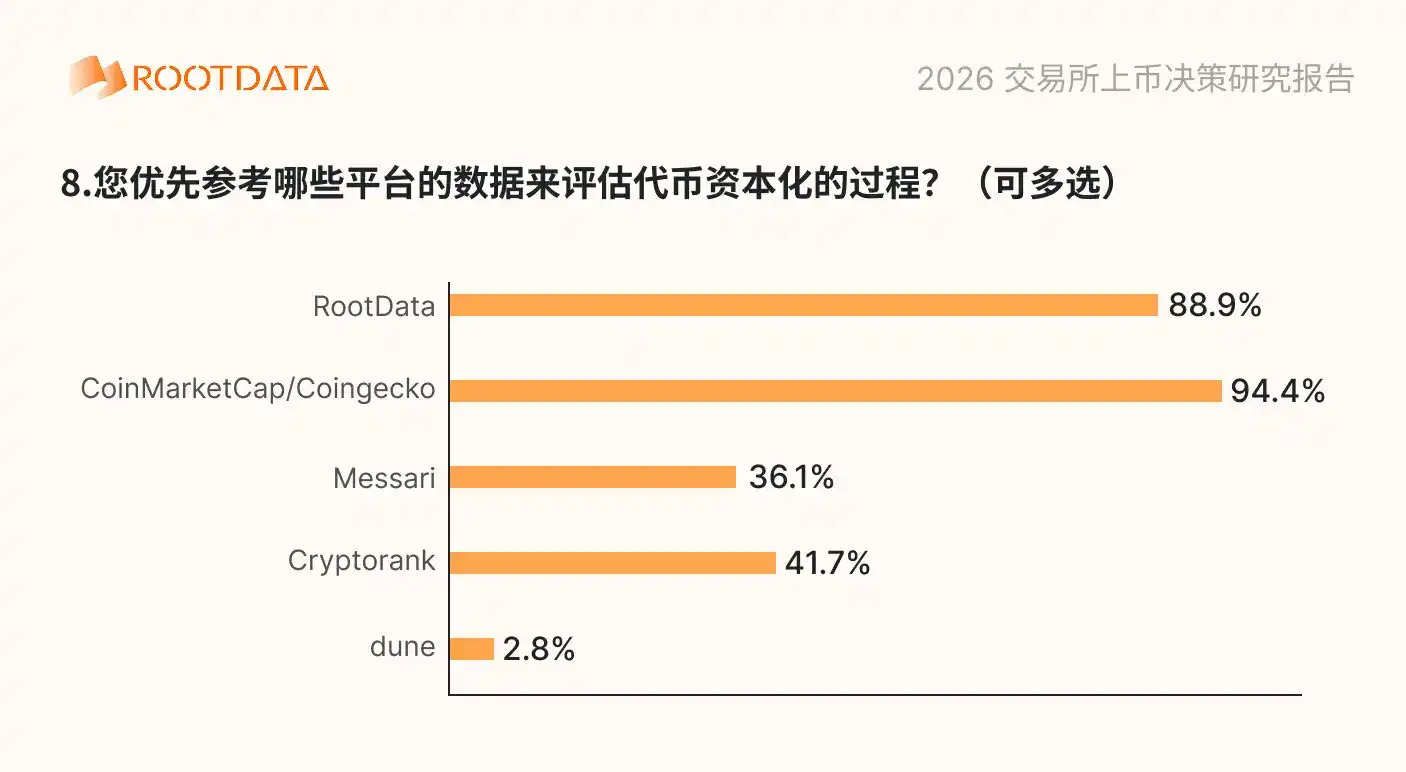
88.9% of respondents stated they choose to reference RootData's data, making it a "desktop essential" tool for exchange Listing teams. This is particularly evident for projects with lower token capitalization (primarily those with their first TGE or not yet listed on major global crypto exchanges). This high penetration rate signifies that the data structure and quality control established by RootData for Web3 projects are becoming an industry standard. For projects with very high token capitalization, 94.4% of respondents会选择 Coingecko or Coinmarketcap platforms for data cross-verification.

Efficiency Boost from Detailed Project Information
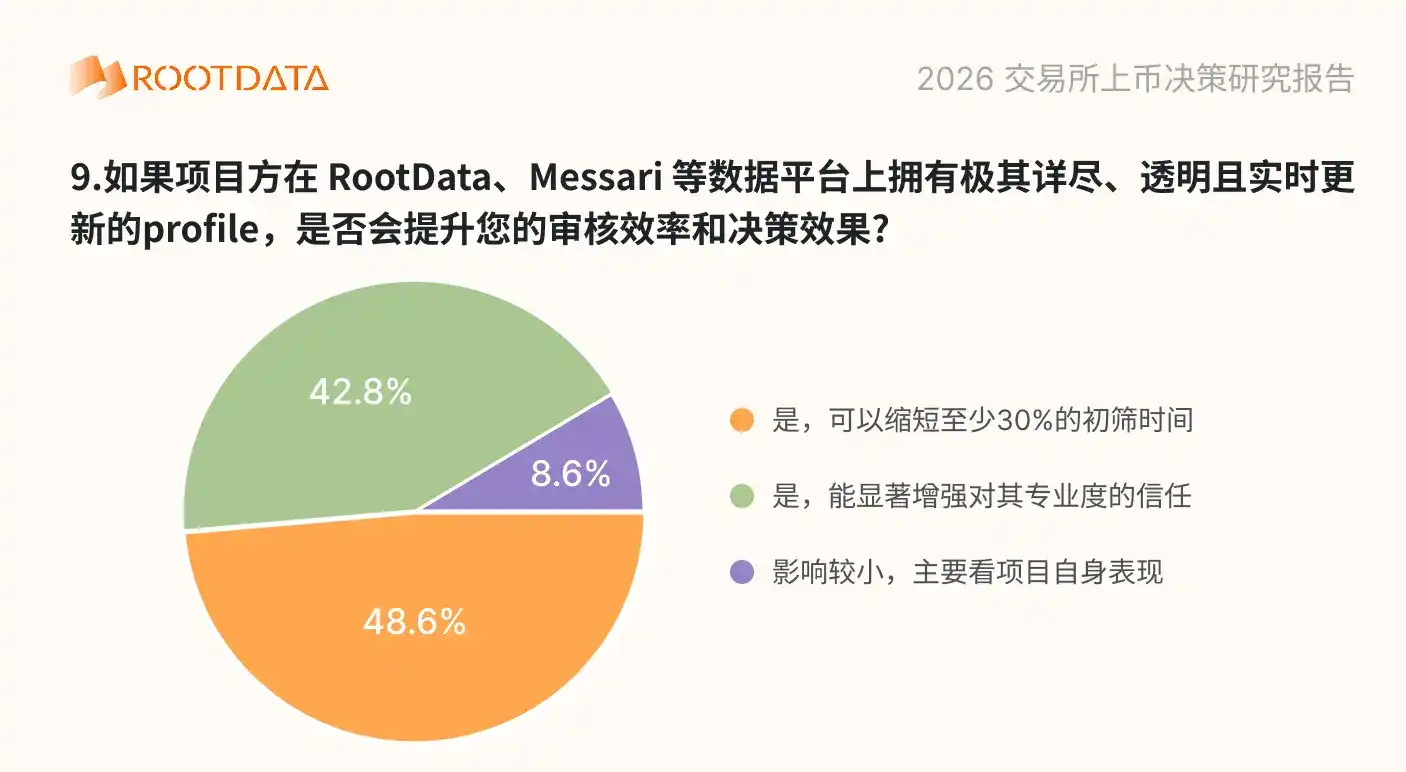
91.4% of respondents explicitly stated that a project being listed on authoritative third-party data platforms like RootData and Crunchbase with detailed information will significantly improve Listing efficiency and好感度,至少可以带来 30% 的审核效率的提升 (at least bringing a 30% improvement in review efficiency).

The Role of Data Platforms in Web3 Development

Only 2.7% of respondents believe projects do not need to focus on data transparency. Listing, being one of the most mysterious links in the industry, has over 80.6% of users agreeing that data platforms are very important for their Listing decisions. This further indicates that whether a project values data information disclosure will directly affect the effectiveness and efficiency of its capitalization.

Summary

The survey results reflect that over half of the professionals in exchange listing departments regard project information transparency as a crucial part of the listing review process, especially information regarding institutional investors, valuation, team, and product roadmap. Sufficient information transparency on third-party data platforms can effectively speed up the review progress (by over 30%), while the review cycle for projects with low transparency will be prolonged.

In the current state of industry development, a large number of projects are陷入 "launching the token only for it to break issue price immediately"窘境, and users have lost trust in the vast majority of crypto projects. The reasons include both the projects' own lack of highlights and reliable business models, as well as many projects being in an information-opaque "black box" state. The disclosure status of a project's core information has become one of the core factors affecting its capitalization progress and effectiveness.


Preguntas relacionadas

QWhat percentage of survey respondents are directly involved in or make decisions about exchange listings?

AOver 69% of respondents are directly involved in or make decisions regarding exchange listings.

QWhat is considered the most expensive hidden cost for exchanges during the listing process, according to the report?

A"Trust cost" is considered the most expensive hidden cost for exchanges, as data uncertainty leads to repeated backtracking in the decision-making process.

QWhich data platform is used by the vast majority (88.9%) of listing teams for reference, especially for projects with low token capitalization?

A88.9% of respondents use RootData as a reference, making it a 'desktop essential' tool for exchange listing teams, particularly for projects with low token capitalization.

QHow does having detailed information on authoritative third-party data platforms like RootData impact the listing efficiency?

A91.4% of respondents stated that having detailed information on platforms like RootData significantly improves listing efficiency and favorability, increasing audit efficiency by at least 30%.

QWhat are the 'mandatory dimensions' or core information that form the credit foundation for a Web3 project during listing reviews?

AThe 'mandatory dimensions' include institutional investors, valuation, team, product roadmap, and the asset's historical evolution, which form the credit foundation for a Web3 project.

Lecturas Relacionadas

U.S. Stock Market Trend: Nasdaq Plunges 3.5% Intraday Before a Remarkable Recovery, All Eyes on CPI Tomorrow

"US Stock Market Trends: Nasdaq Plunges 3.5% Before Dramatic Recovery, Eyes on Tomorrow's CPI" On Tuesday, US markets experienced a wild swing. The Nasdaq initially surged nearly 0.7% before plummeting to a 3.5% intraday loss following a post by Donald Trump on Truth Social. He stated that Iran had shot down a US Apache helicopter in the Strait of Hormuz and that the US "must...respond." The index, however, staged a remarkable recovery in the final two hours, closing down only 0.97%, as subsequent remarks from Trump and Vice President Vance suggested a potential Iran deal within days. The S&P 500 fell 0.26%, while the Dow Jones gained 0.17%, supported by its non-tech components. This incident marked the first loss of a US military asset since tensions with Iran escalated in late February. Despite the event, crude oil prices fell sharply (WTI -3.93%) due to expectations of a near-term deal, OPEC+ plans to increase output, and fears that strong jobs data could lead to Fed rate hikes. Market attention is now laser-focused on the May CPI data release Wednesday morning. This report is seen as critical evidence for whether hot job growth is fueling inflation and will heavily influence expectations for the Federal Reserve's upcoming meeting. A hotter-than-expected reading could trigger further sell-offs, particularly in tech, while a cooler print could spark a significant rebound. The article notes a clear sector rotation, with money flowing out of tech (Nasdaq down over 5% in a week) into defensive sectors like healthcare and consumer staples. Other assets like gold and Bitcoin also remain under pressure. The overarching sentiment is one of "war fatigue," with markets desperately awaiting concrete results from the prolonged Iran negotiations rather than reacting to each new headline.

marsbitHace 6 min(s)

U.S. Stock Market Trend: Nasdaq Plunges 3.5% Intraday Before a Remarkable Recovery, All Eyes on CPI Tomorrow

marsbitHace 6 min(s)

Second Only to GPUs and Memory: MLCCs Are Becoming the Next Billion-Dollar Windfall for AI Computing Power

After GPU and memory, MLCC (Multi-Layer Ceramic Capacitors) is emerging as the next critical component in AI compute, potentially a multi-billion-dollar market. The article highlights a significant, industry-wide price increase for MLCCs, driven not by inventory cycles but by a fundamental, structural demand surge from AI and automotive sectors. AI servers require exponentially more MLCCs than traditional servers—from 2,000 to over 350,000 units per high-end AI rack—primarily to stabilize power for increasingly powerful, low-voltage GPUs. A key AI server's MLCC cost can reach thousands of dollars, making it the third-largest cost component after GPUs and memory. This demand is compounded by the automotive shift to EVs and advanced ADAS. Supply, however, struggles to keep up. Manufacturing high-end MLCCs involves extreme precision and faces six major barriers: proprietary technology, long customer certification cycles (12-18 months for AI), high capital intensity, patent thickets, specialized talent, and massive scale. Industry capacity grows at only ~10% annually, creating a persistent supply-demand gap projected to last until 2030. Three companies dominate this high-end market. **Murata** (40% global share) is the stable leader. **Samsung Electro-Mechanics** offers the highest growth elasticity with aggressive expansion. **Taiyo Yuden** is the purest MLCC play. While their current P/E ratios appear high, they are expected to compress rapidly as earnings surge, powered by significant pricing power and operational leverage. Key risks include a potential slowdown in AI capex, high valuations, competition from Chinese manufacturers in lower tiers, yen appreciation, and consumer electronics weakness. The article concludes that MLCCs are transforming from a commoditized component into a strategic, capacity-constrained asset essential for the AI-powered future.

marsbitHace 36 min(s)

Second Only to GPUs and Memory: MLCCs Are Becoming the Next Billion-Dollar Windfall for AI Computing Power

marsbitHace 36 min(s)

The First to Bring an AI OS to 1.4 Billion People Might Actually Be WeChat?

WeChat has introduced a significant AI update, allowing mini-program developers to integrate their services with WeChat AI. Developers can choose an "automatic mode," where WeChat AI autonomously analyzes and operates mini-programs without additional coding, or a "development mode" for creating customized skills. This move effectively transforms WeChat's vast ecosystem—including millions of mini-programs, WeChat Pay, and official accounts—into an execution layer for AI. The technical documentation reveals that WeChat's approach aligns with industry standards like MCP (Model Context Protocol) and incorporates practical lessons from AI-agent development. Key design principles include a clear "attention weight" system for API calls and a "fact + action" response structure to ensure reliable operations. Unlike Apple's Siri, which struggles with third-party app integration, WeChat's centralized control over mini-program code provides a "God's-eye view," enabling seamless AI orchestration across services. This development revives the concept of "WeChat OS," where the app could function as a natural-language-operated platform for daily tasks—from booking flights to ordering food—all within a chat interface. While challenges remain in areas like payment security and user trust, WeChat's existing service network and massive user base position it uniquely to advance AI agents from conversation to actionable assistance, potentially making complex tasks feel effortless for its 1.432 billion monthly active users.

marsbitHace 1 hora(s)

The First to Bring an AI OS to 1.4 Billion People Might Actually Be WeChat?

marsbitHace 1 hora(s)

Trading

Spot
Futuros
活动图片