2026 Crypto Narratives to Watch: Who Will Be the Next Star?

深潮Publicado a 2025-12-30Actualizado a 2025-12-30

Resumen

The crypto landscape in 2026 is expected to be shaped by several key narratives. GambleFI, including prediction and information markets like Polymarket and Kalshi, will grow as essential tools for real-world decision-making. Launchpads are making a comeback, with community-led fundraising and ICOs raising over $341 million recently, shifting away from airdrops as the default model. Privacy becomes critical for institutional adoption, with over $500 million invested in privacy-focused dApps and blockchains in 2025, emphasizing selective disclosure. Crypto wallets are evolving into neo-banks, integrating banking features like payments, yield, and compliance. DePINs, after a 2025 slump, are poised for a rebound with proven use cases and revenue, as seen in projects like Helium and Hivemapper. Perpetual DEXs like Hyperliquid and dYdX will continue competing with CEXs by offering capital efficiency and innovative risk management. AI’s role expands beyond trading bots to infrastructure—writing smart contracts, managing risk, and optimizing liquidity. Emerging skills include vibecoding, prompt engineering, and AI-augmented research. Additional trends to watch include x402 (on-chain simplification), bot tokenization, stablecoins, and real-world assets (RWA).

Author:HEADBOY

Compiled by: Deep Tide TechFlow

The development of the crypto industry has always been accompanied by the evolution of trends and narratives. The ability to identify opportunities before these trends fully form is a key skill of many successful players in the crypto space. In this article, I will outline the major narratives that are likely to capture the attention of the crypto community in 2026.

▪️ GambleFI: Prediction and Information Markets

Prediction and information markets have evolved from tools primarily for crypto enthusiasts into vital resources for everyday decision-making.

When people want to judge the truth of an event, they often have to sift through numerous articles, blogs, and social media posts, yet still struggle to find reliable insights. Information markets change this. They not only provide clear views on specific events but also back these views with economic stakes.

Currently, Polymarket and Kalshi are the two giants in this field, capturing most of the market attention and trading volume. However, I believe their potential is not yet fully realized, and more protocols will explore different dynamics within this narrative in the future.

This area is worth close attention, especially because it naturally aligns with the needs of real-world users.

▪️ Launchpads: The Return of Fundraising and ICOs

As airdrops gradually cease to be the default model for community launches, we are likely to see more community-led fundraising activities, starting even from the seed stage, accompanied by a strong comeback of ICOs.

Since October 27, 2025 (62 days ago), over $341.35 million has been raised through community fundraising and community-led financing, with more projects expected to launch in Q1 2026:

  • MegaETH: $50 million

  • Monad: $187.5 million

  • Gensyn: $16.14 million

  • Aztec: $52.31 million

  • Superform: $3 million

  • Vooi: $1.5 million

  • Solomon Labs: $8 million

  • Solstice, Football Fun: $1.5 million

  • Makina: $1.3 million

  • Rainbow: $3 million

  • Immune fi: $5 million

  • Reya Labs: $3 million

  • Humidi fi: $6.1 million

  • Zkpass: $3 million

With the launch of some successful projects, community fundraising is expected to become the default model for community launches, fundamentally changing how projects interact with their communities.

In this process, the biggest winners will be the fundraising platforms that offer the most investor-friendly terms while prioritizing strong protocol economics.

Currently, Legion, MetaDao, Buildpad, Echo, Coinlist, and Kaito are the platforms hosting the most token sales this year.

On November 14, 2025, I analyzed the current state of Launchpads based on their performance:
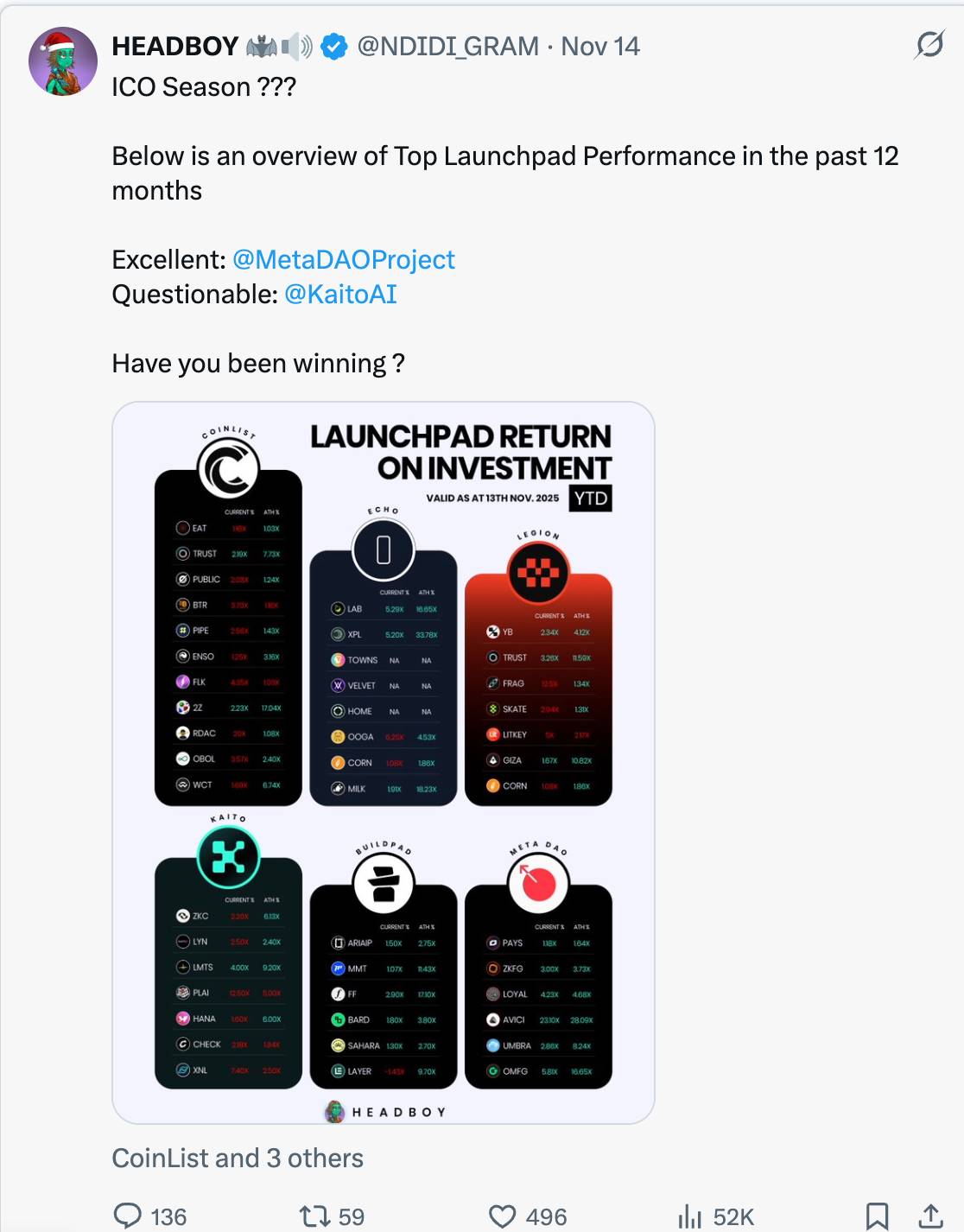
Next year, we are bound to see more new platforms exploring dynamic token issuance models to achieve community fundraising while balancing the interests of investors and protocols. This model will become a new focus of the crypto industry.

▪️ Privacy: The "Stealth" World On-Chain

The lifeblood of the crypto industry is liquidity, and institutions currently control a large portion of it. To attract institutional capital, privacy is no longer an option but a necessity.

Some data simply cannot be made public, such as trading strategies, account balances, counterparty information, or internal fund flows, especially under the watchful eyes of competitors.

The next phase of on-chain applications will not be about merely hiding activities but achieving selective disclosure: proving legitimacy without exposing all information. This is the only way to attract serious capital on-chain.

Since the beginning of 2025, over 44 privacy-focused dApps and blockchain projects have received funding, with a cumulative financing amount exceeding $500 million, clearly indicating the rapid growth in demand for privacy-first applications.

Looking ahead to 2026, we are likely to see more such projects emerge, and existing protocols will unleash their full potential as privacy gradually shifts from a niche feature to a core requirement.

▪️ Digital Asset Neo-Banks: The Full Upgrade of Wallets

The crypto industry has outgrown traditional wallet functionality.

Tools used solely for storage and transfers no longer meet the demand. As more capital, protocols, and real-world businesses operate on-chain, the gap is evident: there is still a lack of a true bridge connecting wallets with complete financial workflows.

Next year, the industry's focus will shift from single-function wallets to wallet-native digital asset neo-banks. These products integrate custody, payments, yield, reporting, and compliance into a single interface.

This is not about replacing traditional banks but upgrading wallets into financial infrastructure.

This year, @Revolut led by a wide margin in overall attention, while newcomer @AviciMoney performed exceptionally well, raising only $3.5 million through community fundraising but still delivering impressive results.

In the future, we are likely to see more similar applications emerge, especially those that offer utility not only to crypto-native users (CT Natives) but also attract a broader user base.

▪️ DePINs: The Decentralized Future of IoT

We witnessed the rise of Decentralized Physical Infrastructure (DePINs) in 2024, followed by a sharp decline in 2025. However, I believe next year will be the time for its full potential to be unleashed.

Projects like Helium have proven that distributed connectivity can operate at scale; Hivemapper has shown that crowdsourced maps can compete with traditional giants; Render has pushed decentralized computing into real demand cycles. Emerging networks like Grass are turning idle resources into measurable economic output.

More interestingly, venture capital firms (VCs) continue to invest in these infrastructures, and some well-known projects have not only maintained usage but also successfully converted it into revenue sources.
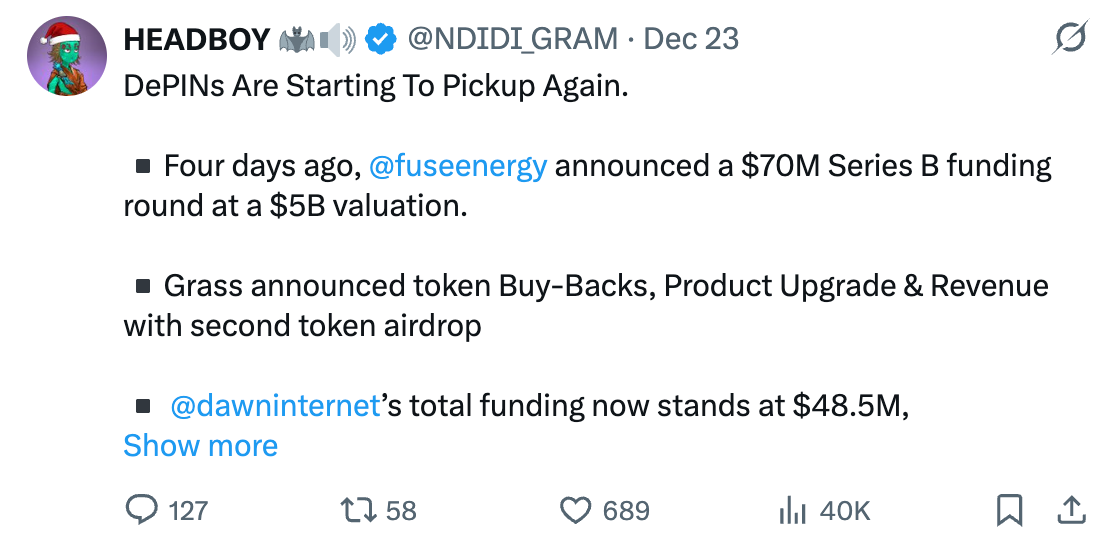
What was once seen as a "narrative of tokenized hardware disguised as malware" is gradually transforming into networks with real users, practical use cases, and revenue. The industry is clearly shifting toward products with real utility and profitability, and this is where DePINs (Decentralized Physical Infrastructure) stand out.

▪️ Perpetual DEXs: The Future of the Derivatives Market

This year, Perpetual Decentralized Exchanges (Perpetual DEXs) dominated the crypto trading narrative, and this trend is far from over.

Platforms like Hyperliquid, dYdX, Lighter, and Aster have proven that perpetual contracts can generate significant trading volume and fee income, even competing with centralized exchanges.

Looking ahead to next year, the ultimate winners will not just be the DEX platforms with the highest trading volumes but those that offer capital-efficient products, low slippage, and innovative risk management. Such platforms will make derivative trading more accessible to both retail and institutional investors.

▪️ AI: The Crypto Evolution of Artificial Intelligence

In recent years, artificial intelligence (AI) has already dominated the broader internet landscape, and it is only a matter of time before it sparks a similar transformation in the crypto space.

We have already witnessed individuals using AI tools to "vibe-code" DeFi applications from scratch and successfully launch them, demonstrating how rapidly AI tools are advancing.

However, AI's role in the crypto industry goes far beyond trading bots or signal analysis. The real transformation will occur when AI becomes infrastructure—writing smart contracts, managing risk, optimizing liquidity, and running protocols faster and at lower costs than humans.

It is foreseeable that AI will emerge as a major narrative in the crypto industry, growing only more important over time. This is an area worth watching closely.

Before 2026 arrives, you should familiarize yourself with the following emerging AI skills:

  • Vibecoding

  • Prompting

  • AI-Augmented Research

  • Automation

Additionally, some other narratives worth watching include:

x402: On-Chain Simplification

Bots: Tokenized Automated Systems

Stablecoins: Tokenized Fiat

Real-World Assets (RWA)

The future of the crypto industry is bright. I believe 2026 will be a year of adventure for those curious about the future of crypto. Look forward to meeting you on the side of wealth creation!


Preguntas relacionadas

QWhat are the main narratives that could lead the focus of the crypto community in 2026 according to the article?

AThe main narratives are GambleFI (prediction and opinion markets), Launchpads (fundraising and the return of ICOs), Privacy (on-chain selective disclosure), Digital Asset Neo-Banks (wallet upgrades), DePINs (decentralized physical infrastructure), Perpetual DEXs (derivatives market), and AI (crypto evolution).

QWhich two platforms are mentioned as the current leaders in the prediction and opinion markets space?

APolymarket and Kalshi are mentioned as the two giants dominating the prediction and opinion markets.

QHow much total capital was raised through community fundraising and community-led financing since October 27, 2025, as stated in the article?

AOver $341.35 million was raised through community fundraising and community-led financing since October 27, 2025.

QWhy is privacy considered a necessity rather than an option for attracting institutional capital to crypto?

APrivacy is a necessity because institutions need to protect sensitive data like trading strategies, account balances, counterparty information, and internal fund flows from competitors, and the next phase requires selective disclosure to prove legitimacy without exposing all information.

QWhat shift does the article predict for wallets in the crypto industry for the coming year?

AThe article predicts a shift from single-function wallets to native digital asset neo-banks that integrate custody, payments, yield, reporting, and compliance into a single interface, upgrading wallets into financial infrastructure.

Lecturas Relacionadas

U.S.-Iran Ceasefire: How Much of a Bitcoin Rally Can a Truce Agreement Support?

Headline: "U.S.-Iran Truce: How Much Can a Ceasefire Agreement Propel Bitcoin's Rebound?" On June 15th, Bitcoin rebounded to around $67,255, marking its first return to the $67,000 level since falling below $60,000 earlier in June. Ethereum and Solana also saw significant gains. The immediate driver for this market-wide recovery in crypto and global risk assets was the signing of a U.S.-Iran ceasefire memorandum, with a formal ceremony scheduled for June 19th. The agreement, which includes reopening the Strait of Hormuz, caused oil prices to plunge roughly 5%, easing inflation expectations and boosting prospects for Federal Reserve rate cuts. This macroeconomic shift fueled a rally in U.S. equities, with the Dow Jones hitting a record high. SpaceX's spectacular post-IPO performance further energized market sentiment. However, on-chain and derivatives data from Glassnode suggest this move is more indicative of a technical rebound from deeply oversold conditions rather than a confirmed trend reversal. The crypto market is undergoing noticeable capital rotation. While Bitcoin ETFs recently saw their worst outflows on record, the bleeding has slowed significantly. Meanwhile, new altcoin ETFs for assets like XRP and Solana are attracting substantial inflows, causing Bitcoin's market dominance to drop to 58%. Despite the rebound, the Crypto Fear & Greed Index remains in "Extreme Fear" territory at 22. The price quickly retreated after touching the $67,000 resistance level, indicating selling pressure persists. Analysis shows short-term speculative supply has been heavily washed out, with holder structure shifting toward a more long-term profile. While panic is subsiding and some on-chain metrics point to accumulation at lower prices, the market currently lacks the strong, sustained institutional buying needed to establish a new bullish trend.

Foresight NewsHace 11 min(s)

U.S.-Iran Ceasefire: How Much of a Bitcoin Rally Can a Truce Agreement Support?

Foresight NewsHace 11 min(s)

Copper, the Gold of 2026

Copper: The New Gold for 2026? Market focus has shifted from AI chips to underlying infrastructure, with copper emerging as a key narrative. Its role is evolving beyond "Dr. Copper"—a traditional indicator of economic cycles—due to structural demand growth from AI data centers (requiring massive electrical infrastructure), grid expansion, EVs, and re-industrialization. Estimates suggest data centers alone could require 300,000 tons of copper by 2050. The core bullish thesis is not just demand but a severe supply constraint. New copper mines take ~17 years to develop, while ore grades are declining and new discoveries are scarce, potentially leading to a 30% supply deficit by 2035. This supply rigidity, coupled with strategic importance, is giving copper a "gold-like" scarcity narrative. Major macro investors, including Stanley Druckenmiller, are allocating to copper as a hedge against dollar weakness and for its exposure to energy transition and geopolitics. Traders like Pierre Andurand have projected prices could reach $40,000/ton. Capital inflows are visible in surging futures trading volumes. Copper mining stocks act as leveraged plays on copper prices. Companies like Freeport-McMoRan (FCX) and Southern Copper (SCCO), as well as Chinese miners like CMOC, have seen significant volatility, offering high upside but also steep drawdowns, reflecting operational and geopolitical risks. While copper remains cyclical and won't fully replicate gold's monetary role, its long-term fundamentals have shifted. Its new scarcity premium, driven by a tightening supply structure and expanding electrical demand, suggests its "goldification" is just beginning.

marsbitHace 18 min(s)

Copper, the Gold of 2026

marsbitHace 18 min(s)

pump.fun's New Feature Brings 'Black Mirror' Into Reality

The article begins by recounting a dark fictional story from *Black Mirror* (Season 7, Episode 1 "Common People"), where a man is forced to perform humiliating tasks online to pay for his wife's life-sustaining medical subscription. It then draws a parallel to a new real-world feature on the crypto platform pump.fun called "Pump.fun Go," which allows users to post and complete paid bounty tasks. This feature gained mainstream attention, often negatively, through extreme examples. A prominent case involved a bounty of 40 SOL (~$2,600) offered to permanently tattoo "$bountywork" on one's forehead. An Indian man completed the task, stating the money "changed his life," and later earned significantly more from a related meme coin. Another bounty paid 200 SOL (~$14,000) for a "bounty.fun" forehead tattoo, with the participant simply stating, "We need the money." The article highlights how this system can amplify darkness, citing the dev behind $Bountywork who spent thousands on bounties for attention-grabbing stunts like eating bugs or drinking hot sauce for small sums. It compares this to past tragic live-streaming incidents where people harmed themselves for money, noting regulation cannot stop those in desperate need. However, it also points to positive, altruistic bounties that have emerged, such as organizing anti-work rallies in New York, performing random acts of kindness for strangers, organizing community food drives, or even helping an elderly person cross the street. The piece concludes by acknowledging the platform reflects both the dark and light sides of human nature when actions are given a price, hoping for more of the latter.

marsbitHace 23 min(s)

pump.fun's New Feature Brings 'Black Mirror' Into Reality

marsbitHace 23 min(s)

Trading

Spot
Futuros
活动图片