2026 Crypto Narratives to Watch: Who Will Be the Next Star?

marsbitPublicado a 2025-12-30Actualizado a 2025-12-30

Resumen

Crypto Narratives to Watch in 2026: Key Trends and Opportunities The crypto industry continues to evolve through narratives and trends. Identifying these early is crucial for success. Key narratives expected to shape 2026 include: - **GambleFi**: Prediction and information markets like Polymarket and Kalshi are becoming essential tools for real-world decision-making, offering economically-backed insights. - **Launchpads**: Community-led fundraising and ICOs are making a strong comeback, with over $341M raised recently. Platforms like Legion, MetaDao, and Coinlist are leading this shift toward investor-friendly and protocol-economy focused sales. - **Privacy**: With institutional capital demanding confidentiality, privacy is no longer optional. Over $500M has been invested in privacy-focused dApps and chains in 2025. Selective disclosure—proving legitimacy without exposing data—will be critical. - **Crypto Neo-Banks**: Wallets are evolving into full financial interfaces integrating custody, payments, yield, reporting, and compliance. Projects like Revolut and Avici are pioneering this shift. - **DePIN**: After a 2025 slump, decentralized physical infrastructure networks like Helium, Hivemapper, and Render are gaining real traction with measurable usage and revenue, attracting continued VC interest. - **Perp DEXs**: Platforms like Hyperliquid and dYdX are proving that decentralized perpetual exchanges can compete with CEXs in volume and fees. The winners will offer capit...

Author:HEADBOY

Compiled by: Deep Tide TechFlow

The development of the crypto industry has always been accompanied by the evolution of trends and narratives. The ability to identify opportunities before these trends fully form is a key skill of many successful players in the crypto space. In this article, I will outline the major narratives that are likely to capture the attention of the community in 2026.

▪️ GambleFI: Prediction and Opinion Markets

Prediction and opinion markets have evolved from tools primarily for crypto enthusiasts into vital resources for everyday decision-making.

When people want to determine the truth of an event, they often have to sift through numerous articles, blogs, and social media posts, yet still struggle to find reliable insights. Opinion markets change this. They not only provide clear views on specific events but also back these views with economic stakes.

Currently, Polymarket and Kalshi are the two giants in this field, capturing most of the market attention and trading volume. However, I believe their potential is not yet fully realized, and more protocols will explore different dynamics within this narrative.

This area is worth close attention, especially because it naturally aligns with the needs of real-world users.

▪️ Launchpads: The Return of Fundraising and ICOs

As airdrops gradually cease to be the default model for community launches, we are likely to see more community-led fundraising activities, starting even from the seed stage, accompanied by a strong comeback of ICOs.

Since October 27, 2025 (62 days ago), over $341.35 million has been raised through community fundraising and community-led initiatives, with more projects expected to launch in Q1 2026:

  • MegaETH: $50 million

  • Monad: $187.5 million

  • Gensyn: $16.14 million

  • Aztec: $52.31 million

  • Superform: $3 million

  • Vooi: $1.5 million

  • Solomon Labs: $8 million

  • Solstice, Football Fun: $1.5 million

  • Makina: $1.3 million

  • Rainbow: $3 million

  • Immune fi: $5 million

  • Reya Labs: $3 million

  • Humidi fi: $6.1 million

  • Zkpass: $3 million

With the launch of some successful projects, community fundraising is expected to become the default model for community launches, fundamentally changing how projects interact with their communities.

In this process, the biggest winners will be the fundraising platforms that can offer the most investor-friendly terms while prioritizing strong protocol economics.

Currently, Legion, MetaDao, Buildpad, Echo, Coinlist, and Kaito are the platforms that have hosted the most token sales this year.

On November 14, 2025, I analyzed the current state of Launchpads based on their performance:

Next year, we are bound to see more new platforms exploring dynamic token issuance models to achieve community fundraising while balancing the interests of investors and protocols. This model will become a new focus in the crypto industry.

▪️ Privacy: The "Stealth" World On-Chain

The lifeblood of the crypto industry is liquidity, and institutions currently control a significant portion of it. To attract institutional capital, privacy is no longer an option but a necessity.

Some data simply cannot be made public, such as trading strategies, account balances, counterparty information, or internal fund flows, especially under the watchful eyes of competitors.

The next phase of on-chain applications will not be about merely hiding activities but achieving selective disclosure: proving legitimacy without exposing all information. This is the only way to attract serious capital on-chain.

Since early 2025, over 44 privacy-focused dApps and blockchain projects have received funding, with a cumulative fundraising amount exceeding $500 million, clearly indicating the rapid growth in demand for privacy-first applications.

Looking ahead to 2026, we are likely to see more such projects emerge, while existing protocols will unlock their full potential as privacy gradually shifts from a niche feature to a core requirement.

▪️ Neo-Banks for Digital Assets: The Full Upgrade of Wallets

The crypto industry has outgrown traditional wallet functionalities.

Tools used solely for storage and transfers are no longer sufficient. As more capital, protocols, and real-world businesses operate on-chain, the gap is evident: there is still a lack of a true bridge connecting wallets with complete financial workflows.

Next year, the industry's focus will shift from single-function wallets to wallet-native neo-banks for digital assets. These products will integrate custody, payments, yield, reporting, and compliance into a single interface.

This is not about replacing traditional banks but upgrading wallets into financial infrastructure.

This year, @Revolut led the pack in overall attention, while newcomer @AviciMoney performed exceptionally well, raising only $3.5 million through community fundraising but still delivering impressive results.

In the future, we are likely to see more such applications emerge, especially those that offer utility not only to crypto-native users (CT Natives) but also to a broader audience.

▪️ DePINs: The Decentralized Future of the Internet of Things

We witnessed the rise of Decentralized Physical Infrastructure (DePINs) in 2024, followed by a sharp decline in 2025. However, I believe next year will be when it fully realizes its potential.

Projects like Helium have proven that distributed connectivity can operate at scale; Hivemapper has shown that crowdsourced maps can compete with traditional giants; Render has pushed decentralized computing into real demand cycles. Emerging networks like Grass are turning idle resources into measurable economic output.

Even more interestingly, venture capital firms (VCs) continue to invest in these infrastructures, and some well-known projects have not only maintained usage but also successfully converted it into revenue streams.
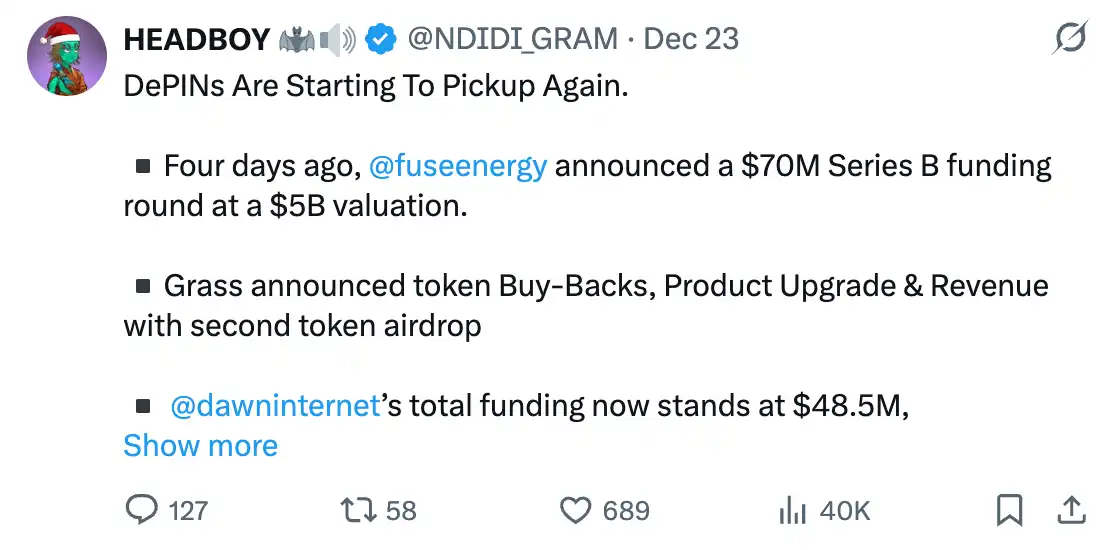
What was once seen as a "narrative of tokenized hardware disguised as malware" is gradually transforming into networks with real users, practical use cases, and revenue. The industry is clearly shifting toward products with genuine utility and profitability, and this is where DePINs (Decentralized Physical Infrastructure) stand out.

▪️ Perpetual DEXs: The Future of the Derivatives Market

This year, Perpetual Decentralized Exchanges (Perpetual DEXs) dominated the crypto trading narrative, and this trend is far from over.

Platforms like Hyperliquid, dYdX, Lighter, and Aster have proven that perpetual contracts can generate significant trading volume and fee revenue, even competing with centralized exchanges.

Looking ahead to next year, the ultimate winners will not just be the DEX platforms with the highest trading volumes but those that offer capital-efficient products, low slippage, and innovative risk management. Such platforms will make derivative trading more accessible to both retail and institutional investors.

▪️ AI: The Crypto Evolution of Artificial Intelligence

In recent years, artificial intelligence (AI) has already dominated the broader internet landscape, and it is only a matter of time before it sparks a similar transformation in the crypto space.

We have already seen individuals use AI tools to "vibe-code" DeFi applications from scratch and successfully launch them, demonstrating how rapidly AI tools are advancing.

However, AI's role in the crypto industry goes far beyond trading bots or signal analysis. The real revolution will occur when AI becomes infrastructure—writing smart contracts, managing risk, optimizing liquidity, and running protocols faster and at a lower cost than humans.

It is foreseeable that AI will emerge as a major narrative in the crypto industry, growing only more important over time. This is an area worth watching closely.

Before 2026 arrives, you should familiarize yourself with the following emerging AI skills:

  • Vibecoding

  • Prompting

  • AI-Augmented Research

  • Automation

Additionally, here are some other narratives worth watching:

x402: On-Chain Simplification

Bots: Tokenized Automated Systems

Stablecoins: Tokenized Fiat

Real-World Assets (RWA)

The future of the crypto industry is bright. I believe 2026 will be a year of adventure for those curious about the future of crypto. Look forward to meeting you on the side of wealth creation!


Preguntas relacionadas

QWhat are the two major players in the prediction and opinion markets mentioned in the article?

AThe two major players in the prediction and opinion markets are Polymarket and Kalshi.

QAccording to the article, what is the total amount of funds raised through community-led fundraising since October 27, 2025?

AOver $341.35 million has been raised through community-led fundraising since October 27, 2025.

QWhy is privacy considered a necessity, not an option, for attracting institutional capital to crypto?

APrivacy is a necessity because institutions need to protect sensitive data such as trading strategies, account balances, counterparty information, and internal fund movements from competitors, which cannot be made public.

QWhat is the key shift in the wallet narrative for 2026, as described in the article?

AThe key shift is from single-function wallets to native digital asset neo-banks that integrate custody, payments, yield, reporting, and compliance into a single interface.

QWhich four emerging AI skills should one be familiar with before 2026, according to the author?

AThe four emerging AI skills are Vibecoding, Prompting, AI-Augmented Research, and Automation.

Lecturas Relacionadas

Quantum Computing "Manhattan Project" Unveiled: Is the Encryption Industry at a Critical Turning Point?

"Quantum Computing 'Manhattan Project' Launched: Is the Crypto Industry at a Critical Juncture?" On June 22, former U.S. President Donald Trump signed two executive orders. The first mandates all federal agencies upgrade their cryptographic systems to new, quantum-resistant standards by 2030. The second orders the Department of Energy to lead the development of a national quantum computer, signaling a shift from laboratory research to a state-enforced national agenda. This creates a hard deadline. A powerful quantum computer could break current encryption. The threat is compounded by "harvest now, decrypt later" attacks, where encrypted data is stored today for future decryption. Federal agencies must appoint migration officers and complete post-quantum cryptography (PQC) upgrades for key establishment by 2030 and digital signatures by 2031. Procurement rules will also be changed, forcing government contractors to comply. The crypto industry faces a direct threat. Bitcoin's ECDSA signatures are theoretically vulnerable. Research indicates millions of Bitcoin with exposed public keys are at risk if quantum computers advance. While projects like Bitcoin Quantum testnets and efforts by Ethereum, Solana, NEAR, and Zcash are exploring quantum-resistant solutions, achieving consensus in decentralized networks remains a major challenge. The centralized U.S. government has started a 5-year countdown. For decentralized crypto networks, the real test is whether they can complete this anti-quantum upgrade before the theoretical threat becomes a practical reality.

Foresight NewsHace 20 min(s)

Quantum Computing "Manhattan Project" Unveiled: Is the Encryption Industry at a Critical Turning Point?

Foresight NewsHace 20 min(s)

Coin Stock Barometer丨BitMine's Total Assets and Investment Reach $10.7 Billion, Exceeding ~$9.3 Billion Floating Loss; Strategy Buys Only 520 BTC, Strive Adds Positions Against the Trend (June 23)

This article provides a weekly market update on "coin-equity" trends, focusing on listed companies holding major cryptocurrencies. Key highlights include: **General Market Trends:** Global equities, particularly in the US, Japan, and South Korea, faced significant sell-offs, led by large tech and AI-related stocks. Analysts cite profit-taking and a shift from hype-driven to performance-driven valuation for AI companies. Market focus is on upcoming Micron Technology's earnings. **Cryptocurrency Treasury Updates:** * **Bitcoin (BTC):** Net weekly BTC purchases by listed companies (excluding miners) totaled approximately $86 million, down 13.97% from the prior week. Strategy (formerly MicroStrategy) purchased only 520 BTC for ~$34.9 million, while Strive Asset Management increased its holdings by 759 BTC for ~$50 million. Other notable actions include Mara Holdings adding 1,000 BTC and Capital B shareholders approving a massive financing plan (up to ~$1.2 trillion) to potentially expand its Bitcoin reserves. * **Ethereum (ETH):** BitMine emerged as the largest corporate ETH treasury, holding 5.67 million ETH (4.7% of supply). It purchased an additional 52,203 ETH ($92 million) in the past week. Sharplink completed a $75 million private placement to fund further ETH accumulation and stock buybacks. * **Solana (SOL):** The top five listed companies hold over 15.7 million SOL combined. However, Solmate Infrastructure, a SOL treasury firm, faces a lawsuit from its largest external shareholder alleging board misconduct and self-dealing. * **Other:** Updates include Canton Strategic's $50 million stock buyback plan and Lite Strategy's $1 million strategic investment in LitVM, a Layer-2 network for Litecoin. The article notes that while crypto treasury firms continue fundraising and accumulation, their stocks may struggle to rise against the broader market downturn until Q4.

marsbitHace 34 min(s)

Coin Stock Barometer丨BitMine's Total Assets and Investment Reach $10.7 Billion, Exceeding ~$9.3 Billion Floating Loss; Strategy Buys Only 520 BTC, Strive Adds Positions Against the Trend (June 23)

marsbitHace 34 min(s)

OpenAI Partners with PE Firms, Investing $4 Billion. Let's Talk About Silicon Valley's Hottest New Role: FDE.

The hottest new role in Silicon Valley is the Forward Deployment Engineer (FDE), a hybrid of engineer and business consultant whose core mission is to transform AI demos into native, practical workflows within client organizations. The recent surge in demand is driven by a strategic shift from leading AI companies. OpenAI, partnering with 19 private equity firms in a $4 billion investment, formed a Deployment Company and acquired Tomoro along with its 150 FDEs. Anthropic also announced a $1.5 billion joint venture with financial institutions like Blackstone. The article, based on interviews with industry experts Jove (FDE lead at Cresta) and Oliver (VP at Invisible Technologies, ex-McKinsey), explores the FDE role and the rise of deployment-focused companies. Key insights include: **The FDE Role:** Jove describes an FDE as a "Forward Deployed CTO"—a technically strong engineer who works intimately with clients to implement AI solutions, learn from the process, and feed those insights back to improve the core product. They require expertise in AI agents, client-facing experience, resilience, and the ability to handle complex, imperfect systems. While AI tools enhance their efficiency, the role's complexity makes full automation a distant prospect. **Industry Shift:** Model companies are moving beyond selling tools to ensuring real-world adoption. This blurs the line between model and application companies. Collaborations with private equity (PE) firms are key, providing access to large portfolios of traditional businesses needing AI transformation. For PE firms, these partnerships offer signal value to LPs, create tangible value in portfolio companies, and provide exposure to high-growth AI assets. **Consulting & Transformation:** AI deployment involves deep, customized workflow redesign, moving beyond simple tool augmentation. Companies like Invisible Technologies build modular platforms to create bespoke, AI-native workflows for clients. While traditional consulting will see growth in helping businesses rethink their models for AI, the real value is captured by firms that leave behind transformed, operational systems. Critical success factors include building robust data foundations and strategically deciding which workflow steps should be deterministic versus AI-driven. The ultimate goal shifts from pure cost-cutting to unlocking new revenue opportunities previously impossible without AI-scale capabilities.

marsbitHace 46 min(s)

OpenAI Partners with PE Firms, Investing $4 Billion. Let's Talk About Silicon Valley's Hottest New Role: FDE.

marsbitHace 46 min(s)

Trading

Spot
Futuros
活动图片