2026 Crypto Narrative Predictions: Reputation Dominance, ICO Revival, and Neo-Banking, with Stablecoins as the Ultimate Winner

marsbitPublicado a 2026-01-08Actualizado a 2026-01-08

Resumen

The article predicts three major narratives for the crypto space in 2026: reputation, the revival of ICOs, and the rise of crypto neobanks. In an AI-dominated landscape, reputation will become a critical differentiator between humans and bots, serving as a trust filter to identify credible actors and deter bad behavior, sybil attacks, and impersonators. ICOs are expected to make a comeback amid clearer regulations. Unlike past failures and recent flawed models like low-float, high-FDV VC launches, a new wave of reputation-based ICOs could foster the next generation of major crypto projects. Crypto neobanks will challenge traditional finance by offering self-custody accounts, yield-earning opportunities, and instant cross-border stablecoin payments. While no clear winners have emerged, stablecoins may ultimately benefit the most from this shift.

Author:Wazz

Compiled by: Deep Tide TechFlow

Reputation

Whether driven by InfoFi, the desire for "ElonBucks," or the lofty life goal of becoming a Key Opinion Leader (KOL) in the crypto space, it's undeniable that our Crypto Twitter (CT) feeds, your favorite token airdrop campaigns, and the testnets you're "farming" are already been flooded with bots. As AI technology continues to advance, this situation will only intensify.
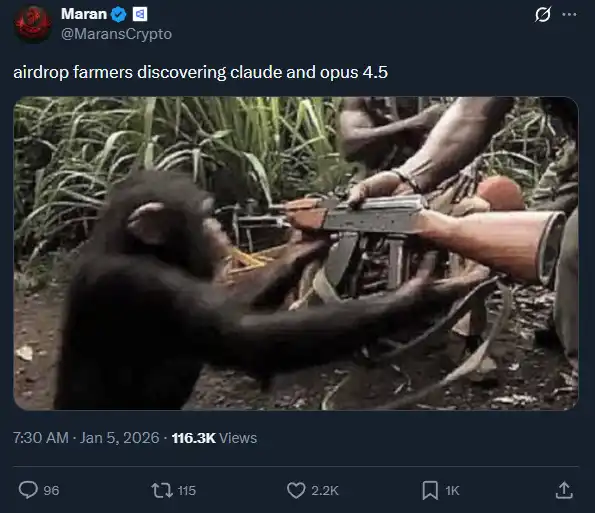
In this chaotic, AI-driven dystopian world, only one thing can distinguish real humans from bots. And no, it doesn't require handing over your biometrics to those "trustworthy" French developers.

That thing is "Reputation." It cannot be replicated by bots (any bot) because it requires hundreds or even thousands of hours to build and can only be maintained through meaningful social connections. It's called "Reputation." And no, you can't have Grok dress it up in a bikini to embellish it.
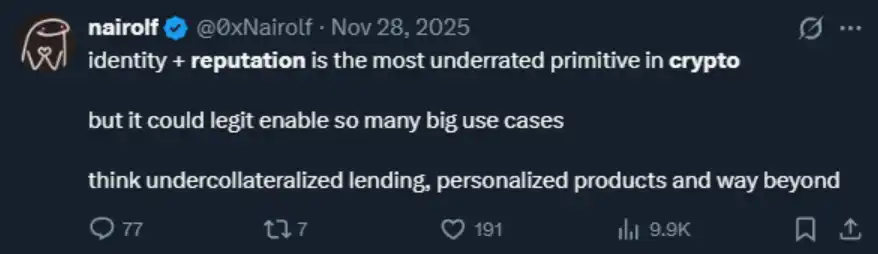
Reputation is an unshakable filter; no matter how much your "binary friends" (referring to bots) flatter in the comments, they ultimately cannot pass this threshold.

It helps you identify bad actors, scammers, and imposters (e.g., @ethos_network); it filters out those who are only there to extract value, sybil attackers, and investors with misaligned incentives (e.g., @legiondotcc); and it allows you to find credible, authentic, and influential voices in the crypto space (e.g., @KaitoAI before the InfoFi craze).

In the age of AI, the importance of reputation will become increasingly prominent. It is not only the key to distinguishing humans from machines but also the cornerstone for ensuring the healthy development of the ecosystem. Therefore, in 2026, reputation will become a dominant topic in the crypto space.

The Revival of ICOs

2017 was a frenzied era for the crypto industry. Driven by a regulatory vacuum, Ethereum's innovative ERC-20 standard, and immense speculative desire, thousands of projects successfully raised funds through what is now widely known as Initial Coin Offerings (ICOs).

This fundraising method was extremely efficient but also became a breeding ground for chaotic scams due to its disorder, eventually being halted by major regulators. However, during that era, major projects like BNB, TRX, and ADA were born and still rank among the top ten cryptocurrencies by market cap today.

The ban on ICOs plunged the crypto industry into a "dark age" and forced the entire sector into an experimental phase regarding token distribution and capital raising.
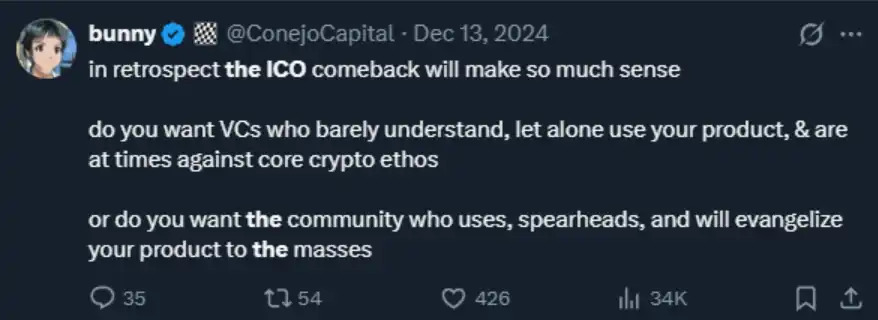
In terms of token distribution, we tried airdrops. Initially, this method achieved good distribution results at low cost and successfully attracted a lot of user attention, but it was eventually overexploited by speculators and industrialized "farmers," draining resources.

In terms of fundraising, we tried the low-circulation, high-FDV (fully diluted valuation) venture capital model. While this method was very beneficial for certain groups (mainly insiders), since most price discovery occurred before the public market, ordinary investors ended up holding the bag, suffering significant losses.
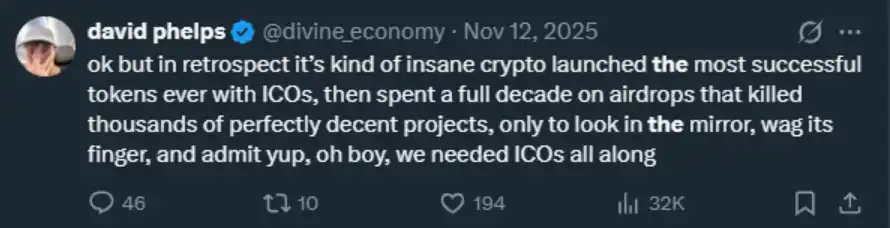
If 2025 is the year of regulatory clarity (which was the main reason ICOs were blocked), then 2026 is likely to become the "Year of the ICO Revival." History may not repeat itself exactly, but it often rhymes—in this new wave of ICOs, we may witness the emergence of some major crypto giants.

This area is becoming one of the most exciting sectors in the crypto industry, with many projects already showing promise, such as the reputation-based ICO project @legiondotcc, as well as @MetaDAOProject and the recently Coinbase-acquired @echodotxyz.

Crypto Neo-Banking

Neobanks have already disrupted traditional banking. Revolut is now one of Europe's most valuable fintech companies, and Nubank is one of the most valuable fintech companies in Latin America. As more digital-native investors emerge, the rise of Crypto Neo-Banking seems natural, especially since it can leverage the same regulatory clarity advantages as ICOs.
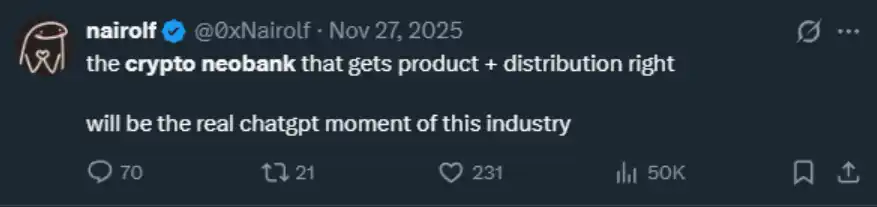
Self-custody accounts, yield-bearing accounts, and direct, instant cross-border stablecoin payments are features that distinguish crypto neo-banks from the traditional banking system.

With the proliferation of stablecoins and the provision of larger, more democratized yield opportunities for holders (no more enduring savings accounts with a mere 0.2% annual interest rate), crypto neo-banks will gradually eat into the market share of traditional finance (TradFi).

Although there are no clear winners yet, and I'm not sure if any tokens will benefit, stablecoins might be the ultimate winner. However, in my view, crypto neo-banking will become one of the most important narratives of 2026.


Preguntas relacionadas

QWhat is predicted to be the dominant narrative in the crypto space by 2026, and why is it considered crucial in the AI era?

AReputation is predicted to be the dominant narrative in the crypto space by 2026. It is considered crucial because it serves as an immutable filter to distinguish real humans from bots, identify bad actors and scammers, and find credible voices in the ecosystem, especially as AI technology advances and bot activity increases.

QWhat event from crypto history is expected to experience a revival in 2026, and what were the two main experimental phases that followed its initial ban?

AThe Initial Coin Offering (ICO) is expected to experience a revival in 2026. The two main experimental phases that followed its initial ban were airdrops (for token distribution) and the low-circulation, high-FDV venture capital model (for fundraising).

QAccording to the article, what are the key features that distinguish crypto neobanks from the traditional banking system?

AThe key features that distinguish crypto neobanks from the traditional banking system are self-custody accounts, yield-bearing accounts, and direct, instant cross-border stablecoin payments.

QWhich asset does the article suggest might be the ultimate winner in the context of the emerging crypto neobanking narrative, and why?

AThe article suggests that stablecoins might be the ultimate winner because their widespread adoption and the ability to provide larger, more democratic yield opportunities for holders will allow crypto neobanks to eat into TradFi's market share.

QName two projects mentioned in the article that are already showing promise in the context of the 'Reputation-based ICO' narrative.

ATwo projects mentioned are @legiondotcc (a reputation-based ICO project) and @MetaDAOProject.

Lecturas Relacionadas

The AI Agent Era Accelerates Its Arrival: Questflow Defines a New Paradigm of Financial Intelligence with On-Chain AI Brokerage

The AI Agent era is accelerating, with the CB Insights AI 100 list highlighting global investment confidence. The focus has shifted from whether AI works to its speed of deployment and ability to manage complex workflows, with autonomous AI Agents driving this transformation. At the forefront is Questflow, a Singapore-based startup redefining financial intelligence through its on-chain AI brokerage. Unlike tools that merely provide data dashboards, Questflow deploys AI Agents that proactively scan markets, form judgments, and execute trades via a conversational interface—operating 24/7 without requiring manual confirmation for each decision. This embodies the new AI paradigm of agents capable of executing multi-step workflows autonomously. Questflow's mission is to democratize institutional-grade trading intelligence. Historically reserved for the ultra-wealthy, this capability is now accessible starting from just $1 through Questflow's "AI Clone + Copy Trade" model. The platform charges only a 1% execution fee, aligning its incentives directly with users and eliminating traditional management or performance fees. The timing is opportune, aligning with key trends identified by CB Insights: the scalable deployment of AI Agents, accelerated AI adoption in financial services, and the maturation of on-chain infrastructure. With robust liquidity on platforms like Hyperliquid and Polymarket, alongside advancements in AI reasoning and non-custodial wallet security, Questflow is positioned to merge the roles of broker, fund, and exchange into a single, accessible platform for millions.

链捕手Hace 33 min(s)

The AI Agent Era Accelerates Its Arrival: Questflow Defines a New Paradigm of Financial Intelligence with On-Chain AI Brokerage

链捕手Hace 33 min(s)

Why Pricing Social Interactions is Doomed to Fail?

Titled "Why Putting a Price on Social Interaction Is Doomed to Fail," this article critiques attempts to monetize social networks directly through SocialFi models, arguing their inevitable failure stems from a fundamental misunderstanding of media dynamics. Using Marshall McLuhan's theory of "hot" and "cold" media, the author posits that social networks are inherently "cold" media. Their value isn't contained in individual posts but is co-created through user participation, interpretation, and fragmented, ongoing interaction (e.g., replies, shares). This ambiguity and need for user involvement are core to their function. The article asserts that SocialFi projects like Friend.tech failed because introducing real-time, tradable financial pricing (a definitive "hot" signal) into this "cold" environment doesn't add a layer—it replaces the medium's essence. The unambiguous price signal overshadows and nullifies the nuanced, participatory social signal. Users become traders, not participants, and when speculative profits vanish, the underlying social ecosystem—never genuinely cultivated—collapses entirely. This principle extends beyond crypto. The author argues platforms like Twitter have gradually "heated up" through metrics (likes, retweets counts, algorithmically defined value), shifting users from participants to performers and eroding organic engagement. The solution isn't to abandon capital but to manage its entry point. Successful models like Substack, Patreon, or Bandcamp allow capital to "condense" at specific, isolated nodes (e.g., subscriptions, one-time payments) without permeating and "heating" every social interaction. They preserve the core "cold," participatory medium while enabling monetization at designated boundaries. The NFT boom and bust serves as a stark parallel: the ancient "cold" medium of collecting (valued for story, community, gradual accumulation) was rapidly destroyed by platforms that introduced real-time floor prices, rarity scores, and trading dashboards, transforming collectors into speculators and vaporizing cultural value when prices fell. The core lesson: "Liquidity equals heat." Injecting high liquidity and definitive pricing into a "cold" participatory medium doesn't optimize it; it fundamentally alters and destroys its value-creating mechanism. The future lies not in pricing every social gesture but in finding precise, non-invasive points for capital to condense without overheating the entire ecosystem.

marsbitHace 41 min(s)

Why Pricing Social Interactions is Doomed to Fail?

marsbitHace 41 min(s)

Trading

Spot
Futuros
活动图片




