2026 Crypto Narrative Predictions: Reputation Dominance, ICO Revival, and Neo-Banking, with Stablecoins as the Ultimate Winner

marsbitPublicado a 2026-01-08Actualizado a 2026-01-08

Resumen

The article predicts three major narratives for the crypto space in 2026: reputation, the revival of ICOs, and the rise of crypto neobanks. In an AI-dominated landscape, reputation will become a critical differentiator between humans and bots, serving as a trust filter to identify credible actors and deter bad behavior, sybil attacks, and impersonators. ICOs are expected to make a comeback amid clearer regulations. Unlike past failures and recent flawed models like low-float, high-FDV VC launches, a new wave of reputation-based ICOs could foster the next generation of major crypto projects. Crypto neobanks will challenge traditional finance by offering self-custody accounts, yield-earning opportunities, and instant cross-border stablecoin payments. While no clear winners have emerged, stablecoins may ultimately benefit the most from this shift.

Author:Wazz

Compiled by: Deep Tide TechFlow

Reputation

Whether driven by InfoFi, the desire for "ElonBucks," or the lofty life goal of becoming a Key Opinion Leader (KOL) in the crypto space, it's undeniable that our Crypto Twitter (CT) feeds, your favorite token airdrop campaigns, and the testnets you're "farming" are already been flooded with bots. As AI technology continues to advance, this situation will only intensify.
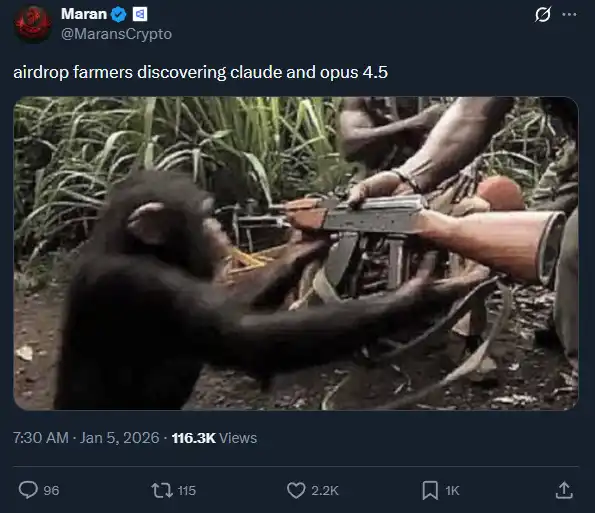
In this chaotic, AI-driven dystopian world, only one thing can distinguish real humans from bots. And no, it doesn't require handing over your biometrics to those "trustworthy" French developers.

That thing is "Reputation." It cannot be replicated by bots (any bot) because it requires hundreds or even thousands of hours to build and can only be maintained through meaningful social connections. It's called "Reputation." And no, you can't have Grok dress it up in a bikini to embellish it.
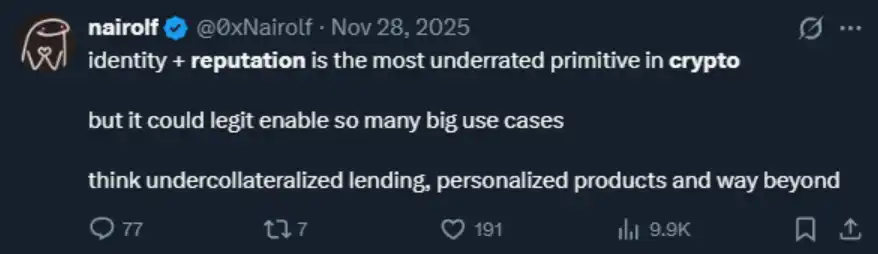
Reputation is an unshakable filter; no matter how much your "binary friends" (referring to bots) flatter in the comments, they ultimately cannot pass this threshold.

It helps you identify bad actors, scammers, and imposters (e.g., @ethos_network); it filters out those who are only there to extract value, sybil attackers, and investors with misaligned incentives (e.g., @legiondotcc); and it allows you to find credible, authentic, and influential voices in the crypto space (e.g., @KaitoAI before the InfoFi craze).

In the age of AI, the importance of reputation will become increasingly prominent. It is not only the key to distinguishing humans from machines but also the cornerstone for ensuring the healthy development of the ecosystem. Therefore, in 2026, reputation will become a dominant topic in the crypto space.

The Revival of ICOs

2017 was a frenzied era for the crypto industry. Driven by a regulatory vacuum, Ethereum's innovative ERC-20 standard, and immense speculative desire, thousands of projects successfully raised funds through what is now widely known as Initial Coin Offerings (ICOs).

This fundraising method was extremely efficient but also became a breeding ground for chaotic scams due to its disorder, eventually being halted by major regulators. However, during that era, major projects like BNB, TRX, and ADA were born and still rank among the top ten cryptocurrencies by market cap today.

The ban on ICOs plunged the crypto industry into a "dark age" and forced the entire sector into an experimental phase regarding token distribution and capital raising.
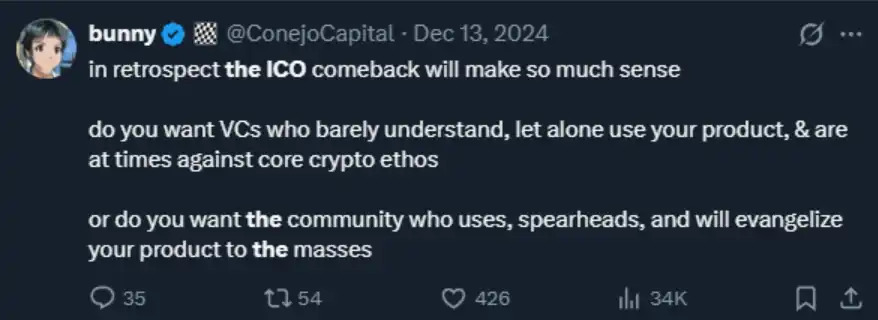
In terms of token distribution, we tried airdrops. Initially, this method achieved good distribution results at low cost and successfully attracted a lot of user attention, but it was eventually overexploited by speculators and industrialized "farmers," draining resources.

In terms of fundraising, we tried the low-circulation, high-FDV (fully diluted valuation) venture capital model. While this method was very beneficial for certain groups (mainly insiders), since most price discovery occurred before the public market, ordinary investors ended up holding the bag, suffering significant losses.
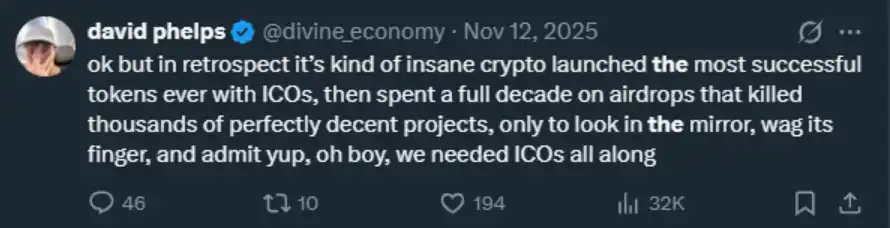
If 2025 is the year of regulatory clarity (which was the main reason ICOs were blocked), then 2026 is likely to become the "Year of the ICO Revival." History may not repeat itself exactly, but it often rhymes—in this new wave of ICOs, we may witness the emergence of some major crypto giants.

This area is becoming one of the most exciting sectors in the crypto industry, with many projects already showing promise, such as the reputation-based ICO project @legiondotcc, as well as @MetaDAOProject and the recently Coinbase-acquired @echodotxyz.

Crypto Neo-Banking

Neobanks have already disrupted traditional banking. Revolut is now one of Europe's most valuable fintech companies, and Nubank is one of the most valuable fintech companies in Latin America. As more digital-native investors emerge, the rise of Crypto Neo-Banking seems natural, especially since it can leverage the same regulatory clarity advantages as ICOs.
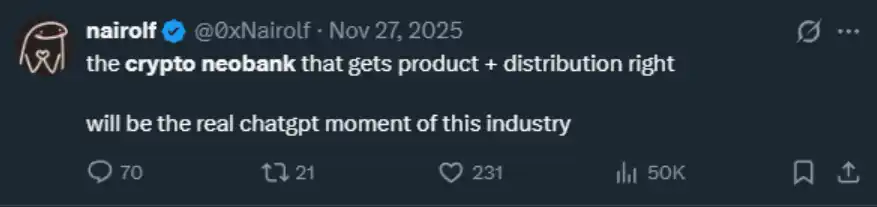
Self-custody accounts, yield-bearing accounts, and direct, instant cross-border stablecoin payments are features that distinguish crypto neo-banks from the traditional banking system.

With the proliferation of stablecoins and the provision of larger, more democratized yield opportunities for holders (no more enduring savings accounts with a mere 0.2% annual interest rate), crypto neo-banks will gradually eat into the market share of traditional finance (TradFi).

Although there are no clear winners yet, and I'm not sure if any tokens will benefit, stablecoins might be the ultimate winner. However, in my view, crypto neo-banking will become one of the most important narratives of 2026.


Preguntas relacionadas

QWhat is predicted to be the dominant narrative in the crypto space by 2026, and why is it considered crucial in the AI era?

AReputation is predicted to be the dominant narrative in the crypto space by 2026. It is considered crucial because it serves as an immutable filter to distinguish real humans from bots, identify bad actors and scammers, and find credible voices in the ecosystem, especially as AI technology advances and bot activity increases.

QWhat event from crypto history is expected to experience a revival in 2026, and what were the two main experimental phases that followed its initial ban?

AThe Initial Coin Offering (ICO) is expected to experience a revival in 2026. The two main experimental phases that followed its initial ban were airdrops (for token distribution) and the low-circulation, high-FDV venture capital model (for fundraising).

QAccording to the article, what are the key features that distinguish crypto neobanks from the traditional banking system?

AThe key features that distinguish crypto neobanks from the traditional banking system are self-custody accounts, yield-bearing accounts, and direct, instant cross-border stablecoin payments.

QWhich asset does the article suggest might be the ultimate winner in the context of the emerging crypto neobanking narrative, and why?

AThe article suggests that stablecoins might be the ultimate winner because their widespread adoption and the ability to provide larger, more democratic yield opportunities for holders will allow crypto neobanks to eat into TradFi's market share.

QName two projects mentioned in the article that are already showing promise in the context of the 'Reputation-based ICO' narrative.

ATwo projects mentioned are @legiondotcc (a reputation-based ICO project) and @MetaDAOProject.

Lecturas Relacionadas

Has Hook Summer Really Arrived? sato, Lo0p, FLOOD Ignite the New Narrative of Uniswap v4

"Hook Summer" Arrives? Sato, Lo0p, FLOOD Ignite Uniswap v4 Narrative Amidst a slight market recovery, attention within the Ethereum ecosystem has shifted to Meme coins built on Uniswap v4's Hook protocol. Following ASTEROID, tokens like sato, sat1, Lo0p, and FLOOD have become market focal points, with market caps ranging from millions to tens of millions, bringing concentrated liquidity to a narrative-dry market. Uniswap v4 Hooks are "plugin smart contracts" that allow developers to inject custom logic at key points in a liquidity pool's lifecycle (initialization, adding/removing liquidity, swaps, etc.), making the AMM programmable. Recent representative projects include: * **sato**: Market cap peaked over $38M; uses a v4 curve mechanism for minting/burning, locking ETH as reserve. * **sat1**: Market cap briefly exceeded $10M, positioning as an "optimized sato," but later declined significantly. * **Lo0p**: Market cap neared $6.6M; a "lending AMM protocol" allowing users to borrow ETH against deposited LO0P tokens without immediate selling pressure. * **FLOOD**: Market cap approached $6M; channels trading reserves into Aave v3 to generate yield, which is retained in the pool. The emergence of these Hook-based tokens could drive long-term growth for the Uniswap ecosystem by attracting users and liquidity to v4 pools. Combined with Uniswap's activated fee switch (partially used to burn UNI), the long-term outlook for UNI appears positive. However, short-term UNI price appreciation is not directly guaranteed. Factors include the sustainability and lifecycle of these new tokens, their price volatility, overall market conditions, and regulatory pressures. Currently, Uniswap v4's TVL ($595M) lags behind v3 and v2, indicating Hook adoption still requires time to mature. In summary, the Hook ecosystem serves as "long-term nourishment" for UNI, but acts more as a "catalyst" than a direct "booster" in the short term. Note: These are early-stage experimental tokens and may carry unknown risks.

marsbitHace 25 min(s)

Has Hook Summer Really Arrived? sato, Lo0p, FLOOD Ignite the New Narrative of Uniswap v4

marsbitHace 25 min(s)

Has Hook Summer Truly Arrived? sato, Lo0p, FLOOD Ignite the New Uniswap v4 Narrative

With the broader market showing signs of recovery, a new wave of interest has emerged around Ethereum-based meme coins. Following ASTEROID, tokens like sato, sat1, Lo0p, and FLOOD, built upon the Uniswap v4 Hook protocol, are capturing market attention. Their market capitalizations range from millions to tens of millions of dollars, injecting much-needed focused liquidity into a market lacking narratives. This article explores whether this trend signifies an incoming "Hook Summer" and its potential impact on UNI's price. Hooks are essentially plug-in smart contracts for Uniswap v4 liquidity pools, allowing developers to inject custom logic at key points in a pool's lifecycle (like initialization, adding/removing liquidity, swaps). This transforms the AMM into programmable building blocks. Key highlighted projects include: * **sato**: Peaked over $38M market cap. It utilizes a v4 curve for minting/burning; buying locks ETH as reserve to mint new tokens, while selling redeems ETH from the reserve and burns tokens. * **sat1**: Market cap briefly exceeded $10M, promoted as an "optimized sato," but later declined significantly. * **Lo0p**: Reached nearly $6.6M. It's a lending AMM protocol where buying LO0P tokens locks them as collateral, allowing users to borrow ETH from the pool reserve at 40% LTV, aiming to improve capital efficiency for idle ETH in LPs. * **FLOOD**: Peaked near $6M. Its mechanism directs asset reserves from buys into Aave v3 to generate yield, with fees and interest retained in the pool to potentially influence the token's price long-term. In the long term, the development of the Hook ecosystem can attract users and liquidity to Uniswap v4, benefiting UNI's fundamentals—especially combined with the recent activation of the protocol fee switch, where a portion of fees is used to burn UNI. However, in the short term, these Hook-based tokens are unlikely to directly drive significant UNI price appreciation. Their impact is moderated by factors like token sustainability, price volatility, and broader market and regulatory conditions. Currently, Uniswap v4's TVL ($595M) still trails behind v2 and v3, indicating adoption and growth will take time. The article concludes that while the Hook ecosystem provides long-term "nourishment" for UNI, its short-term role is more of a "catalyst" than a "booster." Readers are cautioned that these are early-stage experimental tokens and may carry unknown risks.

Odaily星球日报Hace 37 min(s)

Has Hook Summer Truly Arrived? sato, Lo0p, FLOOD Ignite the New Uniswap v4 Narrative

Odaily星球日报Hace 37 min(s)

Interview with Michael Saylor: I Did Say I Would Sell Bitcoin, But Never a Net Sale

Interview with Michael Saylor: I Said We'd Sell Bitcoin, But Never Be a Net Seller In a recent podcast, MicroStrategy Executive Chairman Michael Saylor clarified the company's stance on potentially selling Bitcoin. Following MicroStrategy's earnings call statement about being prepared to sell BTC to fund dividends for its STRC (Strategic) credit product, Saylor emphasized the distinction between selling and being a "net seller." Saylor explained the core business model: MicroStrategy sells credit instruments like STRC and uses the proceeds to buy Bitcoin, which is viewed as "digital capital" expected to appreciate around 30-40% annually. A portion of these capital gains can then be used to pay the dividends on the credit products. He stressed that even if the company sells some Bitcoin for dividends, it simultaneously buys much more with new credit issuance. For example, after raising $3.2 billion from STRC sales in April, the dividend obligation was only $80-90 million, making the company a net buyer. The clarification aims to counter market narratives questioning the value of Bitcoin on MicroStrategy's balance sheet if it were never sold, and to dismiss claims of a "Ponzi scheme." Saylor reiterated his personal philosophy for investors: "Don't be a net seller of bitcoin" and ensure your Bitcoin holdings increase each year. Saylor also discussed Bitcoin's role as the foundation for "digital credit," noting that STRC has become the largest and most liquid preferred stock issue in the U.S., offering high risk-adjusted returns (Sharpe ratio). He highlighted Bitcoin's deep liquidity, stating that even large purchases by MicroStrategy do not move the market significantly, which is driven by macro factors, geopolitical tensions, and capital flows from ETFs and credit products. Finally, Saylor reflected on his early inspiration from sci-fi books, which motivated his path to MIT, and maintained his fundamental thesis on Bitcoin remains unchanged: it is superior digital capital enabling superior digital credit.

链捕手Hace 42 min(s)

Interview with Michael Saylor: I Did Say I Would Sell Bitcoin, But Never a Net Sale

链捕手Hace 42 min(s)

Trading

Spot
Futuros
活动图片




