2026 Crypto Industry Investor Relations and Token Transparency Status Report

marsbitPublicado a 2026-04-16Actualizado a 2026-04-16

Resumen

The 2026 Crypto Investor Relations & Token Transparency Report by Novora analyzes over 150 protocols across major sectors. Key findings reveal a severe transparency gap: less than 1% disclose market maker terms, only 3% have dedicated IR hubs, and just 9% submitted the Blockworks Token Transparency Framework. While 91% of protocols have accessible revenue data, the communication infrastructure to present this to investors is largely absent. Additionally, 62% of tokens offer only governance rights with no active value capture mechanisms. The report concludes that while raw data is available on-chain and via third-party platforms, the critical "translation layer" for institutional adoption is missing. Protocols investing in IR infrastructure now are positioned to gain a significant advantage.

Author: Connor King, Founder of Novora

Compiled by: Hu Tao, ChainCatcher

Last month, we released our "Does Investor Relations Matter in Crypto?" This is the follow-up. We expanded the initial dataset of 53 protocols to over 150 protocols, covering all major sectors: DEX, lending, perpetuals, liquid staking, L1, L2, bridges, DePIN, AI, stablecoins, infrastructure, and CEX tokens. The fully diluted valuation (FDV) of the protocols ranges from $40 million to $45 billion.

We checked 15 binary, verifiable indicators for each protocol: Does the protocol disclose this information? Yes/No. Each data point was cross-verified through public sources: Artemis, Tokenterminal, Blockworks, Dune, DefiLlama.

Here's what we found:
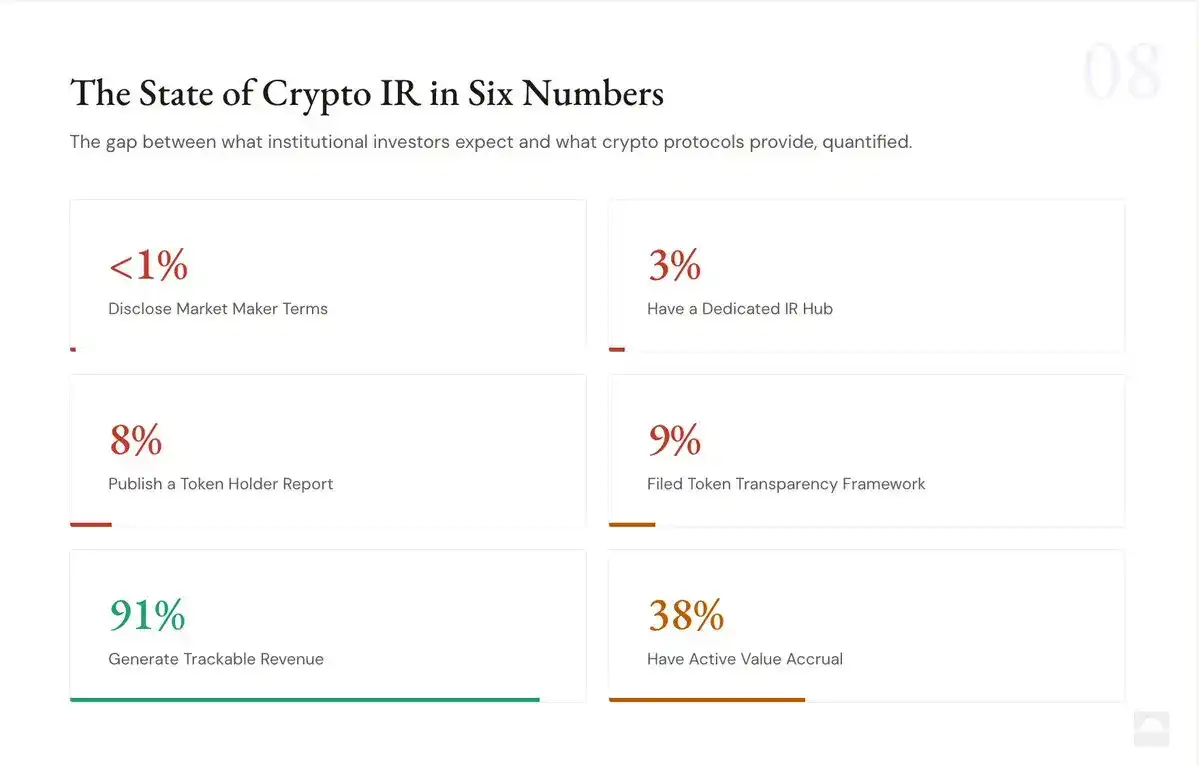
Less than 1% of market makers disclose their market maker terms.

50 protocols. Billions in daily trading volume combined. But only one protocol publicly disclosed information about its market making arrangements.

Market makers set the terms for token trading. These agreements often include token lending, option structures, and performance incentives that directly impact price discovery. In traditional markets, such material agreements are disclosed. But in crypto, every market participant is trading in the dark.

Meteora was the only protocol in the dataset that disclosed its market making arrangements through its 2025 Token Holder Annual Report. One out of over 150.

This is the most impactful transparency gap in the industry.
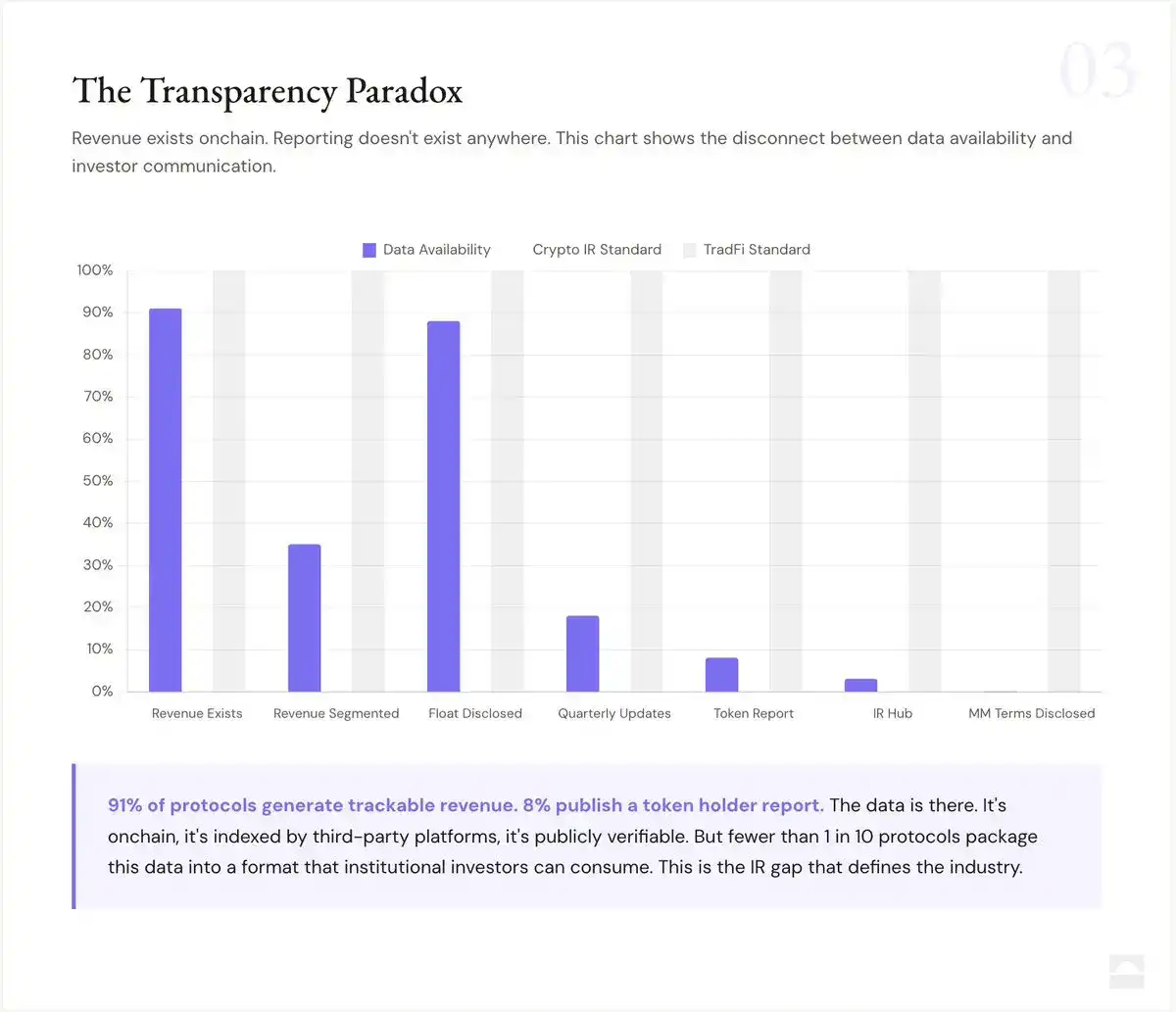
91% have revenue data. 3% have an Investor Relations hub.

Nearly every protocol in this audit publicly provides revenue data, either through third-party platforms or their own data dashboards. The raw data exists.

But only 3% have built a dedicated Investor Relations hub that consolidates this data into an investor-facing experience. The exceptions include Meteora, Jito, Jupiter, Raydium, MetaDAO. Every other protocol scatters information across blogs, governance forums, X threads, and third-party platforms. There is no centralized, institutional-grade investor experience. The gap isn't data availability, it's communication infrastructure.
9% submitted the Blockworks TTF

The Blockworks Token Transparency Framework was submitted to the U.S. SEC in June 2025, covering 18 disclosure standards across supply, distribution, financials, and market structure, backed by Pantera, L1D, and Theia. Out of the 150+ protocols reviewed, only 13 submitted the framework: Jito, Jupiter, Raydium, Morpho, Aerodrome, MetaDAO, Maple, dYdX, Euler, Marinade, EtherFi, Gains Network, and Meteora.

This is a material improvement from zero submissions. But the submission rate dropped from 25% in the initial 53 protocols to 9% at 150+. The original dataset was skewed towards early TTF-adopting DeFi protocols. With a broader sample, the picture is clearer: the vast majority of the market is not opting in. Zero L1s, zero L2s, zero infrastructure protocols submitted the framework. The framework exists. More protocols should use it.

38% have active value accrual, 62% return nothing

We used a broad definition of "active value accrual": Does the protocol have at least one live mechanism that directs economic value directly to token holders (excluding governance rights)? Across 150+ protocols, we identified six distinct models:

  • Direct fee sharing (JUP, DYDX, GMX)
  • Buyback and burn (HYPE, RAY, MET)
  • Staking revenue share (PENDLE, AAVE, ETHFI)
  • Conditional buybacks (LDO)
  • ve-model epoch distribution (AERO)
  • Governance-only, no economic rights (MORPHO, LINK, ARB)
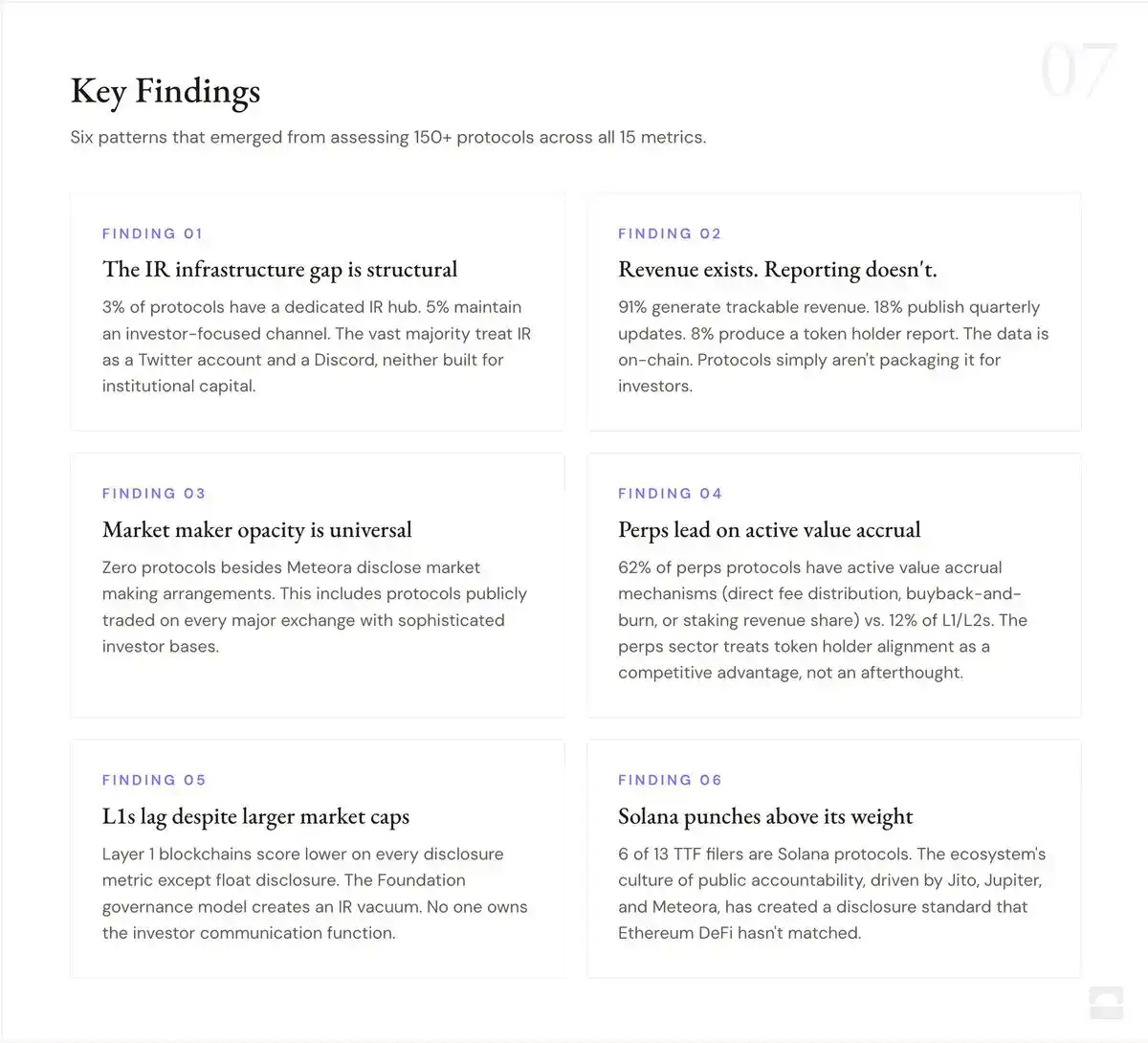
62% of protocols fall into the last category – governance-only tokens with no value accrual, including some of the largest market cap projects in the industry. Sector differences are stark: 62% of Perpetuals protocols have active value accrual, versus just 12% of L1/L2 tokens. Perpetuals treat token holder alignment as a competitive advantage. L1 foundations have not yet done the same. A deep dive into which models actually work is coming next week.

The data layer is built, the communication layer is not

We checked five major third-party platforms: Token Terminal, Dune Analytics, Artemis, DefiLlama, and Blockworks Research. The first four platforms each cover 85-95% of the dataset. 72% of protocols appear on 4 or more platforms. Every protocol in the audit appears on at least one platform. The raw data infrastructure for institutional analysis is largely built. What's missing is the interpretation, packaging, and communication layer that turns data into investable narratives.

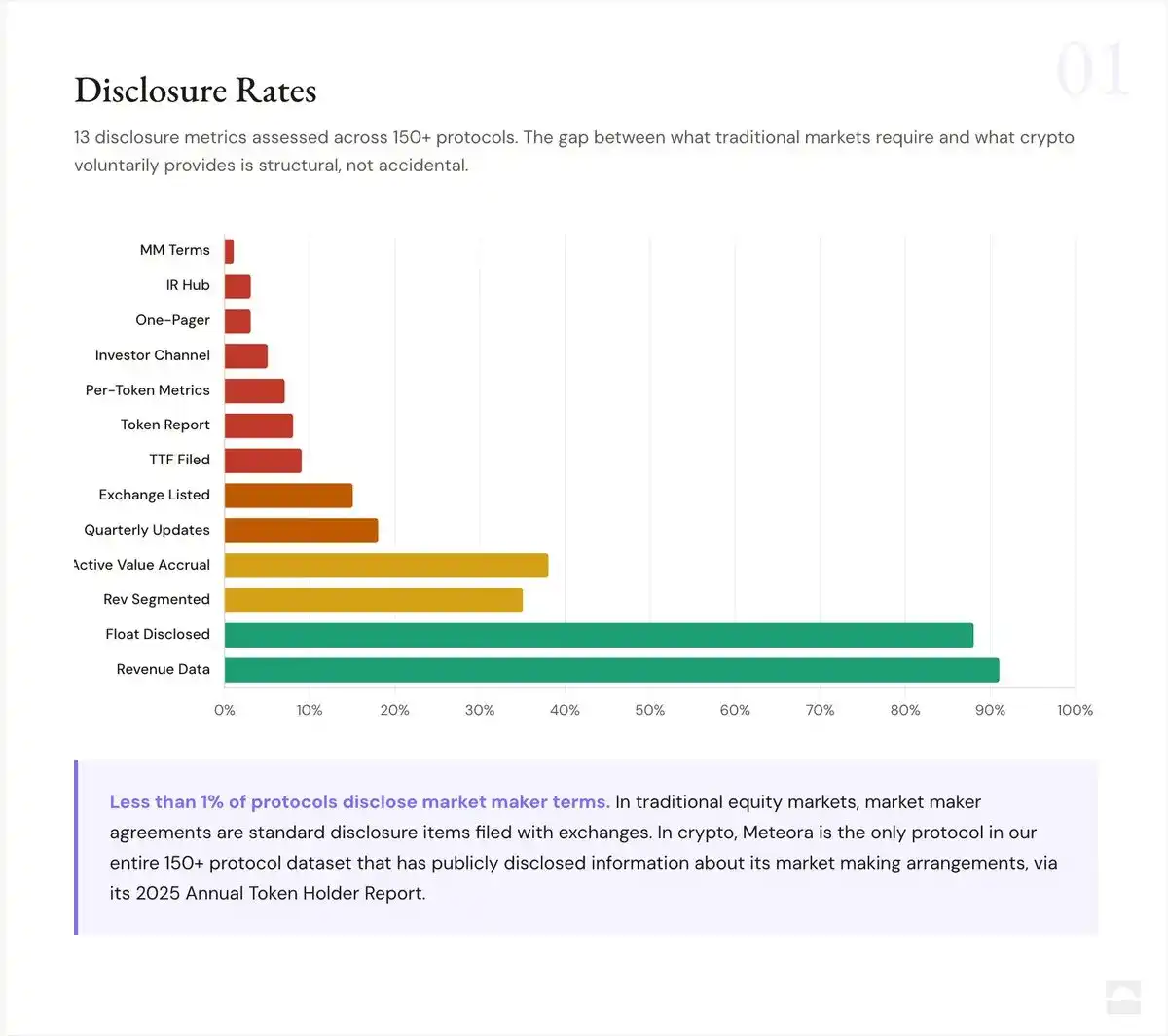
The full disclosure breakdown for 150+ protocols is as follows:

<1% —— Disclose Market Maker Terms
3% —— Dedicated IR Hub
3% —— Provide a One-Pager
5% —— Dedicated Investor Channel
7% —— Publish Single-Token Metrics
8% —— Token Holder Reports
9% —— Submitted TTF
15% —— Disclose Exchange Listings
18% —— Quarterly Updates
35% —— Disaggregated Revenue Disclosure
38% —— Active Value Accrual
88% —— Disclose Circulating Supply
91% —— Revenue Data Available

What this means

The thesis from "Does Investor Relations Matter in Crypto?" holds. The data is even more sobering with the sample size expanded to 150+. Crypto protocols aren't hiding the fundamentals, they're failing to present them. The raw inputs for fundamental analysis exist on-chain and on third-party platforms, but the "translation layer and IR infrastructure that turns data into institutional confidence barely exists. Only 3% have an IR hub, <1% disclose market maker terms, and 91% of the market has not adopted the only available standardized disclosure framework.

The opportunity for protocols is clear: the cost of building IR infrastructure is negligible relative to capital markets upside. Protocols investing in this now will be the first to earn the trust of institutional allocators. The full interactive report with all 150+ protocols is live now:
http://novora.co/research/ir-transparency-2026.html

Next week, we will release the comparative report for this series: "Which Token Value Accrual Model Works?". That report will break down the six token value accrual mechanisms we identified, their empirical performance, and what this means for token classification and institutional adoption.

Preguntas relacionadas

QWhat percentage of the 150+ crypto protocols studied publicly disclose their market maker arrangements?

ALess than 1% (only one protocol, Meteora, disclosed this information).

QAccording to the report, what is the state of data availability versus communication infrastructure for investor relations in crypto?

AThe data layer is built (91% of protocols have revenue data available on third-party platforms), but the communication layer is not (only 3% have a dedicated IR hub to present this data effectively).

QHow many of the protocols analyzed had submitted the Blockworks Token Transparency Framework (TTF)?

A9% (13 out of the 150+ protocols).

QWhat percentage of the protocols were found to have 'active value capture' mechanisms for token holders?

A38% of the protocols had active value capture, while 62% offered only governance rights with no economic value returned to holders.

QWhat is identified as the most significant transparency gap in the crypto industry within the report?

AThe disclosure of market maker terms, as it is a critical agreement that directly impacts price discovery and is standard in traditional markets, yet is almost entirely undisclosed in crypto.

Lecturas Relacionadas

Annual Salary of Millions Competing for Electricians, Meta Rushes to Open Its Own Technical School

The AI boom is facing an unexpected bottleneck: a severe shortage of skilled construction workers and electricians. As tech giants like Meta, OpenAI, and Alphabet race to build massive data centers—such as OpenAI's $16 billion "Stargate" project—they are hitting a critical labor wall. The U.S. needs an estimated 130,000 more electricians, 240,000 construction workers, and 150,000 supervisors by 2030 for AI infrastructure alone, but tens of thousands of electrician jobs go unfilled each year. While AI companies offer high premiums, with electricians earning up to $280,000 annually, worker scarcity still causes massive losses—delays on a single project can cost $14.2 million per month. The complexity of building AI data centers, which require immense power (equivalent to powering hundreds of thousands of homes), sophisticated electrical systems, and advanced liquid cooling solutions, demands highly skilled technicians who are in short supply. To combat this, companies are investing heavily in training. Meta has committed $115 million to a free training school offering tuition, housing, and stipends, targeting 5,000 new workers. OpenAI is partnering with unions to secure skilled labor. These efforts are paying off, with a significant rise in Gen Z interest in trade schools over college. However, the power demands are staggering. AI data centers are driving a rapid surge in electricity consumption, projected to account for up to 12% of U.S. power use by 2028 and raising costs for consumers. Furthermore, the construction boom is project-based, leading to a potential future glut of trained workers once building peaks, which could depress wages industry-wide. The race for AI supremacy now depends as much on skilled hands as on advanced chips.

marsbitHace 53 min(s)

Annual Salary of Millions Competing for Electricians, Meta Rushes to Open Its Own Technical School

marsbitHace 53 min(s)

OpenAI No Longer Sells Its Most Expensive Model for Profit

OpenAI is shifting its business strategy away from promoting its most expensive, flagship models for every task. Recent price cuts—80% for GPT-5.6 Luna and 20% for Terra—signal a deeper change: the company now actively advises users that many tasks don't require the most powerful model. Instead, OpenAI recommends a tiered approach: use the high-end GPT-5.6 Sol for complex planning and analysis, then delegate execution to cheaper models like Luna. This mirrors moves by Anthropic, which recently launched Claude Opus 5 at half the price of its top model, Fable 5. Both companies are de-emphasizing flagship models as primary revenue drivers, using them instead for brand prestige and technological showcases. The industry is entering a "mass-market" phase, similar to automotive, where high-volume, cost-effective models handle daily operations and drive scale. OpenAI's price reductions are partly enabled by AI models themselves optimizing underlying code and infrastructure, creating a self-reinforcing cycle of efficiency gains and cost reduction. Competition is shifting from "who is smartest" to "who offers the best value." The goal is no longer selling individual models but fostering widespread API adoption and ecosystem lock-in. By making AI calls cheap and ubiquitous, companies like OpenAI aim to become the indispensable, utility-like infrastructure powering automated workflows—the "water and electricity" of software, quietly embedded everywhere.

marsbitHace 53 min(s)

OpenAI No Longer Sells Its Most Expensive Model for Profit

marsbitHace 53 min(s)

Will the Fed Definitely Raise Interest Rates in September? How Will Crypto and U.S. Stocks Withstand the Pressure?

The market's expectation for a September Fed rate hike surged dramatically in early August, jumping from under 50% to over 80% within a week. This shift followed a contentious July FOMC meeting, where a 9-3 vote to hold rates revealed growing dissent from hawkish members advocating for an immediate hike to combat persistent inflation. The primary catalyst for this repricing is rising oil prices, driven by renewed geopolitical tensions around the Strait of Hormuz, which threaten global supply. Energy costs directly influence inflation metrics, making the upcoming July CPI report (due August 12th) a critical data point. If it shows inflation reaccelerating, the probability of a September hike will solidify. For Bitcoin and crypto assets, this is typically bearish news. Bitcoin continues to behave as a high-beta, liquidity-sensitive risk asset. A rate hike raises the opportunity cost of holding non-yielding assets and could drive capital toward money markets, pressuring crypto prices in the short term. However, historical patterns suggest that if a hike is perceived as the end of a tightening cycle rather than the start, any negative price impact may be brief. U.S. stocks, particularly crypto-linked equities like Coinbase and growth-oriented tech stocks, are also vulnerable. Higher rates increase discount rates in valuation models, putting pressure on high-multiple companies. This coincides with a pivotal tech earnings season where investor focus has shifted from massive AI capital expenditure to tangible revenue and cash flow generation. Companies with negative cash flow and weak growth narratives could face heightened volatility if borrowing costs rise in September. In summary, a September Fed hike has evolved into a mainstream market scenario. Key factors to watch are oil prices, the July CPI report, and Fed communications, which will determine the final decision and its impact on volatile crypto and equity markets.

marsbitHace 1 hora(s)

Will the Fed Definitely Raise Interest Rates in September? How Will Crypto and U.S. Stocks Withstand the Pressure?

marsbitHace 1 hora(s)

Trading

Spot
活动图片