比特币破新高后大跳水,逾30万人爆仓,12亿美元蒸发

Odaily星球日报Publicado a 2024-03-06Actualizado a 2024-03-06

Resumen

调整还将继续吗?

原文作者:Mary Liu,比推 BitpushNews

周二,比特币在两年多来首次创下历史新高后迅速大跳水。

比推终端数据显示,BTC 在周二上午突破 69, 210 美元,然后迅速回落,盘中一度跌穿 6 万美元,截至发稿时回弹至 6.1 万美元上方。
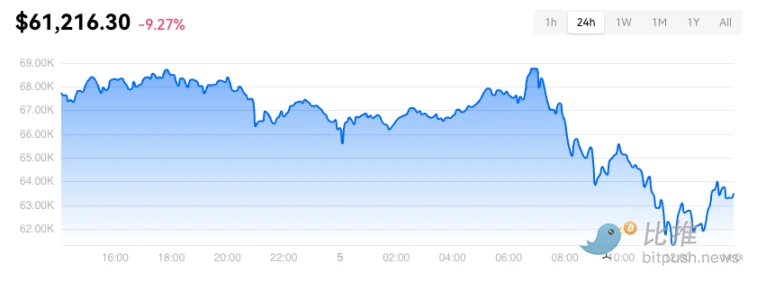
比特币破新高后大跳水,逾30万人爆仓,12亿美元蒸发

以太坊一度上涨 6.5% 至 3, 828.81 美元,随后抹去全部涨幅,跌至 3, 412.64 美元,其他主流山寨币如 ADA、DOGE 和 SHIB 下跌约 10% -12% 。

市场暴涨暴跌导致全网近 12 亿美元爆仓。

根据 CoinGlass 的数据,过去 24 小时内,有 318, 392 名交易者被爆仓,总额达 11.9 亿美元。其中多头爆仓 8.78 亿美元,空头爆仓 3.10 亿美元。最大的单笔爆仓订单发生在 Bitmex 平台,为价值 1135 万美元 LINK/USD 交易对。
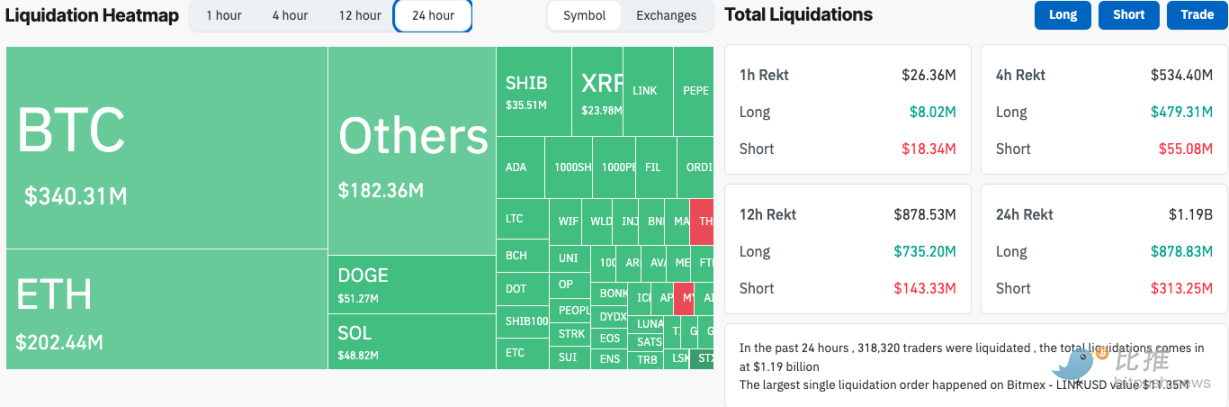
比特币破新高后大跳水,逾30万人爆仓,12亿美元蒸发

还将继续调整?

Reflexivity Research 联合创始人 Will Clemente 在 X 平台表示,周二的爆仓让他想起了 2020 年感恩节前后比特币的走势。当时,多头着眼于即将突破 20, 000 美元的水平,但比特币触及 19, 500 美元后暴跌,并很短的时间内跌落至大约 16, 000 美元。

他在 X 帖子中表示:「任何下跌都是为了洗掉高杠杆的束缚并在此时买入。」

部分分析师警告称,随着未实现利润率接近极端水平,行情可能很快就会降温。

加密货币对冲基金 Kbit 首席执行官兼创始人 Ed Tolson 发文表示:「市场预计将出现大幅调整,调整幅度可能在 10% 到 20% 之间。任何实质性的下跌都将导致加密永续掉期市场出现级联清算,散户纷纷涌入杠杆多头头寸,资金利率非常高。」

他补充道:「在接下来的几个季度,我们预计比特币将表现良好,但一路上会出现大幅调整」。

Oppenheimer 分析师 Owen Lau 也表示:「上涨速度如此之快,以至于我们对调整持谨慎态度,但从长远来看,仍然有支撑积极价格走势的催化剂」。他补充道:「随着比特币变得更有价值,它就会变得更有用。在较高的市值和每日流通量下,它可以支持更大的配置。比特币的波动性随着时间的推移持续下降,允许分配更大的头寸规模。」

加密数据提供商 Kaiko 的研究总监 Clara Medalie 也赞同这种观点,称新纪录是「一个重要的心理里程碑」,并且「证明了加密货币在面临巨大阻力的情况下反弹并继续坚持下去的非凡能力」。

牛市周期加速

关于比特币未来价格走势的猜测甚嚣尘上,一些分析师思考最近的减半前峰值是否加速了通常的市场周期。

历史数据显示,传统上,比特币在减半后大约需要 500 天才能达到历史新高。这种偏离常态的现象表明,我们可能正在进入比特币价格行为的新时代。

对于最近价格调整的影响及其对未来市场趋势的影响,加密货币社区仍然存在分歧。一些分析师认为比特币在继续其上升轨迹之前可能会经历横向波动。

与此同时,也有部分猜测称,比特币 ETF 现货流入和其他市场因素的潜在影响是决定比特币前进道路的关键因素。

自 1 月份推出现货比特币 ETF 以来,机构开始纷纷涌入该行业, 这些 ETF 在过去六周的交易中创下了创纪录的表现,截至本周二收盘,现货比特币 ETF 交易量再次创下新的历史记录,达到 100 亿美元。

Galaxy Digital 研究主管 Alex Thorn 表示:「比特币再次创下历史新高,表明它永远不会消失。在其存在的 15 年里,比特币经历了四次 75% 以上的回撤,但每次都大幅反弹。」


Lecturas Relacionadas

He Kaiming's Team's New Work: After Deleting VAE and Private Data, Text-to-Image Generation Becomes Even Stronger

KaiMing He's team introduces **MiniT2I**, a minimalist text-to-image (T2I) model that challenges the complexity of mainstream approaches. It eliminates components commonly considered essential: the VAE encoder-decoder, AdaLN conditioning mechanisms, auxiliary losses, private training data, and post-training alignment stages like RL/DPO. Instead, it uses a pure flow-matching objective trained directly on RGB pixels. The model employs a simplified **MM-JiT** Transformer architecture. It removes AdaLN blocks for conditioning and instead prepends two lightweight text adapter blocks to a standard pre-norm Transformer, allowing frozen T5 text features to adapt to the denoiser. Training follows a two-stage, LLM-like paradigm using only public datasets: pre-training on LLaVA-recaptioned CC12M for coverage, followed by fine-tuning on ~120k high-quality image-text pairs. With just 258M parameters (B/16), MiniT2I achieves competitive scores (0.87 on GenEval, 84.2 on DPG-Bench), outperforming larger pixel-space models. Scaling to 912M parameters (L/16) yields results comparable to SD3-Medium (~2B parameters) in style, composition, and imagination, though it lags in text rendering and named entities due to public data limitations. Key advantages include lower computational cost (~570 GFLOPs vs. ~1379 for latent models) and architectural simplicity. Acknowledged limitations include patch boundary artifacts in pixel space, side effects of high CFG scales, resolution ceilings for sequences longer than 1024 tokens, and the aforementioned data bottlenecks. The work demonstrates that high-performance T2I generation is possible with a radically simplified, publicly reproducible baseline.

marsbitHace 3 min(s)

He Kaiming's Team's New Work: After Deleting VAE and Private Data, Text-to-Image Generation Becomes Even Stronger

marsbitHace 3 min(s)

The Insurance Industry Faces Its Biggest Competitor: Are Prediction Markets the "Barbarians at the Gate"?

The insurance industry, long a stable "ballast" in the economy, may face a significant challenge from the rise of prediction markets, which are beginning to function as a new form of risk hedging and insurance. Platforms like Kalshi and Polymarket are demonstrating their utility in areas traditionally dominated by insurers. Examples include Kalshi's partnership with sports insurance broker Game Point Capital to offer more cost-effective hedging for NBA team performance bonuses, and Polymarket's collaboration with real estate platform Parcl, allowing users to hedge against housing price fluctuations in major US cities. A New York bar also used Kalshi to hedge a marketing promotion tied to an NBA game outcome, highlighting prediction markets' potential for small business risk management. These markets offer advantages over traditional insurance and sports betting in transparency, liquidity, and flexibility. They allow information monetization across a wider range of events, act as neutral platforms rather than direct counterparties, and provide clearer pricing. A historical precedent is the "Mattress Mack" marketing campaigns, which used sports betting for large-scale customer refunds, but prediction markets offer a more systematic and accessible model. Experts like SIG CEO Jeff Yass see their potential for efficient, parameter-based risk sharing, such as for weather-related property damage. However, challenges remain, including liquidity issues, unclear regulatory boundaries, and potential manipulation of event outcomes. Despite these hurdles, prediction markets represent a growing competitive force for both traditional gambling platforms and segments of the insurance industry.

marsbitHace 4 min(s)

The Insurance Industry Faces Its Biggest Competitor: Are Prediction Markets the "Barbarians at the Gate"?

marsbitHace 4 min(s)

Insurance Industry Faces Its Biggest Competitor: Are Prediction Markets the 'Barbarians at the Gate'?

"Insurance Industry Faces New Rival: Are Prediction Markets the 'Barbarians at the Gate'?" Prediction markets, exemplified by platforms like Kalshi and Polymarket, are emerging as potential disruptors to the traditional insurance industry by offering alternative risk-hedging mechanisms. These markets allow users to bet on specific event outcomes, effectively creating a form of customizable, on-demand insurance. Key examples highlight this shift. In sports, Kalshi partnered with insurance broker Game Point Capital to provide NBA teams with more affordable options to hedge performance bonuses compared to traditional insurers. In real estate, Polymarket's collaboration with Parcl lets users speculate on city-specific housing price indices, allowing homeowners to hedge against price drops or buyers against price increases. Furthermore, businesses like a New York bar have used Kalshi to hedge marketing promotions (e.g., offering free drinks if a team wins), framing the transaction explicitly as placing a "hedge." The article argues prediction markets offer advantages over traditional insurance and even sports betting in transparency, liquidity, and flexibility. They provide a wider range of event coverage, act as neutral platforms rather than counterparties, and offer clearer pricing. The piece cites historical precedents like large "refund promotion" hedges by businesses using sportsbooks but notes prediction markets modernize the concept. However, challenges remain for widespread adoption as an insurance alternative, including limited liquidity in some markets, unclear regulatory status, and potential vulnerabilities in event resolution mechanisms. Despite these hurdles, prediction markets are positioning themselves as new tools for risk management, directly challenging certain segments of the conventional insurance landscape.

Odaily星球日报Hace 10 min(s)

Insurance Industry Faces Its Biggest Competitor: Are Prediction Markets the 'Barbarians at the Gate'?

Odaily星球日报Hace 10 min(s)

Which Crypto Sectors Have Been 'Eaten' by AI Agents?

The article examines the transformative impact of AI Agents on the cryptocurrency landscape, highlighting how specific sectors are becoming increasingly dominated by automated systems. Key "agent-eaten" sectors include derivatives trading (perpetuals), where AI agents demonstrate significantly higher survival and performance rates than human traders; MEV and arbitrage trading, which are almost entirely automated; yield optimization, with over two-thirds of new DeFi protocols incorporating AI agents; and spot trading/portfolio management, where agents drive a growing share of DEX volume. "Battleground" sectors like prediction markets and DeFi lending show a mix, with agents excelling in short-term/arbitrage activities but humans retaining an edge in longer-term, nuanced decisions. Sectors still primarily "human-led" include stablecoin payments/remittances (driven by real-world economic activity) and wallets, where human oversight for approvals and security remains critical. As AI agent activity grows, the article emphasizes the rising importance of human-agent verification layers (e.g., World/AgentKit, t54, Self Protocol) to ensure trust, accountability, and control in an increasingly agentic economy. The conclusion is that while AI agents dominate in speed and optimization-focused areas, human judgment, trust, and real-world context remain essential in value-creating layers like payments and identity.

marsbitHace 11 min(s)

Which Crypto Sectors Have Been 'Eaten' by AI Agents?

marsbitHace 11 min(s)

AC Exits Sonic Board, 'DeFi Godfather' Pulls Off Another Strategic Retreat

Andre Cronje, known as the "DeFi Godfather," and two other founding directors have stepped down from the Sonic Labs board. The S token, once valued at $1.03, has plummeted 97% to $0.028, and the chain's TVL has evaporated 98% from its peak. In his exit statement, Cronje clarified he was a technical architect, not a founder, and distanced himself from token economics and migration decisions behind the token's crash. Cronje revealed his focus for the past 18 months has been his new project, Flying Tulip. This project raised $200 million privately last year at a $10 billion valuation. Its token design includes a perpetual put option (ftPUT NFT) for early investors, allowing them to redeem their initial investment at any time—a protection not extended to public market buyers. This pattern mirrors Cronje's past exits from projects like Yearn Finance and Fantom, where he departed near peak hype, leaving later holders to bear significant losses. Sonic itself has seen a complete management overhaul in recent months. The article frames this as a microcosm of the broader crypto bear market, where Layer-1 chains are bleeding value. It highlights a harsh reality: a project's valuation is often tied to a founder's reputation rather than fundamentals. Ironically, Flying Tulip is set to launch first on the Sonic chain Cronje just left, underscoring a disconnect between the person and the platform.

marsbitHace 32 min(s)

AC Exits Sonic Board, 'DeFi Godfather' Pulls Off Another Strategic Retreat

marsbitHace 32 min(s)

Trading

Spot
Futuros
活动图片