
2025 recap: Navigating a year of market extremes with ‘RISE’ strategy

cointelegraphPublicado a 2025-12-22Actualizado a 2025-12-22

Resumen

The year 2025 was marked by extreme volatility in the crypto industry, with Bitcoin reaching a record high of $125,700 and total market capitalization surpassing $4 trillion, alongside major liquidations and sharp declines. In this environment, CoinW implemented its RISE strategy—focusing on Resilience, Innovation, Scale, and Evolution—to strengthen its role in the digital asset ecosystem. Key initiatives included enhancing platform security, launching products like GemW for asset discovery and DeriW for efficient trading, and expanding its user base to over 20 million registered users. The company emphasized long-term stability over speculative gains, positioning itself for sustained growth in 2026.

Sponsored Content

The year 2025 stands as a period of dichotomy for the crypto industry. It was a time defined by historic milestones, with Bitcoin (BTC) reaching a high of $125,700 and the total crypto market capitalization crossing the $4 trillion threshold for the first time.

These figures underscored the sector’s maturation, further evidenced by the rise of stablecoins processing trillions in transaction volume and major financial incumbents like Visa and BlackRock deepening their onchain integration. However, this growth occurred alongside severe turbulence.

On Oct. 10, a violent price swing triggered the largest liquidation event in history. Approximately $19 billion in leveraged positions were liquidated across all markets, and roughly $1 trillion in total market capitalization was wiped out within days. Later in the year, risk aversion drove further volatility, with Bitcoin shedding over 17% in November alone.

This environment of extremes tested the entire ecosystem’s infrastructure. Market fluctuations revealed stability issues in various venues, prompting a shift in user behavior toward platforms prioritizing long-term security and risk management.

Against this backdrop, crypto platform CoinW centered its 2025 performance on the theme of RISE (Resilience, Innovation, Scale and Evolution), focusing on strengthening its role in the digital asset landscape.

Resilience: Stability as a strategic focus

In 2025, operational stability became a primary metric for user trust. CoinW’s approach to resilience focused on hardening its technical infrastructure and maintaining a consistent service record.

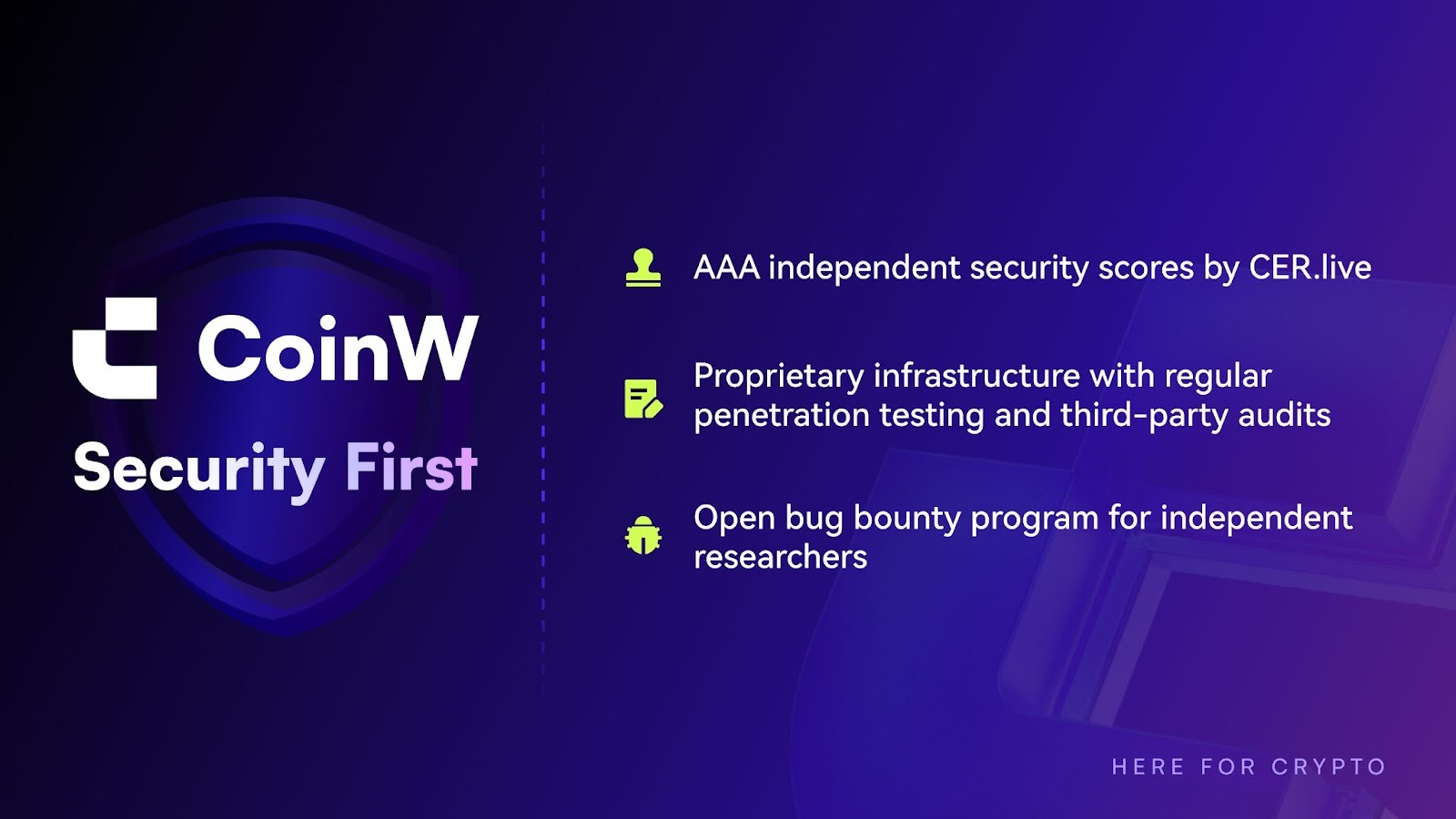
Operating for eight years without any publicly reported material security breaches impacting platform operations, the platform provided a stable venue during the market crashes that disrupted the wider sector. This operational security received external validation with an AAA security rating from CER.live, an independent third-party security assessment platform.
Source: CoinW

To address the specific risks of 2025’s volatility, CoinW utilized its Futures Protection Program. This mechanism is designed to mitigate certain risks associated with extreme market volatility by applying predefined internal algorithms and large-scale liquidation cascades. Since launch, the program has protected over 116,000 users and covered positions totaling 3.3 billion Tether (USDT).

This focus on resilience also extended to the company’s cultural initiatives. CoinW launched its 8th Anniversary Global Marathon, a campaign promoting a “crypto marathon spirit.” The initiative positioned crypto investing as a test of endurance rather than speed, contrasting with the high-risk speculation often seen during bull runs.

Innovation: Expanding the product suite

While resilience focused on maintaining operations, innovation drove the expansion of CoinW’s service offerings. The platform continued to roll out products addressing specific user needs, expanding its scope beyond centralized trading.

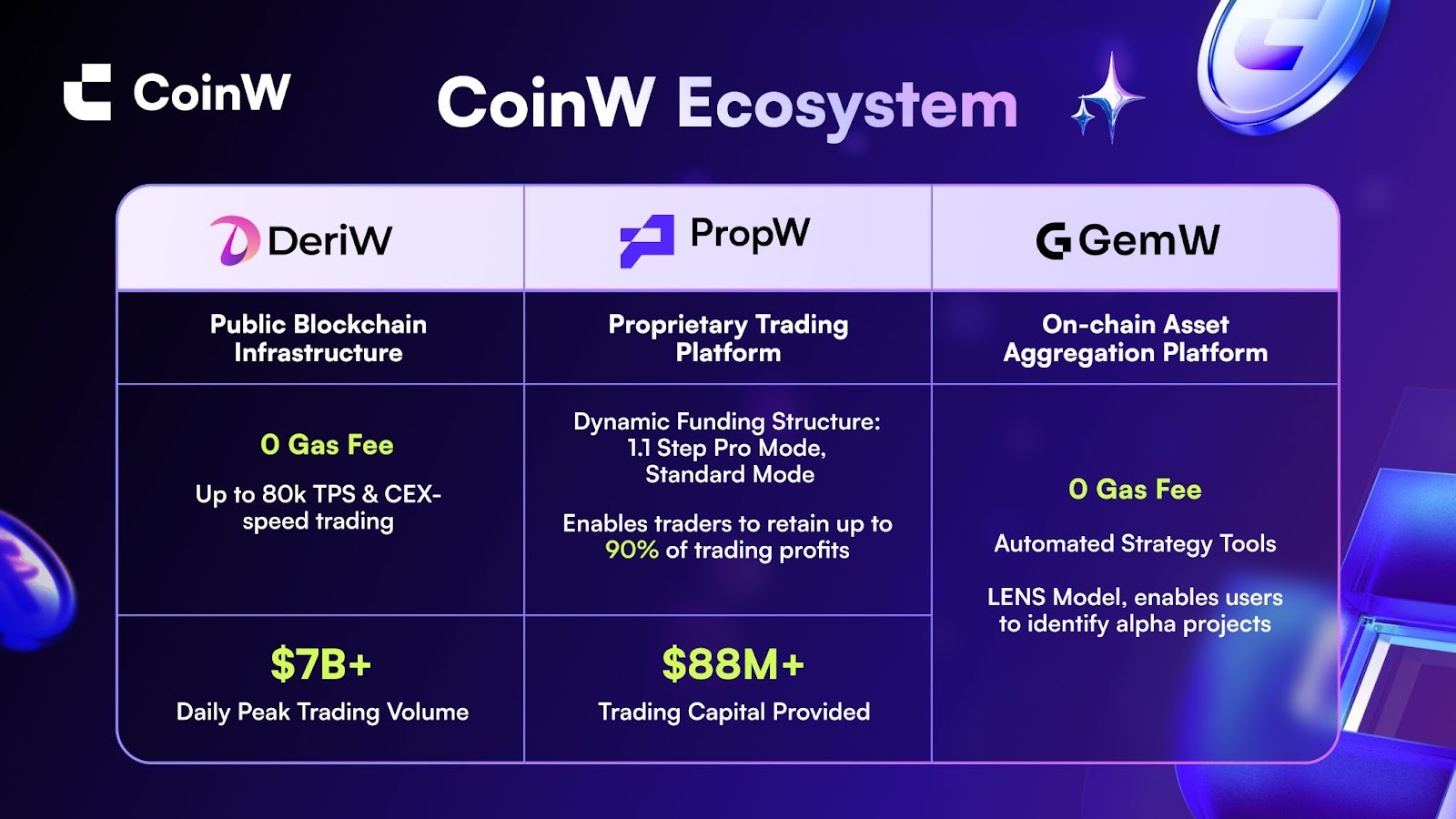
Onchain discovery is fragmented, and early research is slowed by wallet setup and gas requirements. GemW aggregates long-tail assets and lets users trade by simply pasting a contract address, while its LENS model blends onchain data, social sentiment and project analytics to filter signals.

Public-chain perpetuals often force traders to choose between speed, cost and transparent execution. CoinW’s public blockchain infrastructure solution DeriW uses a rollup architecture that supports up to 80,000 TPS and gas-optimized perpetual futures execution with transparent onchain matching, alongside liquidity pools designed to make execution more efficient and low-cost.

Crypto traders seeking scale face limited access to capital and programs built for other asset classes. PropW is a proprietary trading platform that uses an internal performance assessment framework to identify skilled traders and provide them with connectivity and risk tools to operate at a larger scale.
Source: CoinW

Additionally, the WConnect online initiative was established to partner with premium projects to improve infrastructure development and drive industry growth. These launches reflect a suite of tools ranging from asset discovery to decentralized infrastructure, rather than a simple matching engine.

Scale and evolution

This focus on stability and product expansion translated into growth. In 2025, CoinW surpassed 20 million registered users globally, growing its global community to over 1 million members and generating an annual trading volume of more than $200 billion (according to internal metrics and third-party market data sources such as CoinGecko). This volume was particularly concentrated in the derivatives market, where CoinW achieved a Top 3 ranking on CoinGecko.

In August 2025, CoinW completed a major platform upgrade. This update marked the platform’s transition from a standalone centralized exchange to a broader digital asset ecosystem.

Central to this evolution was the introduction of a Unified Gateway. This feature creates a bridge between centralized trading and the onchain world. Users can access trading, wealth management and asset discovery through a single account, reducing the friction typically associated with moving between Web2 and Web3 environments.

The long-term view

As the industry looks toward 2026, the events of 2025 reinforce the necessity of robust infrastructure. Volatility remains a constant factor, and platforms built on solid foundations are better positioned to endure market cycles.

“In a market dominated by high volatility, only platforms that remain committed to long-termism and possess sufficient resilience and structural capabilities can cut through the noise to establish enduring competitiveness,” says Nassar Al Achkar, CoinW’s chief strategy officer.

For CoinW, the volatility of 2025 was a proving ground for its RISE strategy. Mirroring the “marathon spirit” it champions, the platform prioritized endurance over speed, building the scale and infrastructure it believes are necessary for 2026.

Disclaimer: This article is provided for informational purposes only and does not constitute financial, investment, legal or regulatory advice, nor an offer or solicitation to buy or sell any digital assets, products or services. Digital asset trading involves significant risk, including the potential loss of capital.

The availability of products and services described herein may vary by jurisdiction and is subject to applicable laws, regulations and eligibility requirements. Any references to ratings, assessments or third-party evaluations are provided for informational purposes only and do not constitute regulatory approval, endorsement or guarantees of security or performance.


Criptos en tendencia

Preguntas relacionadas

QWhat was the key theme of CoinW's 2025 strategy, and what does the acronym RISE stand for?

AThe key theme of CoinW's 2025 strategy was RISE, which stands for Resilience, Innovation, Scale, and Evolution.

QWhat major market event occurred on October 10, 2025, and what was its impact?

AOn October 10, 2025, a violent price swing triggered the largest liquidation event in history, with approximately $19 billion in leveraged positions liquidated and about $1 trillion in total market capitalization wiped out within days.

QHow did CoinW's Futures Protection Program help users during the extreme market volatility?

ACoinW's Futures Protection Program used predefined internal algorithms to mitigate risks from extreme market volatility and large-scale liquidation cascades. It protected over 116,000 users and covered positions totaling 3.3 billion USDT.

QWhat was the significance of CoinW's platform upgrade in August 2025?

AThe August 2025 upgrade marked CoinW's transition from a standalone centralized exchange to a broader digital asset ecosystem, highlighted by the introduction of a Unified Gateway that bridges centralized trading with the onchain world.

QAccording to the article, what metric did CoinW achieve in 2025 that demonstrated its growth in scale?

AIn 2025, CoinW surpassed 20 million registered users globally, grew its community to over 1 million members, and generated an annual trading volume of more than $200 billion, achieving a Top 3 ranking in derivatives on CoinGecko.

Lecturas Relacionadas

From South Korea to the United States: Blue-Collar Jobs Are Becoming Increasingly Popular, Thanks to AI

AI is reshaping the labor market's value proposition. The traditional four-year college degree is losing its appeal as a guaranteed career path, while skilled blue-collar trades like electricians, welders, and plumbers are experiencing historic demand and wage premiums. This shift is driven by dual pressures: AI's displacement of certain white-collar roles and a booming need for physical infrastructure and data center construction. Data confirms the trend. In the U.S., vocational school revenue surged, and a significant portion of recent layoffs are AI-related. Surveys show a majority of Gen Z adults plan to pursue blue-collar work, citing better job security against AI automation. Vocational education interest has exploded recently. Experts cite a psychological shift as younger generations seek tangible, AI-resistant careers and avoid high student debt. In many cases, salaries for skilled trades now match or exceed those requiring a bachelor's degree. In South Korea, semiconductor vocational high schools boast near-total employment, with graduates securing high-paying roles at companies like Samsung. The shortage is structural, exacerbated by a retiring baby boomer workforce and massive infrastructure projects. Companies like JPMorgan Chase, Meta, and Lowe's are investing heavily in training programs. However, overcoming historical stigma and a "perception gap" around trade careers remains a key challenge to closing the talent gap.

marsbitHace 1 hora(s)

From South Korea to the United States: Blue-Collar Jobs Are Becoming Increasingly Popular, Thanks to AI

marsbitHace 1 hora(s)

Qualcomm: AI Hype Subsides, When Will Smartphones Emerge from the Gloom?

Qualcomm reported its Q3 FY2026 results (ending June 2026), with revenue of $9.95B, down 4% YoY but above expectations. Gross margin declined to 53.1%, pressured by rising costs across manufacturing and memory. Key business segments showed mixed performance: Handset revenue fell 19.6% YoY to $5.09B, dragged by an 11% decline in non-Apple Android shipments and weaker high-end mix. Conversely, Automotive revenue surged 61% to $1.59B, and IoT grew 9% to $1.83B. Core operating profit dropped 41% YoY due to margin compression and higher expenses. Management's Q4 FY2026 guidance projects revenue of $9.7B-$10.5B, in line with consensus, but Non-GAAP EPS guidance of $2.05-$2.25 fell short of expectations. Amidst persistent weakness in its core handset market, Qualcomm is pursuing growth in AI, focusing on Edge AI (smartphones, PCs, automotive) and Data Center AI. Its data center strategy includes four pillars: AI accelerators (e.g., AI200), commercial CPUs (Dragonfly C1000), custom silicon, and connectivity solutions. While these initiatives initially boosted its stock, concerns over AI capital expenditure sustainability have since erased those gains. The company targets $5B in data center revenue for FY2027 and $15B for FY2029. The report concludes that with the traditional handset business still under pressure, the data center opportunity is currently viewed as a longer-term option, and a more conservative valuation based on core operations may be warranted until AI contributions materialize.

marsbitHace 1 hora(s)

Qualcomm: AI Hype Subsides, When Will Smartphones Emerge from the Gloom?

marsbitHace 1 hora(s)

From TPU to Self-Evolving Agents: How Jeff Dean Predicts the Next Step in AI

At the 2026 YC Startup School, Jeff Dean outlined his vision for AI's next phase, shifting focus from simply scaling models to building intelligent, autonomous systems. He believes AI's progress is no longer just about creating smarter models, but about integrating them into systems capable of long-term, iterative work, automated experimentation, and continuous learning. This evolution moves the competition from "who has the bigger model" to "who can best organize intelligence." Dean suggests AI capabilities are now comparable to a junior engineer, enabling the automation of complex workflows. However, the true challenge and opportunity lie in managing these AI "workers" at scale. He emphasizes the importance of **context engineering**—structuring tools, memory, and feedback loops—over raw model power. For startups, this means building deep expertise in niche domains where general models currently fail (near 0-1% success rates), leveraging proprietary data, specialized tools, and domain-specific evaluators. A recurring theme is re-examining fundamental constraints. Dean's past work, like moving Google's search index to memory or creating the TPU, stemmed from questioning outdated assumptions about hardware and cost. He sees similar inflection points today, particularly in **specialized inference hardware** to drastically reduce latency and energy consumption for real-time Agent operation. Notably, he points out that in modern AI systems, the dominant cost is often not computation but **data movement**. Reliable, long-running Agents require robust system design, borrowing concepts from distributed computing like checkpointing, state management, and parallel exploration to handle failures and maintain progress over days or weeks. As AI automates execution, the scarcest human skills will shift to **defining clear specifications**, **judging what problems are worth solving** (taste), and designing effective feedback loops. Ultimately, Dean's framework prioritizes understanding the problem deeply, identifying the true bottlenecks, and systematically building closed-loop systems where AI can not only perform tasks but also improve AI itself.

marsbitHace 1 hora(s)

From TPU to Self-Evolving Agents: How Jeff Dean Predicts the Next Step in AI

marsbitHace 1 hora(s)

Trading

Spot

Artículos destacados

Cómo comprar O

¡Bienvenido a HTX.com! Hemos hecho que comprar O1 exchange (O) sea simple y conveniente. Sigue nuestra guía paso a paso para iniciar tu viaje de criptos.Paso 1: crea tu cuenta HTXUtiliza tu correo electrónico o número de teléfono para registrarte y obtener una cuenta gratuita en HTX. Experimenta un proceso de registro sin complicaciones y desbloquea todas las funciones.Obtener mi cuentaPaso 2: ve a Comprar cripto y elige tu método de pagoTarjeta de crédito/débito: usa tu Visa o Mastercard para comprar O1 exchange (O) al instante.Saldo: utiliza fondos del saldo de tu cuenta HTX para tradear sin problemas.Terceros: hemos agregado métodos de pago populares como Google Pay y Apple Pay para mejorar la comodidad.P2P: tradear directamente con otros usuarios en HTX.Over-the-Counter (OTC): ofrecemos servicios personalizados y tipos de cambio competitivos para los traders.Paso 3: guarda tu O1 exchange (O)Después de comprar tu O1 exchange (O), guárdalo en tu cuenta HTX. Alternativamente, puedes enviarlo a otro lugar mediante transferencia blockchain o utilizarlo para tradear otras criptomonedas.Paso 4: tradear O1 exchange (O)Tradear fácilmente con O1 exchange (O) en HTX's mercado spot. Simplemente accede a tu cuenta, selecciona tu par de trading, ejecuta tus trades y monitorea en tiempo real. Ofrecemos una experiencia fácil de usar tanto para principiantes como para traders experimentados.

505 Vistas totalesPublicado en 2026.06.19Actualizado en 2026.06.29

Cómo comprar O

Cómo comprar PROS

¡Bienvenido a HTX.com! Hemos hecho que comprar Pharos (PROS) sea simple y conveniente. Sigue nuestra guía paso a paso para iniciar tu viaje de criptos.Paso 1: crea tu cuenta HTXUtiliza tu correo electrónico o número de teléfono para registrarte y obtener una cuenta gratuita en HTX. Experimenta un proceso de registro sin complicaciones y desbloquea todas las funciones.Obtener mi cuentaPaso 2: ve a Comprar cripto y elige tu método de pagoTarjeta de crédito/débito: usa tu Visa o Mastercard para comprar Pharos (PROS) al instante.Saldo: utiliza fondos del saldo de tu cuenta HTX para tradear sin problemas.Terceros: hemos agregado métodos de pago populares como Google Pay y Apple Pay para mejorar la comodidad.P2P: tradear directamente con otros usuarios en HTX.Over-the-Counter (OTC): ofrecemos servicios personalizados y tipos de cambio competitivos para los traders.Paso 3: guarda tu Pharos (PROS)Después de comprar tu Pharos (PROS), guárdalo en tu cuenta HTX. Alternativamente, puedes enviarlo a otro lugar mediante transferencia blockchain o utilizarlo para tradear otras criptomonedas.Paso 4: tradear Pharos (PROS)Tradear fácilmente con Pharos (PROS) en HTX's mercado spot. Simplemente accede a tu cuenta, selecciona tu par de trading, ejecuta tus trades y monitorea en tiempo real. Ofrecemos una experiencia fácil de usar tanto para principiantes como para traders experimentados.

517 Vistas totalesPublicado en 2026.06.22Actualizado en 2026.06.29

Cómo comprar PROS

Qué es VERONA

I. Introducción al Proyecto VERONA es una blockchain construida para todos, en todas partes a través de la abstracción de cadenas. Utilizando su capa de Abstracción Generalizada, VERONA se distingue por integrar funcionalidades complejas de blockchain, como cuentas, firmas e interoperabilidad, directamente a nivel de protocolo. Este enfoque permite interactuar con aplicaciones de blockchain sin necesidad de entender las tecnologías subyacentes.1) Información Básica Nombre: VERONA (VERONA)III. Enlaces Relacionados Enlace al sitio web oficial: https://xion.burnt.com/ Libro Blanco: https://xion.burnt.com/whitepaper.pdf Exploradores: https://explorer.burnt.com/ Redes Sociales: https://x.com/burnt_xion Nota: La introducción del proyecto proviene de los materiales publicados o proporcionados por el equipo oficial del proyecto, que es solo para referencia y no constituye asesoramiento de inversión. HTX no se hace responsable de ninguna pérdida directa o indirecta resultante.

596 Vistas totalesPublicado en 2026.06.22Actualizado en 2026.06.22

Qué es VERONA

Discusiones

Bienvenido a la comunidad de HTX. Aquí puedes mantenerte informado sobre los últimos desarrollos de la plataforma y acceder a análisis profesionales del mercado. A continuación se presentan las opiniones de los usuarios sobre el precio de A (A).

活动图片













