2025 Airdrop Survival Rules: From Gold Rush to Holding These Two Aces

marsbitPublicado a 2025-12-12Actualizado a 2025-12-12

Resumen

In 2025, the airdrop farming landscape shifted dramatically, moving from a "gold rush" to a challenging environment with significantly reduced returns. The absence of an "altcoin season" and Bitcoin's market dominance led to lower valuations for airdropped tokens, with many projects launching at lower fully diluted valuations (FDVs) and experiencing immediate sell-offs. This resulted in smaller airdrops, often not even covering gas fees, causing many farming studios to shut down or pivot to other ventures. Despite the downturn, new farming methods emerged. "InfoFi" or "talk-to-earn" platforms like Kaito, Cookie Snaps, and Galxe’s Starboard allowed users to earn tokens by creating quality content and analysis on social media, lowering entry barriers and offering faster returns compared to traditional on-chain interactions. Binance Alpha also became a key income source for many, though its rewards diminished over time due to increased competition and lower token values. The two most reliable strategies for sustaining profits were: 1) Participating in high-profile token launches (e.g., on BuidlPad, Kaito, or Legion), focusing on projects with strong community hype and oversubscribed sales, which often provided quick, substantial gains at TGE. 2) Stablecoin farming through platforms like Binance’s Web3 Wallet, which offered low-risk, high-yield opportunities (e.g., Plasma’s collaboration with Binance offered over 70% APY for USDT depositors). These methods provided steady r...

Author: Asher, Odaily Planet Daily

As 2025 draws to a close, being the Odaily Planet Daily author who "loves talking about airdrops and writing interaction guides the most" (I wrote the vast majority of the interaction tutorial section articles this year), it's time for an annual summary on airdrop hunting.

After liquidating my holdings in on-chain AI Agent sector Meme coins at the beginning of the year, I devoted most of my time to interacting with various popular projects. I tried almost all the hot airdrop projects, and of course, I didn't miss out on the pitfalls either. As the year-end approaches, I've had many conversations with friends who are also passionate about airdrop hunting, summarizing the changes in the landscape this year.Because of this, I deeply feel that airdrop hunting in 2025 has quietly shifted from a "gold rush for all" to a "collective retreat."

Plummeting Airdrop Returns, Studios Exit En Masse

Looking back at 2025, the airdrop hunting sector rapidly fell from "get-rich-quick myths" into a "winter of intense competition." Big airdrops disappeared, small airdrops shrank, and "getting rekt by the airdrop" became the norm. The most common phrase among "airdrop hunters" this year most直观地揭示了这一变化: "Small airdrops are only $5 to $10, and the Gas fee to claim them is more expensive than the tokens; past airdrop rewards of over 10% with no lock-up have now dropped to 2-3%, and are released in batches."

The sharp drop in returns directly triggered a mass exodus of studios."From the days when any interaction made money, to now not even covering the basic team wages. It's not that we didn't try hard, it's that the era quietly closed its door." Odaily Planet Daily learned from interviews that large numbers of teams have either shut down directly or shifted to more controllable businesses like cross-border e-commerce; the few teams that remain are barely surviving, almost entirely relying on Binance Alpha's daily 'certain airdrop claims' to scrape by. However, with the significant drop in the value of airdropped tokens on Binance Alpha throughout November, studios will likely face a second wave of concentrated exits in the short term.

More absurdly, the biggest profit source for many studios this year wasn't token airdrops, but hoarding hardware. A studio friend joked self-deprecatingly: "Didn't make much from airdrop hunting this year, but the RAM sticks I hoarded in February rose from 55 yuan to 240 yuan, a pants-load of RAM sticks became the most profitable investment of the year."
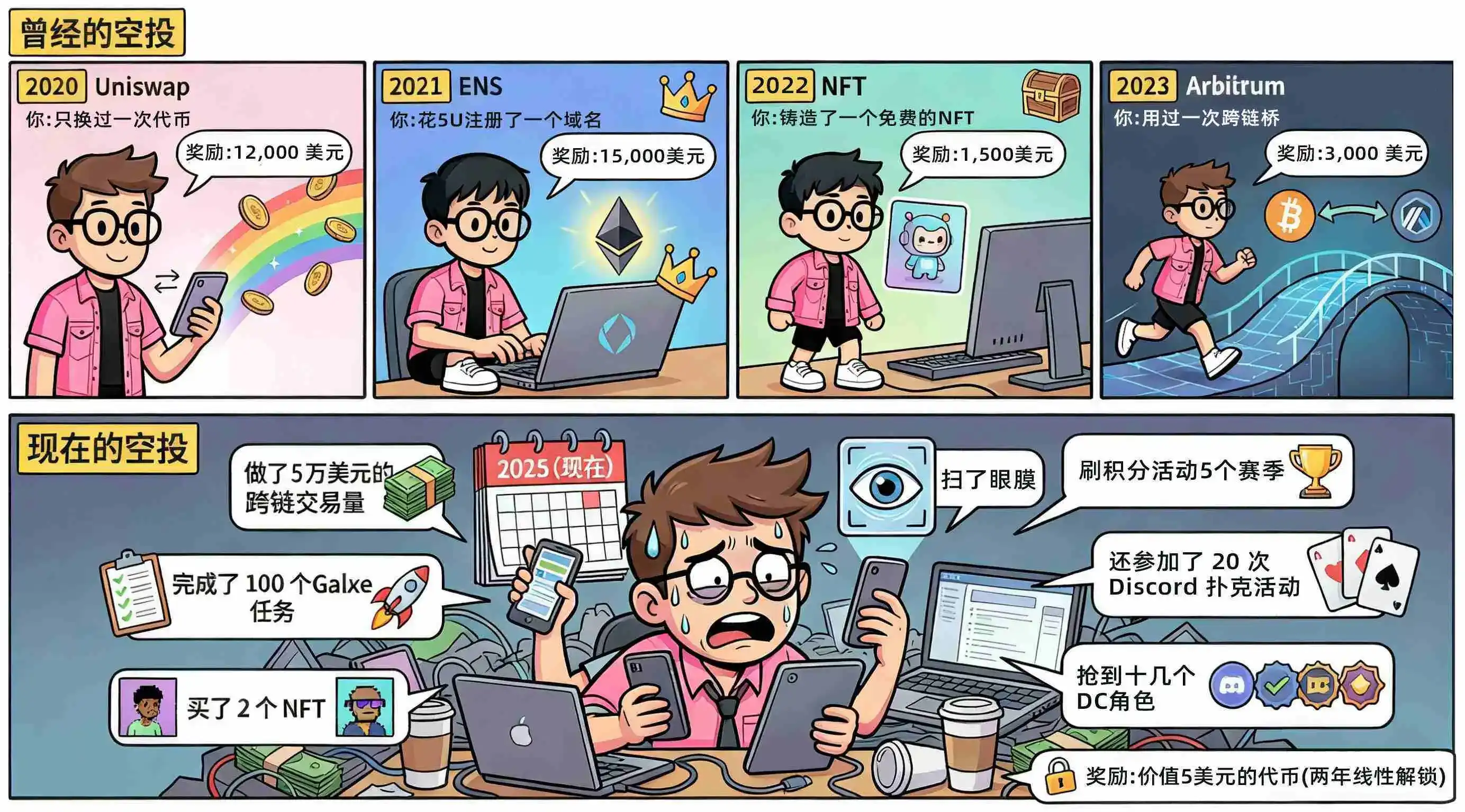
The airdrop hunting sector moves from "get-rich-quick myths" to "winter of intense competition"

No Altcoin Season is the Root Cause of Declining Airdrop Returns

Airdrop returns本质上依赖于空投代币的后续表现, which in turn often rely on the tailwind of "altseason"—that golden window when altcoins collectively rotate and surge hundredfold. However, throughout 2025, the crypto market was stuck in a prolonged BTC-dominant pattern, with altcoins generally depressed. According to on-chain data, BTC's market dominance continued to rise, hitting a high of 63% at one point this year. BTC dominance meansliquidity doesn't spill over, altcoins don't rotate, and new projects struggle to gain traction—without this price amplifier, airdrop values can't rise, and airdrop hunting returns are注定走弱.
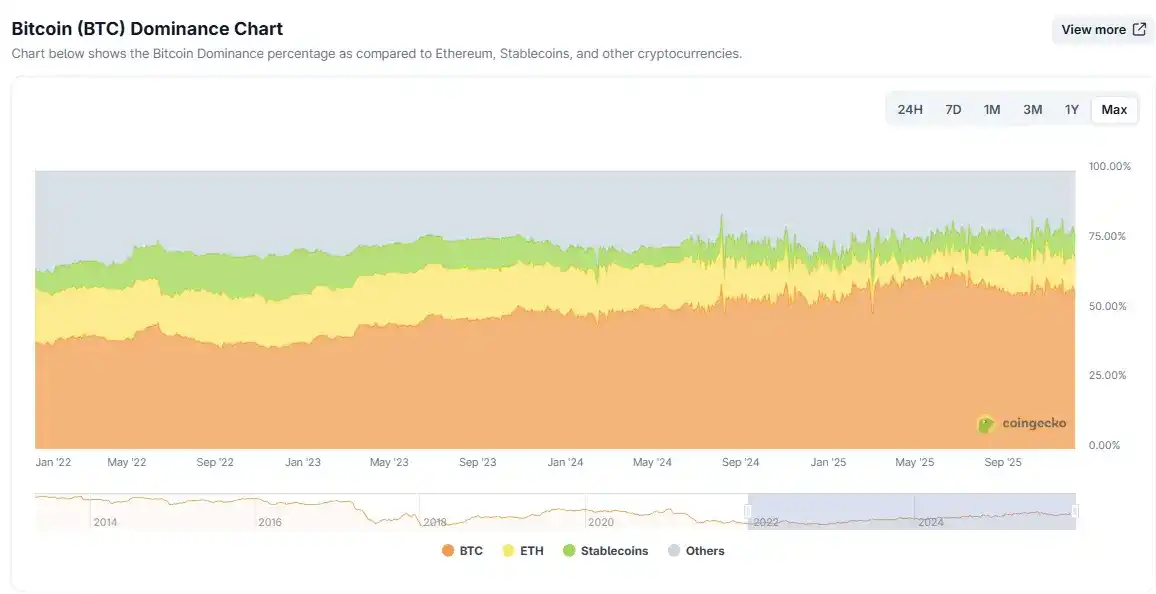
BTC Market Dominance

This "no altseason" situation directly hits the core pain point of airdrop hunting—the upfront investment in Gas fees, time, and resources often results in tokens that open low and go lower, or even go to zero. Per-account returns have shrunk from tens or even hundreds of dollars in the past to just a few dollars, often not even covering the Gas fees.

Further analysis shows that, on one hand, the opening market caps of newly launched projects this year were generally lower, with valuation systems collapsing across the board. From the heyday of ARB and STARK airdrops opening with FDVs动不动就 10-20 billion USD, to many projects now starting with only a few hundred million or even tens of millions in FDV, there's little room for imagination, and the airdrops are already worthless at launch.(Let's be honest, the former sky-high valuations of star projects were also partly due to airdrop hunters who frantically刷数据, had no loyalty, and abandoned projects after the drop.)

On the other hand, even if the opening valuation is low, expecting a "catch-up rally" is difficult. Many projects have "rat warehouse" insiders entering early, who dump mercilessly on the market upon launch, or even rug pull directly, with花样崩盘层出不穷: 50% drops in a day, crashes over 80%, pump at open followed by a slow bleed, airdrops being集中抛售, etc. Many veteran hunters sigh that "sell immediately upon receipt" should be an iron rule, because 90% of altcoins are注定归零, and the risk of heavy betting far outweighs the potential reward.

Therefore, the immediate returns from airdrops are extremely limited, and if one chooses to hold through the market, being a "diamond hands," they often not only miss the rebound but end up with even lower final returns.

Despite the significant drop in airdrop returns in 2025, the sector has not completely stalled. Odaily Planet Daily observes thatthe methods of airdrop hunting are quietly diversifying, no longer just单纯每日参与测试网交互、刷主网交易量 to gamble on token airdrops, but gradually forming multiple细分方向.

Diversification of Airdrop Hunting

From Traditional Hunting to "Skill-Based Hunting"

The biggest innovation in the airdrop hunting sector in 2025 is undoubtedly the "talk-to-earn economy." InfoFi (Information Finance,信息金融化) uses token incentives to directly reward high-quality information creators, while also alleviating the issues of information fragmentation and lack of trust in the crypto world.

Since Kaito launched its "Yap-to-Earn" mechanism, it's been easy to see a flood of "Upcoming TGE Project Analysis" posts while scrolling through X. Subsequently, Cookie launched Cookie Snaps, highlighting "analyzing crypto projects and KOLs to get rewards for quality CT content", and Galxe used Starboard in a data-driven way to help projects screen and incentivize key contributors. The launch of these mechanisms triggered KOLs to compete in posting project analysis threads, vying for token airdrops, and also made "talk-to-earn" a popular concept within the circle—earning project airdrops simply by posting and writing reviews.

Traditional airdrop hunting may have reached a turning point. The hard work of "running multiple accounts with scripts, grinding interactions" often ends with being slashed by the sybil system—not only wasted effort, but not even a single airdrop received. Having followed projects for years, full of expectation, only to be met with the outcome of "getting rekt" is utterly disheartening.

With the arrival of the "talk-to-earn" era, platforms like Kaito and Cookie use content points and influence rewards, lowering the participation barrier, offering faster returns, lower costs, and greater potential. In the new landscape, a high-quality post on X, with images and opinions, can generate even more value than a week of on-chain interactions.

Now, "talk-to-earn" on X is essentially creating a refined airdrop hunting account in a different form. Going with the flow and actively adapting to the new model of airdrop hunting is the way to earn more token airdrops.

Binance Alpha: The Main Source of Survival for Studios

Since its launch in May 2025, Binance Alpha was once hailed as the "wealth engine" of the airdrop hunting world, reaching its peak during the "golden month" of September. Since May, Binance Alpha and Binance Booster(For more related content, read: Don't Just Grind Points for Airdrops, Binance Alpha's Booster Activity is Also Worth Participating In) provided studios with "stable startup capital," earning $500 to $2000 per month, allowing studios to move from "survival" to "expansion." Many hunters joked, "Binance is疯狂撒钱, making it seem like money grows on trees."

<p style="text-align: justify; font-size: 16px; font-weight: inherit; word-break: break-all;极速赛车开奖结果查询 官网 168 飞艇开奖直播 开奖记录 历史结果 体彩 福彩 双色球 大乐透 排列三 排列五 七星彩 快乐8 3D 七乐彩 胜负彩 任选九 半全场 进球彩 北京单场 竞彩足球 竞彩篮球</p> </body></html>

Preguntas relacionadas

QWhat are the two main strategies mentioned in the article for surviving the airdrop hunting landscape in 2025?

AThe two main strategies are participating in new token launches (打新) and engaging in stablecoin yield farming (稳定币理财).

QAccording to the article, what is the fundamental reason for the sharp decline in airdrop profits in 2025?

AThe fundamental reason is the lack of an 'altcoin season' or a bull market for山寨币. The market was dominated by Bitcoin (BTC独大), which meant liquidity did not flow into altcoins, preventing them from rising in value and thus devaluing airdropped tokens.

QWhat new airdrop hunting method, dubbed 'Yap-to-Earn' or '嘴撸', became popular in 2025?

AThe new method is 'InfoFi' or 'Information Finance', where users earn token rewards by creating high-quality content, such as project analysis posts on platforms like X (Twitter), through mechanisms introduced by platforms like Kaito and Cookie.

QWhy did Binance Alpha's airdrop rewards decrease significantly after its initial success?

AThe rewards decreased due to two main factors: a massive influx of new users and studios (increased competition, or '僧多') and a more severe drop in the actual value of the airdropped tokens themselves, with many crashing immediately after launch ('肉少').

QWhat is presented as the long-term, stable foundation for a sustainable airdrop hunting strategy?

AStablecoin yield farming (稳定币理财) is presented as the long-term foundation. It offers a low-risk way to earn steady returns and sometimes substantial airdrops (like with Plasma), which helps preserve capital and provide a reliable income stream during bear markets.

Lecturas Relacionadas

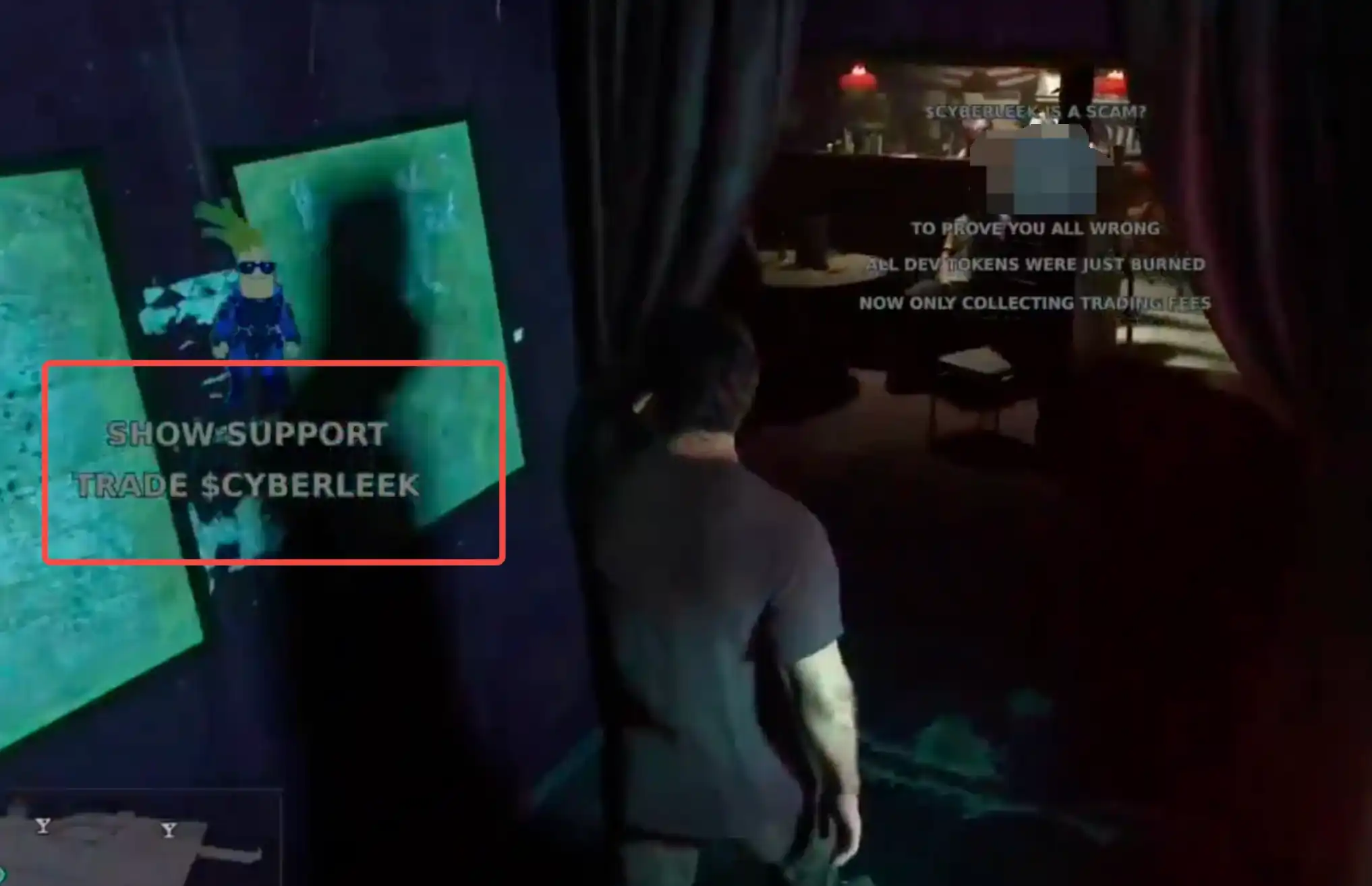
Hacker Leaks GTA6 and Launches a Token: Leaked Videos Become Ad Space for $CYBERLEEK, Must Buy Tokens to Vote for Next Clip

A hacker group called "CyberLeek" has leaked gameplay footage of the highly anticipated video game *GTA 6*, which is slated for release in 2026. Simultaneously, the group launched a meme token, $CYBERLEEK, on Solana. The leaks, which include maps and gameplay clips, are heavily watermarked with advertisements urging viewers to buy the token. Investigations of blockchain data reveal that the token was created and funded from a single wallet approximately eight hours before the first leak was released, suggesting a coordinated plan. The group has implemented a voting system where token holders can "vote" for the next type of content to be leaked by sending $CYBERLEEK tokens to a designated wallet—a process that permanently transfers the tokens to the hackers. This creates a self-sustaining cycle where interest in the leaks drives token purchases. Financially, the operation involved minimal upfront costs (less than $3,500 in out-of-pocket expenses) but generated significant revenue. On its first day, the token saw $15 million in trading volume, netting the creators an estimated $30,000 from transaction fees alone. While the group later burned a large portion of its developer-held tokens (worth over $1 million) to build trust, the fee-generating mechanism remains intact. The game's publisher, Take-Two Interactive, has initiated legal proceedings to identify the hackers. Despite this, the case demonstrates a new model where leaked intellectual property is used as leverage to promote and profit from a cryptocurrency, with meme token markets serving as an additional revenue stream.

marsbitHace 16 min(s)

Hacker Leaks GTA6 and Launches a Token: Leaked Videos Become Ad Space for $CYBERLEEK, Must Buy Tokens to Vote for Next Clip

marsbitHace 16 min(s)

Jensen Huang's Daughter: From Chef to an $8 Million Annual Salary

Madison Huang, daughter of NVIDIA founder Jensen Huang, recently made a rare public appearance in Beijing during the 2026 World Robot Conference. As the Senior Director of Product and Technology Marketing for NVIDIA's Physical AI Platform, with an annual salary of approximately $1.2 million, her visit focused on evaluating leading Chinese robotics companies like UBTech, Unitree, and others. This highlights NVIDIA's strategic interest in the burgeoning Chinese robotics ecosystem, a key battleground for the development of Physical AI—technology that enables machines to understand and interact with the physical world. Huang's career path is unconventional. Initially pursuing her passion, she studied culinary arts, worked as a chef, and later held a marketing role at LVMH. She joined NVIDIA as an intern in 2020 after completing an MBA, quickly rising through the ranks. Her brother, Spencer Huang, followed a similar path, closing a cocktail bar he co-founded to also join NVIDIA, where he now works on robotics software. Jensen Huang has publicly addressed nepotism concerns, humorously noting that some "second-generation" employees outperform their parents. The conference itself underscored China's vibrant robotics sector, marked by Unitree's recent blockbuster IPO and a pipeline of companies preparing to go public. While hardware development and manufacturing are advancing rapidly, industry leaders like Wang Xingxing of Unitree point to the next critical challenge: developing the "brain" or AI that allows robots to perform diverse, unseen tasks based on simple instructions. With massive manufacturing scale and diverse real-world testing scenarios, China is positioned as a central player in the global race to define the future of robotics.

marsbitHace 2 hora(s)

Jensen Huang's Daughter: From Chef to an $8 Million Annual Salary

marsbitHace 2 hora(s)

He Gave Wang Xingxing the First 2 Million, Now Serves as Chairman for the Next 'Unitree'

On August 19, 2024, Unitree Robotics, China's "first humanoid robotics stock," went public. Its founder, Wang Xingxing, started a decade ago with his self-developed XDog. In 2016, at a critical funding juncture, he received his first angel investment of 2 million RMB from Yin Fangming. This bet has since yielded a return of over 140 times. Yin Fangming is more than just a key investor. He was a co-founder of the AI robotics company ROOBO, whose own venture ultimately struggled. This firsthand experience with the hardware challenges in robotics gave him unique insight when backing Unitree, a company renowned for its hardware R&D and cost control. While his own company faltered, Yin continued investing shrewdly. He partially cashed out some Unitree shares early, reinvesting the proceeds into sectors like energy (e.g., solid-state battery firm TaiLan) and commercial aerospace (e.g., small launch vehicle developer XianDeng Aerospace). However, his most significant move after Unitree is his deep involvement with Galaxy General, a leading embodied AI unicorn. In July 2024, Yin stepped from behind the scenes to officially become its Chairman, indicating a role far beyond a typical investor. This comes as Galaxy General is viewed as preparing for future capital moves. Yin's career has consistently been ahead of the curve—from mobile internet to AI and robotics. Known for his foresight and low profile, he declined an interview for this story, offering only a statement encouraging support for visionary entrepreneurs like Wang Xingxing.

marsbitHace 3 hora(s)

He Gave Wang Xingxing the First 2 Million, Now Serves as Chairman for the Next 'Unitree'

marsbitHace 3 hora(s)

Coldcard Theft Reflection: Source Code Visibility Does Not Equal Security

The article examines the open-source vs. closed-source debate in crypto, prompted by a theft of over $100M in Bitcoin from Coldcard hardware wallets. It clarifies key terminology: true "Free and Open Source Software" (FOSS) grants four essential freedoms (use, study, share, modify), while "source available" code, like Coldcard's firmware, may have usage restrictions. The piece argues that visible source code alone does not guarantee security; actual safety depends on the economic incentives for thorough, ongoing review by skilled individuals. Using Bitcoin Core as a model, the article describes a successful, transparent open-source development culture built on public review and consensus. It contrasts this with the Coldcard case, where a critical bug in a lightly-reviewed, source-available library went undetected for years, highlighting a "tragedy of the commons" scenario where assumed but absent scrutiny creates vulnerability. The economics of licensing are crucial: restrictive licenses can limit the pool of motivated commercial reviewers. Finally, the article explores AI's impact. It cites the Bitcoin Red Team's use of AI to rapidly audit codebases and find vulnerabilities at scale, demonstrating a powerful new tool for security. However, AI also floods projects with low-quality code, straining maintainers. The piece concludes that in high-stakes crypto, only well-audited projects—whether open or closed-source—can withstand evolving threats, with AI both challenging and aiding security practices.

marsbitHace 3 hora(s)

Coldcard Theft Reflection: Source Code Visibility Does Not Equal Security

marsbitHace 3 hora(s)

Trading

Spot
活动图片