2008-style crisis ahead? – How crypto investors are reacting to ‘zero rate cuts’

ambcryptoPublicado a 2026-03-21Actualizado a 2026-03-21

Resumen

With expectations of zero rate cuts and persistent inflation risks, crypto market dynamics are shifting toward capital preservation. While the total crypto market cap remains stable near $2.4 trillion, defensive positioning is evident as stablecoin supply hits a new all-time high of $316 billion. USDT outflows and declining exchange reserves indicate investors are moving liquidity into on-chain stablecoins, preparing to redeploy when risk appetite improves. Analysts warn that sustained high yields and borrowing costs could heighten systemic risks, echoing pre-crisis conditions. This cautious stance suggests stablecoins are becoming a key hedging tool amid deteriorating macro conditions.

Markets are now pricing in the “long-term” macro impact of the ongoing war.

Notably, one consistent theme across analysts is that expectations for rate cuts this year have effectively dropped to zero. Historically, crypto has thrived in low-rate environments, where cheap liquidity fuels risk-taking and makes leverage more accessible.

However, with inflation risks embedding deeper into the economy, the outlook for fresh capital inflows is clearly weakening. In fact, a recent Bloomberg report indicates that investors are pricing U.S. inflation above 5% over the next 12 months, based on the 1-year breakeven rate.
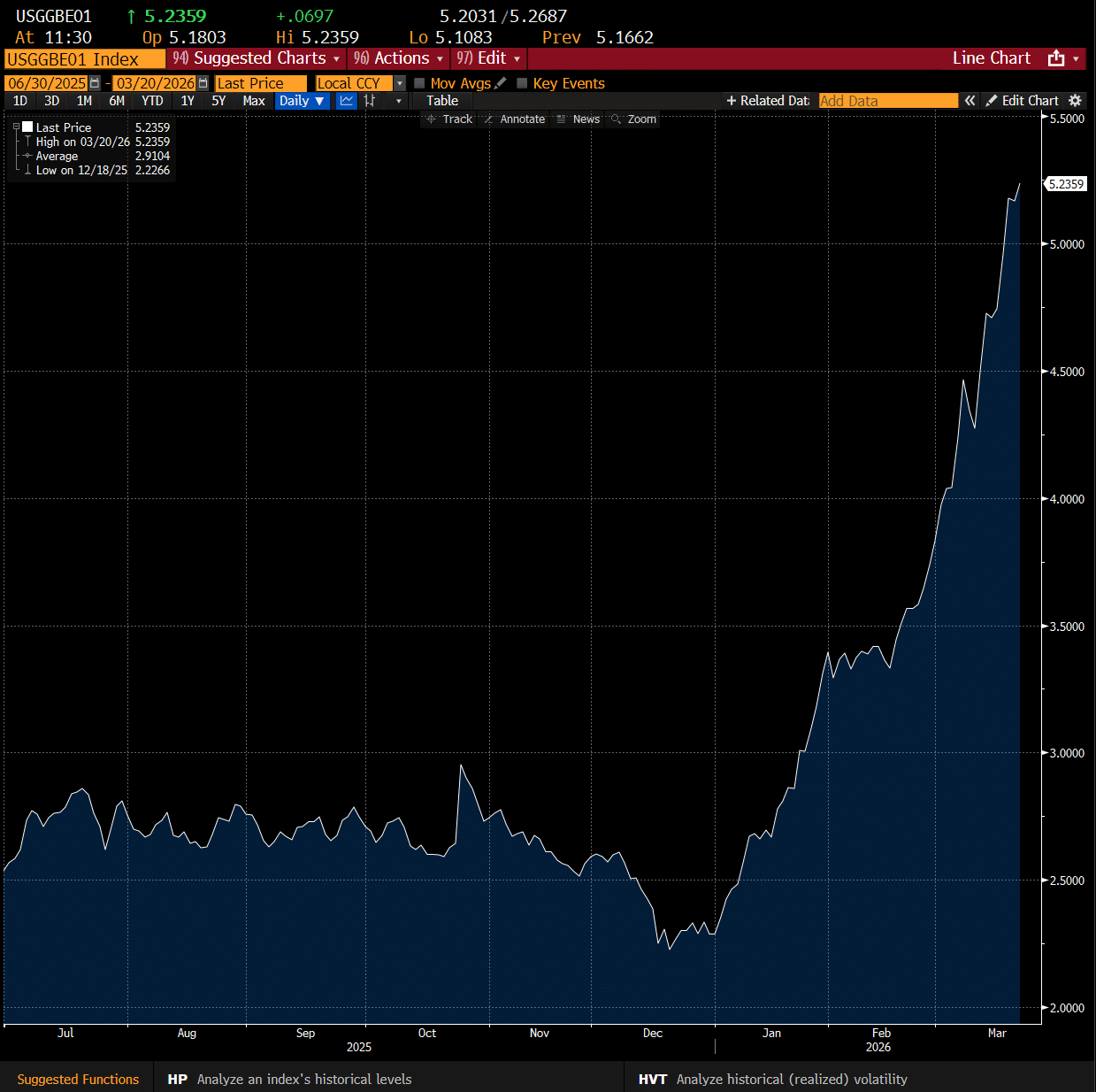
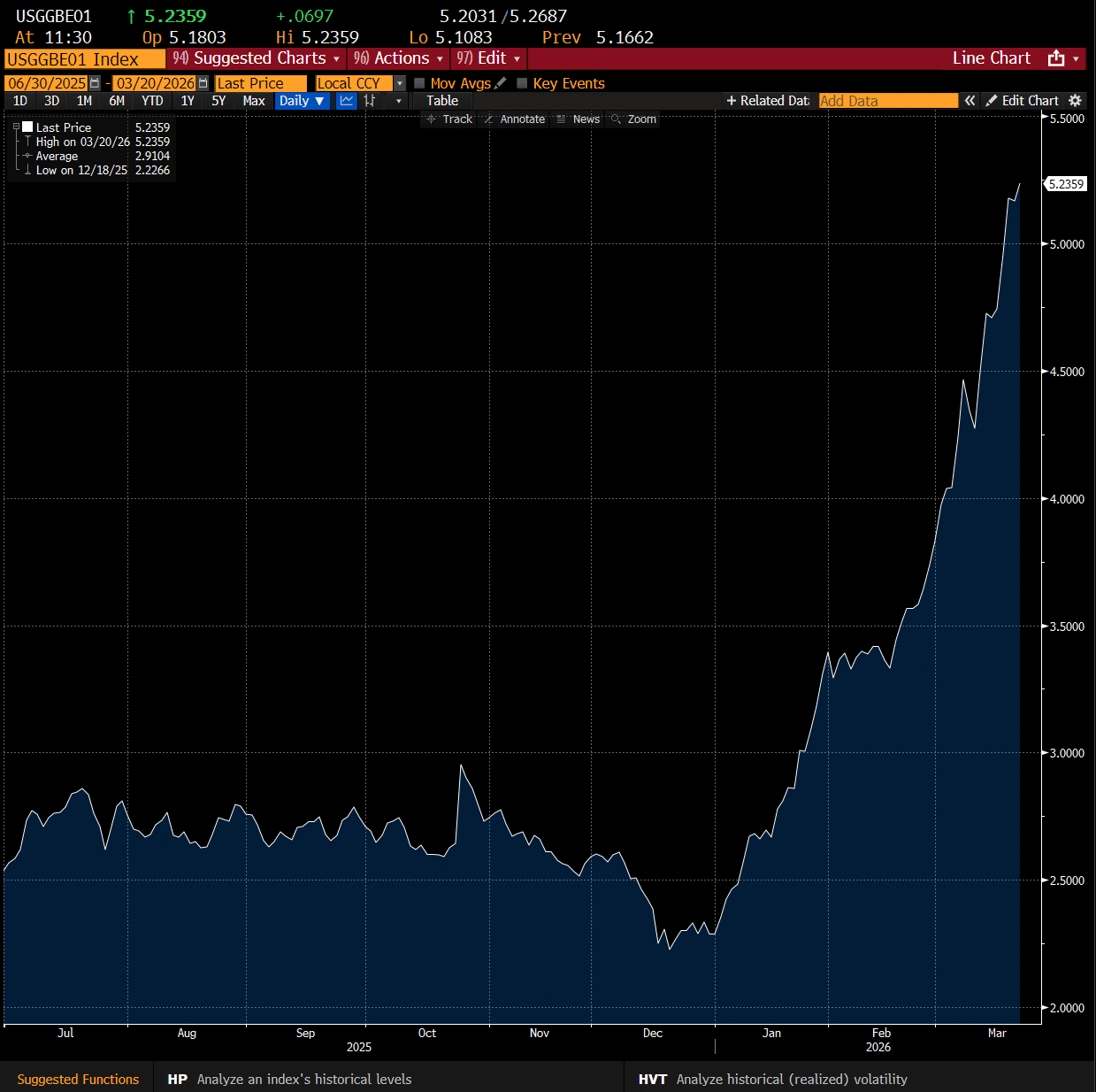
Source: X

So the natural question is, what does this mean for crypto?

Interestingly, some analysts are now flagging the risk of a 2008-style financial crisis. The pressure point here is the U.S. Treasury market, with yields pushing up to 4.37%, the highest level since July 2025. With debt levels already elevated, higher yields raise government borrowing costs, tightening the overall macro setup.

In short, if the Fed holds a zero rate-cut stance through the year, the risk of a crisis can’t be ruled out, especially with the data backing it. For crypto, that naturally shifts the focus toward hedging and capital preservation. So the question is, with macro tightening becoming structural, are stablecoins set to become the “long-term” parking zone for capital?

Defensive capital builds in crypto as macro conditions deteriorate

Zooming out, the long-term impact of the war still doesn’t appear to be fully priced into crypto markets.

Despite bearish macro commentary, total crypto market cap has held steady around the $2.4 trillion level, with no meaningful outflows. Large-cap assets continue to trade near key resistance zones without any significant rejection, indicating that conviction remains intact and risk hasn’t meaningfully unwound.

That said, the underlying data is starting to shift. Stablecoin market cap is up 2.22% this month, recently hitting a new all-time high of $316 billion. This points to liquidity building on the sidelines, with capital staying within crypto rather than rotating out.
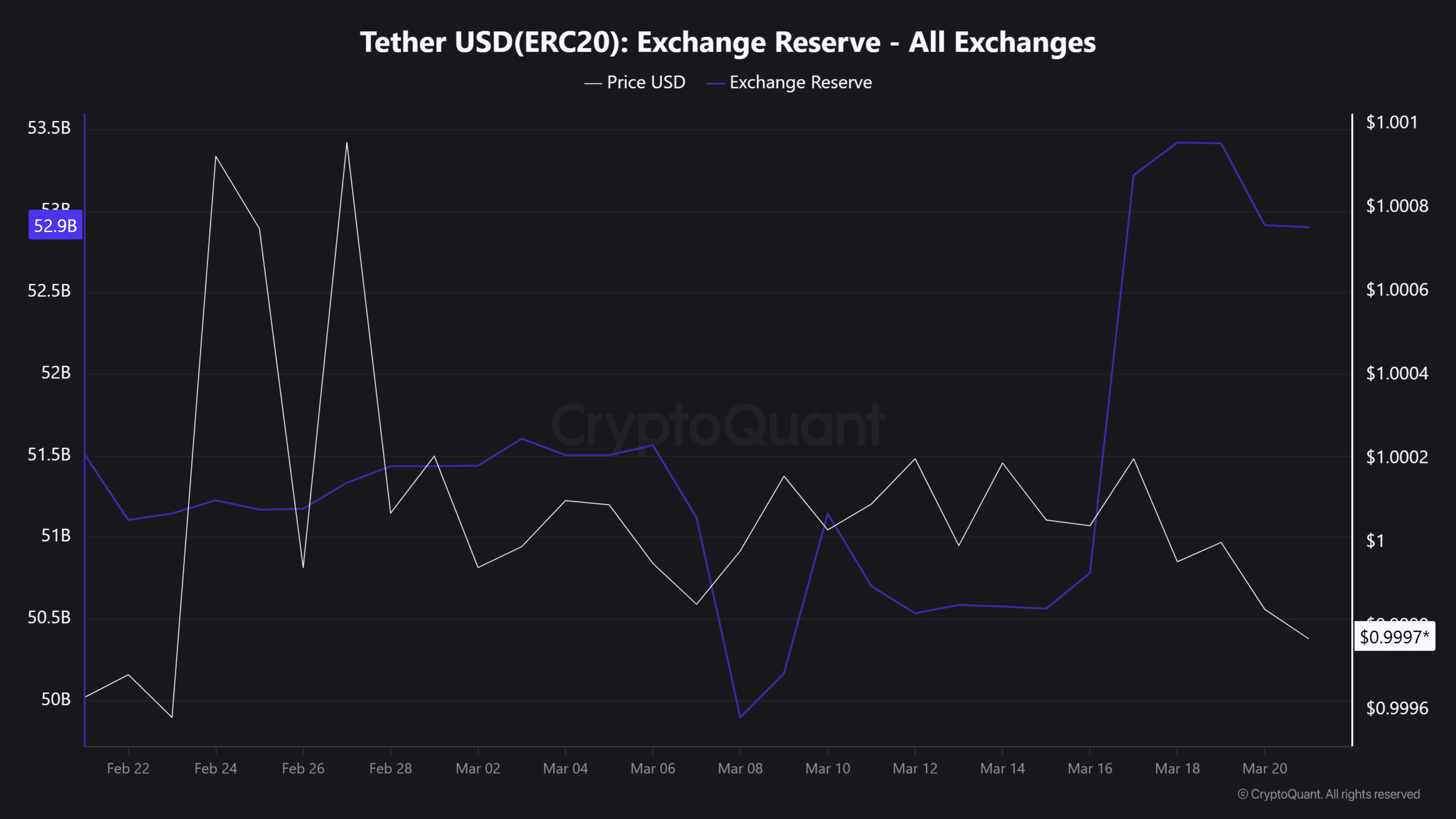
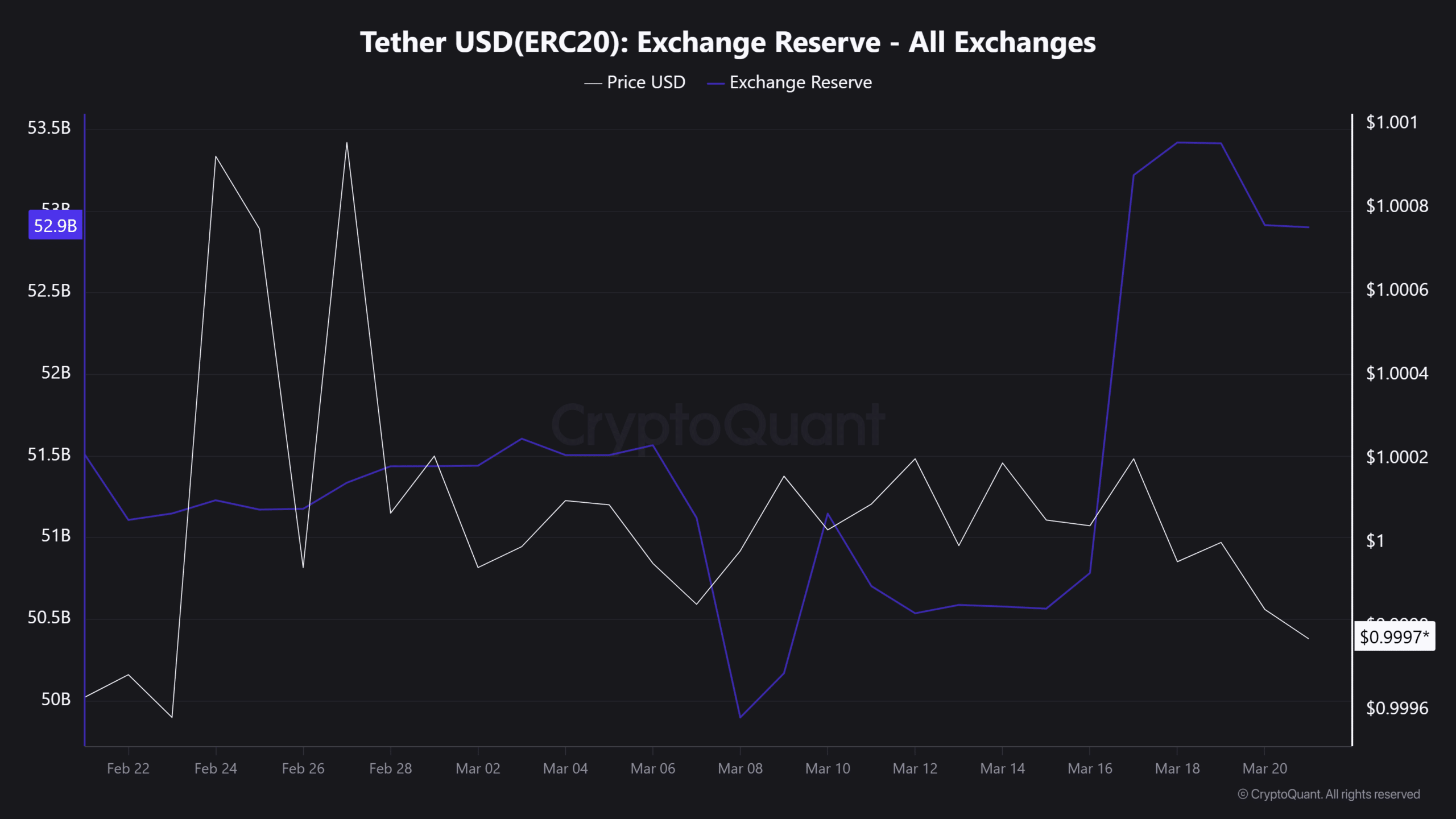
Source: CryptoQuant

Supporting this trend, USDT netflows, according to CryptoQuant, have recorded their first significant outflow of over $500 million in nearly two weeks, pushing exchange reserves down by approximately 0.97% over the past three days.

From a technical perspective, this suggests sideline capital is starting to move off exchanges, with investors rotating into safe positions. Against the backdrop of a bearish macro environment, the market clearly appears to be in a “cautious” positioning phase, with liquidity being preserved on-chain.

For crypto’s long-term outlook, that’s a constructive signal. With the war keeping rate-cut expectations low and U.S. economic risks at historically high levels (supported by analyst forecasts and hard data), investors piling into stablecoins are likely staging capital to deploy once risk appetite returns, making it a trend to watch closely.


Final Summary

  • High inflation, rising U.S. Treasury yields, and zero rate-cut expectations are creating a risk-off environment, prompting crypto investors to preserve capital.
  • Rising stablecoin supply and USDT outflows show investors are staging capital on-chain, ready to deploy once risk appetite returns.


Preguntas relacionadas

QWhat is the main concern for crypto investors according to the article, and how are they reacting?

AThe main concern is the combination of high inflation, rising U.S. Treasury yields, and expectations of zero interest rate cuts, creating a risk-off environment. Crypto investors are reacting by preserving capital, moving it into stablecoins as a defensive strategy.

QHow does the article link the current macroeconomic situation to a potential 2008-style crisis?

AThe article links it through the pressure on the U.S. Treasury market, with yields reaching a high of 4.37%. With elevated debt levels, higher yields increase government borrowing costs, tightening the overall macroeconomic environment and raising the risk of a financial crisis if the Fed maintains a zero rate-cut stance.

QWhat does the recent growth in stablecoin market capitalization indicate about investor behavior?

AThe stablecoin market cap hitting a new all-time high of $316 billion, along with USDT netflows moving off exchanges, indicates that investors are building liquidity on the sidelines. This shows a shift towards cautious, defensive positioning, with capital being preserved on-chain and staged for future deployment when risk appetite returns.

QDespite bearish macro conditions, what does the steady total crypto market cap around $2.4 trillion suggest?

AIt suggests that conviction among crypto investors remains intact and that risk hasn't meaningfully unwound. Large-cap assets are holding near key resistance levels without significant rejection, indicating that there have been no major capital outflows from the crypto market overall.

QWhat is the 'constructive signal' for crypto's long-term outlook mentioned in the article?

AThe constructive signal is that investors are piling into stablecoins, staging capital on-chain. This indicates that liquidity is being preserved within the crypto ecosystem and is poised to be deployed back into risk assets once macroeconomic conditions improve and risk appetite returns.

Lecturas Relacionadas

Anthropic and OpenAI Have Single-Handedly Severed the Logic of Pre-IPO Stock Tokenization

The pre-IPO stock token market is experiencing significant turmoil following strong statements from AI giants Anthropic and OpenAI. Both companies have updated their official policies, declaring that any transfer of their company shares—including sales, transfers, or assignments of share interests—without prior board approval is "invalid" and will not be recognized in their corporate records. This means buyers in such unauthorized transactions would not be recognized as shareholders and would have no shareholder rights. A major point of contention is the use of Special Purpose Vehicles (SPVs), which are legal entities commonly used by pre-IPO token platforms to pool investor funds and indirectly acquire shares from employees or early investors. The companies explicitly state they do not permit SPVs to acquire their shares, and any such transfer violates their restrictions. They warn that third parties selling shares through SPVs, direct sales, forward contracts, or stock tokens are likely engaged in fraud or are offering worthless investments due to these transfer limits. This stance directly threatens the core model of many pre-IPO token platforms, which rely on SPV structures. The announcement revealed additional risks within this model, such as complex "SPV-within-SPV" layering that obscures legal transparency, increases management fees, and creates a chain reaction risk of invalidation. Following the news, tokens like ANTHROPIC and OPENAI on platforms like PreStocks fell sharply (over 20%). The market reaction highlights a divergence: while asset-backed pre-IPO tokens plummeted, purely speculative pre-IPO futures contracts, which are bilateral bets on future IPO prices with no claim to actual shares, remained relatively stable as they are unaffected by the transfer restrictions. The industry is split on the implications. Some believe the fundamental logic of pre-IPO token trading is broken if leading companies reject SPV-held shares, potentially causing a domino effect. Others, like Rivet founder Nick Abouzeid, argue that buyers of such unofficial tokens always knowingly accepted the risk of non-recognition by the company. The statements serve as a stark risk warning and a corrective measure for a market where valuations for some AI-related pre-IPO tokens had soared to irrational levels, far exceeding recent funding round valuations.

marsbitHace 40 min(s)

Anthropic and OpenAI Have Single-Handedly Severed the Logic of Pre-IPO Stock Tokenization

marsbitHace 40 min(s)

Anthropic and OpenAI Personally Sever the Logic of Pre-IPO Crypto-Stocks

The pre-IPO token market has been rocked by strong statements from Anthropic and OpenAI. Both AI giants have updated official warnings, declaring that any sale or transfer of their company shares without explicit board approval is "invalid" and will not be recognized on their corporate records. This directly targets Special Purpose Vehicles (SPVs), the common legal structure used by pre-IPO token platforms. These platforms typically use an SPV to acquire shares from employees or early investors, then issue blockchain-based tokens representing a claim on the SPV's economic benefits. Anthropic and OpenAI's position means that if an SPV's share purchase lacked authorization, the underlying asset could be deemed worthless, nullifying the token's value. Anthropic explicitly warned that any third party selling its shares—via direct sales, forwards, or tokens—is likely fraudulent or offering a valueless investment. The crackdown highlights risks in the popular SPV model, including complex multi-layered "Russian doll" SPV structures that obscure legal ownership, add fees, and concentrate risk. If one layer is invalidated, the entire chain could collapse. Following the announcements, tokens like ANTHROPIC and OPENAI on platforms like PreStocks fell sharply (over 20%). In contrast, purely speculative pre-IPO prediction contracts remained stable, as they involve no actual share ownership. The move is seen as a corrective measure amid a market frenzy where some pre-IPO token valuations (e.g., Anthropic's token hitting a $1.4 trillion implied valuation) far exceeded recent official funding rounds. Opinions are split: some believe this undermines the core logic of pre-IPO token trading if top companies reject SPVs, while others argue buyers always assumed this legal risk when accessing unofficial channels. The statements serve as a stark warning and a potential catalyst for market de-leveraging and clearer boundaries.

Odaily星球日报Hace 44 min(s)

Anthropic and OpenAI Personally Sever the Logic of Pre-IPO Crypto-Stocks

Odaily星球日报Hace 44 min(s)

The Waged Worker Driven to Poverty by AI Subscriptions

"AI Membership: The Hidden Cost Pushing Workers Toward 'Poverty'" The widespread corporate push for AI adoption is creating a hidden financial burden for employees. Companies, from giants like Alibaba to small firms, are mandating AI use, often tying token consumption to KPIs, but frequently refuse to cover the costs. Workers are forced to pay for subscriptions out of pocket to stay competitive and avoid being replaced. Front-end developer Long Shen spends up to 2000 RMB monthly on tools like Cursor and ChatGPT Plus, seeing it as a necessary 3% salary investment to handle 90% of his coding tasks. While it boosted his performance and led to promotions, he now faces idle time at work, pretending to be busy. Designer Peng Peng navigates strict company firewalls by using personal devices and accounts for AI image generation tools like Midjourney, spending hundreds monthly without reimbursement, while her boss demands faster, more numerous revisions. The pressure creates workplace anxiety and suspicion. Programmer Li Huahua, after a friend's experience of raised KPIs following AI success, fears being branded a "traitor" for using it yet worries about falling behind if she doesn't. The dynamic allows management to demand results without understanding the tools or covering expenses, treating employees like AI "agents." While some, like entrepreneur Jin Tu, find high value in paid AI, building entire systems and winning competitions, for most, it's a trap. Free tools like Kimi and Doubao are introducing fees, closing off alternatives. The initial efficiency gains individual advantage, but as AI becomes ubiquitous, the personal edge disappears, workloads increase, and a cycle of dependency begins. Workers like Long Shen realize they cannot maintain AI-generated code without AI, making stopping harder than continuing to pay. The tool promising liberation is instead becoming a compulsory, costly chain in the modern workplace.

marsbitHace 1 hora(s)

The Waged Worker Driven to Poverty by AI Subscriptions

marsbitHace 1 hora(s)

SK Hynix's Trillion-Won Empire: The Successors

"SK Hynix's Trillion-Won Empire and Its Heirs" explores the unconventional succession narrative within SK Group, South Korea's second-largest conglomerate, following SK Hynix's dramatic market rise. Unlike traditional chaebol scripts prioritizing the eldest son, ownership, and political marriages, Chairman Choi Tae-won's three children from his first marriage are charting distinct paths. The eldest daughter, Choi Yun-jeong, is considered the most visible candidate. With a background in biology, consulting, and a PhD, she holds executive roles at SK Bioscience and SK Inc.'s growth strategy unit, focusing on biopharma and new businesses. Her marriage is to an AI infrastructure entrepreneur, not a traditional chaebol heir. The second daughter, Choi Min-jeong, took a unique route by voluntarily serving as a South Korean naval officer, including a tour in the Gulf of Aden. She later worked on policy and strategy for SK Hynix in Washington D.C. before co-founding an AI-driven healthcare startup in San Francisco. She married a former U.S. Marine Corps officer, connecting the family to U.S. defense and policy networks. The son, Choi In-geun, who has Type 1 diabetes, followed a more classic preparatory path with a physics degree and a stint at SK E&S but left to join McKinsey's Seoul office. He remains publicly silent and holds no SK shares, defying the traditional "crown prince" archetype. Their paths unfold against the backdrop of their parents' high-profile, contentious divorce and a record-setting asset division lawsuit. The article argues that as SK Hynix becomes a geopolitical asset in the AI era, the conventional rules of chaebol inheritance are changing. The heirs are being groomed not simply to take over, but to navigate a complex global landscape defined by AI, biotech, geopolitics, and policy, forging legitimacy through their own expertise and networks rather than birth order alone.

marsbitHace 1 hora(s)

SK Hynix's Trillion-Won Empire: The Successors

marsbitHace 1 hora(s)

Trading

Spot
Futuros

Artículos destacados

Cómo comprar WAR

¡Bienvenido a HTX.com! Hemos hecho que comprar WAR (WAR) sea simple y conveniente. Sigue nuestra guía paso a paso para iniciar tu viaje de criptos.Paso 1: crea tu cuenta HTXUtiliza tu correo electrónico o número de teléfono para registrarte y obtener una cuenta gratuita en HTX. Experimenta un proceso de registro sin complicaciones y desbloquea todas las funciones.Obtener mi cuentaPaso 2: ve a Comprar cripto y elige tu método de pagoTarjeta de crédito/débito: usa tu Visa o Mastercard para comprar WAR (WAR) al instante.Saldo: utiliza fondos del saldo de tu cuenta HTX para tradear sin problemas.Terceros: hemos agregado métodos de pago populares como Google Pay y Apple Pay para mejorar la comodidad.P2P: tradear directamente con otros usuarios en HTX.Over-the-Counter (OTC): ofrecemos servicios personalizados y tipos de cambio competitivos para los traders.Paso 3: guarda tu WAR (WAR)Después de comprar tu WAR (WAR), guárdalo en tu cuenta HTX. Alternativamente, puedes enviarlo a otro lugar mediante transferencia blockchain o utilizarlo para tradear otras criptomonedas.Paso 4: tradear WAR (WAR)Tradear fácilmente con WAR (WAR) en HTX's mercado spot. Simplemente accede a tu cuenta, selecciona tu par de trading, ejecuta tus trades y monitorea en tiempo real. Ofrecemos una experiencia fácil de usar tanto para principiantes como para traders experimentados.

122 Vistas totalesPublicado en 2024.12.11Actualizado en 2026.04.28

Cómo comprar WAR

Discusiones

Bienvenido a la comunidad de HTX. Aquí puedes mantenerte informado sobre los últimos desarrollos de la plataforma y acceder a análisis profesionales del mercado. A continuación se presentan las opiniones de los usuarios sobre el precio de WAR (WAR).

活动图片










