$200 Million Investment in MrBeast's Company: Top Creator MrBeast Becomes Tom Lee's Trump Card

marsbitPublicado a 2026-01-18Actualizado a 2026-01-18

Resumen

Investment firm BitMine Immersion Technologies (BMNR), led by Wall Street analyst Tom Lee, has announced a $200 million investment into Beast Industries, the parent company of top YouTube creator MrBeast (Jimmy Donaldson). The deal signals a strategic move toward integrating decentralized finance (DeFi) into Beast Industries’ upcoming financial services platform. MrBeast, with over 460 million subscribers and 100 billion views, has built a massive media empire through high-cost, high-impact videos, often spending $3–5 million per video. Despite annual revenues of around $400 million, his content business operates with thin margins. His profitable venture, Feastables—a chocolate brand with $250 million in annual sales—provides a stable cash flow and retail presence. MrBeast has openly discussed his “cash-poor” status, reinvesting nearly all earnings back into content and expansion. His approach prioritizes growth and audience retention over short-term profitability. The partnership with Tom Lee and BMNR suggests a deeper foray into financial infrastructure, potentially involving DeFi solutions for payments, programmable accounts, and decentralized asset management. This move could redefine the relationship between creators, audiences, and financial ecosystems—though it also carries risks regarding user trust and regulatory complexity. At 27, MrBeast continues to leverage his unprecedented influence to explore new frontiers, now entering the world of crypto and decentralize...

Author: Seed.eth

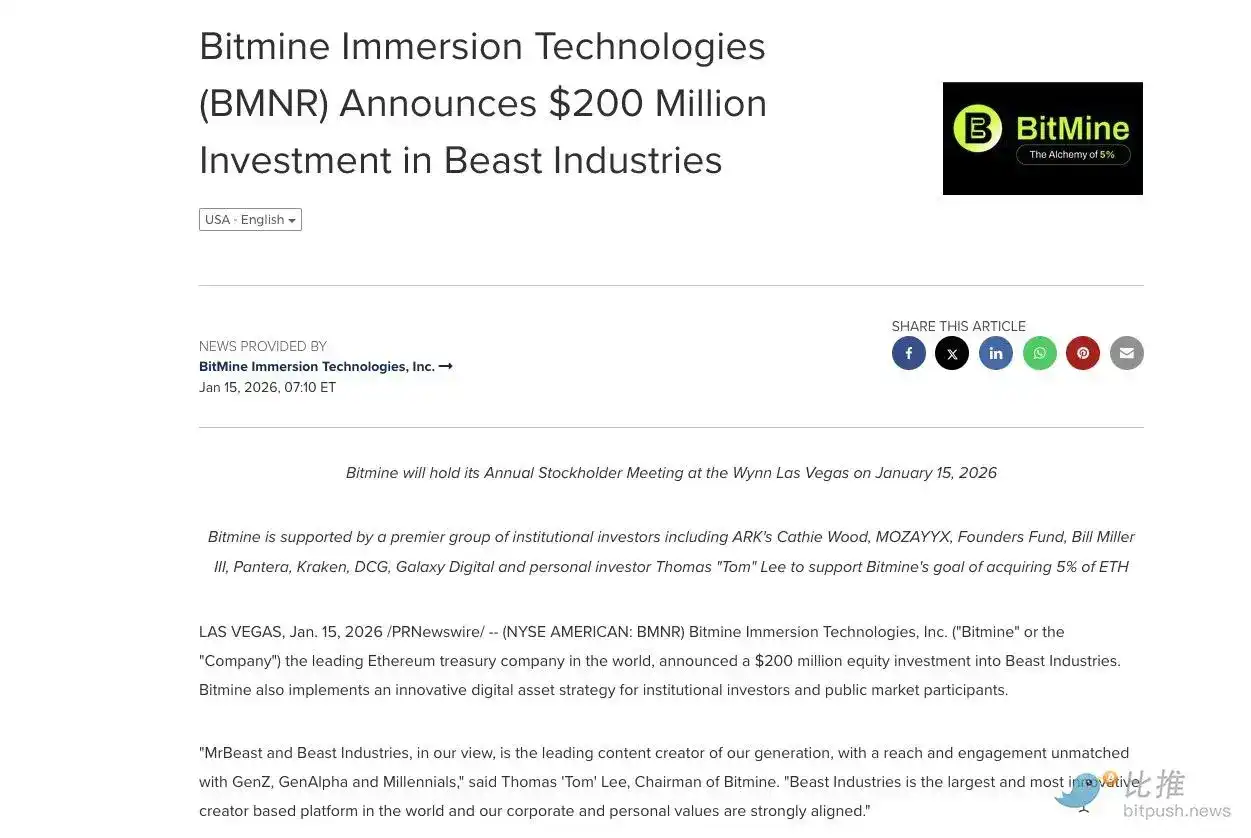
$200 million—that's the figure just announced.

BitMine Immersion Technologies (BMNR), chaired by Wall Street's renowned analyst Tom Lee, has declared an investment in Beast Industries, the parent company of global top creator MrBeast. Meanwhile, Beast Industries mentioned in its official statement that the company will explore how to "integrate DeFi into the upcoming financial services platform" in the future.
At first glance, this seems like another familiar crossover: traditional finance, crypto, internet fame, entrepreneurship. On one side is the YouTube霸主 with over 400 million cumulative global subscribers, whose videos can algorithmically boost visibility; on the other is Wall Street's top analyst, adept at weaving grand blockchain narratives into balance sheets. It all seems perfectly logical.

MrBeast's Journey

Looking back at MrBeast's early videos, it's hard to connect them to today's Beast Industries, valued at $5 billion.
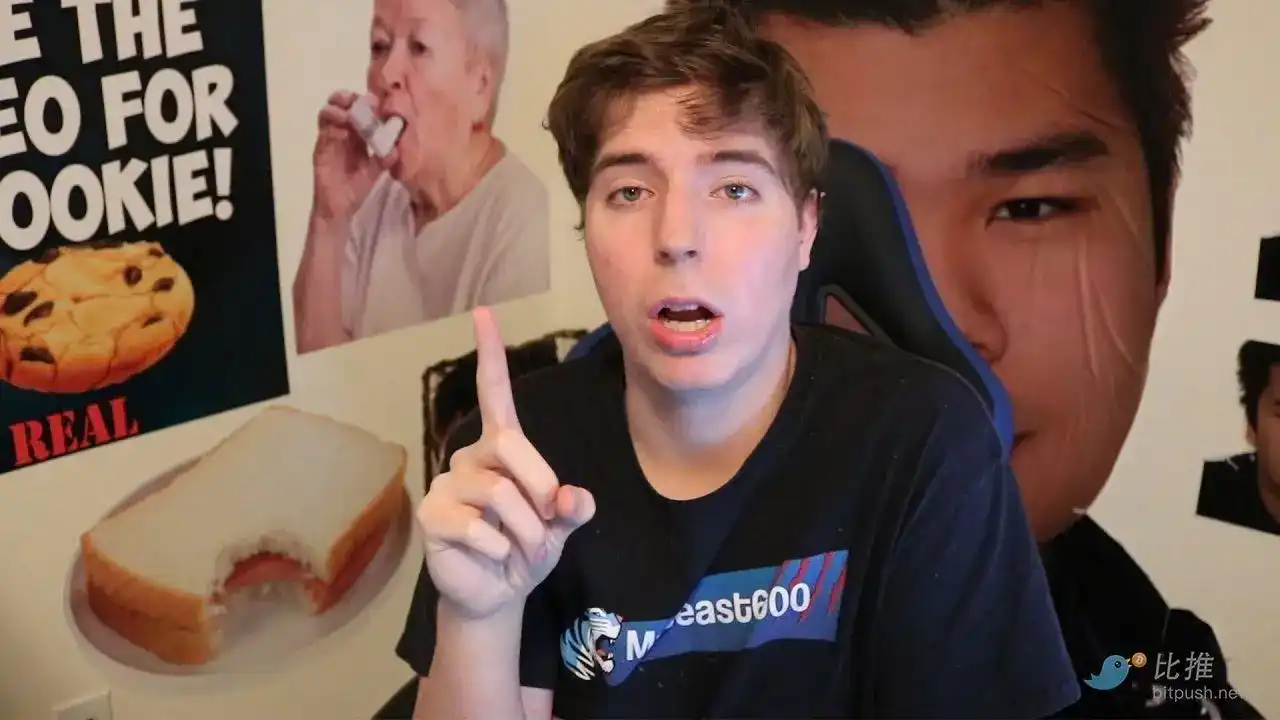
In 2017, shortly after graduating high school, Jimmy Donaldson uploaded a video of himself counting continuously for 44 hours—"Counting to 100,000 Challenge!" The content was almost childishly simple: no plot, no editing, just one person repeating numbers into the camera. Yet, it became the turning point of his content career.

He was not yet 19, with only about 13,000 channel subscribers. After release, the video quickly surpassed a million views, becoming the first globally viral case.

Reflecting on that period in later interviews, he once said:

"I wasn't really trying to go viral; I just wanted to know if the outcome would be different if I devoted all my time to something no one else was willing to do."

Jimmy Donaldson succeeded in building his audience, evolving into the MrBeast we know today. More importantly, from that moment, he developed an almost obsessive belief: attention isn't a gift of talent but something earned through investment and endurance.

Treating YouTube as a Business, Not a Creative Platform

Many creators, after gaining fame, choose to "play it safe": reduce risk, increase efficiency, turn content into stable cash flow.

MrBeast chose the opposite path.

He has repeatedly emphasized in multiple interviews:

"Basically, all the money I make goes into the next video."

This is the core of his business model.

By 2024, his main channel had over 460 million subscribers, with total video views exceeding 100 billion. But behind this lies extremely high costs:

  • Production costs for top videos often range from $3–5 million;
  • Some large-scale challenges or charity projects can exceed $10 million;
  • His Prime Video show "Beast Games" was described by himself as "completely out of control" in production, and he admitted in an interview: losses reached tens of millions of dollars.

He didn't express regret when saying this:

"If I don't do this, viewers will watch someone else.

At this level, you can't win while trying to save money."

This statement can almost serve as the key to understanding Beast Industries.

Beast Industries: $400 Million in Annual Revenue, But Thin Profits

By 2024, MrBeast consolidated all operations under Beast Industries.

Public information shows this company has far exceeded the scope of "creator side hustles":

  • Annual revenue exceeds $400 million;
  • Business spans content production, FMCG retail, licensed merchandise, tool-based products;
  • After the latest funding round, market expectations place its valuation around $5 billion.

But it's not easy.

MrBeast's YouTube main channel and Beast Games bring massive exposure but consume almost all profits.
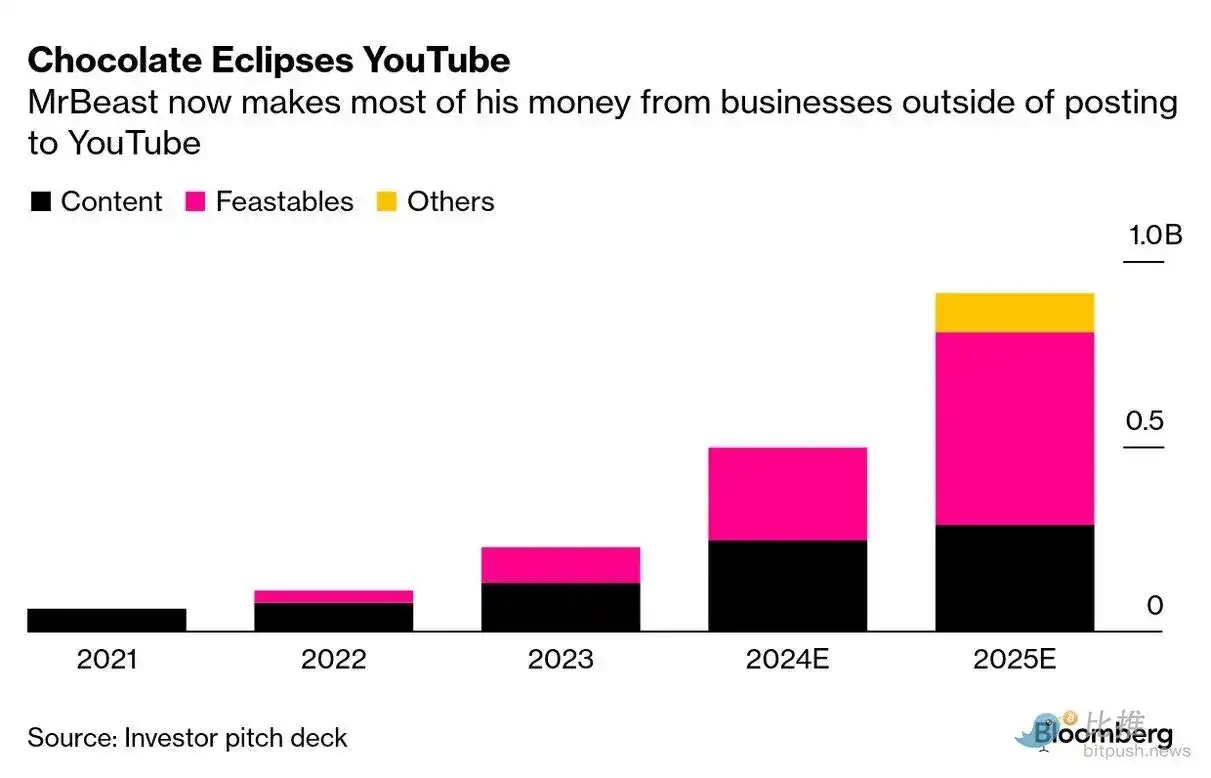
In stark contrast is his chocolate brand, Feastables. Public data shows Feastables generated about $250 million in sales in 2024, contributing over $20 million in profit. This marked Beast Industries' first stable, replicable cash flow business. By late 2025, Feastables had entered over 30,000 physical retail stores across North America (including Walmart, Target, 7-Eleven, etc.), covering the U.S., Canada, and Mexico, significantly boosting offline sales capabilities.

MrBeast has often stated that video production costs are rising, even "increasingly hard to break even." Yet he continues investing heavily in content, seeing it not just as video production costs but as purchasing traffic for the entire business ecosystem.

The core barrier of the chocolate business isn't production but reach. While other brands spend huge sums on ads, he just needs to release a video. Whether the video itself is profitable becomes less important, as long as Feastables keeps selling, the business loop sustains.

"I'm Actually Broke"

In early 2026, MrBeast revealed in a Wall Street Journal interview that he's broke, sparking discussion:

"I'm basically in a 'negative cash' state right now. They all say I'm a billionaire, but there's not much money in my bank account."

This wasn't "humblebragging" but a natural result of his business model.

MrBeast's wealth is highly concentrated in unlisted equity; though he holds just over 50% of Beast Industries, the company continues expanding, hardly paying dividends; he personally avoids keeping cash.

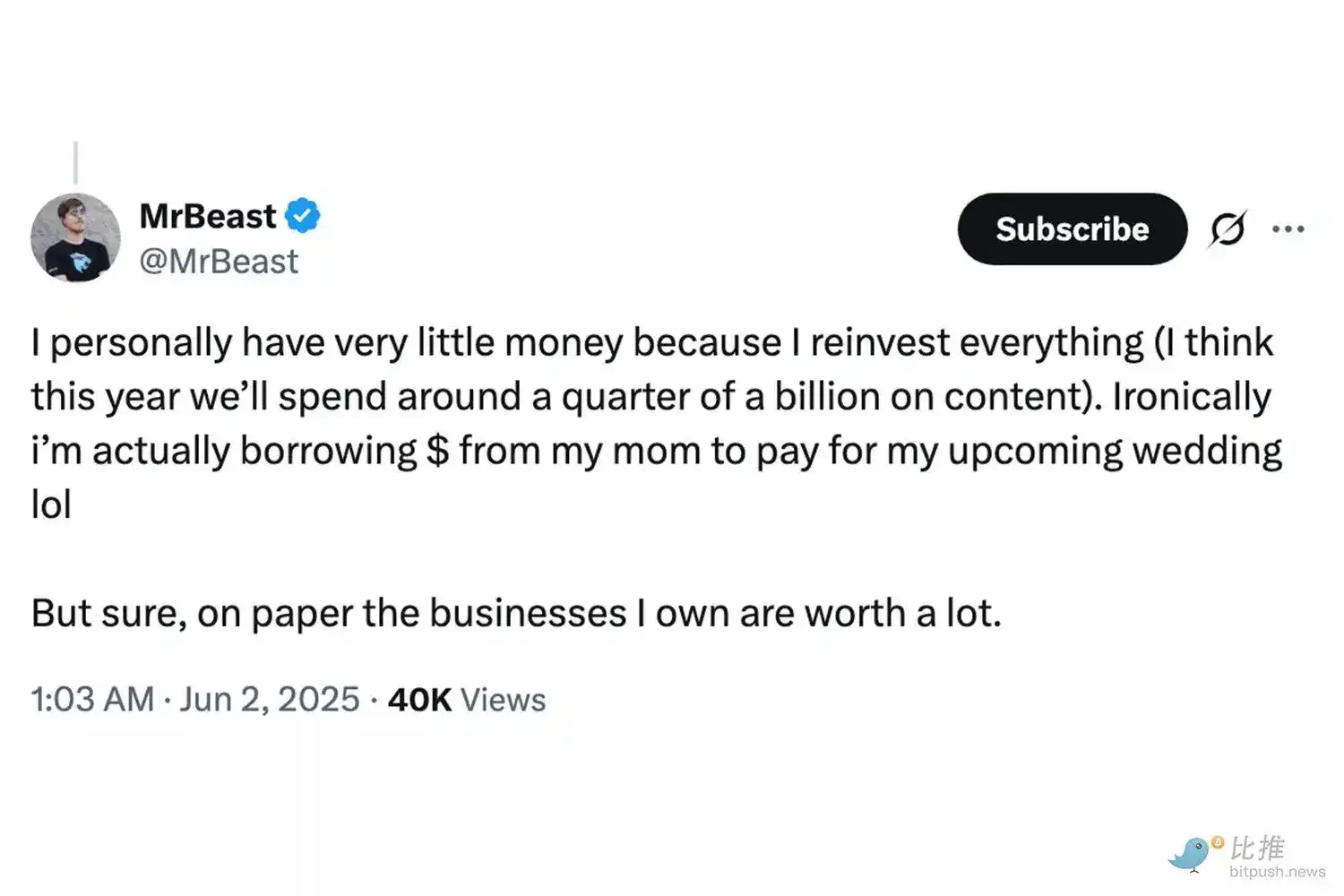
In June 2025, he admitted on social media that he'd spent all his savings on video production, even borrowing money from his mother to pay for his wedding.
As he later explained more bluntly:

"I don't check my bank account—it affects my decision-making."

And the sectors he invests in extend far beyond content and consumer goods.

In fact, during the 2021 NFT boom, on-chain records show he purchased and traded multiple CryptoPunks, some sold for 120 ETH each (then worth hundreds of thousands of dollars).
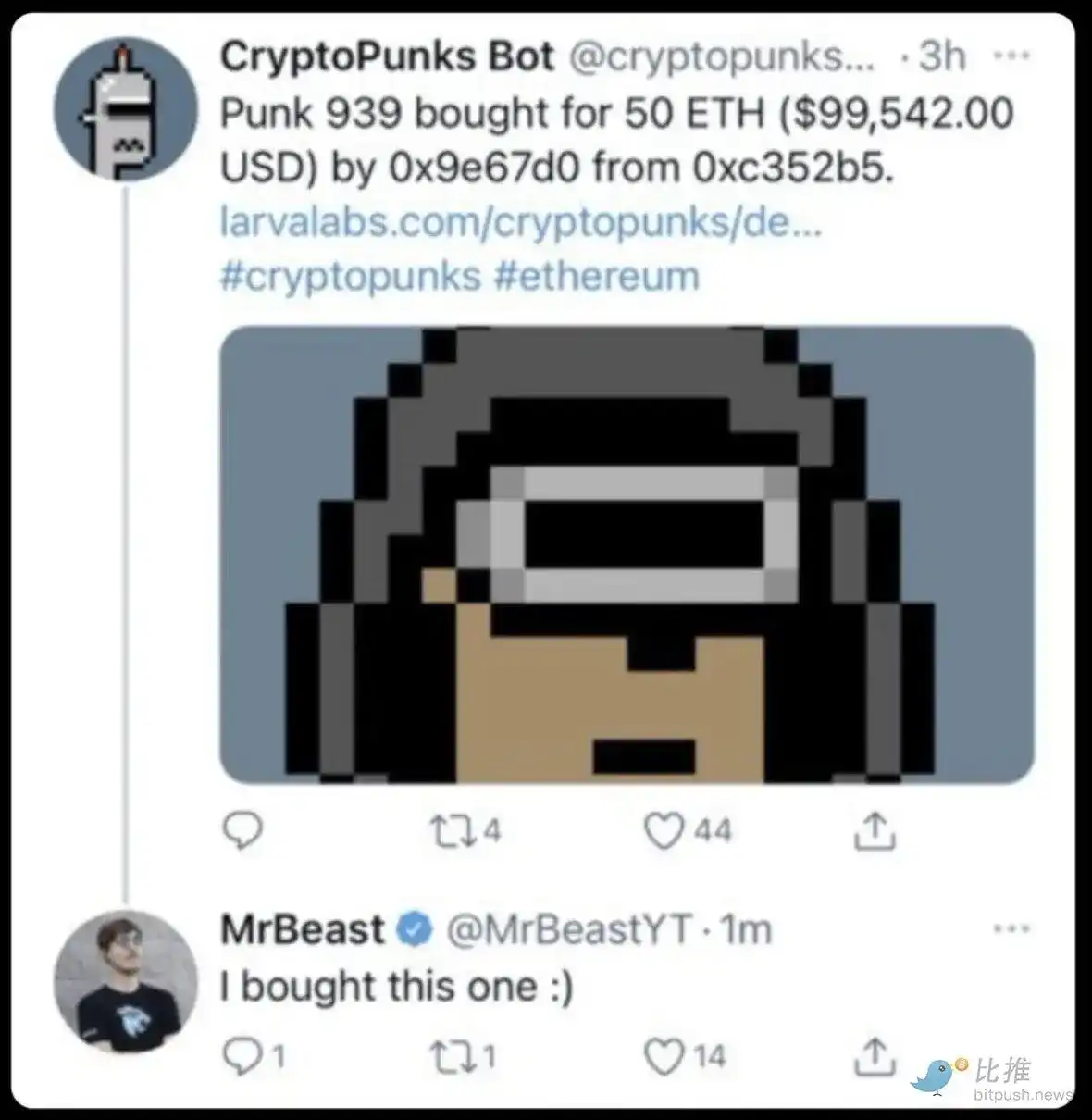
However, as the market corrected, his attitude became cautious.

The real turning point came when the "MrBeast" business model itself reached a critical juncture.

When someone controls a top global traffic gateway but remains in a state of high investment, cash strain, and expansion reliant on funding, finance is no longer just an investment option but essential infrastructure to rebuild.

Internally, Beast Industries has increasingly focused on one question: How to make users not just "watch content, buy products," but enter a long-term, stable, sustainable economic relationship?

This is precisely the direction traditional internet platforms have long attempted: payments, accounts, credit systems. At this juncture, the emergence of Tom Lee and BitMine Immersion (BMNR) steers this path toward more structural possibilities.

Partnering with Tom Lee to Build a DeFi Foundation

On Wall Street, Tom Lee has always played the role of "narrative architect." From early explanations of Bitcoin's value logic to emphasizing Ethereum's strategic role in corporate balance sheets, he excels at translating tech trends into financial language. BMNR's investment in Beast Industries isn't chasing influencer hype but betting on a programmable future for attention gateways.

So, what exactly does DeFi mean here?

Current public information is extremely restrained: no token issuance, no yield promises, no fan-exclusive financial products. But the phrase "integrating DeFi into the financial services platform" points to several possibilities:

- Lower-cost payment and settlement layer;

- Programmable account systems for creators and fans;

- Asset recording and equity structures based on decentralized mechanisms.

The imagination is vast, but real challenges are clear. In today's market, whether native DeFi projects or traditional institutions exploring transitions, most haven't truly established sustainable models. If they can't find a differentiated path in this fierce competition, the complexity of financial operations might erode his core capital accumulated over years: fan loyalty and trust. After all, he has repeatedly stated:

"If one day what I do harms my audience, I'd rather do nothing."

This statement will likely be tested repeatedly in every future financialization attempt.

So, when the world's strongest attention machine seriously starts constructing financial infrastructure, will it become the next-generation platform or an "overly bold" crossover?

The answer won't come quickly.

But one thing he understands better than anyone: the greatest capital isn't past glory but the right to "start over."

After all, he's only 27.

Preguntas relacionadas

QWhat is the amount of investment BitMine Immersion Technologies (BMNR) announced to put into Beast Industries, and who is the chairman of BMNR?

ABitMine Immersion Technologies (BMNR) announced a $200 million investment into Beast Industries. The chairman of BMNR is Tom Lee, a well-known Wall Street analyst.

QWhat is the core philosophy behind MrBeast's (Jimmy Donaldson) business model regarding revenue and content investment?

AThe core philosophy of MrBeast's business model is to reinvest almost all the money he earns back into the next video. He believes that at his level, you cannot win while trying to save money, and constant high investment is necessary to maintain audience attention.

QWhich business under Beast Industries provided stable and replicable cash flow in 2024, and what was its approximate profit?

AThe chocolate brand Feastables under Beast Industries provided stable and replicable cash flow in 2024. It had sales of approximately $250 million and contributed over $20 million in profit.

QWhy did MrBeast describe himself as being in a 'negative cash' state despite his company's high valuation?

AMrBeast described himself as being in a 'negative cash' state because his wealth is highly concentrated in the non-liquid equity of his privately held company, Beast Industries. The company reinvests almost all its profits for expansion and does not issue dividends, and he personally chooses not to retain much cash, even borrowing money for personal expenses like his wedding.

QWhat potential applications of DeFi (Decentralized Finance) are suggested for Beast Industries' future financial services platform according to the article?

AThe article suggests that Beast Industries' future financial services platform could explore DeFi for a lower-cost payment and settlement layer, a programmable account system for creators and fans, and an asset recording and equity structure based on decentralized mechanisms.

Lecturas Relacionadas

While Everyone Says NFTs Are 'Dead', the Art World is Quietly Completing an 'On-Chain Renaissance'

While many declare NFTs "dead" and dismiss them as overhyped JPEGs, a significant institutional shift is quietly underway within the art world, signaling a "on-chain renaissance." Traditional art, a ~$60B market, is stagnant, aging, and highly concentrated, facing a massive $80 trillion generational wealth transfer to digital-native heirs. Contrary to the narrative, leading institutions have been building infrastructure for digital and on-chain art. Major museums like MoMA, the Centre Pompidou, LACMA, and the Guggenheim have acquired seminal NFT works into their permanent collections. Top galleries like Pace, Gagosian, and Hauser & Wirth have launched NFT platforms or accepted crypto, with Pace giving a solo show to generative artist Tyler Hobbs. Auction houses Sotheby's and Christie's operate dedicated on-chain sales platforms. This follows a historical pattern where every major art movement—from Impressionism to Pop Art—was initially mocked before institutional acceptance. NFT art, only 7-12 years old, is progressing faster. Auction data shows resilience, with works by Beeple ($69.3M), Pak (~$91M), and Dmitri Cherniak ($6.2M in a bear market) achieving high prices. A new cohort of collectors (e.g., FlamingoDAO, PleasrDAO) and "Medici" figures like Cozomo de' Medici are accumulating foundational works. The core argument is that NFTs represent not a speculative asset class but a new ownership system for digital culture, solving provenance issues through immutable, timestamped blockchain records. The medium has survived the speculative crash and is being institutionalized. The bet isn't on short-term price rallies but on the long-term cultural significance of on-chain art as the defining medium for the next generation of collectors.

marsbitHace 26 min(s)

While Everyone Says NFTs Are 'Dead', the Art World is Quietly Completing an 'On-Chain Renaissance'

marsbitHace 26 min(s)

Jensen Huang's Message to Graduates: AI Won't Replace You, But Those Who Excel at Using AI Will

NVIDIA CEO Jensen Huang, addressing 2026 graduates at Carnegie Mellon University, emphasized that AI will not replace people, but those who leverage AI effectively will have an advantage. He delivered this message during a commencement speech where he also received an honorary doctorate, his seventh. Huang reflected on his personal journey as an immigrant, starting from humble beginnings as a dishwasher to co-founding NVIDIA. He shared early struggles, including a near-bankruptcy moment saved by honesty with Sega, highlighting resilience and learning from failure. He positioned the current era as the dawn of the AI revolution, a shift as significant as past computing waves. Huang explained that AI is redefining computing from human-written software to machine learning, creating a new industry focused on manufacturing intelligence. While acknowledging fears about job displacement, he argued that AI amplifies human capabilities rather than replaces human purpose. Tasks may be automated, but the core meaning of professions remains. Huang urged graduates to embrace this transformative time with responsibility and optimism. He stated that AI should democratize technology, bridging gaps and enabling broader participation in creation and problem-solving. His final advice was to actively engage with the opportunity: "So run, don’t walk," and to put their hearts into their work.

marsbitHace 33 min(s)

Jensen Huang's Message to Graduates: AI Won't Replace You, But Those Who Excel at Using AI Will

marsbitHace 33 min(s)

Three Scenarios for BTC's Future Direction and a Duel Between Two Strong Forces | Special Invited Analysis

**Title: Three Scenarios for BTC's Future Trajectory and a Key Duel | Invited Analysis** The market remains at a critical juncture. Over the past week, Bitcoin (BTC) consolidated broadly between $79,500 and $80,600, validating previous technical analysis. The current focus is on whether this marks the start of a new uptrend or a pause within a larger correction. **BTC Multi-Cycle Analysis & Three Possible Scenarios** BTC's daily chart structure, following its peak at $126,200 in October 2025, presents three primary technical scenarios based on Elliott Wave theory: 1. **Bullish Scenario (End of Correction):** The corrective A-B-C wave from $126,200 ended at the $60,000 low in February 2026. The current price action is the start of a major Wave I uptrend. A subsequent Wave II pullback would not break below $60,000. 2. **Bearish Scenario 1 (Complex Correction):** The correction is unfolding as an A-B-C-D-E pattern. The current move from $60,000 is a D-wave rally. After its completion, a final E-wave decline could potentially breach the $60,000 level. 3. **Bearish Scenario 2 (Larger Correction):** The entire move down from $126,200 to $60,000 was a large A-wave. The current rally is a B-wave correction within a larger A-B-C structure, to be followed by a C-wave decline below $60,000. *Analysis suggests Scenario 2 is less probable due to time disproportions between waves. The battle is effectively between the Bullish Scenario (1) and Bearish Scenario (3).* **Key BTC Levels & Weekly Strategy** On the 4-hour chart, BTC trades above a crucial consolidation zone ("Central Pivot C"). * **Key Resistance:** $83,500-$84,500; $89,000-$90,500. * **Key Support:** $78,500-$79,500 (pivot upper bound); $73,500-$75,000; $69,500-$70,500. **Weekly Outlook:** The market direction hinges on BTC's ability to hold above or break below the $78,500-$79,500 support zone. * **Mid-term Strategy:** Neutral/Wait-and-see stance due to unclear direction. * **Short-term Tactics:** Two contingency plans using 30% max capital: * **Plan A (Bullish):** Look for long entries if price holds above $78,500-$79,500 with confirming signals. Initial stop-loss below $78,500. * **Plan B (Bearish):** Consider short positions if price breaks below $73,500-$75,000 with confirming signals. Initial stop-loss above $76,500. **HYPE Analysis & Strategy** HYPE's daily chart shows a seven-segment structure from its January low of $20.46, forming a "rising pivot" zone. * **Key Level to Watch:** $45.76 (previous high). A break above would confirm the bullish structure remains intact. * **Short-term Strategy:** Focus on pivot zone boundaries ($38.41 upper, $34.44 lower). * **Long:** Consider on support near $38.41 with bullish confirmation signals. * **Short:** Consider on a break below $34.44 with bearish confirmation signals. * Position size must be below 30% with strict stop-loss discipline. **Risk Management Reminder:** Always set an initial stop-loss upon entry. Move stop-loss to breakeven at +1% profit, then trail it upwards to lock in profits dynamically. All views are based on technical analysis for informational purposes only and do not constitute investment advice. The market is inherently risky.

Odaily星球日报Hace 42 min(s)

Three Scenarios for BTC's Future Direction and a Duel Between Two Strong Forces | Special Invited Analysis

Odaily星球日报Hace 42 min(s)

Sequoia Interview with Hassabis: Information is the Essence of the Universe, AI Will Open Up Entirely New Scientific Branches

Demis Hassabis, co-founder and CEO of Google DeepMind and Nobel laureate, discusses the path to AGI and its profound implications in a Sequoia Capital interview. He outlines his lifelong dedication to AI, tracing his journey from game development (e.g., *Theme Park*)—a perfect AI testing ground—to neuroscience and finally founding DeepMind in 2009. He emphasizes the critical lesson of being "5 years, not 50 years, ahead of time" for successful entrepreneurship. Hassabis reiterates DeepMind's two-step mission: first, solve intelligence by building AGI; second, use AGI to tackle other complex problems. He highlights the transformative potential of "AI for Science," particularly in biology where tools like AlphaFold have revolutionized protein folding. He envisions AI-powered simulations drastically shortening drug discovery from years to weeks and enabling personalized medicine. Furthermore, he predicts AI will spawn new scientific disciplines, such as an engineering science for understanding complex AI systems (mechanistic interpretability) and novel fields enabled by high-fidelity simulators for complex systems like economics. He posits a fundamental worldview where information, not just matter or energy, is the essence of the universe, making AI's information-processing core uniquely suited to understanding reality. He defends classical Turing machines as potentially sufficient for modeling complex phenomena, including quantum systems, as demonstrated by AlphaFold. On consciousness, Hassabis suggests first building AGI as a powerful tool, then using it to explore deep philosophical questions. He believes components like self-awareness and temporal continuity are necessary for consciousness but that defining it fully remains an open challenge. He predicts AGI could arrive around 2030 and, once achieved, would be used to probe the deepest questions of science and reality, much as envisioned in David Deutsch's *The Fabric of Reality*.

链捕手Hace 59 min(s)

Sequoia Interview with Hassabis: Information is the Essence of the Universe, AI Will Open Up Entirely New Scientific Branches

链捕手Hace 59 min(s)

Trading

Spot
Futuros
活动图片