8 小时流入 12 亿美元,EigenLayer 将交出什么答卷?

foresightnewsPublicado a 2024-02-06Actualizado a 2024-02-06

Resumen

EigenLayer 重启再质押窗口,用户需考虑单个 LST 33% 上限与充满不确定性的协议风险 。

EigenLayer 重启再质押窗口,用户需考虑单个 LST 33% 上限与充满不确定性的协议风险 。


撰文:Peng SUN,Foresight News


北京时间今日凌晨 4 点,EigenLayer 再次开放为期 4 天的 LST 再质押窗口,并取消所有 LST 存款上限。据 DefiLlama 数据,EigenLayer 今日已流入约 50 万枚 ETH(约 12.74 亿美元),TVL 超 30 亿美元,现为 36.46 亿美元。


在本次开放再质押窗口前,EigenLayer 表示团队正在引入一种分配再质押积分的新方法,该方法将把分配给任何 LST、LRT 或个人存款的再质押积分上限设定为未来发行总量的 33%。换言之,EigenLayer 积分已明确与代币空投绑定。但与此同时,单个 LST 上限已被限制为 33%,对于 Puffer 这样目前只提供单个 stETH 存款的协议来说,也是不小的挑战。


目前市场正处于 Restaking 风口,再质押热度犹存,但 EigenLayer AVS 服务尚未上线主网,其「共享安全」的业务尚未跑通,而其他 Restaking 协议大多只是存款,合约、LST 与提款均存在一定风险。热潮之后总会回归冷静,市场是否继续买单,Restaking 又将交出什么样的答卷,我们拭目以待。


一、EigenLayer 路线图进展


2023 年 6 月,EigenLayer 在以太坊上推出第一阶段主网。11 月,EigenLayer 推出 EigenLayer 和 EigenDA 的第二阶段测试网,拟于今年上半年进入第二阶段主网,目前仍是第二阶段测试网。EigenLayer 还计划于今年进入第三阶段测试网与主网。


按照路线图,EigenLayer 将于 2024 年第一季度上线主动验证服务(AVS)主网。目前,EigenLayer AVS 正处于测试网阶段。除 EigenDA 外,Aethos、AltLayer、Blockless、Drosera Network、Espresso、Ethos、Hyperlane、Lagrange、Near、Omni、Silence Laboratories、Witness Chain 均可为 EigenLayer AVS 测试网提供服务。


二、五次存款限额调整


自主网上线以来,EigenLayer 已 5 次开放存款窗口,并提高存款上限。


第一次是 2023 年 6 月,EigenLayer 最初将再质押代币上限设置为 9600 枚 LST,用户单笔最多存款 32 枚 ETH。


第二次是 2023 年 7 月,EigenLayer 每类 LST 上限(包括 rETH、stETH 和 cbETH)增加到 1.5 万枚,没有个人存款限制,总存款上限为 3 万枚。


第三次是 2023 年 8 月,EigenLayer 再次提高 LST(包括 rETH、stETH 和 cbETH)存款上限,每一枚 LST 再质押代币数量最多为 10 万枚。


第四次是 2023 年 12 月,EigenLayer 新增 6 种新的 LST,包括 wBETH、osETH、swETH、AnkrETH、EthX、oETH。所有 LST 代币存款上限设置为 20 万枚。1 月 3 日,当总存款限额接近 50 万枚时,EigenLayer 暂停存款。


第五次则是 2024 年 2 月 6 日,不仅新增 sfrxETH、mETH 与 LsETH 存款类别,还取消了所有 LST 的存款上限,唯一限制大概就是时间了,本次存款将于北京时间 2 月 10 日 04:00 暂停。


细数去年的 4 次调整,每次都在开放后不久快速触达硬顶。这一次,EigenLayer 不再对总存款与单笔存款作出限制,在开放 4 小时后增幅超 7.5 亿美元(约 32.6 万枚 ETH),截止发稿前的 8 小时后已流入 12.8 亿美元(约 55.7 万枚 ETH)。


三、其他 Restaking 协议


作为 EigenLayer 的「子孙后代」,Kelp DAO、Magpie、Renzo、ether.fi、Puffer 等头部协议进展与数据情况如何?对投资者来说,还有哪些窗口机会可以抓住?


基于 Eigenlayer 构建的原生流动性再质押协议 Puffer Finance 自 2 月 1 日开放存款,一周不到其 TVL 已达到约为 4.55 亿美元,用户在 2 月 9 日前参与 stETH 和 wstETH 质押可获双倍积分奖励,目前 Puffer 仍处于第二阶段。


多链流动性质押平台 Kelp DAO TVL 现为 3.13 亿美元,较 4 天前涨近 6000 万美元,涨幅约 22.7%。目前,ETHx、stETH、sfrxETH 均未达到各自 15 万枚、10 万枚、3 万枚存款上限。本次再质押存款窗口截止时间为 2 月 9 日。


多链收益协议 Magpie 创建的 SubDAO 组织 Eigenpie 的 LST 存款窗口开放至 2 月 10 日 3:00,用户可将其 stETH、rETH、mETH、sfrxETH 再质押至 Eigenpie 中。截止 2 月 6 日,Eigenpie 总锁仓价值(TVL)突破 2 亿美元,较上周翻了一倍。


流动性质押平台 ether.fi TVL 现为 7.52 亿美元,较 4 天前增幅约 48.3%,TVL 增加约 2.45 亿美元。1 月 31 日,ether.fi 开启 Mega Week 活动,持续至 2 月 11 日 02:00,将为用户提供忠诚度积分与 300 万 EigenLayer 积分。


基于 EigenLayer 构建的以太坊质押协议 Renzo 在 1 月 16 日完成 320 万美元的种子轮融资后,TVL 大幅上涨,但近期增幅较小,现为 2.05 亿美元,较 4 天前增加 5000 万美元,涨超 32%。Renzo 已于 2 月 6 日 4:00 支持 wBETH 存款。


四、Restaking 热的背后:空投预期


事实上,EigenLayer 的再质押在今年率先跑出很大程度上得益于生态项目的空投预期。譬如,1 月中旬,Rollup 即服务协议 AltLayer 公布空投标准与代币经济学,其中 13.05% 将分配给 EigenLayer 再质押用户。与此同时,Renzo 也公布 320 万美元种子轮融资,刷 Renzo 博空投预期达成,两则消息引爆市场对 Restaking 赛道的关注。


目前,EigenLayer、Eigenpie、Swell、ClayStack、Inception、Sommelier、GenesisLRT、Rest Finance 等 Restaking 协议已明确发币,除原生协议积分外,部分项目还可获得 EigenLayer 多重积分奖励。


更多项目可参考《Restaking 赛道大盘点,「质押年」不容错过的项目知多少?


五、风险提示


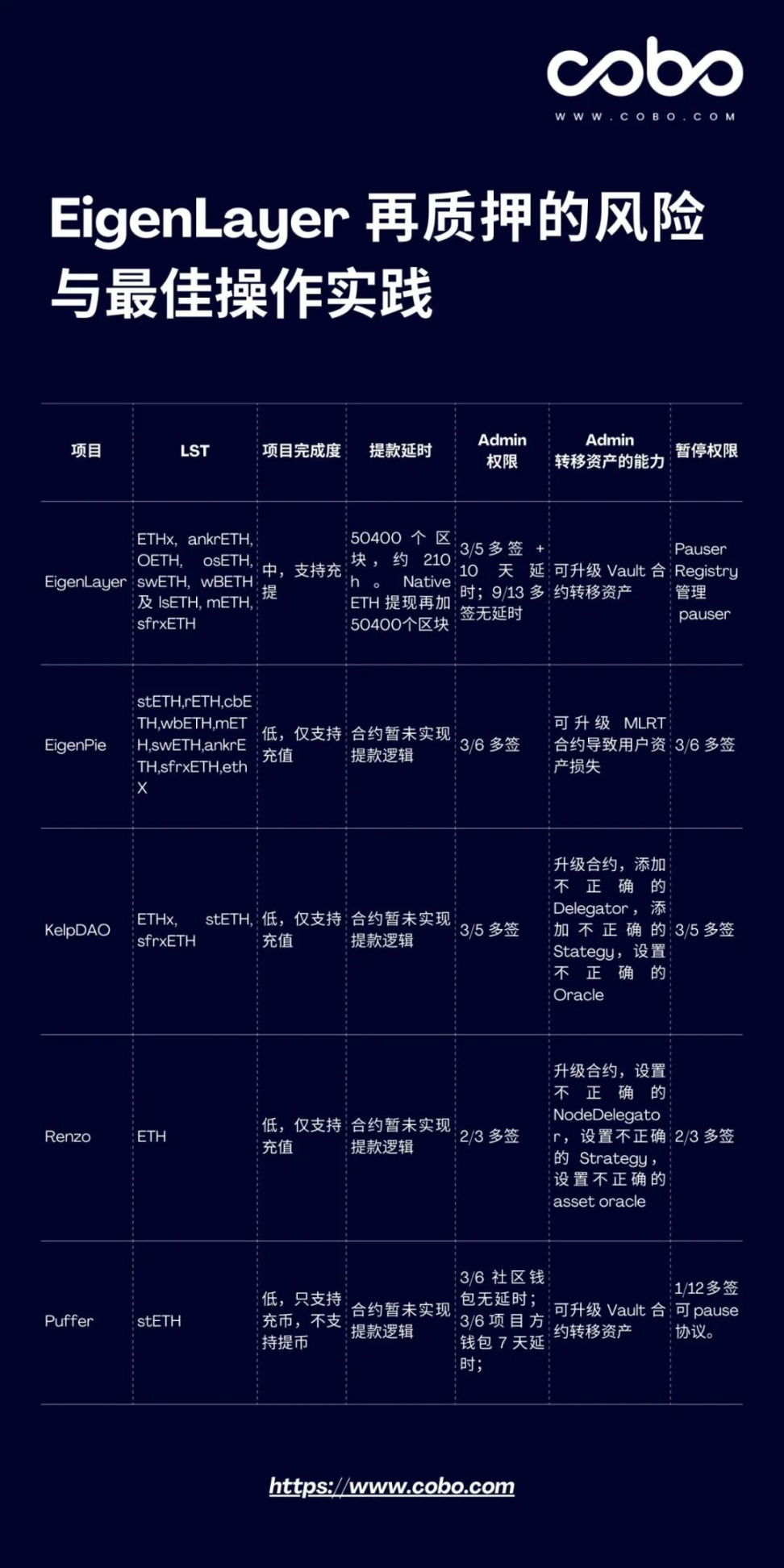
今日,Cobo 发布《EigenLayer 再质押的风险与最佳操作实践》,提示用户当前的 Restaking 协议存在合约风险、LST 风险与退出风险,并已与 Eigenpie、Kelp DAO、Renzo 等项目方进行沟通确认。

Lecturas Relacionadas

The "Impossible Triad" Is Fundamentally a Pseudo-Problem

The article argues that blockchain's fundamental limitation is not the scalability trilemma (decentralization, scalability, security), which has been largely solved, but the lack of **privacy** and, until recently, clear **legitimacy**. Blockchain is described as a slow, expensive, globally shared computer whose core value is censorship resistance and verifiability. While ideal for native digital assets like money (e.g., stablecoins), its default transparency acts as a **tax**, exposing all transactions and enabling MEV extraction, which deters serious institutional capital. Simultaneously, its permissionless nature created regulatory ambiguity. The piece contends that **privacy** is the missing critical feature. It rejects the false choice between total transparency and complete anonymity. Modern cryptography (like zero-knowledge proofs) enables **compliant privacy**: users can prove facts (solvency, KYC status, compliance) without revealing the underlying sensitive data (specific holdings, identities). This preserves auditability for regulators and eliminates the leak of financial information. With recent regulatory progress (e.g., the GENIUS Act) addressing legitimacy, adding default, provably compliant privacy becomes a pure upgrade. It transforms blockchain from a costly, public ledger into a confidential settlement layer, finally bridging the gap to mainstream institutional and individual adoption of on-chain finance.

链捕手Hace 9 hora(s)

The "Impossible Triad" Is Fundamentally a Pseudo-Problem

链捕手Hace 9 hora(s)

Optical Chips: Collective Capacity Expansion

The global optical chip industry is experiencing a massive wave of expansion driven by surging AI data center demand. Major players across the US, Japan, Europe, and China are aggressively investing to ramp up production capacity. In the US, Coherent is expanding its 6-inch Indium Phosphide (InP) semiconductor fab in Texas, supported by CHIPS Act funding and a $2 billion strategic investment from NVIDIA. Lumentum is building a new factory for InP optical devices, and Nokia is scaling its advanced photonic chip packaging and testing capabilities. NVIDIA's investments aim to secure future supply of critical lasers and optical interconnect products for AI infrastructure. Japan's JX Advanced Metals, a leading InP substrate supplier, plans a multi-billion yen investment to increase its capacity 7-10 times, strengthening its grip on the crucial upstream materials market. In Europe, IQE and Tower Semiconductor settled a patent dispute and signed a multi-year InP epitaxial wafer supply agreement, highlighting that next-generation silicon photonics platforms will integrate high-performance InP components. STMicroelectronics and Sivers Semiconductors are also expanding silicon photonics production and partnerships. China is rapidly building out its domestic supply chain. Dongshan Precision's subsidiary, Source Photonics, announced a $12 billion project to expand optical chip and module production. Companies like Sanan Optoelectronics and Yunnan Germanium are scaling up InP chip manufacturing and substrate production, moving towards vertical integration from materials to modules. While debate continues around the exact future architecture—whether CPO (Co-Packaged Optics), NPO, or pluggables will dominate—analysts like Morgan Stanley argue the underlying driver is unchangeable: the explosive growth in bandwidth demand. This will inevitably increase the volume of optical engines, lasers, and related content per GPU, regardless of the final technical path. The competition for "more light" in the AI era has intensified into a global, full-chain capacity race.

marsbitHace 11 hora(s)

Optical Chips: Collective Capacity Expansion

marsbitHace 11 hora(s)

Stablecoins Finally Find Real Yield: An In-Depth Look at On-Chain Reinsurance Re | A Conversation with Re Founder Karan Saroya

Stablecoin Real Yield Found: A Deep Dive into On-Chain Reinsurance with Re's Karan Saroya As stablecoin supply exceeds $170 billion, the search for sustainable, non-speculative yield intensifies. Re, an on-chain reinsurance platform, provides an answer: connecting stablecoin capital to the trillion-dollar traditional reinsurance market. Re operates as a regulated reinsurer, accepting stablecoin deposits as collateral to back US insurance companies. These insurers pay premiums, generating yield that flows back to on-chain depositors. Currently supporting 35 insurers and underwriting $500 million, Re projects scaling to over $1 billion soon. Key insights from a Bankless podcast with founder Karan Saroya and investor Avichal of Electric Capital: 1. **Uncorrelated, Real-World Yield:** Re offers stablecoin holders access to reinsurance returns (targeting 12-14%+), an asset class entirely separate from crypto or equity markets. 2. **Operational Efficiency via Smart Contracts:** Re replaces traditional, labor-intensive capital fundraising with smart contracts, allowing a ~12-person team to compete with industry giants. 3. **Regulatory Leverage:** For every $1 of collateral, regulations allow backing $5-7 in written premiums. This leverage amplifies returns from the underlying risk-free rate. 4. **DeFi Integration:** Depositors receive receipt tokens, which can be used in protocols like Morpho for "looping," potentially pushing yields to 18-20%+. 5. **The "DeFi Mullet" Model:** A compliant front-end (regulated reinsurer) paired with a decentralized back-end (smart contracts, DeFi capital markets). 6. **RE Governance Token:** Modeled on Lloyd's of London, the token governs the central capital pool's allocation, counterparty acceptance, and parameters. 7. **Real Economic Impact:** Capital funds real-world productivity (factories, clinics, businesses) via insurance, moving beyond crypto's internal loops. The discussion highlights a pivotal moment: DeFi's supply-side infrastructure is now met by real demand for productive yield, potentially kickstarting a flywheel where vast on-chain stablecoin capital seeks these real-world returns.

链捕手Hace 13 hora(s)

Stablecoins Finally Find Real Yield: An In-Depth Look at On-Chain Reinsurance Re | A Conversation with Re Founder Karan Saroya

链捕手Hace 13 hora(s)

1996 or 1999? Walsh's First Test is 'How to View AI'

"1996 or 1999? Wall's First Big Test Is 'How to View AI'" Federal Reserve Chairman Wall's initial challenge is not whether to raise or cut rates, but a more fundamental judgment: what kind of boom is the current AI boom? This will determine the Fed's policy path and define his legacy. Economics is split between two opposing views, according to reporter Nick Timiraos. One sees imminent productivity gains that will increase supply and cool inflation, allowing the Fed to hold steady. The other argues that while productivity benefits are distant, demand shocks are here now, and waiting for data confirmation risks missing the intervention window, forcing sharper rate hikes later. Wall has signaled a leaning toward the first view, echoing 1996-era Alan Greenspan, who embraced strong, productivity-driven growth without fear of inflation. However, Wall faces a different macro environment than Greenspan did, with tariff pressures, expanding fiscal deficits, and diminishing globalization benefits, which could force more significant inflation pressures even if AI benefits materialize. Wall's logic, expressed before taking office, is that AI-driven productivity gains won't show in official data for years. If the Fed waits for confirmation, it might mistakenly tighten policy and choke off the very growth that could suppress inflation. This argues for using forward-looking narratives over lagging data. Chicago Fed President Austan Goolsbee presents a key counter-argument. He distinguishes between expected and unexpected productivity booms. A widely anticipated boom, like the current AI wave, can cause people to spend future wealth gains in advance, overheating the economy before productivity actually rises, thus requiring preemptive rate hikes. He cites rising costs for AI data centers as evidence of such overheating. Fed Governor Christopher Waller offers a rebuttal to Goolsbee, noting the "expected spending" mechanism only works if people can borrow against future income, which many households cannot do due to borrowing constraints. Wall also faces a paradox related to his desire to reduce the Fed's use of "forward guidance" (pre-announcing policy moves). This practice was established in 1999 when Greenspan began signaling hikes to avoid market shocks. If the economy follows a less optimistic path, Wall may be forced to choose between using the guidance he wants to abolish or risking market volatility by staying silent. The ultimate question defining Wall's first major test remains: Is this 1996 or 1999?

marsbitHace 14 hora(s)

1996 or 1999? Walsh's First Test is 'How to View AI'

marsbitHace 14 hora(s)

Trading

Spot
Futuros
活动图片