Axelar(AXL)和Wormhole通过Lido温度检查投票,将提供stETH跨链BNB Chain服务

Odaily星球日报Publicado a 2024-01-29Actualizado a 2024-01-29

Resumen

跨链桥最初仅支持BNB Chain,后续可能扩展至其他EVM链。

2023 年 10 月,LayerZero 建立了面向 Lido 所发行的 stETH 的跨链桥,允许将其跨链至 BNB Chain 和 Avalanche。

LayerZero 曾向治理组织 Lido DAO 寻求批准,但在该组织正式批准之前就部署了该跨链桥。技术上而言这并不违规,而这种做法也并非完全前所未见——Lido 曾建立了各种跨链桥,并非所有跨链桥都等到社区投票后才启动。但 Lido DAO 部分社区成员认为 LayerZero 营销方式不当,他们认为 LayerZero 试图在没有 DAO 批准的情况下冒充官方 Lido 合作伙伴。一名成员在 Lido DAO 治理论坛上发文表示:“宣布未定事件,是对 DAO 的不尊重,也是一种明显的不严肃的体现。”

当时一封由一系列加密基础设施提供商签署的声明表示,LayerZero 在不当利用先发优势,以在竞争对手之前“锁定”用户。Lido 战略顾问 Hasu 在 Lido DAO 论坛上表示:“通过单方面部署跨链桥并以官方方式营销,似乎是在向 DAO 施加压力,以避免流动性碎片化。通过这样的营销吸引用户,使得其他的跨链桥提案受限,并且让 DAO、Lido 质押者和参与链陷入了困境。”

随着越来越多的区块链诞生,跨链“互操作性”变得至关重要,跨链桥是跨链互操作性正常运作所需的关键基础设施。但是这些服务也容易出现问题,这就是为什么协议对它们授予认可的地方如此重要的原因。

Lido 的对 stETH 的认可被视为互操作性提供商的重要标志,根据 DeFi Llama 的数据,其 TVL 达 208 亿美元,在 DeFi 协议中位列第一。

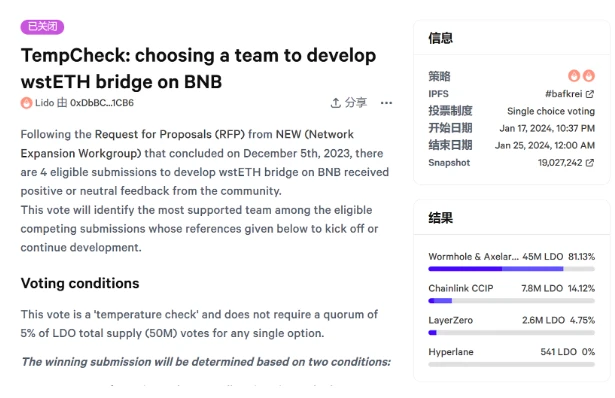
今年 1 月 17 日,Lido DAO 发起了一项选择 BNB Chain 的 wstETH 跨链桥开发者的温度检查投票,选项分别包括 Axelar & Wormhole、Chainlink CCIP、LayerZero、Hyperlane。最终 Axelar & Wormhole 支持率达 81.1% ,Chainlink 为 14.1% ,而 LayerZero 仅 4.7% 。
Axelar(AXL)和Wormhole通过Lido温度检查投票,将提供stETH跨链BNB Chain服务

在即将进行的正式投票后,Axelar & Wormhole 将很快成为 stETH 跨链至 BNB Chain 的“官方”服务提供者。

Axelar(AXL)和Wormhole通过Lido温度检查投票,将提供stETH跨链BNB Chain服务

Interop Labs(Axelar 开发商)首席执行官 Sergey Gorbunov 在接受 CoinDesk 采访时表示:“Axelar 和 Wormhole 团队决定合作,将两个网络的安全性有效结合起来,提供跨链 ETH LST 的有效安全性。”

Gorbunov 表示,Axelar 和 Wormhole 的目标是防止“服务提供商固化”,即服务提供商利用他们的先发优势永久巩固自己在协议基础设施中的地位。Axelar 和 Wormhole 跨链方式是开源且可扩展的,根据 Lido 基金会的选择,可能进行后端扩展以支持其他跨链桥提供商。这种可组合性是 Axelar+ Wormhole 提案中开源方法特点之一,其他提案无法复制,该“缺陷”导致了投票结果呈一边倒的形势。

Axelar 表示,跨链桥最初仅支持 BNB Chain,后续可能扩展至其他 EVM 链。

Wormhole 基金会首席商务官 Robinson Burkey 告表示:“在我看来,这不止是一次普通的治理投票,它变得更多地关乎原则而不仅仅是技术。代币持有者能够基于个人意愿支持符合协议利益的最佳选择,如果你剥夺了代币持有者的这种权力,那么就是在逐渐削弱去中心化的基本原则。”


Lecturas Relacionadas

Ethereum Q1 2026 Report: Fees Decline, Users and Transaction Volume Hit New Highs

Ethereum Q1 2026 Report: Fees Down, Users & Transactions Hit New Highs Token Terminal's Q1 2026 report on Ethereum presents a pivotal development: the network achieved record highs in monthly active users (13.2M, +85.9% YoY), total transactions (200.4M, +81.5% YoY), and throughput (25.78 TPS), while transaction fees on the mainnet plummeted by 47.9% quarter-over-quarter. This shift is attributed to the network's strategic move into a "low fees for scale" phase, exemplified by the Fusaka upgrade which increased data capacity and lowered block space costs, releasing pent-up demand (a manifestation of Jevons's Paradox). The report highlights a core narrative shift for Ethereum: from a DeFi-centric blockchain to a global financial settlement layer. It maintains a dominant position in tokenized assets, holding majority market shares among top chains in stablecoins (61.8%), tokenized funds (73.0%), and tokenized commodities (84.0%). Growth in tokenized funds (+73.1% YoY) and commodities (+325.9% YoY) was particularly strong, driven by institutions like BlackRock and JPMorgan entering the space. Contrasting these usage gains, several USD-denominated value metrics declined in Q1: fully diluted market cap fell 30.3% QoQ, total value locked (TVL) dropped 11.0%, and ecosystem transaction volume decreased 24.0%. The report interprets this as Ethereum prioritizing long-term network expansion and cementing its role as the default settlement layer for finance over short-term fee capture. The commentary from Etherealize argues that, much like the early internet, Ethereum's open, permissionless model is poised to win over closed alternatives as institutional tokenization accelerates.

marsbitHace 35 min(s)

Ethereum Q1 2026 Report: Fees Decline, Users and Transaction Volume Hit New Highs

marsbitHace 35 min(s)

He Just Raised 2.7 Billion, and Li Fei-Fei Also Invested

Pete Florence, a former senior research scientist at Google DeepMind and a key contributor to the Vision-Language-Action (VLA) model architecture, is deliberately distancing his startup, Generalist AI, from the trendy "world model" label. He argues that the industry should prioritize concrete goals over buzzwords. His goal is to create robots that can perform a vast range of unseen tasks with high speed and success rates, without needing task-specific training data. Recently, his company raised $400 million (¥2.7 billion) at a $2 billion valuation. Notable investors include NVIDIA's NVentures, Bezos Expeditions, NFDG, as well as Xiaomi co-founder Lin Bin, Zoom founder Eric Yuan, and renowned AI scientist Fei-Fei Li. Florence's approach stems from his academic background at MIT under Professor Russ Tedrake, focusing on understanding the physical world. After joining DeepMind, he developed models like Transporter Network and co-created the VLA framework. He left in 2025 to found Generalist AI. The company has launched two models: GEN-0, which demonstrated that scaling laws apply to physical motion, and GEN-1. GEN-1 was trained on over 500,000 hours of physical interaction data collected via a specialized wearable device. It achieves a 99% success rate on precise mechanical tasks like folding boxes and maintains performance three times faster than its predecessor. Florence believes GEN-1 is reaching a commercial utility threshold similar to the GPT-3 inflection point. The substantial funding round, following GEN-1's release, signifies strong investor confidence in Generalist AI's practical, goal-driven path to creating versatile, useful robots, regardless of the "world model" terminology.

marsbitHace 41 min(s)

He Just Raised 2.7 Billion, and Li Fei-Fei Also Invested

marsbitHace 41 min(s)

Two Legends Lost in Three Days: Is Google's AI Talent Dam Cracking?

In three days, Google lost two AI legends. On June 18, Noam Shazeer, co-author of the seminal "Attention is All You Need" paper and Gemini co-lead, left for OpenAI. Just 48 hours later, John Jumper, 2024 Nobel laureate and AlphaFold lead, departed DeepMind for Anthropic. This follows Andrej Karpathy joining Anthropic in May. These moves highlight a structural trend: top AI talent is concentrating at mission-driven, pre-IPO firms like OpenAI and Anthropic, while Google becomes a primary source. The exodus stems from a core mission mismatch. Google's ad-centric model often subordinates AI research to product and revenue goals, creating friction for pioneers like Shazeer, who returned in 2024 only to leave again. In contrast, OpenAI and Anthropic offer singular focus on pushing AI boundaries, whether towards AGI or safety-aligned models, which deeply appeals to top researchers like Jumper. Financial incentives amplify the pull. With both OpenAI and Anthropic nearing IPO, employees stand to gain immensely from equity, an upside Google's mature stock cannot match. Furthermore, the 2023 merger of Google Brain and DeepMind, intended to consolidate strength, has instead created cultural tension and slowed the path from research to product, as evidenced by Gemini's pace. This talent redistribution is reshaping the AI landscape. While Google retains vast data and compute resources, its true crisis is the quiet, continuous loss of the people who define the field's future. The real moat in AI is not infrastructure, but the concentration of brilliant minds—a battle Google is currently losing.

marsbitHace 2 hora(s)

Two Legends Lost in Three Days: Is Google's AI Talent Dam Cracking?

marsbitHace 2 hora(s)

Behind the AI Report Card, Lies a Chinese 'Exam Setter'

Beyond the familiar performance charts like MMLU-Pro and MMMU, which major AI models strive to ace, stands a key "examiner": Chinese-Canadian researcher Wenhu Chen. An assistant professor at the University of Waterloo and founder of TIGERLab, Chen addresses the crucial need for more rigorous AI evaluation. As models like GPT-4 began scoring near-perfect results on older benchmarks like MMLU, it became difficult to distinguish their true capabilities. In response, Chen introduced MMLU-Pro in 2024, featuring harder, more reasoning-focused questions with more answer choices, successfully reintroducing meaningful performance gaps. His work extends to multi-modal evaluation with MMMU and its enhanced version, MMMU-Pro. These benchmarks test a model's ability to understand and reason with complex information from images, charts, and text across diverse academic subjects, exposing the significant challenges even top models face in genuine comprehension. Chen's background in complex QA, table reasoning, and his experience at Google DeepMind on projects like Gemini inform his approach. He understands that effective benchmarks must anticipate how models might "cheat" by memorizing data or avoiding visual analysis. His lab also actively researches video understanding and generation models (e.g., UniVideo, Vamba), ensuring his evaluation work is grounded in practical model-building challenges. Now at Meta's Super Intelligence Lab, Chen continues his focus on multi-modal data and evaluation, representing the deep yet often unseen contributions of Chinese talent in shaping the fundamental tools of the AI industry.

marsbitHace 2 hora(s)

Behind the AI Report Card, Lies a Chinese 'Exam Setter'

marsbitHace 2 hora(s)

Trading

Spot
Futuros
活动图片