18-Year-Old Hacker's Boastful Discord Display Leads to Uncovering of $19 Million Theft Case

Odaily星球日报Publicado a 2026-05-13Actualizado a 2026-05-13

Resumen

An 18-year-old hacker from the U.S., Dritan Kapllani Jr., has been exposed by on-chain investigator ZachXBT for his alleged involvement in multiple cryptocurrency social engineering attacks, with total funds stolen estimated at $19 million. The case gained attention after Dritan inadvertently revealed his involvement during a Discord voice call in April 2026, where he screen-shared his Exodus wallet containing approximately $3.68 million to show off his wealth during a "Band 4 Band" argument. Tracing this wallet address led investigators to uncover its connection to a major theft from March 14, 2026, where 185 Bitcoin (worth around $13 million at the time) was stolen. Approximately $5.3 million from that heist was funneled into Dritan’s wallet. Further analysis linked the same wallet to over $5.85 million from other social engineering attacks dating back to 2025. While Dritan has not yet been formally charged, he is identified as "Co-Conspirator 1" in recently unsealed court documents related to the 185 Bitcoin theft case. Another individual, Meme coin KOL yelotree, is also implicated for allegedly assisting with money laundering through a car rental business. Dritan, who had been living a lavish lifestyle and was previously seen as untouchable within hacking circles, turned 18 recently, making him legally accountable. His previous "immunity" has ended as law enforcement closes in.

Original | Odaily Planet Daily(@OdailyChina)

Author | Asher(@Asher_ 0210)

Last night, on-chain investigator ZachXBT exposed an 18-year-old hacker from the United States named Dritan Kapllani Jr. According to the disclosed information, this young man named Dritan Kapllani Jr. is suspected of involvement in multiple social engineering attacks targeting cryptocurrency users, with an estimated total amount involved of approximately $19 million. Although he has not been formally charged yet, he has already been included as a 'co-conspirator' in U.S. judicial documents.

This case quickly attracted attention, not only because of the massive amount involved but also because its starting point was highly dramatic—a voice call meant for showing off wealth became the breakthrough for the entire investigation.

Just Showing Off Wealth Once on Discord

On April 23, 2026, a dispute that occurred in a Discord voice channel kicked off the incident.

It was a voice call known as 'Band 4 Band,' where participants compared their 'strength' in the most direct way—by showcasing their respective assets. The atmosphere soon shifted from teasing to rivalry. Driven by this sentiment, Dritan, to prove he was richer, directly started screen sharing and displayed his Exodus wallet interface, showing a balance of about $3.68 million.
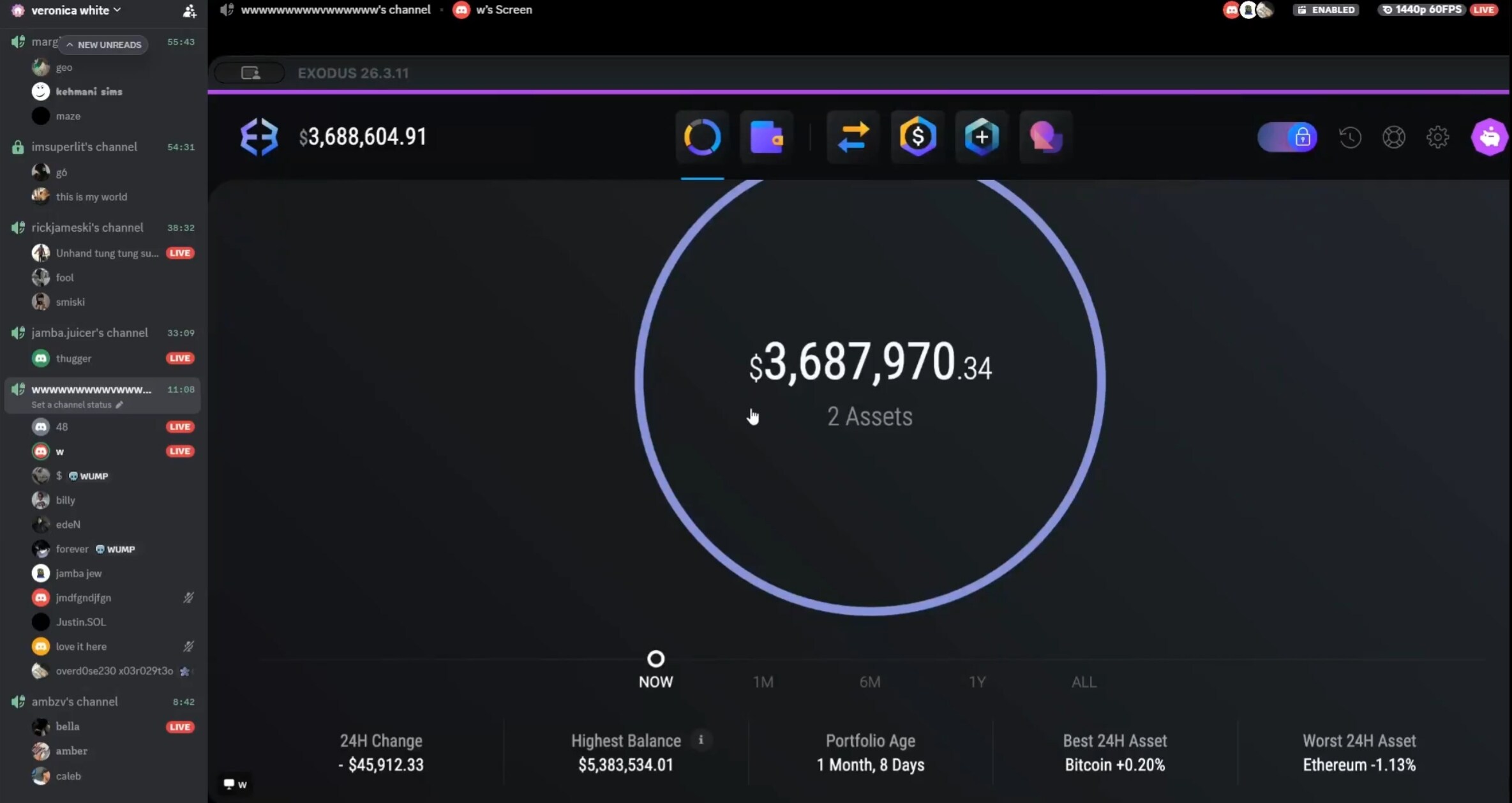
A few weeks later, this scene was revisited. On-chain investigator ZachXBT used this address as a starting point, linking together what were originally scattered transactions one by one, gradually revealing a longer funding trail.

A Cache of 185 Bitcoin Theft Funds Surfaces

Going back to March 14, 2026, a social engineering theft involving 185 Bitcoins occurred, valued at around $13 million at the time. The funds were quickly transferred out of the original address and swiftly entered an on-chain distribution system.

As early as the next day, about $5.3 million of it was transferred into the wallet Dritan displayed during the Discord voice call (address: 0x4487db847db2fc99372a985743a26f46e0b2bba6). Over the next few weeks, this approximately $5.3 million was continuously split, transferred through multiple addresses, and sent to various destinations. By the time of that April 23 voice conversation, about $1.6 million had already been further moved.
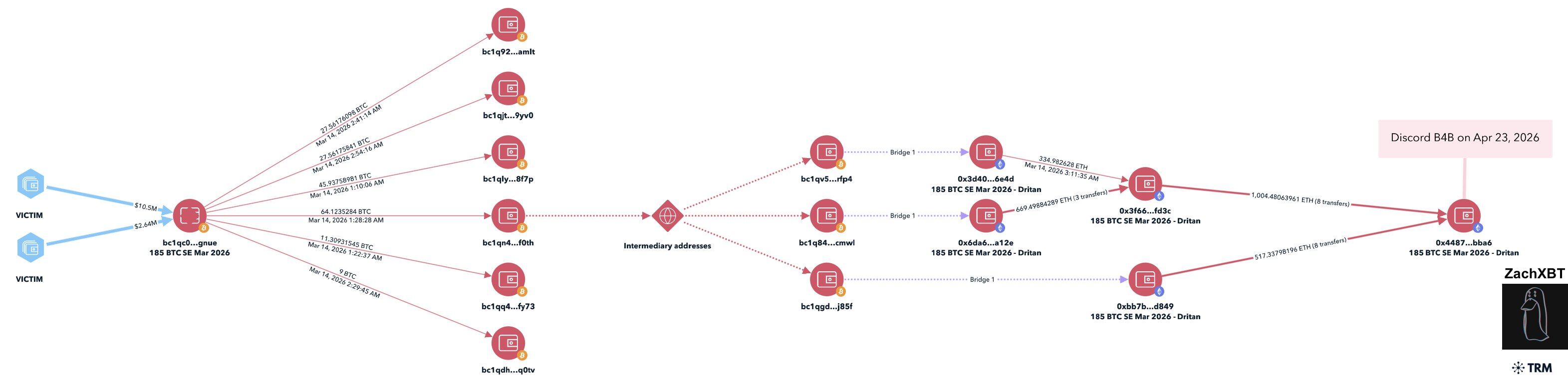
Not the First Time Involved in Crypto Theft

Tracing back from the wallet address Dritan displayed, it quickly became apparent that the funds in it didn't only come from that 185 Bitcoin theft.

According to on-chain analysis, the funding sources for this wallet can be traced back to multiple social engineering thefts in 2025, totaling over $5.85 million. Different victims, different times, but after the funds were transferred away, they would be rapidly split and then moved on through a string of addresses, following a very similar pattern. By matching these funds one by one, it was found that many transfers eventually landed in this wallet address Dritan displayed.

It's worth noting that Dritan once had a 'Band 4 Band' dispute with hacker John Daghita (Lick). Lick was later arrested for allegedly stealing about $46 million in U.S. government funds, and in a later-deleted Telegram post, he had publicly shared Dritan's old address (address: 0x97da0685dbba50b4cbabb0ca9e8336f4fbe41122). Currently, this move appears more like an act of retaliation.

Judging from on-chain behavior, this old address showed a highly consistent pattern with the funds flow of the wallet Dritan displayed in terms of fund splitting methods, transfer paths, and subsequent destinations, and is therefore believed to be used by the same controlling party.

Judicial Documents 'Name' Him for the First Time

It wasn't until May 11, 2026, that this on-chain funding trail was officially confirmed for the first time in judicial documents. That day, the criminal indictment against Trenton Johnson was unsealed. He was charged for his involvement in that 185 Bitcoin theft case and faces up to 40 years in prison.

In the indictment, a key co-conspirator is labeled as 'Co-Conspirator 1 (CC-1),' and the on-chain analysis community has already pointed this identity towards Dritan Kapllani Jr. Although Dritan has not been formally charged yet, he has transitioned from a 'linked address' in on-chain inference to a 'co-conspirator structure' in the judicial narrative.

Additionally, the same document mentions another individual involved—Meme coin KOL yelotree, who is accused of assisting in money laundering through his car rental business in Miami and faces up to 30 years in prison.

Turning 18, The Dissolute Life Comes to an End

Previously, Dritan had been living a life of extravagance for a long time, frequently posting related content on Instagram and interacting with other hackers via Telegram. In hacker circles, he was once considered to have a kind of 'protagonist aura'—several groups associated with him (like ACG, 41 / RM Boyz, etc.) were successively dealt with by law enforcement, yet he himself remained untouched.

But as he turned 18, this 'aura' ended, and his past actions began to be pursued legally.

Preguntas relacionadas

QWho exposed the 18-year-old hacker Dritan Kapllani Jr., and what was the initial trigger for the investigation?

AThe hacker was exposed by blockchain investigator ZachXBT. The investigation was triggered by Dritan showing off his Exodus wallet (with a balance of about $3.68 million) during a 'Band 4 Band' Discord voice call on April 23, 2026.

QWhat is the total estimated value linked to the social engineering attacks involving Dritan Kapllani Jr.?

AThe cumulative amount linked to the social engineering attacks involving Dritan Kapllani Jr. is approximately $19 million.

QHow did a specific 185 Bitcoin theft connect to Dritan's wallet, and what happened to the funds?

AIn the 185 Bitcoin theft on March 14, 2026 (worth about $13 million at the time), approximately $5.3 million was transferred into the Exodus wallet Dritan later showed off. This money was then split and moved through multiple addresses, with about $1.6 million transferred out before the Discord call.

QWhat is Dritan Kapllani Jr.'s status in the US legal case (Trenton Johnson) related to the 185 Bitcoin theft?

AIn the unsealed criminal complaint against Trenton Johnson, Dritan Kapllani Jr. is referenced as 'Co-Conspirator 1 (CC-1).' While he has not been formally charged yet, his role has moved from a blockchain-inferred association to being officially identified as a co-conspirator in the judicial narrative.

QAccording to the article, why did Dritan's perceived 'main character halo' in the hacker community end?

ADritan's perceived 'main character halo' in the hacker community ended because he turned 18 years old. Upon reaching legal adulthood, his past actions became subject to legal consequences and prosecution.

Lecturas Relacionadas

From South Korea to the United States: Blue-Collar Jobs Are Becoming Increasingly Popular, Thanks to AI

AI is reshaping the labor market's value proposition. The traditional four-year college degree is losing its appeal as a guaranteed career path, while skilled blue-collar trades like electricians, welders, and plumbers are experiencing historic demand and wage premiums. This shift is driven by dual pressures: AI's displacement of certain white-collar roles and a booming need for physical infrastructure and data center construction. Data confirms the trend. In the U.S., vocational school revenue surged, and a significant portion of recent layoffs are AI-related. Surveys show a majority of Gen Z adults plan to pursue blue-collar work, citing better job security against AI automation. Vocational education interest has exploded recently. Experts cite a psychological shift as younger generations seek tangible, AI-resistant careers and avoid high student debt. In many cases, salaries for skilled trades now match or exceed those requiring a bachelor's degree. In South Korea, semiconductor vocational high schools boast near-total employment, with graduates securing high-paying roles at companies like Samsung. The shortage is structural, exacerbated by a retiring baby boomer workforce and massive infrastructure projects. Companies like JPMorgan Chase, Meta, and Lowe's are investing heavily in training programs. However, overcoming historical stigma and a "perception gap" around trade careers remains a key challenge to closing the talent gap.

marsbitHace 19 min(s)

From South Korea to the United States: Blue-Collar Jobs Are Becoming Increasingly Popular, Thanks to AI

marsbitHace 19 min(s)

Qualcomm: AI Hype Subsides, When Will Smartphones Emerge from the Gloom?

Qualcomm reported its Q3 FY2026 results (ending June 2026), with revenue of $9.95B, down 4% YoY but above expectations. Gross margin declined to 53.1%, pressured by rising costs across manufacturing and memory. Key business segments showed mixed performance: Handset revenue fell 19.6% YoY to $5.09B, dragged by an 11% decline in non-Apple Android shipments and weaker high-end mix. Conversely, Automotive revenue surged 61% to $1.59B, and IoT grew 9% to $1.83B. Core operating profit dropped 41% YoY due to margin compression and higher expenses. Management's Q4 FY2026 guidance projects revenue of $9.7B-$10.5B, in line with consensus, but Non-GAAP EPS guidance of $2.05-$2.25 fell short of expectations. Amidst persistent weakness in its core handset market, Qualcomm is pursuing growth in AI, focusing on Edge AI (smartphones, PCs, automotive) and Data Center AI. Its data center strategy includes four pillars: AI accelerators (e.g., AI200), commercial CPUs (Dragonfly C1000), custom silicon, and connectivity solutions. While these initiatives initially boosted its stock, concerns over AI capital expenditure sustainability have since erased those gains. The company targets $5B in data center revenue for FY2027 and $15B for FY2029. The report concludes that with the traditional handset business still under pressure, the data center opportunity is currently viewed as a longer-term option, and a more conservative valuation based on core operations may be warranted until AI contributions materialize.

marsbitHace 23 min(s)

Qualcomm: AI Hype Subsides, When Will Smartphones Emerge from the Gloom?

marsbitHace 23 min(s)

From TPU to Self-Evolving Agents: How Jeff Dean Predicts the Next Step in AI

At the 2026 YC Startup School, Jeff Dean outlined his vision for AI's next phase, shifting focus from simply scaling models to building intelligent, autonomous systems. He believes AI's progress is no longer just about creating smarter models, but about integrating them into systems capable of long-term, iterative work, automated experimentation, and continuous learning. This evolution moves the competition from "who has the bigger model" to "who can best organize intelligence." Dean suggests AI capabilities are now comparable to a junior engineer, enabling the automation of complex workflows. However, the true challenge and opportunity lie in managing these AI "workers" at scale. He emphasizes the importance of **context engineering**—structuring tools, memory, and feedback loops—over raw model power. For startups, this means building deep expertise in niche domains where general models currently fail (near 0-1% success rates), leveraging proprietary data, specialized tools, and domain-specific evaluators. A recurring theme is re-examining fundamental constraints. Dean's past work, like moving Google's search index to memory or creating the TPU, stemmed from questioning outdated assumptions about hardware and cost. He sees similar inflection points today, particularly in **specialized inference hardware** to drastically reduce latency and energy consumption for real-time Agent operation. Notably, he points out that in modern AI systems, the dominant cost is often not computation but **data movement**. Reliable, long-running Agents require robust system design, borrowing concepts from distributed computing like checkpointing, state management, and parallel exploration to handle failures and maintain progress over days or weeks. As AI automates execution, the scarcest human skills will shift to **defining clear specifications**, **judging what problems are worth solving** (taste), and designing effective feedback loops. Ultimately, Dean's framework prioritizes understanding the problem deeply, identifying the true bottlenecks, and systematically building closed-loop systems where AI can not only perform tasks but also improve AI itself.

marsbitHace 23 min(s)

From TPU to Self-Evolving Agents: How Jeff Dean Predicts the Next Step in AI

marsbitHace 23 min(s)

Trading

Spot
活动图片





