速览Delphi Digital Web3游戏年度报告20个要点

Odaily星球日报Publicado a 2023-12-26Actualizado a 2023-12-26

Resumen

负重前行的 2023 与蓄势待发的 2024。

原文来源:Stacy Muur 

原文编译:Luffy,Foresight News

加密研究机构 Delphi Digital 发布了一份 Web3 游戏年度报告,加密研究员 Stacy Muur 总结了报告的 20 个看点。

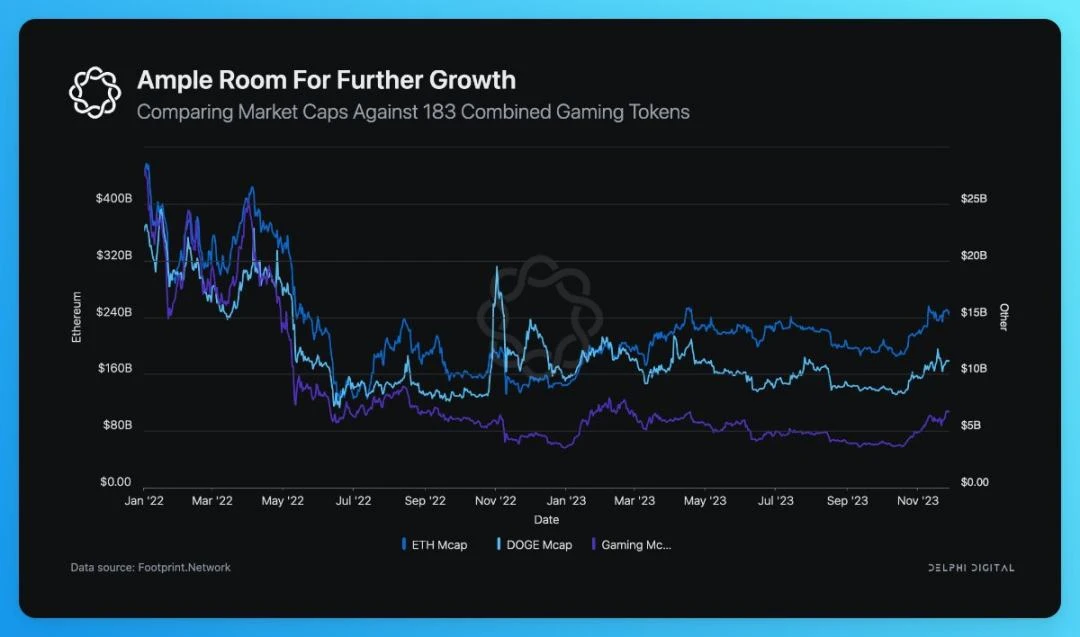
1、 2023 年 183 个游戏项目的总市值全年稳定在 40 至 70 美元之间,比 2022 年的历史高点下降了 86% 。但游戏行业仍有巨大的增长潜力。
速览Delphi Digital Web3游戏年度报告20个要点

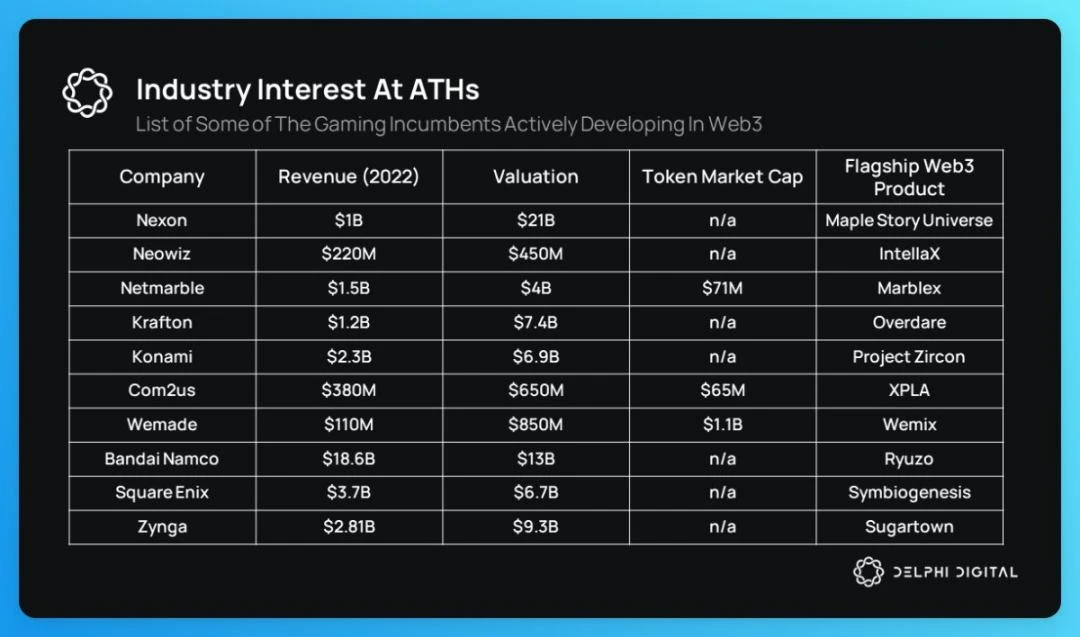
2、游戏巨头进入 Web3 市场的兴趣正在增长。

3、随着进入流程改进和法规更加宽松,移动端游戏已成为对 Web3 开发人员越来越有吸引力的平台。
速览Delphi Digital Web3游戏年度报告20个要点

4、区块链游戏的主要市场依次为菲律宾、尼日利亚、巴基斯坦、新加坡、越南、韩国、香港、中国和阿拉伯联合酋长国。

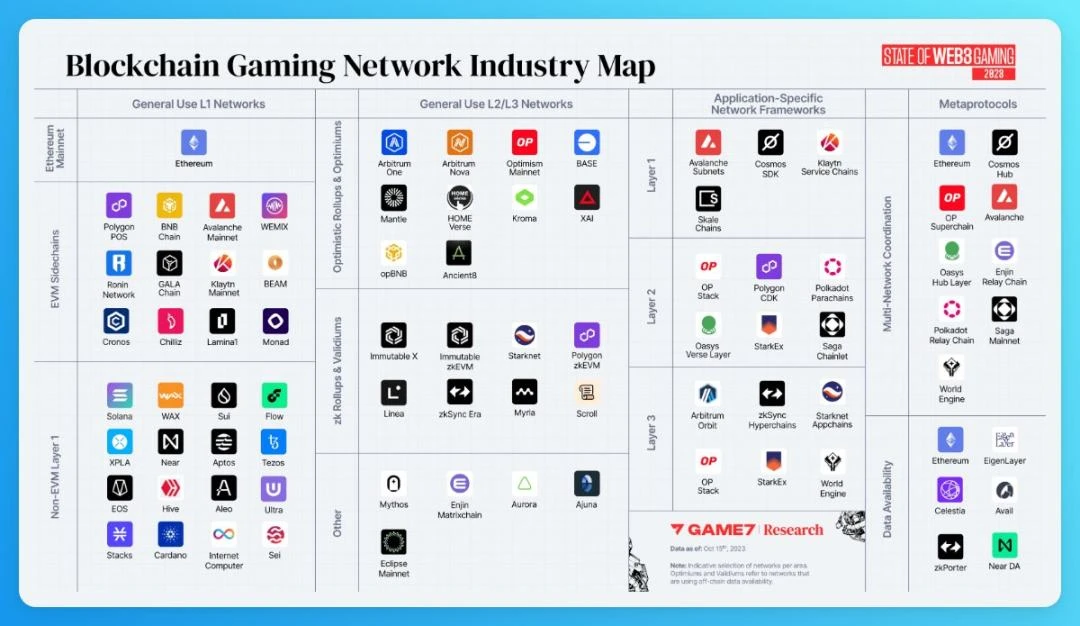
5、专注于游戏的区块链网络总数逐年增加。报告显示,仅 2023 年就出现了 76 个新网络,包括通用 L1、L2 和应用链。因此, 2024 年的一个重要主题对玩家流动性的争夺。
速览Delphi Digital Web3游戏年度报告20个要点

6、到 2023 年,区块链游戏产生的平均链上交易量是 DeFi 协议的 23 倍,显然这将成为许多游戏专用网络、子网和区块链的重点关注领域。

7、在所有可玩的区块链游戏中,只有略多于 5% 的游戏每日玩家数量超过 100 个用户钱包。

8、玩家激励、游戏启动和维护运营的成本不断上升,Web3 游戏在经济上难以维持。

速览Delphi Digital Web3游戏年度报告20个要点

9、区块链游戏的用户获取成本可能非常昂贵。事实上,某些案例研究表明,与非 Web3 游戏相比,区块链领域移动休闲游戏的客户获取成本高出 77% 。

10、为了实现盈利和规模化,众多 Web3 游戏将不得不扩大其商业化用户基础,增加鲸鱼的支出,或者两者兼有。

11、目前,每天约有 120 万个独立活跃钱包参与游戏,每日游戏交易为 1500 至 2500 万笔。

速览Delphi Digital Web3游戏年度报告20个要点

12、Optimism 和 OP Stack 成为全链游戏 (FOCG) 开发人员最受欢迎的选择。 Starknet 是 FOCG 另一个受欢迎的基础设施。

13、Telegram (TON) 加密游戏是一种新趋势。

速览Delphi Digital Web3游戏年度报告20个要点

14、人工智能驱动的「生成代理」将创造全新的玩家体验。

15、根据 Delphi 的观点,值得关注的人工智能和加密游戏交叉点的项目有 Parallel、Today - 、AI ARENA、Geppetto AI、AVALON。

16、Web3 游戏开发的基础设施正在快速扩张。

17、根据 Delphi Digital 的说法,潜力最大的两个项目是 HYTOPIA 和 Ronin Network。

速览Delphi Digital Web3游戏年度报告20个要点

18、过去两年,AAA 级游戏无疑是区块链游戏行业关注的焦点。

19、在高水平上,AAA 游戏不仅相互竞争,而且还与更广泛的 Web2 射击游戏市场竞争。

速览Delphi Digital Web3游戏年度报告20个要点

20、 2024 年对于 Web3 游戏行业来说将是激动人心的一年。

Lecturas Relacionadas

Unveiling the Whales of the World Cup Prediction Market: Smart Money Stumbles on the Pitch, 'Buy No' Outperforms 'Buy Yes'

**Title: Unveiling the Whales of the World Cup Prediction Market: "Smart Money" Stumbles on the Pitch as "Buying No" Outperforms "Buying Yes"** An analysis of pre-match trades over $5,000 on Polymarket for 20 completed group stage matches reveals a counterintuitive finding: large "smart money" bets were not consistently accurate. Aggregated pre-match buying volume was $89.55 million, with a weighted hit rate of only 48.5%. Holding these positions would have resulted in an estimated net loss of about $1.76 million (ROI -2.0%), challenging the notion that big money reliably predicts outcomes. The data highlights several key dynamics. Draws proved to be a major risk, significantly impacting bets on favored teams, as seen in Belgium-Egypt and Spain-Cape Verde. Markets were more efficient for clear mismatches (e.g., Germany's big win) but became prone to bias when favorites were overvalued. Notably, buying "No" shares (betting against a specific outcome) significantly outperformed buying "Yes," with hit rates of 62.4% vs. 37.5%. This suggests the market often overprices popular narratives, creating value in contrarian positions. Individual trades showed extreme volatility. One wallet (mintblade) earned an estimated $6.77 million by betting against Iran, while another (LEEEROYJENKINS) lost roughly $8.39 million on a Belgium win. The market favors high-risk, high-reward information trading rather than steady arbitrage. For sustained insight, wallets with consistent performance across multiple matches (e.g., swisstony) are more telling than one-off big bets. Ultimately, the Polymarket acts less as a crystal ball and more as a mirror, reflecting crowd bias and the inherent unpredictability of football. True "smart money" may lie not in predicting the future, but in identifying and exploiting market mispricings while respecting risk.

marsbitHace 18 min(s)

Unveiling the Whales of the World Cup Prediction Market: Smart Money Stumbles on the Pitch, 'Buy No' Outperforms 'Buy Yes'

marsbitHace 18 min(s)

Bezos' Third Startup Still Can't Avoid Musk

Jeff Bezos Returns as CEO for Third Venture, Still Can't Avoid Musk After stepping down as Amazon CEO in 2021, Jeff Bezos has returned to the front lines as co-CEO of Prometheus, an AI startup he founded. In a recent CNBC interview, Bezos described the experience as "Type 2 fun"—exhausting but ultimately rewarding. Founded less than a year ago, Prometheus has already raised over $18 billion in two funding rounds, achieving a staggering $41 billion valuation. Prometheus aims to develop a "General Engineer AI" to accelerate the entire "invention loop"—design, simulation, testing, and manufacturing—for complex physical products like jet engines, spacecraft, and medical devices. This positions the company at the intersection of Bezos's past experiences: Amazon's platform-building scale and Blue Origin's rigorous physical engineering. This marks Bezos's third major venture, following Amazon and Blue Origin. His co-CEO is Vik Bajaj, bringing expertise from life sciences and hard tech. Bezos now dedicates most of his time to Prometheus, signaling his belief in its transformative potential. The move also comes as Bezos's space company, Blue Origin, faces challenges, including a recent test explosion delaying its New Glenn rocket. Meanwhile, Elon Musk's SpaceX achieved a record-breaking IPO, surpassing Amazon's market cap. While Musk focuses on AI for executing physical tasks (like Tesla's robots and SpaceX's engineering), Bezos is betting on AI to *invent* in the physical world. Prometheus enters a crowded industrial AI field with players like OpenAI, NVIDIA, and Tesla's Optimus. Its lofty valuation bets on the unproven but massive opportunity to become the foundational platform for engineering in the AI era—a "blue ocean" Bezos hopes to define before Musk does.

marsbitHace 20 min(s)

Bezos' Third Startup Still Can't Avoid Musk

marsbitHace 20 min(s)

Won't US Stocks Ever Fall Again? The 'Great Melt-up' Trap in the Era of High Debt

The article analyzes a popular theory circulating online that the U.S. stock market may be mathematically incapable of a true, sustained decline due to the country's massive and growing national debt. The argument suggests that the government's only path to managing this debt is through inflation and money printing, which would nominally lift asset prices like stocks, creating a perpetual "melt-up." The author places this idea within the historical context of market melt-ups, such as the dot-com bubble and Japan's asset bubble, where prices detach from fundamentals driven by momentum and FOMO. While acknowledging that a high-debt environment creates incentives for inflation, which is generally favorable for assets over cash, the article refutes key claims of the online theory. It clarifies that interest payments are not about to exceed GDP, that printing money is not the only option for the government, and that stocks do not reliably rise in lockstep with hyperinflation, citing historical examples from Germany, Zimbabwe, and Venezuela. The more probable outcome, according to the author, is a prolonged period of financial repression—moderate inflation above interest rates that slowly erodes debt and cash purchasing power, leading to nominally higher asset prices but potentially lower real returns. The core warning is that while long-term market trends may be upward, this does not eliminate the risk of significant interim crashes (30%, 40%, or more) or guarantee real wealth creation during inflationary times. The conclusion advises against betting one's entire financial future on a smooth, perpetually rising market narrative. Instead, it recommends a disciplined, diversified strategy involving productive assets (stocks, real estate, some gold, short-term bonds) and an adequate cash buffer to avoid forced selling during downturns. The key takeaway is to avoid extreme concentration in expensive assets and leverage, and not to base investment decisions on the hope that every market dip will inevitably be rescued.

marsbitHace 41 min(s)

Won't US Stocks Ever Fall Again? The 'Great Melt-up' Trap in the Era of High Debt

marsbitHace 41 min(s)

Trading

Spot
Futuros
活动图片