对话比特币生态社区:比特币铭文是否会迎来第二春?

Odaily星球日报Publicado a 2023-11-14Actualizado a 2023-11-14

Resumen

在进入铭文生态时,要做好全方位的调研,不要太 FOMO。

对话比特币生态社区:比特币铭文是否会迎来第二春?

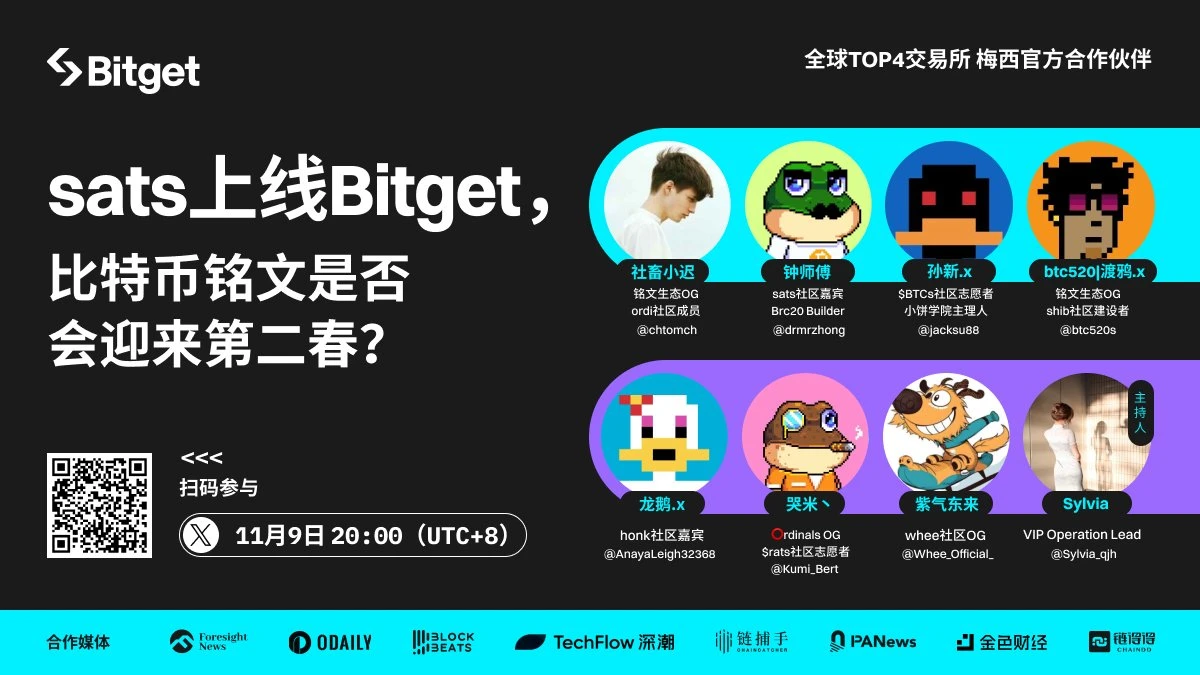
近日,Bitget 在其中文社区举办了主题为"sats 上线 Bitget,比特币铭文是否会迎来第二春"的 X Space,共同探讨近期火出圈的比特币生态。参与嘉宾包括比特币生态社区的多名 OG:ordi 社区-社畜小迟、sats 社区-钟师傅、BTCs 社区-孙新.x、shib 社区-btc 520 |渡鸦.x、honk 社区-龙鹅.x、rats 社区-哭米丶、whee 社区-紫气东来。

以下为社区对话实录:

主持人:hello,大家晚上好,欢迎来到 Bitget 中文和 Bitget Builder 中文联合主办的 AMA。我是本次 Space 的主持人 Sylvia,也是咱们 Bitget VIP 的运营负责人。今天我们讨论的第一个问题是比特币铭文市场与传统现货交易对比起来,它最突出的一个优点是什么呢?

钟师傅:最大的优点就是去中心化,没有项目方跑路的风险和担忧。此外,它也不会出现各种智能合约的漏洞。不需要授权各种各样乱七八糟的网站。此外,新项目的启动环境也相对更加公平。

Kumi:我认为最突出的优势还是公平发售。很多新手,项目方,VC,庄家有机会同台竞技。他能让我们这些普通投资者也获得收益,我相信这是最突出的优点。
BTC 520 :总结下来的话,有三个关键词:一个是投放红利,一个是持仓红利,另外一个是建设红利。

社畜小迟:我主要想分享两个点,第一点是全流通。第二是价格上涨快。因为其独特的交易方式会使价格的上涨变得非常螺旋化,大家要看到好的一方面,要看到它不好的一方面。

孙新:它纯粹的链上玩法使其高度透明化,我们不用再看 VC,机构,项目方的脸色,也不用担心莫名其妙的砸盘,以及无限解锁,漏洞等等。所以它的第一大特点就是铸币权在我们散户手里,另外第二个特点就是定价权也来到咱们散户手里,或者说参与者的手里。

紫气东来:铭文赛道它属于普通的散户,大家人人都有机会参与,最原始的一级筹码通过 Mint 的方式在所有的散户手里流通。所以他表现出来的就是的确很公平。但是它也有一个缺点,很容易一夜之间就这个缩水 70% 、 80% 、 90% ,甚至 99% 。

龙鹅:最突出的肯定是公平安全,还有它的天然群众基础比较大,因为它是大家一起去铸造币,这让 B2C 20 系列在最初阶段就会产生一定的群众基础。

主持人:我们都知道明年比特币 5 月份的时候会减半,想请各位老师预测一下减半后比特币生态会达到怎样一个状态,以及咱们普通用户如果参与,什么时候会是一个合适的时机?

孙新:从我的理解来说,这次行情将叠加三层 buff。第一个 BTC 减半,大概还有不到半年的时间。第二个 buff BTC 现货 ETF 的通过,将是一个大概率的事件,也会成为下个牛市的最强助推器。第三个就是比特币生态的繁荣。那么对于新人,我觉得要加入到比特币生态还是要注意以下方面:

1. 在进入铭文生态时,要做好全方位的调研,不要太 FOMO。

2. 学会管理风险,把风险控制在自己可承受的范围内。

3. 要保持一个学习的心态。

龙鹅:我们玩 BRC 20 的时候要控制仓位,也要敢于投入一些,你看准了你自己认可的,你就要去为自己认可的这个项目去努力。其次要按比例去投入,去布局,还是得能拿住。再次,选择一些比较认可的社区,去深入研究这个板块,挖掘更多的机会。
除了嘉宾们进行了激烈的讨论和交流外,热心观众也加入了讨论,以下是用户关于铭文生态最关心的问题。

热心观众:我买的是 Shiba 社区的铭文,我想问一下 Shiba 后面会有什么生态?

BTC 520 :

关于 Shiba 铭文的相关信息我之前分享过,现在社区的主要方向还是要做好基础建设。至于说后面有什么样的动作,其实很难去讲。只要把这些基础的东西做好之后,才能吸引很多的大户进场。因为很多东西都是不确定的,而我是抱有一个比较平和的心态,只要基础建设起来了一切都会有的。包括你能看到的,Shiba 正在构建一个全球共识社区,我们其实也可以去自发的自愿的去做一些这样的事情,来形成更多的共识。

Lecturas Relacionadas

The World Cup Has Only Just Begun, But AI Predictions Already Have Models Hailed as 'Godly' and Others Flipping Over

After only a few days of the World Cup, AI models are being widely used for match predictions, with mixed early results. These models analyze details like scores, upsets, red cards, and key players, offering users in prediction markets an extra layer of analysis beyond odds and news. Qwen gained early attention for its remarkably accurate calls on the opening day, correctly predicting Mexico's 2-0 win over South Africa and Korea's 2-1 victory over the Czech Republic, while also highlighting red card risks and match flow. Copilot had its own highlights, accurately forecasting the Mexico 2-0 result, the Korea 2-1 win, and a surprising 1-1 draw between Brazil and Morocco. However, it also misjudged several matches, like predicting a Swiss win that ended in a draw with Qatar and missing Australia's upset over Turkey. ChatGPT provided detailed pre-match analysis and correctly called the Mexico 2-0 score, explaining factors like home-field advantage. Yet, it struggled to anticipate upsets, often siding with the stronger team on paper, as seen in its missed calls for the Australia-Turkey and Japan-Netherlands matches. Social media tests pitted models like Gemini, Grok, and Claude against each other for the same games, revealing different predictive "scripts" even for the same fixture. Overall, while AI models like Qwen and Copilot have shown promising, high-profile successes in early matches, their consistency and ability to predict genuine upsets remain in question. As the tournament progresses, more data will be needed to determine which models offer the most reliable insights for prediction markets.

Odaily星球日报Hace 3 min(s)

The World Cup Has Only Just Begun, But AI Predictions Already Have Models Hailed as 'Godly' and Others Flipping Over

Odaily星球日报Hace 3 min(s)

The Unfinished Tale of Jueying, DaXiao Robotics Swiftly "Raises Funds"

Following a major fundraising round involving several prominent investment institutions, DaXiao Robotics, a company backed by SenseTime, has secured hundreds of millions of US dollars in financing for the first half of 2026. This move signals SenseTime's renewed and substantial bet on "Physical AI" through embodied intelligence, following the relative underperformance of its autonomous driving unit, Jueying. While Jueying achieved mass production partnerships in the smart vehicle sector, it failed to become a pivotal player in the high-level autonomous driving landscape, leading to its gradual independence from SenseTime's core financials. DaXiao Robotics now emerges as SenseTime's next major venture into the physical world. The new funding will focus on developing a "world model" and integrated hardware-software solutions for commercial applications like retail, security, and hospitality. This ambition is significantly more complex and capital-intensive than previous projects. A world model requires understanding spatial relationships, physics, and causality to guide robots in long-term tasks, demanding immense computational resources, data, and engineering. The article highlights several challenges. First, the massive funding, while substantial, may still be strained by the high costs of R&D, data collection, and commercial deployment. Second, SenseTime itself, despite narrowing losses, continues its high-investment growth model and cannot solely bankroll this new, expensive endeavor. Third, DaXiao Robotics, led by SenseTime co-founder Wang Xiaogang, carries the technical heritage and resources of its parent company but also potentially its organizational inertia. It operates in a field increasingly dominated by agile, young technical founders. Ultimately, DaXiao Robotics represents SenseTime's attempt to secure a leading industrial position in embodied intelligence—a goal its Jueying unit did not fully achieve in autonomous driving. The new venture starts with strong capital backing, but faces the critical task of rapidly transitioning from technological narrative to sustainable commercial delivery in an early-stage, costly, and highly competitive arena.

marsbitHace 12 min(s)

The Unfinished Tale of Jueying, DaXiao Robotics Swiftly "Raises Funds"

marsbitHace 12 min(s)

Crypto 2029: The Ultimate Forecast for the Four-Year Cycle of the Cryptocurrency Industry

Title: Crypto 2029: The Ultimate Four-Year Cycle Prediction for the Encryption Industry This article outlines a detailed, stage-by-stage prediction for the crypto industry from the present to 2029, focusing on tangible shifts rather than abstract theory. Key predictions include: **2026 Mid-Year:** The market shifts focus from traditional tokens to synthetic perpetual contracts for private company shares (e.g., SpaceX on Hyperliquid), which become primary price discovery tools for pre-IPO assets. Most altcoins languish as the market seeks assets with real underlying value. **2026 Year-End:** The "AI + crypto" narrative fades as the AI industry itself does not require crypto infrastructure, except for prediction markets betting on model performance. Concurrently, a quiet institutional adoption of asset tokenization (e.g., money market funds) begins under new regulations like the CLARITY Act, creating a dual economy. **2027:** Major public blockchain foundations pivot decisively to serve institutional clients with compliance tools and enterprise sales, while quietly building infrastructure for a future wave of accredited retail investors. Three sectors hit growth ceilings: private perpetual contracts (due to legal restrictions on marketing), stablecoins (due to political uncertainty ahead of the 2028 US election), and tokenized assets (due to cautious institutional scaling). **2028:** Speculative trading diminishes as market efficiency drains liquidity. A major liquidation cascade in synthetic perpetual contracts exposes the flaw of lacking a legally enforceable underlying asset. In response, regulations are revised to allow marketing of private security secondary sales to accredited investors. This creates a legal, direct market for private company equity, absorbing much of the demand previously met by synthetic derivatives. **2029:** A new bull market emerges, driven not by tokens but by tradable equity in innovative private companies (biotech, robotics, AI). Tokens without legally enforceable claims to real assets lose all liquidity. Successful blockchains become invisible settlement infrastructure. Stablecoins grow steadily at a policy-capped rate. Speculation becomes a niche. Core Questions Answered: 1. **Token Value:** Determined solely by legally enforceable claims to real-world assets. 2. **Tech Adoption:** Achieved through blockchain-based primary/secondary markets for private equity, not through forcing tokens onto tech firms. 3. **Crypto as Infrastructure:** The transition happens silently; the technology becomes a mundane, unseen utility like traditional settlement systems. The entire thesis hinges on one testable variable: by late 2028, whether accredited retail investors gain legal, direct access to private asset markets. If not, the core premise—that legal frameworks, not technology, are the main bottleneck—fails.

Foresight NewsHace 20 min(s)

Crypto 2029: The Ultimate Forecast for the Four-Year Cycle of the Cryptocurrency Industry

Foresight NewsHace 20 min(s)

Trading

Spot
Futuros
活动图片