Hacker bungles DeFi exploit: Leaves stolen $1M in contract set to self destruct

CointelegraphPublicado a 2022-04-22Actualizado a 2022-04-22

Resumen

In a rare comedic bungle among DeFi exploits, an attacker has fumbled their heist at the finish line leaving behind over $1 million in stolen crypto.

In a rare comedic bungle among DeFi exploits, an attacker has fumbled their heist at the finish line leaving behind over $1 million in stolen crypto.
Just after 8AM UTC on Thursday April 21st, blockchain security and analytics firm BlockSec shared it had detected an attack on a little known DeFi lending protocol called Zeed, which styles itself a “decentralized financial integrated ecosystem”.
The attacker exploited a vulnerability in the way the protocol distributes rewards, allowing them to mint extra tokens which were then sold, crashing the price to zero, but netting just over $1 million for the exploiter.
Blockchain analytics firm PeckShield noted the stolen crypto was transferred to an “attack contract”, a smart contract which automatically and quickly executes the found exploit.
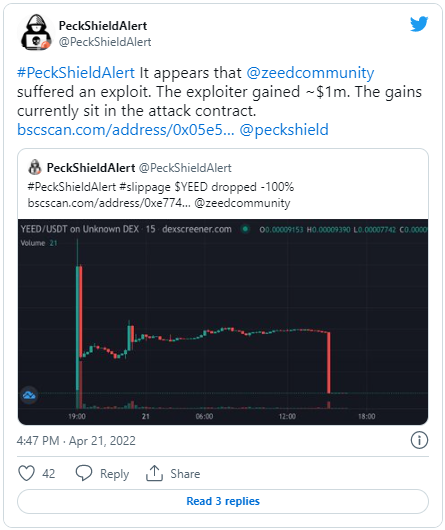
However the attacker was apparently so excited by their successful heist that they forgot to transfer over $1 million worth of stolen crypto out of their attack contract before they set it to self-destruct, permanently and irreversibly ensuring the funds can never be moved.
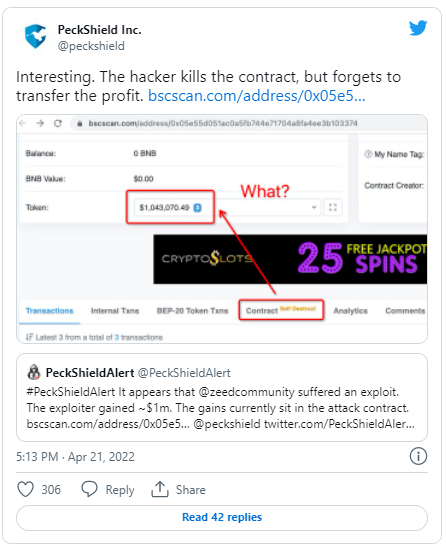
Using a blockchain scanner to view the attack contract address shows that $1,041,237.57 worth of BSC-USD Binance-Peg token is forever stuck in the contract and the successful self-destruction of the contract was confirmed at 7:15AM UTC on April 21.
It's one of the more bizarre turns of events since the Polygon hacker did an “Ask Me Anything” using embedded messages on Ethereum(ETH) transactions after stealing $612 million from the protocol in August 2021. The question and answer session revealed the attacker hacked “for fun” and thought “cross-chain hacking is hot.”
This latest hack is on the smaller end regarding the amount stolen, and other DeFi protocol hacks have seen hundreds of millions siphoned off as with the recent Ronin bridge hack where attackers made off with over $600 million.
Other notable DeFi exploits include the $80 million worth of crypto stolen from Qubit Finance in January where attackers tricked the protocol into believing they had deposited collateral, allowing them to mint an asset representing a bridged crypto.
DeFi marketplace Deus Finance was exploited in March when hackers manipulated the price feed of a pair of stablecoins resulting in the insolvency of user funds, netting the hackers over $3 million.


Lecturas Relacionadas

Bitcoin Trading Strategy Breakdown: Celebrity Predictions and Classic Models All Fail, Only These Four Indicators Remain

Analysis of Bitcoin Trading Strategies: Why Celebrity Forecasts and Classic Models Fail, Leaving Only These Four Reliable Indicators This analysis examines the failure of common Bitcoin prediction methods and identifies four reliable indicators for constructing a trading strategy. The author reviewed all major BTC prediction approaches from 2017-2025, categorizing them into three groups: celebrity price targets (consistently over-optimistic), analytical models like Stock-to-Flow (broken post-2022), and on-chain signals. The key finding is that more data often creates confusion, not clarity. The strategy discards unreliable elements: celebrity predictions (incentivized to be extreme), pure models (invalidated by post-ETF market changes), and the Fear & Greed Index used alone (too many false signals). Four reliable indicators were selected: 1. **MVRV Z-Score:** Accurately identifies cycle bottoms when entering its green zone (e.g., 2018, 2020, 2022). Note: Its ability to call tops is now ineffective post-2024. 2. **SOPR (28-day MA):** Consistently signals bottoms when below 1.0, indicating holders are selling at a loss. 3. **ETF Net Flow:** A crucial post-2024 metric showing institutional momentum (e.g., sustained inflows = buying). 4. **Macro Liquidity (Fed policy & M2):** Sets the overall directional bias (e.g., bullish during easing cycles). The core strategy involves waiting for a multi-signal共振 (resonance). For example, a bottom signal requires MVRV in the green zone + SOPR < 1.0. A top signal requires overheated on-chain data + sustained ETF outflows. Macro policy sets the overall direction. The Fear & Greed Index is only used as a weighted confirmatory signal, never alone. Action is only taken when three or more indicators align. The author automated this into a monitoring system that sends Telegram alerts only when signals trigger. As of the article's date (April 15, 2026), the system showed a strong bottom signal: extreme fear (F&G=12), MVRV in the buy zone, and SOPR < 1.0. The only contrary signal was weak ETF flows. Historically, such triple on-chain共振 has preceded 100%+ returns. The conclusion emphasizes building a personal framework over relying on external predictions, allowing for iterative improvement and customization based on individual risk tolerance.

marsbitHace 1 hora(s)

Bitcoin Trading Strategy Breakdown: Celebrity Predictions and Classic Models All Fail, Only These Four Indicators Remain

marsbitHace 1 hora(s)

Trading

Spot
Futuros
活动图片