147 Trillion vs 70 Billion: The Rise of On-Chain 'Risk Managers' and the Potential Dawn of a New Era in DeFi Asset Management

marsbitPublicado a 2026-05-21Actualizado a 2026-05-21

Resumen

"147 Trillion vs 70 Billion: The Rise of On-Chain 'Risk Managers' and the Potential Dawn of a New Era in DeFi Asset Management" Key Points: The role of professional asset managers is emerging in DeFi, ending the era where protocols and governance dictated everything. While early DeFi protocols like Aave and Compound bundled risk management within their code, innovations like Morpho have separated infrastructure from risk judgment. This allows specialized "Risk Managers" to operate independent lending vaults, acting as on-chain asset managers. The market, though early with ~$7B in assets under management (AUM), is rapidly consolidating around top performers like SteakhouseFi (RWA focus), SentoraHQ (AI-driven models), and Gauntlet (crisis management). This modular structure mirrors TradFi's division of labor: distributors (e.g., exchanges) source capital, Risk Managers design strategies and set standards, and underlying protocols handle custody and execution. For traditional asset managers, this familiar structure presents clear entry paths: 1) **Distribution**: Partnering with Risk Managers as a backend service. 2) **Supply**: Bringing real-world assets (RWA) on-chain as collateral. 3) **Operation**: Becoming a Risk Manager themselves (e.g., Bitwise). The core competency required is shifting from coding to traditional risk underwriting and financial expertise—areas where established institutions hold a natural advantage. While the current DeFi market (~$80B) is minuscule co...

Authored by: Tiger Research

Compiled by: AididiaoJP, Foresight News

The weight of DeFi lending is shifting from protocols to risk managers who possess the power of choice. Entering the market boils down to one decision: to borrow this judgment, to provide it, or to own it yourself.

Key Takeaways

  • The role of asset manager is emerging in DeFi. The era where protocols and governance decided everything is over.
  • The market is still early, but capital and distribution channels are starting to concentrate towards leading managers, whose track records are becoming institutional benchmarks.
  • There are three paths to entry: distribution (risk manager as backend), supply (bringing assets on-chain), and operation (becoming a risk manager).
  • The chosen path determines the level of control gained, the capabilities required, and the risks assumed.
  • The core question is not *whether* to enter DeFi, but *which* judgment calls to delegate and which to retain.

1. Risk Managers: On-Chain Asset Management Specialists
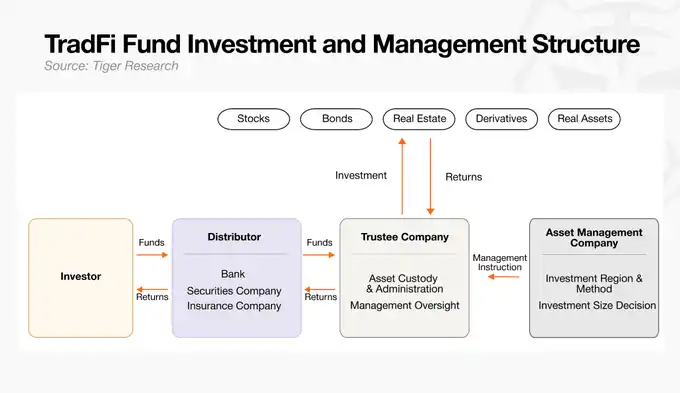
Just as traditional finance long ago separated judgment from execution, the crypto market has matured to a point where each function is handled by specialized players. The division of labor in TradFi is as follows:

  • Asset Manager: The "brain" of the fund, formulating strategies and issuing specific instructions to the custodian.
  • Custodian: Holds the assets, executes investments per the manager's instructions, and provides oversight.
  • Distributor: Distributes fund products to investors and raises capital.

The crypto market has corresponding roles. DeFi was initially designed to rely entirely on smart contract code, but over time it became clear that code alone cannot fully control on-chain risks.

To safely operate on-chain lending, a class of professionals specializing in assessing and coordinating complex risks emerged. They are called risk managers and have de facto taken on the role of asset managers within the on-chain ecosystem.

2. Early DeFi Had No Professionals
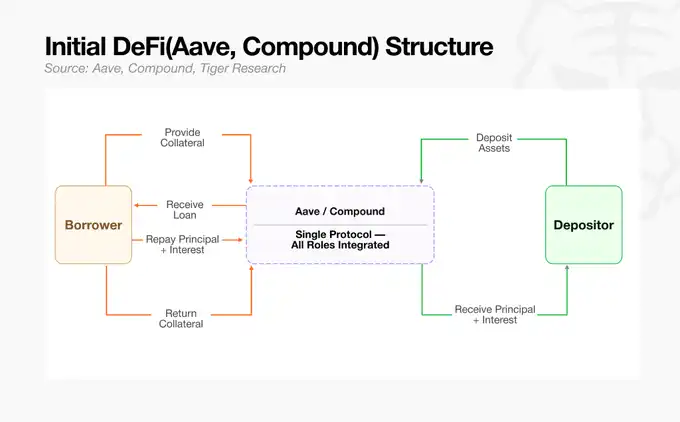
Early DeFi protocols like Aave and Compound bundled lending infrastructure and risk standards into a single structure. Risk managers existed back then, but because all assets were in one giant pool, their role was limited to being a "risk manager" at the system level, adjusting the protocol's overall risk parameters. As high-volatility assets flowed in, the single-pool design meant one bad asset could spread losses throughout the entire system. Someone had to manage this contagion risk.
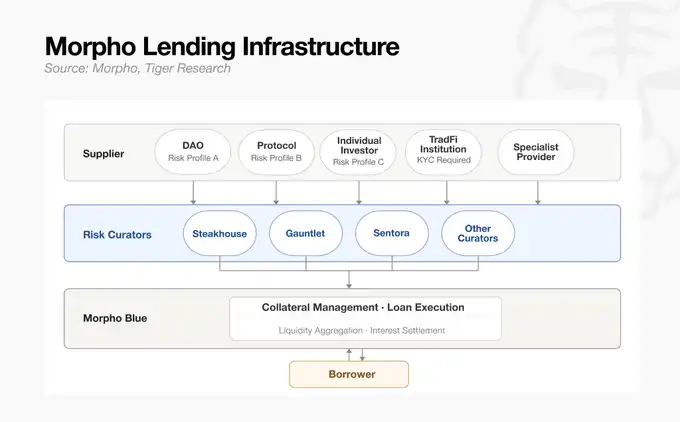
This changed with the advent of Morpho, which separated collateral assets and loan terms into independent markets. By replacing the single giant pool with a multi-vault structure, asset management strategies became modular, and the role of the risk manager transformed completely. They were no longer passive risk managers within a single protocol's fixed framework; they became external professionals able to design and operate independent lending vaults according to their own criteria.

With infrastructure and risk judgment fully separated, risk managers evolved from system-level risk managers into "asset managers" for the crypto market, actively operating multiple vaults.

3. Current Market Leaders
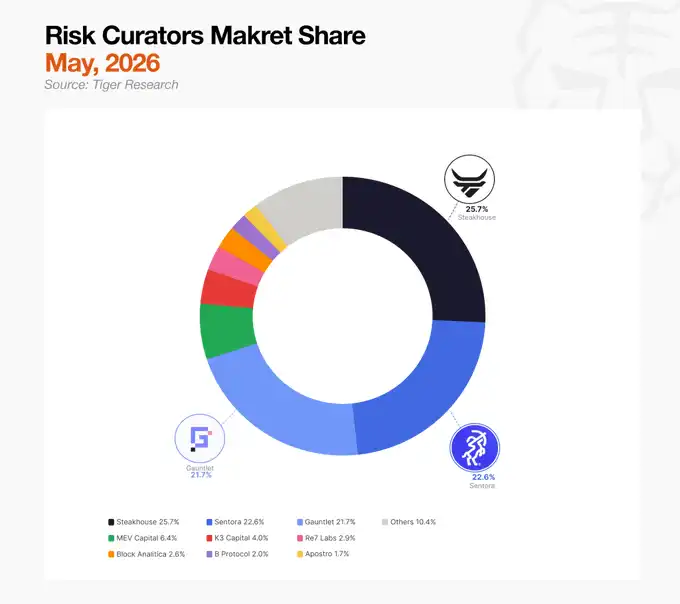
As of May 2026, the risk manager market manages roughly $70 billion in assets, with the top three teams accounting for 70% of that share. This market only truly entered the institutional arena in 2025, yet capital has quickly concentrated, indicating capital is chasing teams with reliable track records. The three leading teams reached the top via different paths:
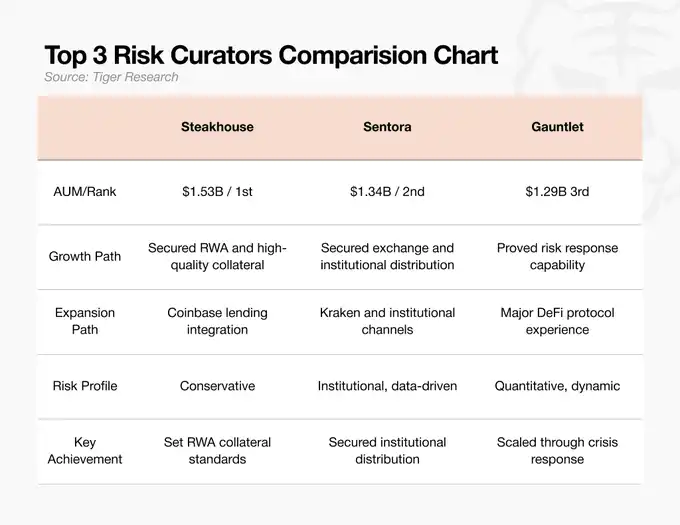
  • SteakhouseFi: A conservative risk manager leading the adoption of high-grade real-world assets (RWAs, like US Treasuries). As the backend for Coinbase's lending service, it unlocked distribution channels and currently ranks first in AUM ($15.3B as of Feb 2026). Beyond AUM, this team sets industry standards for which RWAs qualify as legitimate DeFi collateral.
  • SentoraHQ: A team built on AI risk models and institutional-grade data infrastructure. As Kraken's backend, it has secured institutional capital pipelines, ranking second in AUM ($13.4B). It won the channel connecting exchanges to institutional clients.
  • Gauntlet: Initially an on-chain quant analytics firm simulating risk parameters. In October 2025, when one of its vaults saw an influx of $775M, the team normalized collapsing APYs within 10 days, proving its capabilities. Ranking third in AUM ($12.9B), it is recognized as the strongest team in risk defense and crisis response to massive inflows.

At this stage, the risk manager market is no longer a simple TVL race but a competition to establish standards first: collateral standards, distribution channels, and risk response capabilities.

4. Traditional Asset Management vs. DeFi Risk Managers
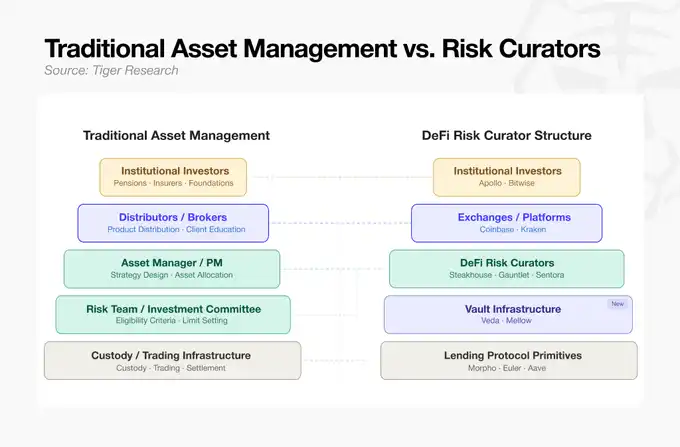
As Morpho fragmented the market, each collateral type required professional judgment. Specialist risk teams like Steakhouse entered as DeFi risk managers. Through this shift, DeFi began to approximate the traditional asset management process.

Reading the chart from top to bottom shows how today's DeFi infrastructure replicates the labor division of TradFi on-chain:

  • Capital Sourcing & Distribution (Top): Institutional investors are at the top as capital sources. Their large capital pools flow into the on-chain ecosystem via major CeFi exchanges and platforms, which assume the role of TradFi distributors (brokers).
  • Strategy Design & Risk Control (Middle): Below are the DeFi risk managers who decide how the incoming capital is managed. Analogous to TradFi asset managers' portfolio managers (PMs) and risk committees, they set asset eligibility criteria and limits and design the overall investment strategy.
  • Product Assembly & Custody (Bottom): The risk managers' strategies become investable on-chain products via the vault infrastructure below. At the very bottom are lending protocol primitives, which hold assets and execute settlements in code, replacing TradFi's custody and trading infrastructure.

From capital sourcing to management to custody, the entire workflow now mirrors the labor division of traditional finance. For traditional TradFi institutions, on-chain lending is no longer a foreign domain but a structured market with a familiar architecture, creating natural entry points.

5. A TradFi-Like Industry: Where Are the Opportunities?

As on-chain lending infrastructure adopts a labor division akin to TradFi asset management, the door is open for institutional entry. But not every layer has the same entry barriers.

  • Distribution Layer: The customer-facing, front-end market. Highly saturated, making it inefficient for TradFi institutions to compete head-on here.
  • Management Layer: An area driven entirely by financial expertise and human judgment. Assessing, controlling, and packaging asset risk is the core work of traditional asset managers. They can apply existing risk management capabilities to already-built, modular infrastructure without constructing complex systems, instantly gaining a business model.
  • Custody & Infrastructure Layer: Asset custody and transaction processing are technology-intensive, requiring deep blockchain engineering capabilities. It is unrealistic for TradFi institutions to build their own systems and compete here.

Unlike other layers requiring technical or platform-first advantages, the management layer presents the clearest window of opportunity where TradFi institutions can achieve market leadership using the very risk management capabilities they already possess.
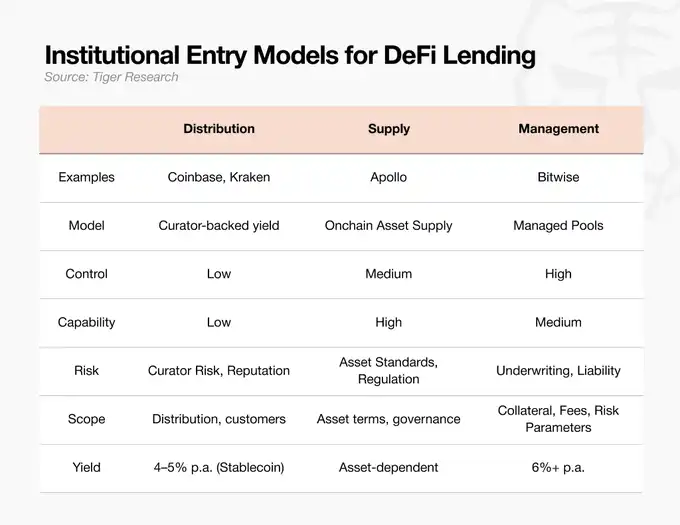
Institutions currently enter the DeFi market through three paths: distribution, supply, and operation. Regardless of the path chosen, the engine driving the market is the asset manager's "risk curation" ability.

Distribution: Risk Manager as Backend
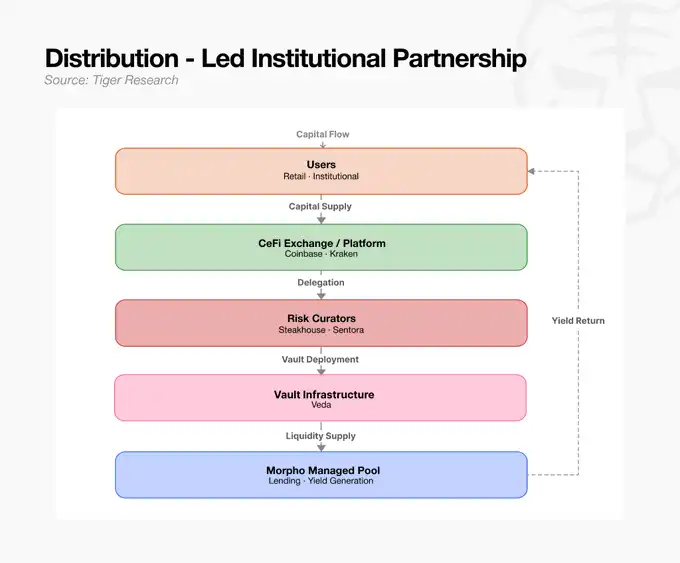
Connect with proven external risk managers as a backend for quick market entry. This suits exchanges and fintech companies with client channels but lacking internal management capabilities. Strategy is outsourced, but reputational risk and accountability for the chosen risk manager remain with the distributor.

This is the path chosen by centralized exchanges with strong client touchpoints but unwilling to directly manage the complexities of on-chain lending risk. They connect to proven external risk managers as backends and launch lending services. The exchange distributes large capital pools through its own platform, while collateral evaluation and risk management are entirely handed over to the partner risk manager.

Supply: Pushing Assets onto On-Chain Rails

Asset managers holding RWAs or credit assets directly supply these assets to the market. Like Apollo, they can acquire governance tokens of protocols like Morpho while supplying assets, thereby shaping infrastructure standards (e.g., collateral standards). The challenge lies in asset standardization and regulatory infrastructure development.

Large private equity funds or institutions holding real-world assets directly place their own capital on the on-chain rails. Apollo not only simply supplies assets but also acquired governance tokens of a major lending protocol. This move aims to push rules and standards so that its RWAs are recognized as superior, safer "official collateral" in the on-chain market.

But asset suppliers cannot arbitrarily register any asset as collateral. Someone must calmly assess whether the asset is truly safe and whether it can be liquidated immediately in an on-chain liquidation event. This requires the rigorous evaluation and endorsement capabilities of a risk manager. Ultimately, the supply path also must rely on the asset manager's risk validation capability to be viable.

Operation: Becoming a Risk Manager (Bitwise)
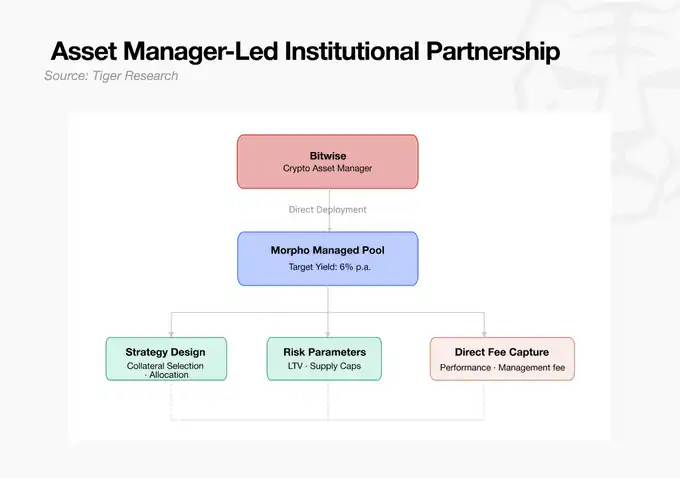
The asset manager designs its own strategy and operates its own vault. Bitwise defined on-chain vaults as "ETF 2.0" and entered directly. This path offers the strongest control over fees and collateral standards, but the manager bears full responsibility for operational failure. It suits asset managers with in-house risk teams.

This is the path where a traditional asset manager itself enters as a risk manager, without relying on external platforms. Bitwise defined the on-chain lending vault structure as "ETF 2.0" and entered the market directly. Leveraging its own portfolio construction capabilities and risk control systems, it designs and controls vaults itself, directly establishing a management fee model on-chain.

6. Before the Capital Arrives

Given the current trajectory, traditional asset managers are most likely to gain an advantageous position as on-chain lending matures. With the DeFi ecosystem's modularization and labor division, the capabilities truly needed by the market have shifted. Not the ability to write code, but the traditional financial expertise of underwriting collateral and setting risk limits. The competitive advantage of institutions with decades of experience can directly extend on-chain.

But today's DeFi market is still too small for global mega-managers. The global traditional asset management market is approximately $147 trillion, with BlackRock alone managing $14 trillion. In contrast, the entire DeFi market is around $80 billion, with the portion managed by risk managers at only $70 billion. This is merely 1/2000th of BlackRock's AUM.

Yet, it is precisely this massive scale gap that reveals the runway for growth. Institutional capital will not flow where risks are uncontrolled. Once risk managers lay secure on-chain rails for capital and regulatory frameworks take shape, the story changes. Even a tiny fraction flowing in from the $147 trillion could rapidly expand the $80 billion market.

Some opportunities exist only while the market is still small. Currently, the main players in the risk manager market can be counted on one hand. Institutions going on-chain need rails, and the teams that lay these rails first will set the standards.

Institutions entering later will find a safer, clearer market, but they will also become one of many players within already-established standards.


Preguntas relacionadas

QWhat fundamental shift is happening in DeFi lending according to the article?

AThe weight in DeFi lending is shifting from the protocols themselves to risk managers who possess decision-making power. The market is evolving from a model where protocols and governance decided everything to one where specialized asset manager roles are emerging.

QWhat are the three primary paths for traditional institutions to enter the DeFi market as described in the article?

AThe three primary entry paths are: 1. Distribution: Acting as a front-end and using proven external risk managers as the back-end. 2. Supply: Bringing real-world assets (RWA) on-chain as collateral. 3. Operation: Becoming a risk manager themselves by designing strategies and operating their own vaults.

QHow did the role of 'risk managers' in DeFi evolve, and what platform catalyzed this change?

AInitially, risk managers in protocols like Aave and Compound were limited to adjusting system-wide parameters within a single giant pool. Their role evolved fundamentally with the advent of Morpho, which introduced isolated markets and a multi-vault structure. This modularity allowed risk managers to become external professionals who design and operate independent lending vaults based on their own standards, effectively becoming crypto's 'asset managers'.

QAccording to the article, which layer of the DeFi lending stack represents the clearest opportunity window for traditional financial (TradFi) institutions and why?

AThe management layer represents the clearest opportunity. This layer is driven entirely by financial expertise and human judgment for assessing, controlling, and packaging asset risk—the core competency of traditional asset managers. Unlike the distribution or infrastructure layers, TradFi institutions can leverage their existing risk management capabilities on the already-built modular infrastructure without needing to develop complex technical systems.

QWhat key comparison does the article make to highlight the potential growth runway for DeFi asset management?

AThe article compares the massive scale of the traditional asset management industry (approximately $147 trillion) and a single giant like BlackRock ($14 trillion AUM) to the current size of the DeFi risk manager market (~$70 billion in AUM). This vast disparity shows the significant growth potential. Once risk managers establish safe on-chain 'rails' and regulatory frameworks mature, even a small fraction of the traditional capital flowing in could rapidly expand the DeFi market.

Lecturas Relacionadas

Blocked Its Own Treasure, WeChat AI Steps Up

Tencent's stock surged over 10% on June 2nd amid reports that WeChat, with 1.43 billion monthly users, is finalizing tests for a native AI Agent. The reported feature, accessible by swiping right from the main interface, allows users to issue commands in natural language. The AI then decomposes tasks and automatically calls upon relevant Mini Programs within WeChat to complete actions like ordering food, booking tickets, or making payments, creating a closed-loop service execution system. This strategic shift follows the internal conflict and subsequent "blocking" of Tencent's standalone AI app, Yuanbao, by WeChat for violating sharing rules during a 2026 Spring Festival promotion. The incident highlighted a lack of internal consensus and exposed the weakness of competing in the standalone AI assistant arena against rivals like ByteDance's Doubao (345M MAU) and Alibaba's Qianwen. The new WeChat AI Agent aims to leverage WeChat's unique assets—its massive user base, standardized Mini Program APIs, WeChat Pay, and identity system—to move from simple content generation to actual task execution. Analysts note this changes the competitive landscape from model benchmarks to which AI can connect to more real-world services. However, success depends on key variables: the capability of Tencent's underlying Hunyuan model, managing massive inference costs, and redesigning incentives for Mini Program developers whose traffic might be bypassed. The move is seen as an attempt to keep user service intent within WeChat's ecosystem as AI begins to redefine how users access services.

marsbitHace 55 min(s)

Blocked Its Own Treasure, WeChat AI Steps Up

marsbitHace 55 min(s)

ByteDance Adopts Arm CPUs, Jensen Huang: So Sad I Didn't Buy Arm

**Summary:** At Computex 2026, Arm CEO Rene Haas announced that ByteDance and Oracle have adopted Arm's self-designed Arm AGI data center CPU. The company expects significant revenue growth from this product, projecting $20 billion in demand for the 2027/2028 fiscal years. Haas noted that restricting AI-capable CPUs from the US to China is nearly impossible due to their widespread applications. Arm's stock has surged dramatically this year, notably rising 16% after NVIDIA's Arm-based Vera CPU and RTX Spark announcements. A highlight was the informal, humorous on-stage conversation between Haas and NVIDIA CEO Jensen Huang. Huang joked about NVIDIA's failed attempt to acquire Arm and playfully lamented selling his Arm shares. Both executives showed a clear sense of camaraderie and shared regret over the missed merger. Key technical topics were discussed: 1. **AI PC Design:** Huang explained NVIDIA's RTX Spark superchip (with a 20-core Arm CPU) is designed for future AI agents that will autonomously run and use tools on PCs, blending local and cloud processing. 2. **Agent vs. OS:** Huang emphasized the operating system remains crucial, as AI agents rely on its APIs and tools to function. 3. **Growth Constraints:** He identified the shift to "useful AI" that generates profitable tokens as a primary driver for immense, almost limitless, computational demand. Haas outlined Arm's strategy across PC and data centers. For PCs, Arm collaborates with partners like NVIDIA and MediaTek, offering its compute subsystem (CSS) for custom SoCs. In data centers, its Arm AGI CPU (built on TSMC's 3nm process) has gained major partners including OpenAI, Meta, and now ByteDance and Oracle. Arm presented a multi-year roadmap for its in-house CPU line. The article concludes that while GPUs dominated the AI training race, the explosion of AI agents is shifting significant focus to CPUs for inference, state management, and tool orchestration. The industry is trending towards vertical integration, with companies like cloud providers designing chips and chip/IP firms offering full solutions, all competing to deliver more efficient computing per watt.

marsbitHace 1 hora(s)

ByteDance Adopts Arm CPUs, Jensen Huang: So Sad I Didn't Buy Arm

marsbitHace 1 hora(s)

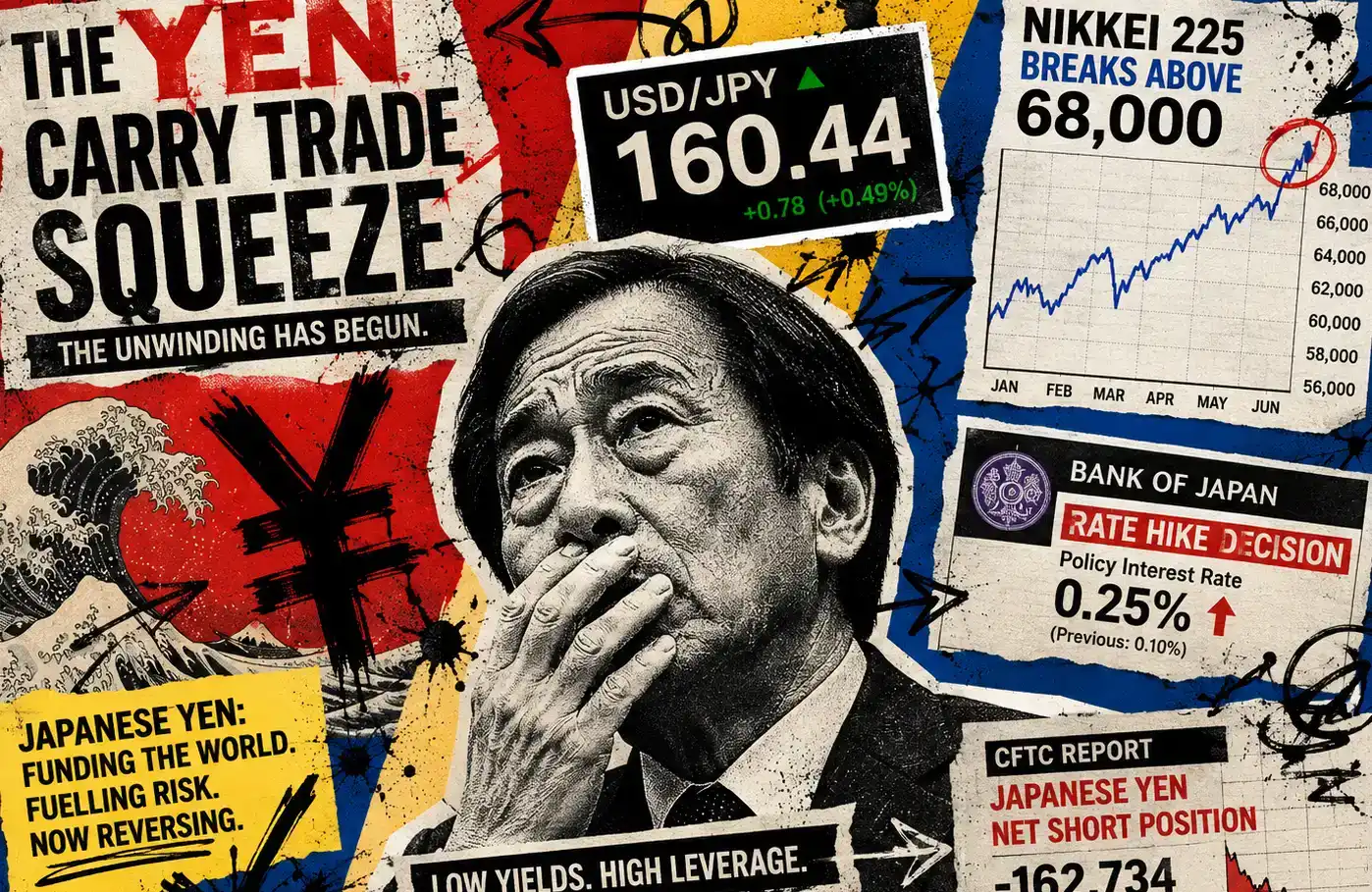
New Wall Street Play: Yen Shorts Still Adding, But Japan Stocks Don't Rely on Carry Trade Unwinding

On June 3rd, USD/JPY hit 160.44, its highest level since July 2024, while the Nikkei 225 surged past 68,000 points. Contrary to popular narratives of an imminent "carry trade unwind" akin to August 2024, data reveals a more complex picture. Speculative net short positions in yen futures have actually increased, reaching -114,667 contracts by late May, suggesting traders are doubling down rather than retreating. Meanwhile, Japan's Finance Ministry conducted its largest-ever single-round FX intervention (11.73 trillion yen) in April-May but failed to hold the 160 yen line. The Nikkei's rally is not driven by carry trade dynamics. Foreign investors are aggressively buying Japanese stocks, with net purchases in 2026 running nearly 16 times higher than 2025 levels. This inflow is concentrated in AI and semiconductor-related stocks like SoftBank and Socionext, fueled by positive sector outlooks, rather than being a flight from unwinding yen shorts. Furthermore, the Nikkei has continued climbing despite the Bank of Japan's (BOJ) rate hikes to 0.75%. This disconnect exists because the current equity boom is fueled by AI-driven foreign investment, not reliant on cheap yen funding. However, this relationship remains fragile. Should the BOJ hike rates further (e.g., to 1.0%) while dollar weakness increases carry trade costs, the trajectories of the yen and Japanese stocks could reconverge, potentially triggering volatility.

marsbitHace 1 hora(s)

New Wall Street Play: Yen Shorts Still Adding, But Japan Stocks Don't Rely on Carry Trade Unwinding

marsbitHace 1 hora(s)

Broadcom's Q3 Guidance Misses Expectations by $12 Billion, After-Hours Trading Plummets Over 13%, AI Narrative "Cooling"?

On June 3, Broadcom released record Q2 FY26 results with revenue of $22.19B, up 48% YoY, and AI chip sales of $10.8B, up 143%. Adjusted EPS of $2.44 beat estimates. However, its Q3 AI semiconductor revenue guidance of $16B, while up over 200% YoY, fell roughly $1.2B (7%) short of analyst consensus expectations of $17.2B. This miss, coupled with slightly weaker-than-expected software revenue, triggered a severe market reaction. CEO Hock Tan maintained the FY26 AI revenue outlook of over $100B but did not raise it, disappointing investors who had priced in more robust growth. The stock plummeted over 13% in after-hours trading, erasing roughly $270B in market cap. The sell-off extended to peers like Marvell. A key concern for markets, particularly for Chinese optical module suppliers, was Tan's comment that the contribution of AI networking (e.g., Ethernet switches, optical interconnect chips) to AI revenue, currently near 40%, is expected to normalize to around 30% over time, signaling a potential peak in growth for that segment. Despite the guidance shortfall, Tan reiterated that AI demand remains "insatiable" and reaffirmed the long-term target of exceeding $100B in AI revenue by FY27. The reaction highlights the heightened sensitivity and premium valuation placed on AI-exposed stocks, where anything less than stellar guidance can prompt significant profit-taking. The broader question is whether this represents a cooling AI narrative or a correction in overstretched valuations.

marsbitHace 1 hora(s)

Broadcom's Q3 Guidance Misses Expectations by $12 Billion, After-Hours Trading Plummets Over 13%, AI Narrative "Cooling"?

marsbitHace 1 hora(s)

Trading

Spot
Futuros

Artículos destacados

Cómo comprar ERA

¡Bienvenido a HTX.com! Hemos hecho que comprar Caldera (ERA) sea simple y conveniente. Sigue nuestra guía paso a paso para iniciar tu viaje de criptos.Paso 1: crea tu cuenta HTXUtiliza tu correo electrónico o número de teléfono para registrarte y obtener una cuenta gratuita en HTX. Experimenta un proceso de registro sin complicaciones y desbloquea todas las funciones.Obtener mi cuentaPaso 2: ve a Comprar cripto y elige tu método de pagoTarjeta de crédito/débito: usa tu Visa o Mastercard para comprar Caldera (ERA) al instante.Saldo: utiliza fondos del saldo de tu cuenta HTX para tradear sin problemas.Terceros: hemos agregado métodos de pago populares como Google Pay y Apple Pay para mejorar la comodidad.P2P: tradear directamente con otros usuarios en HTX.Over-the-Counter (OTC): ofrecemos servicios personalizados y tipos de cambio competitivos para los traders.Paso 3: guarda tu Caldera (ERA)Después de comprar tu Caldera (ERA), guárdalo en tu cuenta HTX. Alternativamente, puedes enviarlo a otro lugar mediante transferencia blockchain o utilizarlo para tradear otras criptomonedas.Paso 4: tradear Caldera (ERA)Tradear fácilmente con Caldera (ERA) en HTX's mercado spot. Simplemente accede a tu cuenta, selecciona tu par de trading, ejecuta tus trades y monitorea en tiempo real. Ofrecemos una experiencia fácil de usar tanto para principiantes como para traders experimentados.

369 Vistas totalesPublicado en 2025.07.17Actualizado en 2026.06.02

Cómo comprar ERA

Discusiones

Bienvenido a la comunidad de HTX. Aquí puedes mantenerte informado sobre los últimos desarrollos de la plataforma y acceder a análisis profesionales del mercado. A continuación se presentan las opiniones de los usuarios sobre el precio de ERA (ERA).

活动图片