SEC, CPI and a ‘strong rebound’ — 5 things to know in Bitcoin this week

CointelegraphPublicado a 2023-06-13Actualizado a 2023-06-13

Resumen

Bitcoin faces a week full of potential price triggers — both up and down — as BTC price action drops below a major trend line.

Bitcoin starts a “massive” week in a precarious position as key support stays out of reach for bulls.

After fresh losses across crypto markets over the weekend, BTC/USD closed the week below $26,000 for the first time in three months.

Both Bitcoin and altcoins continue to struggle thanks to legal battles raging in the United States and their impact on market sentiment.

Fragile markets will now encounter a slew of volatility triggers, however, as U.S. macro data releases accompany the next steps in the crypto legal debacle.

In what promises to be five days full of surprises, traders will likely experience none of the lackluster sideways price action characteristic of crypto markets before the recent upheaval.

How will the coming week shape up? Cointelegraph looks at the major things to consider when it comes to Bitcoin and wider crypto market price action.

Bitcoin loses key trend line, but some remain bullish

Bitcoin’s price closed the weekly candle in a disappointing position thanks to last-minute downside wiping value from crypto as a whole.

The removal of various altcoins by certain trading platforms concerned about U.S. legal ramifications sent prices tumbling, leading BTC/USD to its lowest weekly close since mid-March, data from Cointelegraph Markets Pro and TradingView shows.
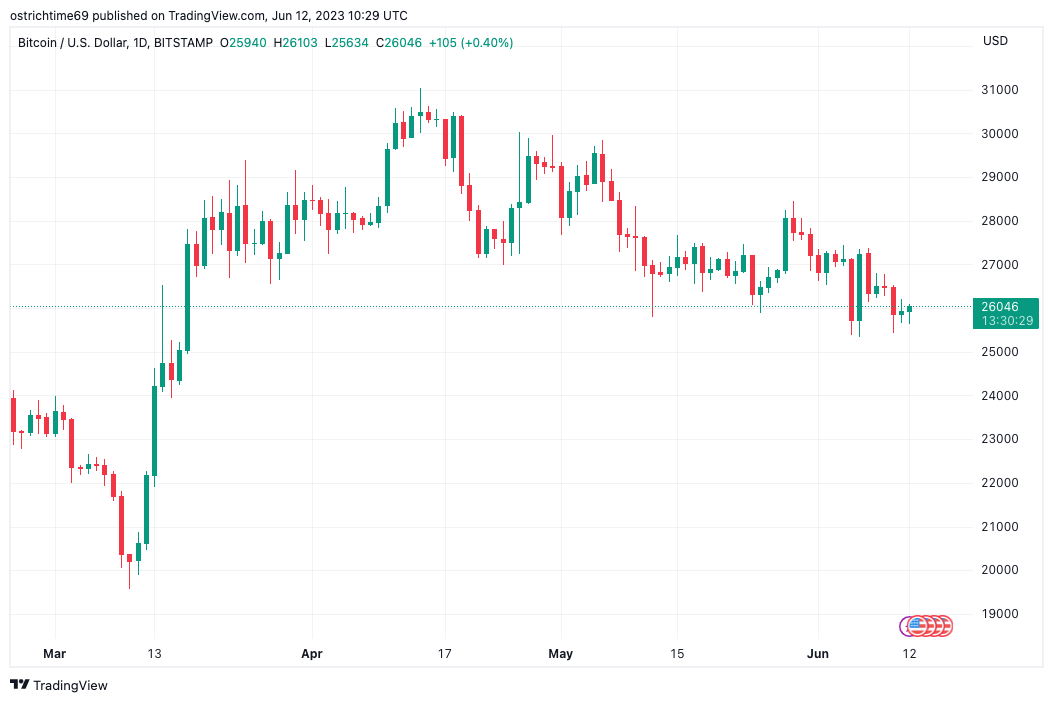
BTC/USD 1-day candle chart on Bitstamp. Source: TradingView

In doing so, the pair also locked out the 200-week moving average (MA) as support.

“A BTC Weekly Candle Close below the 200-week MA could confirm it as a lost support,” trader and analyst Rekt Capital warned beforehand.

“In that case, $BTC could relief rally into the MA next week, potentially to flip it into new resistance. This sort of turn of technical events could precede additional downside.”

BTC/USD annotated chart. Source: Rekt Capital/Twitter

Michaël van de Poppe, founder and CEO of trading firm Eight, held similar concerns about the fate of the total crypto market cap.

Lecturas Relacionadas

Japanese Rates Return to 1996 Levels, Can Bitcoin Withstand the September Rate Hike?

Japanese borrowing costs have hit their highest levels since 1996, with yields on 30-year bonds reaching 4.185%. This marks a significant shift for a country long reliant on negative rates. Concurrently, Bitcoin surged 22% past $80,000, seemingly decoupled from the bond market turmoil. Historically, the massive yen carry trade has fueled global risk assets, predicated on near-zero Japanese rates. This assumption is now challenged. A potential rate hike by the Bank of Japan in September could strengthen the yen, forcing carry trade unwinds and potentially triggering a global deleveraging event, as seen in August 2024 when Bitcoin fell sharply. Conversely, if the yen weakens further, Bitcoin could attract Japanese investors as a hedge against currency depreciation and the country's massive debt burden. Institutional adoption in Japan is growing, with regulatory changes paving the way for potential crypto ETFs by 2027. The key variable is the BoJ's September policy signal. If it hints at a rapid tightening cycle to combat inflation and support the yen, risk assets like Bitcoin may face selling pressure from carry trade liquidation. However, if debt sustainability concerns limit its hawkishness, leading to a weaker yen, Bitcoin could benefit. Currently, the market is betting on a slow-motion debt crisis, not a sudden collapse. While Bitcoin shows resilience, its fate remains tied to the direction of the yen and the scale of any carry trade unwind.

marsbitHace 3 min(s)

Japanese Rates Return to 1996 Levels, Can Bitcoin Withstand the September Rate Hike?

marsbitHace 3 min(s)

How Can Bitcoin Resist Quantum Computers? A Comparison of Three Lattice-Based Signature Schemes

"Bitcoin's Quantum Defense: A Comparison of Three Lattice-Based Signature Schemes" by the Blockstream Research Team explores how Bitcoin can transition to quantum-resistant digital signatures, as current schemes like Schnorr and ECDSA are vulnerable to quantum computers. The report evaluates three lattice-based signature candidates—Dilithium, Falcon, and Hawk—against criteria like on-chain cost (key/signature size), implementation complexity, deployment risks, and support for Bitcoin's key derivation standard (BIP-32). The analysis recommends a minimum Security Level 3 for Bitcoin due to its long-term security needs. Dilithium (ML-DSA) is praised for its simplicity and integer-only operations, making it easier to implement securely, but it has the largest signature size (~5.3 KB for Level 3). Falcon (FN-DSA) offers the most compact signatures (e.g., ~3.1 KB for Level 5) and the fastest verification, though its signing requires complex floating-point sampling—a solvable engineering challenge. Hawk, despite its small size, was withdrawn from NIST standardization after a security vulnerability was discovered, highlighting the importance of conservative security margins. Currently, neither Dilithium nor Falcon has a fully viable, production-ready BIP-32 key derivation method. The report concludes that if a lattice-based scheme had to be chosen now, Falcon-1024 would be the preferred option for its balance of size, speed, and mature security assumptions. However, the short-term recommendation remains hash-based signatures (like SPHINCS+) for their lower risk, with a potential future hybrid or full transition to Falcon once its standard (FN-DSA) is finalized and well-supported.

marsbitHace 5 min(s)

How Can Bitcoin Resist Quantum Computers? A Comparison of Three Lattice-Based Signature Schemes

marsbitHace 5 min(s)

Trading

Spot
活动图片