Coin price today 06/05: Bitcoin continues to close the week in the red, Altcoin rise slightly as US stocks are almost flat

Tap Chi BitcoinPublicado a 2023-06-05Actualizado a 2023-06-06

Resumen

Bitcoin continues to print a red weekly candle following the previous weekend's bull run. The market-leading asset closed the first week of June in the red at $27,115, with a 3.38% drop.
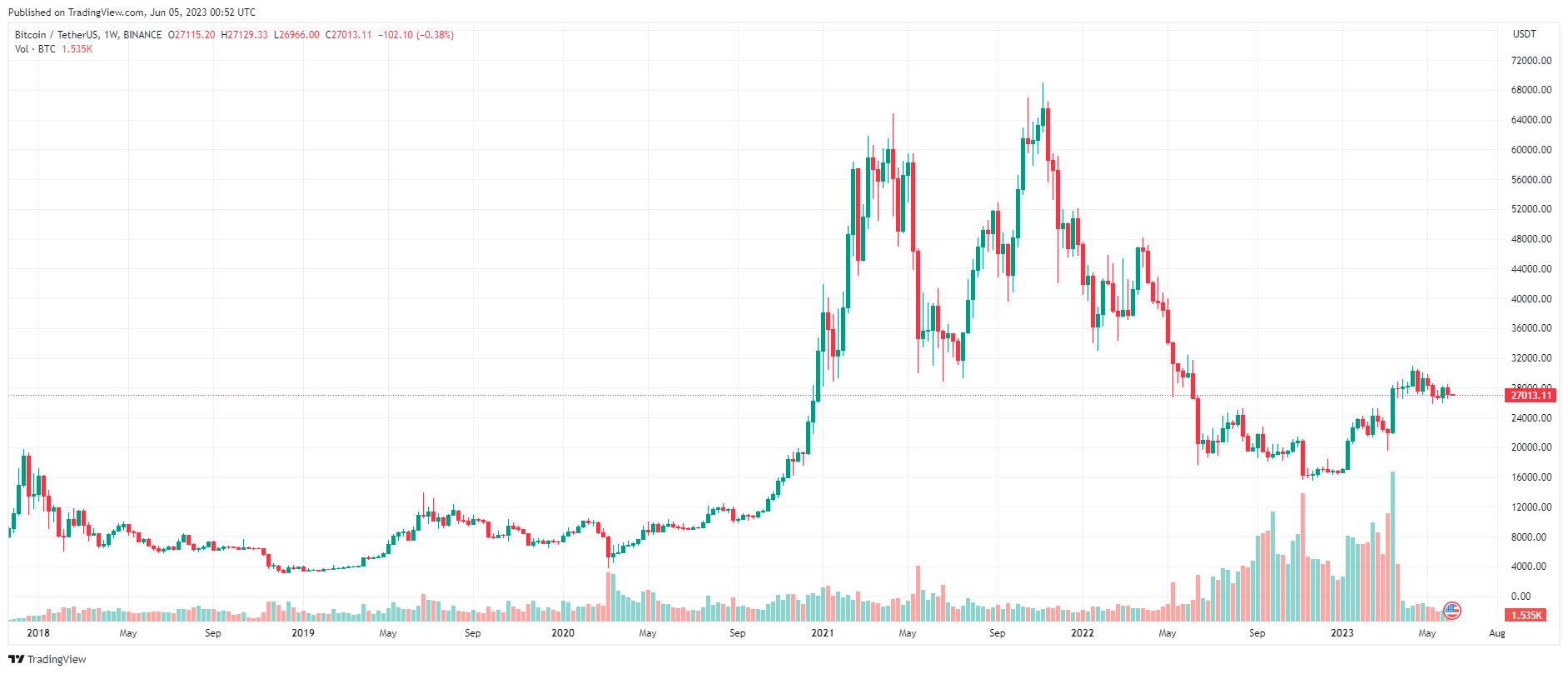
Bitcoin continues to print a red weekly candle following the previous weekend's bull run. The market-leading asset closed the first week of June in the red at $27,115, with a 3.38% drop.

BTC Price Chart – 1 week | Source: TradingView

U.S. stock market futures were little changed on Sunday night after a broad-based rally last week, sending the S&P 500 to its best week since March and a peak since last August.

Dow Jones futures contract increased by 75 points; S&P 500 futures edged up 0.09% and Nasdaq-100 futures were mostly flat.

On Friday, stocks rallied at the weekend following strong May jobs data. The Dow rose 701.19 points, or 2.12%, marking its best day since January, to close. week at 33,762.76. The S&P 500 rose 1.45% to 4,282.37, while the Nasdaq Composite jumped 1.07% to 13,240.77, posting a sixth straight week of gains.

Over the weekend, President Joe Biden signed into law the debt ceiling bill, preventing the possibility of defaulting on the US government's debt.

Investor sentiment was good on Friday, after the Labor Department reported nonfarm payrolls growth in May. Public and private sector employment rose 339,000 in May, Compared to the Dow Jones estimate of 190,000, average hourly earnings grew at an annualized rate of 4.3%, slightly below economists' forecasts. The report also allayed fears of an impending recession.

What's more, investors are focused on whether the stock market is on track to recover in 2023, led by just a handful of tech stocks, and whether the market could form a medium correction. term or not.

Meanwhile, after a tense first-quarter earnings month, things should calm down next week. Investors will XEM at food demand and prices from JM Smucker, Campbell Soup and United Natural Foods. Stitch Fix, Signet Jewelers and DocuSign will also conduct income statements.

In terms of economic data, traders will keep an eye on PMI data for May from both the Institute of Supply Management and S&P Global on Monday, as well as factory orders and durable goods for April. On Monday On Wednesday, the Mortgage Bankers Association will release the latest data on home loan applications.

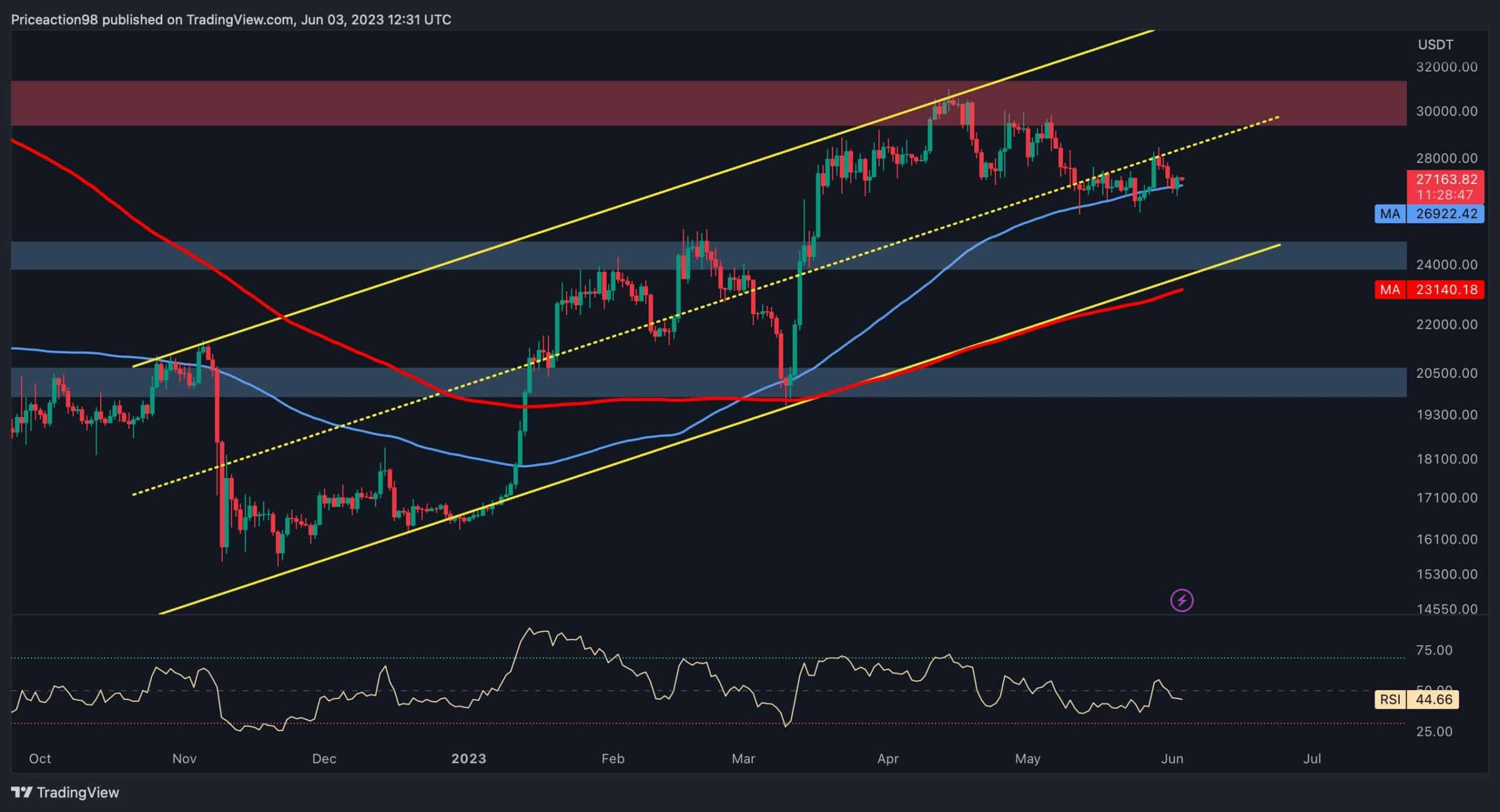
Bitcoin price is currently going through an accumulation phase and has touched the 100-day moving average at $26,922. However, two key support areas ahead are likely to halt the ongoing decline and trigger the next rally.

During the accumulation phase, BTC dipped slightly below the middle trendline of the ascending channel and tested it as a pullback. However, the price continued its downtrend by printing small red candles in a row and temporarily pausing at the 100-day moving average around $26,900.

A drop below this level, the lower threshold of the channel at $24,000 and the 200-day moving average at $23,000 could be potential price targets.

On the other hand, if Bitcoin finds support at the 100-day moving average, an attempt to break above the stiff $30,000 resistance will be the most likely scenario.
Source: TradingView

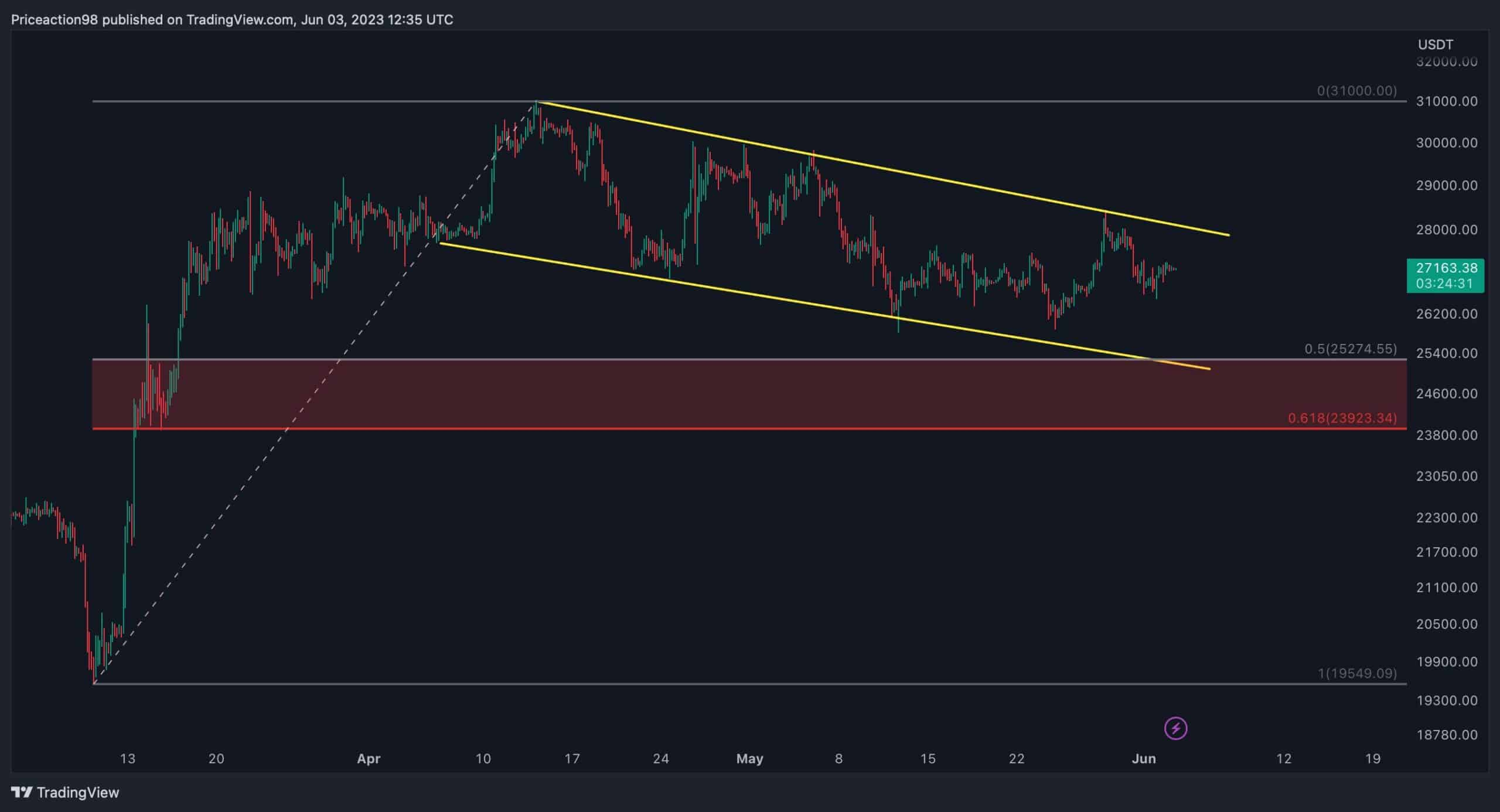
Analyzing the 4-hour time frame, a flag pattern was developed during the recent correction of the market. BTC price is currently consolidating within this flag, forming lower highs and lower lows.

However, there is a strong support area between the 61.8% ($23,923) and 50% ($25.274) levels of the Fibonacci retracement level. These two Fibonacci levels indicate potential targets for corrective periods. Given the current market situation, it is likely that the price will continue to correct until it reaches this important support area.
Source: TradingView

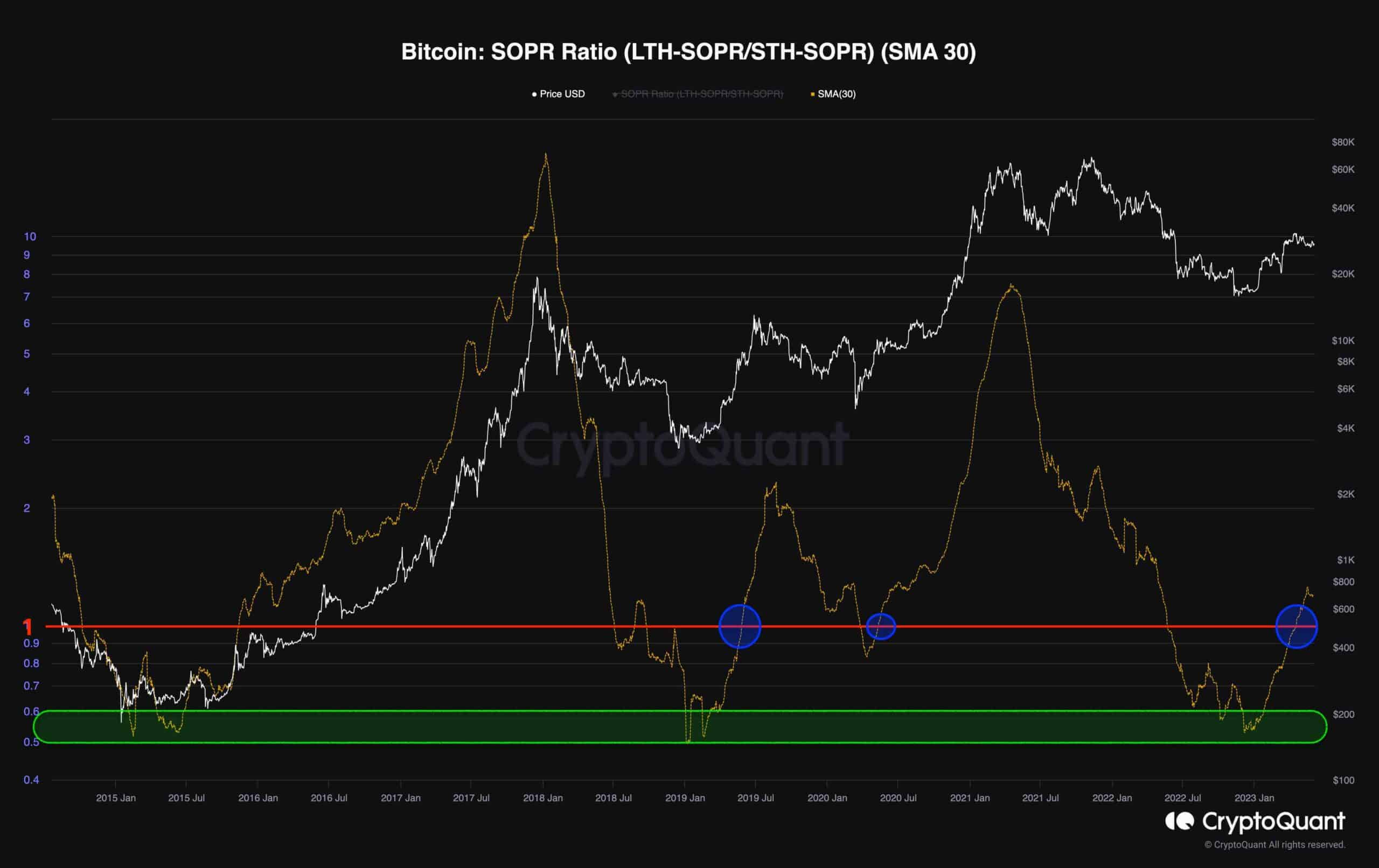
The following chart shows the SOPR ratio along with Bitcoin price since the 2015 Bearish. It has consistently signaled long-term investment opportunities, as in the previous two bearish cycles in 2015 and 2019.

This ratio hit its lowest level since 2019, around 0.53, in December 2022, indicating the beginning of a bull phase in the market. It is currently experiencing an uptrend, crossing 1, which coincides with successful bull runs in the crypto market.

While it is uncertain whether the bull market is over, as long as the SOPR ratio remains above 1, buyers are likely to continue to prevail.
Source: CryptoQuant

Despite BTC closing the first week of June in the red, the Altcoin market is still struggling to maintain slight gains in the short-term.

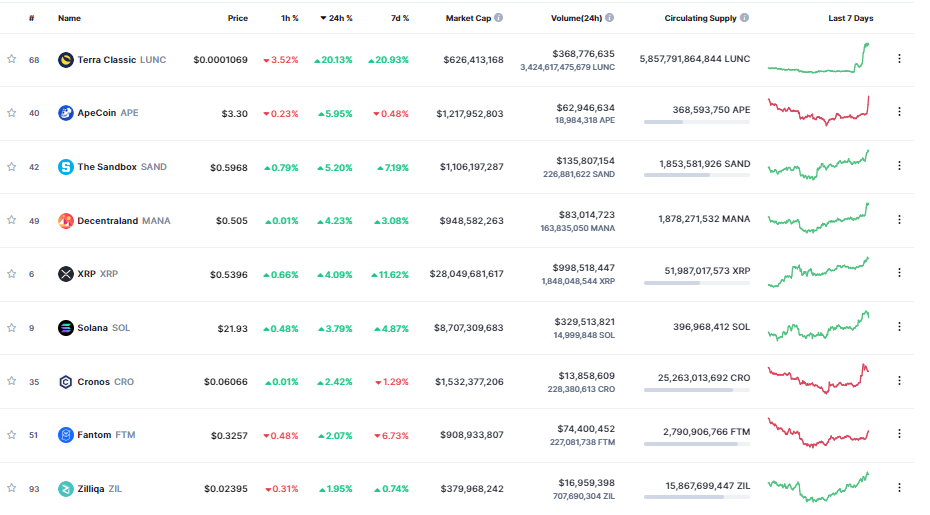
The most prominent of the day was Terra Classic (LUNC), when the token price jumped more than 20% in just 24 hours. This increase was mainly due to increased buying pressure, pushing LUNC 's market capitalization to $626 million, with over $138 million flowing into the project in just one day.

Other Altcoin such as ApeCoin (Ape), The Sandbox (SAND), Decentraland (MANA), XRP (XRP), Solana (SOL), Cronos (CRO), Fantom (FTM), Ziliqa (ZIL)… increased slightly from 2- 6%.
Source: Coinmarketcap

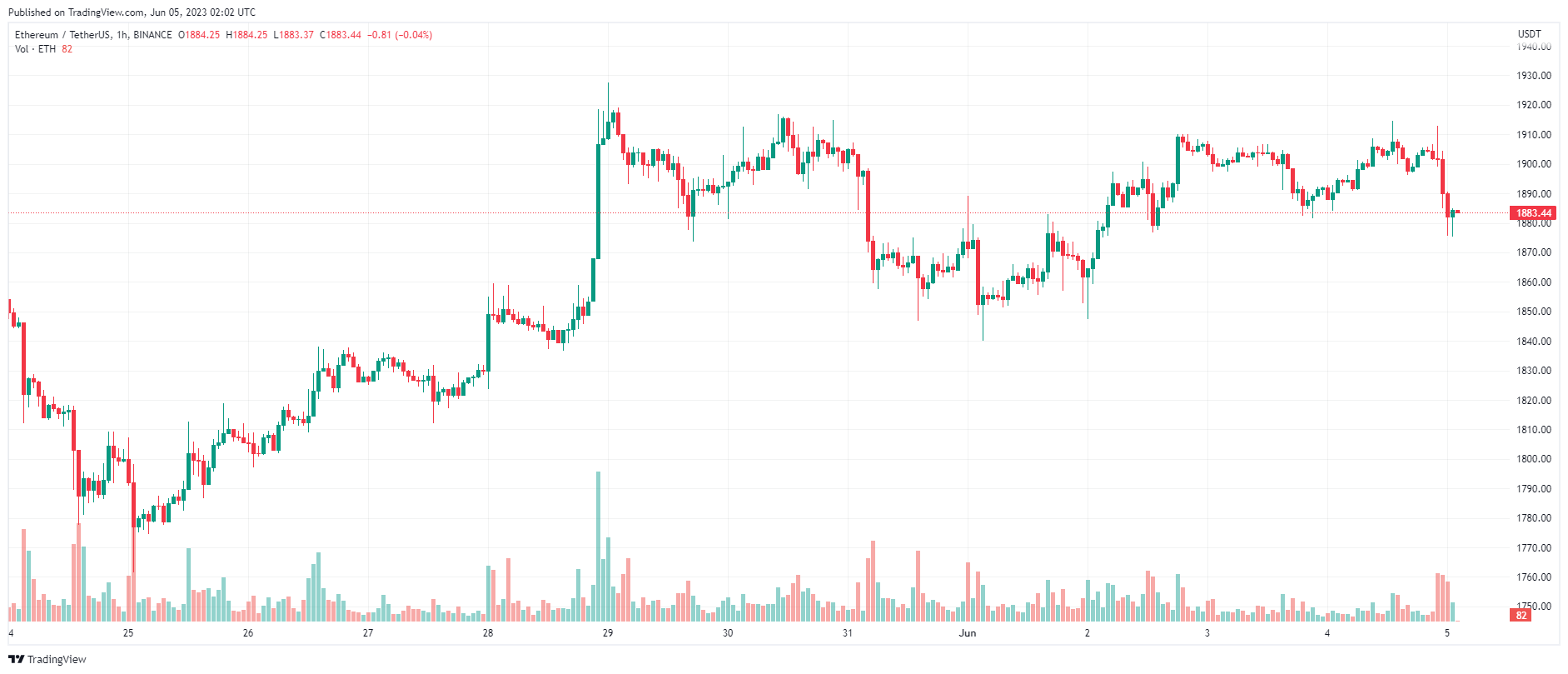
Ethereum (ETH) turned bearish, establishing a local intraday bottom at $1,877 after failing to sustain above $1,900. The project with the second largest market capitalization also ended the week in the red, ending the streak of 2 consecutive weeks of growth since mid-May.
ETH price chart – 1 hour | Source: TradingView

Lecturas Relacionadas

Jensen Huang: Prompts are Becoming Obsolete, Loops are the New Paradigm

Jensen Huang, alongside AI leaders like Peter Norvig, Boris Cherny, and Andrew Ng, is advocating for a shift from "prompt engineering" to "loop engineering" as the new paradigm for AI development. Instead of manually crafting individual prompts, the focus is now on designing autonomous loops—systems where AI agents execute tasks, self-validate results, and iterate until completion without constant human oversight. A loop is a management framework that enables agents to operate independently. Key implementations are seen in Claude Code (with features like /loop, /goal, and /schedule) and OpenAI Codex, which employ multiple agents working in parallel within isolated environments. A core principle is the separation of roles: one agent (or model) performs the task, while an independent agent (or a smaller, separate model) validates the output to ensure objectivity. The article outlines a practical roadmap for implementing loops, starting with a "four-condition test" to assess suitability, building a minimal viable loop, and emphasizing critical pitfalls to avoid, such as lacking hard stop conditions or allowing loops to handle tasks requiring human judgment. This evolution is framed as the fourth major shift in AI interaction: from Prompt Engineering (crafting instructions) to Context Engineering (providing background information), then to Harness Engineering (building tool-enabled environments), and finally to Loop Engineering (creating self-sustaining systems). This progression reflects a consistent trend of increasing abstraction, moving human involvement from direct instruction to system design and rule-setting. The concept has academic roots in frameworks like ReAct, which formalized the "reason-act-observe" cycle. While loop engineering promises greater automation, experts caution about managing token costs and warn against outsourcing understanding—AI can assist, but deep problem comprehension remains essential.

marsbitHace 38 min(s)

Jensen Huang: Prompts are Becoming Obsolete, Loops are the New Paradigm

marsbitHace 38 min(s)

GPT Designs GPT

OpenAI has unveiled its first custom AI chip, Jalapeño, a move signaling a strategic shift beyond being a mere model company. While many see it as a challenge to NVIDIA, its core aim is to control the entire intelligent production pipeline—from models and chips to data centers and energy. The key driver is the evolving competitive landscape: model advantages are shrinking, while the computational gap in areas like cost-per-token, system throughput, and energy efficiency is becoming the true long-term barrier. Jalapeño is primarily an inference chip, targeting the massive and growing "inference tax"—the daily operational cost of generating tokens for services like ChatGPT and APIs. By designing its own hardware optimized for its specific workloads and future product roadmaps (even using AI to aid the chip design process), OpenAI aims to drastically reduce token generation costs and improve system efficiency. This creates a potential flywheel: better models help design better chips, which lower costs for running next-generation models, supporting more users and products, which in turn provides more data to refine future chips. The strategy mirrors Apple’s integrated approach, building a closed loop where hardware, software, and applications are co-optimized. In the long term, OpenAI is not trying to become the next NVIDIA (a supplier of "shovels" to all AI companies) but to own and operate the entire "mine"—selling the end product of intelligence itself. This move marks OpenAI's ambition to evolve from creating the smartest models to controlling the foundational infrastructure of AI production.

marsbitHace 1 hora(s)

GPT Designs GPT

marsbitHace 1 hora(s)

Ethereum Foundation Interim Executive Director Speaks Out: What Is Our Mission?

The Ethereum Foundation's core mission is to ensure Ethereum remains a truly permissionless, censorship-resistant, private, and open infrastructure for large-scale, sovereign coordination. The article clarifies the EF's focus and dismisses irrelevant objectives, such as pursuing institutional popularity or short-term speculation. Its core work centers on eliminating systemic weaknesses. This involves fortifying Ethereum across multiple layers—protocol, access, user, and institutional—against exploitation, control, or surveillance. Key initiatives include minimizing harmful MEV and preventing privileged control over transaction flow, making unconditional privacy a foundational default, ensuring staking remains permissionless and decentralized, and strengthening user-facing access points to uphold autonomy. Concurrently, the EF aims to seize strategic opportunities. These include leading the transition to post-quantum cryptography, achieving a fully verifiable protocol stack, establishing Ethereum as private digital cash, integrating user-owned AI agents with personal wallets, and demonstrating that trusted-neutral infrastructure can competitively handle disintermediated coordination at an institutional scale. The article also addresses recent organizational changes, stating that personnel departures were due to strategic realignment, role fit, or natural evolution. It clarifies the approach to spin-outs, emphasizing that external funding will be provided only for work critical to the EF's mission that reduces Ethereum's dependency without creating new risks or mission drift. Ultimately, the EF is committed to building an enduring, neutral system that reshapes global coordination, focusing relentlessly on the principles of censorship resistance, openness, privacy, and sovereignty (CROP).

链捕手Hace 1 hora(s)

Ethereum Foundation Interim Executive Director Speaks Out: What Is Our Mission?

链捕手Hace 1 hora(s)

Trading

Spot
Futuros
活动图片