随着香港为散户投资者开放加密货币交易,比特币跃升至关键价格阻力位

CoindeskPublicado a 2023-05-24Actualizado a 2023-05-24

Resumen

由于香港表示散户投资者可以从 6 月 1 日起交易数字资产,比特币 ( BTC ) 周二早盘升至关键价格阻力位。

由于香港表示散户投资者可以从 6 月 1 日起交易数字资产,比特币 ( BTC ) 周二早盘升至关键价格阻力位。

香港证券及期货事务监察委员会 (SFC) 宣布将从 6 月 1 日起接受交易所向散户投资者提供加密货币交易的申请,并补充说获批的代币需要有 12 个月的业绩记录和可观的市值。证监会表示,注册交易所将被禁止提供稳定币和生息工具。

该公告符合长期以来的预期,即亚洲的发展将促进下一次加密货币牛市,并与西方,尤其是美国缺乏规律性形成鲜明对比

比特币在亚洲时段上涨超过 2% 至 27,500 美元,试探了连接头肩 (H&S) 形态第一和第二波谷的水平趋势线的前支撑转阻力位。本月初,该加密货币跌破趋势线,证实了 H&S 的崩溃,并为进一步下滑至 25,000 美元打开了大门。

“这看起来像是一个与宏观无关的基于现货的举动,而且时间恰逢香港将从 6 月 1 日起允许在许可数字资产平台上进行BTC和ETH零售交易的消息,”Noelle Acheson,作者Crypto Is Macro Now 通讯,在周二的版本中说。 “这并不完全出人意料——裁决和时间安排在很大程度上是意料之中的。但在一个低迷的市场中,由于来自其他方面的不利因素, 确认更为重要,”艾奇逊补充道。

Per Acheson 表示,香港为散户投资者开绿灯加密货币交易的决定并不意味着对加密货币的需求会大量涌现,因为本地交易商可能已经通过离岸场所进入市场。尽管如此,艾奇逊指出,该公告是“一个受欢迎的提醒,即加密货币采用池在明年及以后可能会大幅增长”。
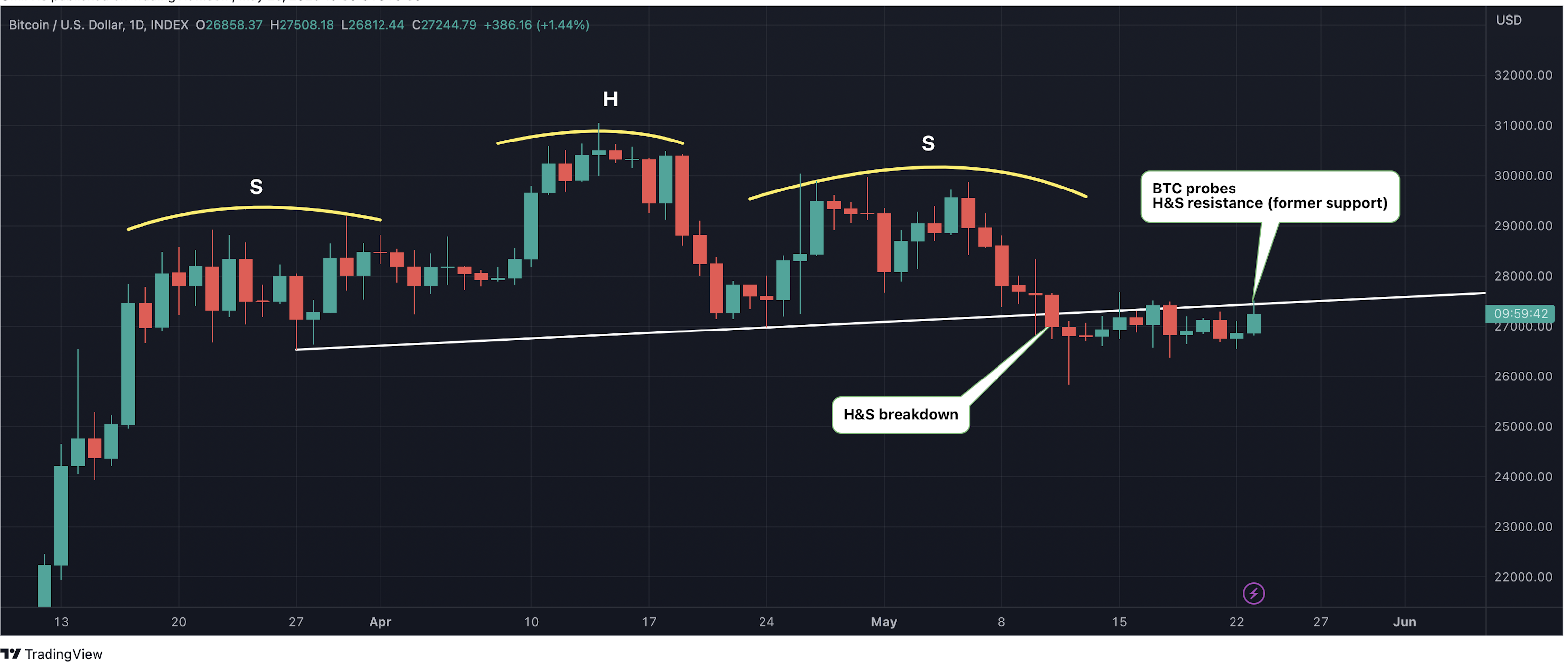
比特币周二早些时候升至 H&S 阻力位。 (TradingView)(TradingView)

据总部位于加拿大的数字资产流动性提供者Secure Digital Markets 称,比特币需要清除 H&S 趋势线阻力位和 27,500 美元的 20 天简单移动平均线才能确认牛市复苏。

“只要价格保持在这种 [H&S] 形态的颈线 [水平趋势线] 以及 20 日移动平均线下方,我们就应该预期会进一步下跌至 25,250 美元,可能跌至 24,000 美元,”那里的分析师写道。

比特币的短期前景还取决于正在进行的美国债务上限戏剧和美元指数的轨迹。财政部长珍妮特耶伦警告说,如果不能达成债务协议,政府将在 6 月初耗尽资金,为许多人所说的灾难性违约敞开大门。 一些分析师表示,成功解决债务上限问题可能会让财政部从市场吸走流动性,并对比特币施加下行压力。

最后,债券收益率正在上升,这表明投资者正在重新评估美联储继续其加息行动并在更长时间内保持较高借贷成本的可能性。

截至发稿时,美国 10 年期国债收益率升至 3.75% 的两个多月高位,而两年期国债收益率则跳升至 4.4%,为 3 月 13 日以来的最高水平。收益率上升削弱了科技股等风险资产的吸引力,加密货币和黄金等零收益资产。

Lecturas Relacionadas

After Marvell's 32% Surge, the Chinese Chip Family Behind It Emerges

The stock price of Marvell Technology surged 32.5% on June 2nd, driven by NVIDIA CEO Jensen Huang highlighting its custom ASICs and optical interconnects as core to AI data center architecture. This event brought attention to the Chinese semiconductor family behind Marvell: the Dai siblings. The story centers on three siblings, all UC Berkeley graduates, whose three-decade entrepreneurial journey aligns with major semiconductor industry shifts. In 1995, youngest sister Dai Wei Li co-founded Marvell with her husband Sehat Sutardja and his brother, focusing on storage controllers. Eldest brother Dai Wei Min founded EDA company Ultima, later sold to Cadence, and later founded VeriSilicon (芯原) in China, becoming a leading semiconductor IP provider. Second brother Dai Wei Jin co-founded EDA firm Silicon Perspective (sold to Cadence) and GPU IP company Vivante, later acquired by VeriSilicon. The combined "Dai-Sutardja" family network extends beyond Marvell. Their ventures and investments form a comprehensive ecosystem for the post-Moore's Law, chiplet era. Key holdings include: Dream Big Semiconductor (AI SuperNICs, acquired by Arm), Alphawave (high-speed SerDes IP, acquired by Qualcomm), and Silicon Box (a chiplet advanced packaging foundry). VeriSilicon itself thrives on the AI ASIC and IP boom in China. Collectively, the family's AI infrastructure-related portfolio is estimated at over $22 billion. Their strategy represents a distinct path: building critical components for open standards and key manufacturing capacity in the chiplet era, rather than pursuing standalone AI chip dominance. While this path may not create the next NVIDIA, it has enabled repeated successful exits and sustained influence within the global semiconductor industry.

marsbitHace 46 min(s)

After Marvell's 32% Surge, the Chinese Chip Family Behind It Emerges

marsbitHace 46 min(s)

Microsoft is Afraid of Being Marginalized by AI Giants

Microsoft, once the defining force of the PC era, now faces a familiar challenge in the AI age: the risk of being relegated to a profitable but invisible infrastructure provider. This anxiety was laid bare at Build 2026, where CEO Satya Nadella unveiled a major strategic pivot. The catalyst was a quiet April agreement that dissolved Microsoft's exclusive licensing and cloud-hosting deal with OpenAI, its once-vital partner. This erased Microsoft's key AI moat. With OpenAI and Anthropic defining AI applications and gaining enterprise traction—even within Microsoft's own ranks—Nadella had to answer: without exclusivity, what is Microsoft's role? The answer was a suite of seven in-house AI models, a developer-focused AI workstation (Surface RTX Spark Dev Box), and, most crucially, the Agent 365 platform for enterprise AI governance. The models, notably targeting Anthropic's strengths in coding and enterprise, signal a defensive move. However, the broader strategy is to make the models themselves less decisive. Financially, Microsoft's AI revenue is strong, driven largely by Azure running others' models. Yet its user-facing products like Copilot show weak penetration and engagement. Microsoft earns infrastructure money but lacks direct user mindshare. Nadella's core fear is being "hollowed out." As OpenAI and Anthropic prepare for IPOs and gain financial independence, they may build their own infrastructure, threatening Azure's lucrative AI revenue stream. Microsoft's window is to entrench itself deeper: not as the model creator, but as the indispensable platform for securely deploying, managing, and governing all AI models within the enterprise through Agent 365. Build 2026 revealed Microsoft's bet: in the AI era, the ultimate power lies not in any single model, but in the enterprise "operating system" that controls them. Nadella is determined to ensure Microsoft is the driver of this new era, not just a passenger.

marsbitHace 1 hora(s)

Microsoft is Afraid of Being Marginalized by AI Giants

marsbitHace 1 hora(s)

CPU, Quietly Returning to the Center of the AI Computing Power Stage

Over the past three years, AI computing power narratives have been dominated by GPUs. However, starting in 2026, this story began to shift. While training large models remains GPU-intensive, the rapid growth of inference and AI agent workloads, which require high levels of task orchestration, concurrency, and data flow management, has highlighted a renewed critical role for CPUs. These are tasks GPUs are not designed to handle. Intel's recent launch of the Xeon 6+ processor, built on its Intel 18A process and featuring up to 288 efficiency cores (E-cores), exemplifies this strategic pivot. It is positioned not as a mere companion to GPUs but as the essential "control plane" for AI infrastructure, optimized for high-density, energy-efficient, and high-throughput workloads characteristic of AI agents and inference. This "CPU resurgence" is not about CPUs outperforming GPUs in raw computation. It reflects a systemic bottleneck: as AI scales from training single models to deploying countless intelligent agents, the demand for coordination and data handling surges. Major cloud providers are also developing their own high-density ARM-based server CPUs for similar workloads. However, Intel's success with this strategy faces significant challenges. Competition includes NVIDIA's integrated CPU-GPU solutions, the expanding adoption of cloud vendors' in-house ARM CPUs, and the crucial market test of Intel's 18A manufacturing process against rivals like TSMC's N2. In conclusion, CPUs are indeed reclaiming a central, though redefined, role in AI compute—managing the complex orchestration that enables massive-scale AI deployment. While the trend is clear, which company will ultimately lead this CPU resurgence remains an open question to be decided in the data centers of 2027 and beyond.

marsbitHace 1 hora(s)

CPU, Quietly Returning to the Center of the AI Computing Power Stage

marsbitHace 1 hora(s)

Trading

Spot
Futuros
活动图片