Bitcoin HODLing Has Never Been More Popular

CoinDeskPublicado a 2023-05-24Actualizado a 2023-05-24

Resumen

More BTC than ever has been held for at least a year, according to Glassnode, a potentially bullish sign.

Investors are hanging onto their bitcoin (BTC) longer than ever – HODLing in industry parlance – according to data from Glassnode.

The proportion of BTC that’s been held for at least a year has climbed to a record 68%, Glassnode data shows, while 55% of bitcoin has been held for at least two years and 40% for three years.

Many analysts consider it bullish when BTC sits dormant on grounds that investors are choosing to hold on rather than sell. The prevalence of buy-and-hold in crypto contrasts with the long-term shift in U.S. stocks, a market where investors now hold assets for dramatically less time than they used to.
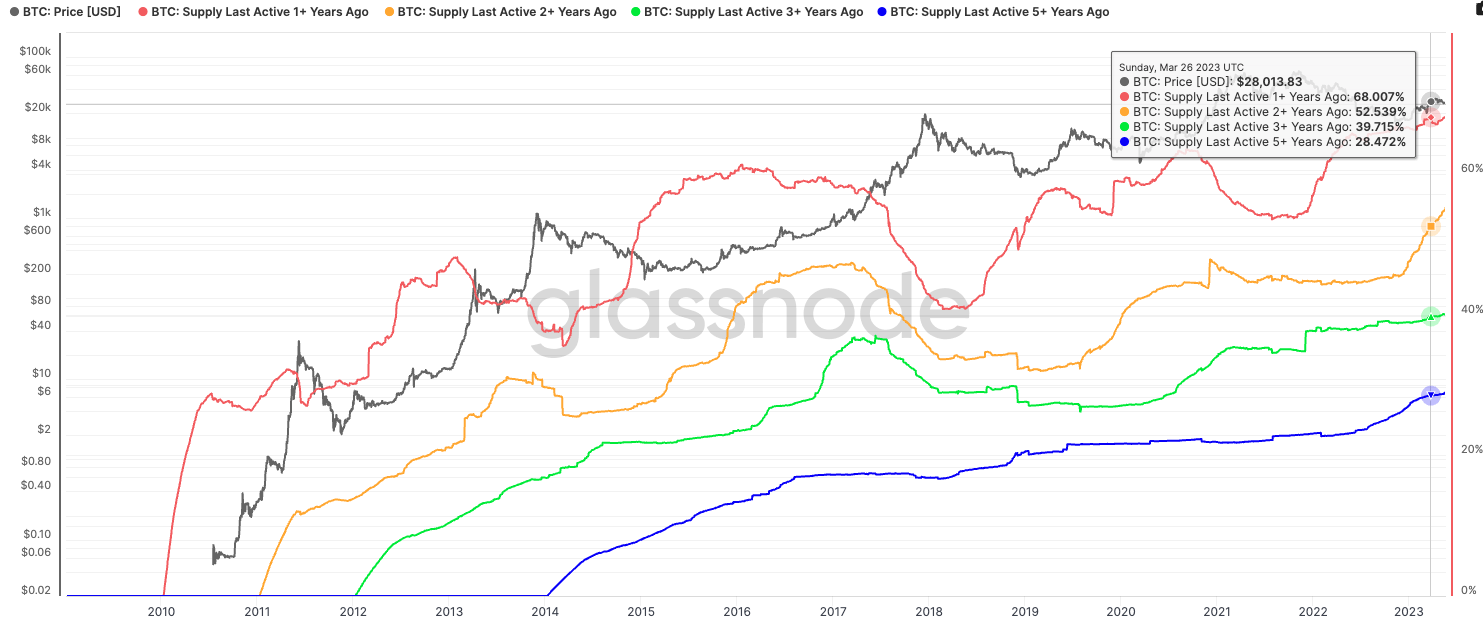
BTC: supply last active 1yr + age bands (Glassnode)

Sean Farrell, head of digital assets research at FundStrat, said that being a long-term holder has tended to get more popular over time. The exception is when markets get frothy and investors who bought dips sell their older coins to eager buyers.

“The trend is bullish insofar it means that higher prices are ahead in this cycle and any reticence to sell from current HODLers could result in a mini-supply squeeze,” said Farrell.

He added that looking at long-term holder supply metrics is not necessarily useful for short-term price signals.

Long-Term-Holder Supply, which Glassnode deems as coins held for longer than 155 days, has also seen a new all-time high — reaching 14.46 million bitcoin. “This reflects coins acquired immediately after the FTX failure maturing into long term holder status,” said the report.
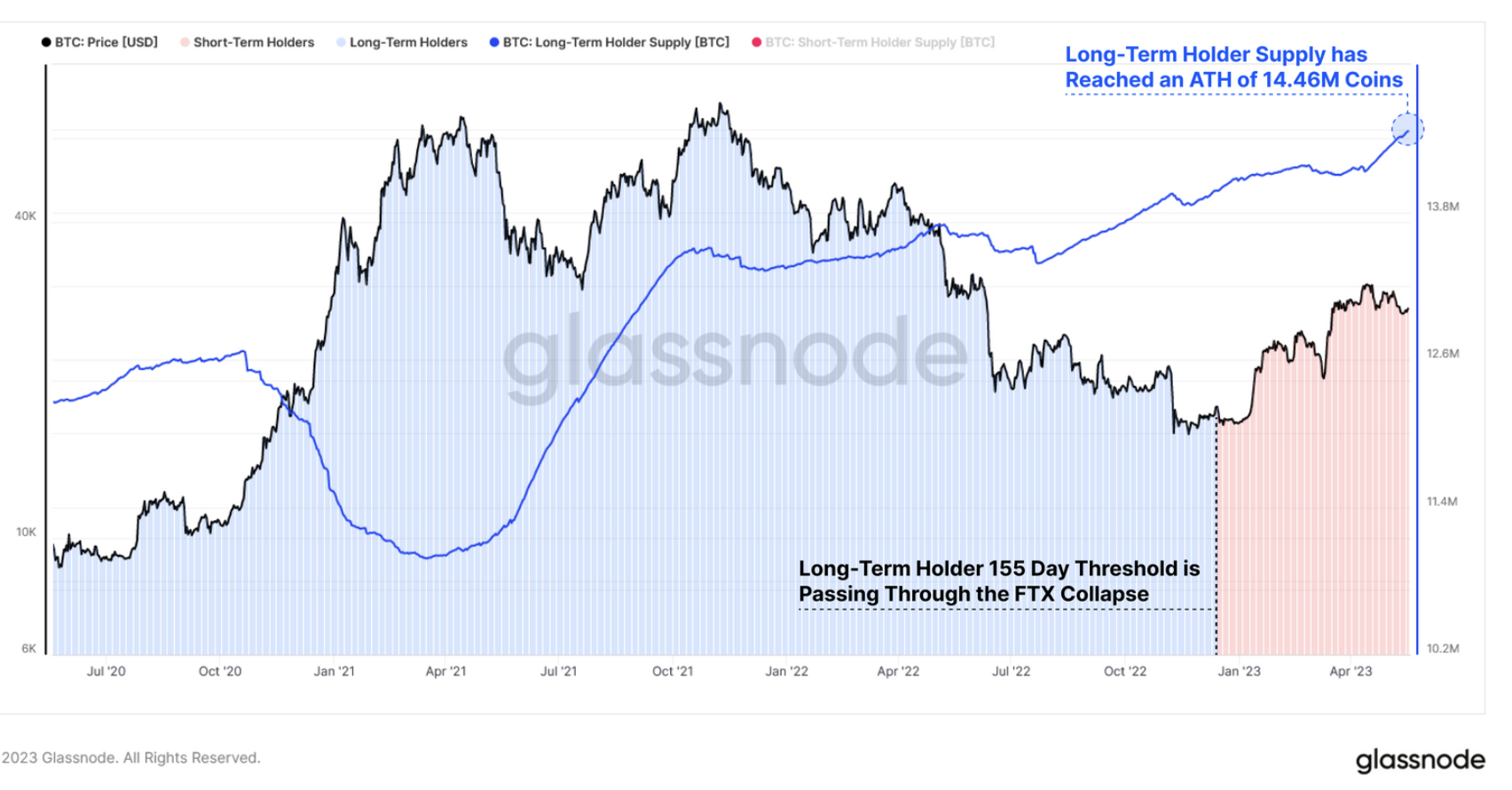
Bitcoin long term/short term holder threshold (Glassnode)

Glassnode’s Liveliness metric – which compares the relative balance between HODLing and spending behavior – also shows investors are hanging on. It has fallen to the lowest level since December 2020.

Lecturas Relacionadas

Ethereum Foundation Interim Executive Director Speaks Out: What Is Our Mission?

The Ethereum Foundation's core mission is to ensure Ethereum remains a truly permissionless, censorship-resistant, private, and open infrastructure for large-scale, sovereign coordination. The article clarifies the EF's focus and dismisses irrelevant objectives, such as pursuing institutional popularity or short-term speculation. Its core work centers on eliminating systemic weaknesses. This involves fortifying Ethereum across multiple layers—protocol, access, user, and institutional—against exploitation, control, or surveillance. Key initiatives include minimizing harmful MEV and preventing privileged control over transaction flow, making unconditional privacy a foundational default, ensuring staking remains permissionless and decentralized, and strengthening user-facing access points to uphold autonomy. Concurrently, the EF aims to seize strategic opportunities. These include leading the transition to post-quantum cryptography, achieving a fully verifiable protocol stack, establishing Ethereum as private digital cash, integrating user-owned AI agents with personal wallets, and demonstrating that trusted-neutral infrastructure can competitively handle disintermediated coordination at an institutional scale. The article also addresses recent organizational changes, stating that personnel departures were due to strategic realignment, role fit, or natural evolution. It clarifies the approach to spin-outs, emphasizing that external funding will be provided only for work critical to the EF's mission that reduces Ethereum's dependency without creating new risks or mission drift. Ultimately, the EF is committed to building an enduring, neutral system that reshapes global coordination, focusing relentlessly on the principles of censorship resistance, openness, privacy, and sovereignty (CROP).

链捕手Hace 34 min(s)

Ethereum Foundation Interim Executive Director Speaks Out: What Is Our Mission?

链捕手Hace 34 min(s)

STRC 跌破面值,比特币财库实验进入下半场

The price of STRC, Strategy's dividend-paying preferred stock, has fallen below its $100 face value, triggering a re-evaluation of the "bitcoin treasury" corporate model. This highlights a critical tension: the company's asset base consists of high-volatility, non-cash-flow-generating Bitcoin, while its capital structure requires continuous cash payouts for dividends and interest. The decline of STRC signals that market pressure is shifting from asset price volatility to the pricing of the company's financing tools. Strategy's core model involves a three-step conversion: turning equity into Bitcoin exposure, converting Bitcoin holdings into capital market credit, and packaging non-yielding BTC into cash-paying securities like STRC. While Strategy holds a massive 847,363 BTC, the focus is now on cash flow mismatches. The company faces annual preferred stock dividend obligations of approximately $1.7 billion, far exceeding the cash flow from its legacy software business. Its ability to meet these obligations relies on continued access to capital markets. The market is now scrutinizing which of three potential costs becomes untenable first: rising dividend costs to attract investors, dilution costs from issuing more common stock, or the reputational cost of selling BTC—a move contrary to its "hodl" narrative. For the broader crypto market, a constrained Strategy means the potential loss of a predictable, narrative-driven marginal buyer for Bitcoin. The STRC discount serves as a reminder that the longevity of such models depends not just on Bitcoin's price, but also on financing windows, cash reserves, and investor willingness to pay a "trust premium" for the structure.

marsbitHace 1 hora(s)

STRC 跌破面值,比特币财库实验进入下半场

marsbitHace 1 hora(s)

Standard Chartered Bank’s 50-Fold Fantasy: Predicting AAVE to Reach $3,500

Standard Chartered Bank has issued an optimistic research report predicting that the AAVE token could surge 50-fold to $3,500 by 2030. This forecast is based on the projection that the total value locked (TVL) in DeFi will grow 37x to approximately $2.7 trillion, driven by stablecoin expansion and the tokenization of real-world assets (RWA). The bank's model links Aave's potential valuation directly to its protocol revenue, which is primarily driven by net interest margins. The report highlights Aave's current dominant position, noting it captures over 80% of the net earnings ("protocol retained earnings") in the lending sector while holding only about half of its TVL. It also points to the recent launch of the Aave V4 architecture and a healthy revenue stream of $142 million in 2025 as positive fundamentals. Grayscale's separate analysis, applying traditional valuation metrics like DCF, concluded AAVE is currently undervalued. However, the article notes significant challenges. Aave's peer-to-pool lending model suffers from inherent capital inefficiency, with an estimated $52 million annual "deadweight loss" due to idle funds needed for liquidity buffers. This structural flaw was exposed during the April KelpDAO exploit, which locked a WETH pool at 100% utilization for days. Emerging protocols like Morpho, with more efficient point-to-point models, are cited as growing competitive threats. In summary, while institutional forecasts paint a macro picture of massive growth fueled by RWA adoption, Aave's path forward hinges on addressing its core structural limitations and competitive pressures within the evolving DeFi lending landscape.

链捕手Hace 2 hora(s)

Standard Chartered Bank’s 50-Fold Fantasy: Predicting AAVE to Reach $3,500

链捕手Hace 2 hora(s)

Trading

Spot
Futuros
活动图片