BRC-20 Meme 热潮席卷比特币网络,BTC “见顶”跌破2.75万美元

比推Publicado a 2023-05-09Actualizado a 2023-05-09

Resumen

加密基金管理公司 BitBull Capital 首席执行官 Joe DiPasquale 分析道,自 3 月中旬左右的反弹以来,BTC 和 ETH 都没有测试过近期支撑。DiPasquale 表示,BTC 可能会在再次反弹之前测试 25,000 美元至 27,000 美元之间的支撑位,逢低买入 BTC 和 ETH 是一种“合理的策略”。

随着基于比特币 BRC-20 标准的 Meme (模因)代币交易量飙升至两年高位,比特币周一跌破2.75万美元,链上数据显示,从历史数据来看,模因币的投机狂热预示着比特币短期“见顶”或者看跌逆转。

meme热度“吸血”

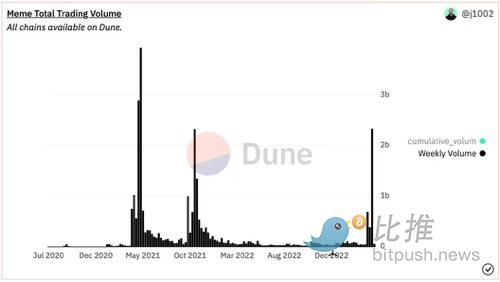
根据区块链观察员 James Tolan 基于 Dune 分析的追踪器,上周加密市场的 meme 币交易量为 23 亿美元,比前一周的 3.87 亿美元增长了六倍,达到 2021 年 5 月以来的最高水平。
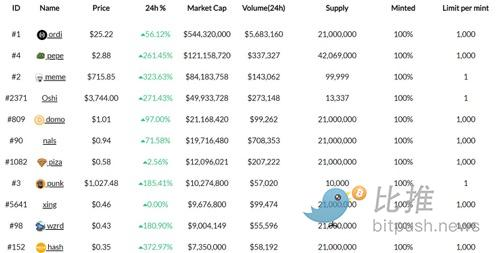
这波投机狂潮由 pepecoin (PEPE) 引领,一种以悲伤蛙表情包为主题的代币,于 4 月中旬推出,最大供应量为 420 万亿。上周五, PEPE 的市值突破10 亿美元,最终达到 18.2 亿美元的峰值,对于一个推出不到一个月的加密货币来说是一个惊人的成就。比推终端数据显示,截至发稿时,PEPE 的市值为 9.31 亿美元。

PEPE 热潮还刺激了对其他低市值代币的投机,如 DINO、WSB、CHAD 和 4TOKEN,这些代币在过去两周内上涨了百分之几百。Tolan认为,从历史上看,无实际用例的山寨币投机狂热预示着比特币的看跌逆转。
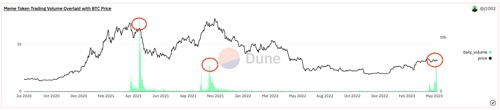
截至发稿时,比特币交易价格跌破 27,500 美元,24小时跌幅5%,美元指数 (DXY) 小幅反弹,美元指数衡量美元兑包括欧元在内的主要货币的汇率,比特币的走势通常与美元指数相反,该指数上周五在意外强劲的美国就业数据公布后短暂反弹至 101.75,目前徘徊在 101.37 附近。

BRC-20 代币费用创多年新高

随着围绕模因币的炒作越来越多,比特币网络的交易量不断增加。根据加密数据分析平台Dune Analytics 的数据,BRC-20 的每日铸币费在 5 月 7 日创下了 247 BTC 的历史新高,该数值表明该费用达到了两年来的最高水平。

BRC-20 代币标准是比特币区块链上的实验性代币标准,以以太坊的 ERC-20 为蓝本。BRC-20 代币标准由一位名叫 Domo(推特账号“ @domdata”)的匿名链上分析师于 3 月创建,它允许程序员通过Ordinals协议创建和发送可替代代币。

与 ERC-20 代币不同,BRC-20 代币不使用智能合约,并且需要比特币钱包来铸造和交易这些代币。

BRC-20 代币标准近几个月出现爆炸式增长,尤其是随着 Pepe (PEPE) 和 Memetic (MEME) 等模因币的出现。5 月 3 日,比特币网络累计支付的费用超过 350 万美元,比 4 月底激增 400%。BTC Ordinals 的总费用为 641 BTC,YCharts的数据显示,比特币 5 月 7 日的平均交易费用达到 19.21 美元。

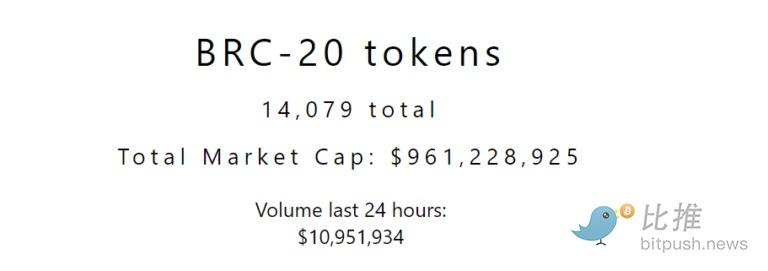
比特币网络上的BRC-20 代币数量已超过 14,000,其中许多是模因币。这些币的总市值超过 9.52 亿美元,24 小时交易量超过 1000 万美元。
CPI前的抛售

谈到宏观经济因素,交易员本周重点关注 5 月 10 日发布的美国4 月份消费者价格指数 (CPI) ,以衡量美联储在降低通胀方面的进展,该指数追踪范围广泛的商品和服务的价格变动,其他关键数据包括初请失业金人数和生产者物价指数。当美联储积极提高利率以抑制通货膨胀时,投资者通常会出售“风险资产”。

CPI 被称为整个加密货币的波动催化剂,匿名交易员 Aqua在推文中分析称,市场或出现“战术性抛售”, BTC/USD 进入更广泛的修正区间。他写道:“如果 CPI 数据良好,我们也许还有一次冲高机会,但这看起来越来越像一个修正,我们一定会在未来几周看到市场调整”。

全球资产管理公司贝莱德5月8日发布报告称,央行与通胀的斗争远未结束,风险较高的资产今年可能会继续遭受重创。该公司预计,未来几个月世界各国央行将进一步收紧货币政策,将全球经济推入衰退。

加密基金管理公司 BitBull Capital 首席执行官 Joe DiPasquale 分析道,自 3 月中旬左右的反弹以来,BTC 和 ETH 都没有测试过近期支撑。DiPasquale 表示,BTC 可能会在再次反弹之前测试 25,000 美元至 27,000 美元之间的支撑位,逢低买入 BTC 和 ETH 是一种“合理的策略”。

Lecturas Relacionadas

Where Is the AI Infrastructure Industry Chain Stuck?

The AI infrastructure (AI Infra) industry chain is facing unprecedented systemic bottlenecks, despite the rapid emergence of applications like DeepSeek and Seedance 2.0. The surge in global computing demand has exposed critical constraints across multiple layers of the supply chain—from core manufacturing equipment and data center cabling to specialty materials and cleanroom facilities. Key challenges include four major "walls": - **Memory Wall**: High-bandwidth memory (HBM) and DRAM face structural shortages as AI inference demand outpaces training, with new capacity not expected until 2027. - **Bandwidth Wall**: Data transfer speeds lag behind computing power, causing multi-level bottlenecks in-chip, between chips, and across data centers. - **Compute Wall**: Advanced chip manufacturing, reliant on EUV lithography and monopolized by ASML, remains the fundamental constraint, with supply chain fragility affecting production. - **Power Wall**: While energy demand from data centers is rising, power supply is a solvable near-term challenge through diversified energy infrastructure. Expansion is further hindered by shortages in testing equipment, IC substrates (critical for GPUs and seeing price hikes over 30%), specialty materials like low-CTE glass fiber, and high-end cleanroom facilities. Connection technologies are evolving, with copper cables resurging for short-range links due to cost and latency advantages, while optical solutions dominate long-range scenarios. Innovations like hollow-core fiber and advanced PCB technologies (e.g., glass substrates, mSAP) are emerging to meet bandwidth needs. In summary, AI Infra bottlenecks are multidimensional, spanning compute, memory, bandwidth, power, and supply chain logistics. Advanced chip manufacturing remains the core constraint, while substrate, material, and equipment shortages present immediate challenges. The industry is moving toward hybrid copper-optical solutions and accelerated domestic supply chain development.

marsbitHace 51 min(s)

Where Is the AI Infrastructure Industry Chain Stuck?

marsbitHace 51 min(s)

Autonomy or Compatibility: The Choice Facing China's AI Ecosystem Behind the Delay of DeepSeek V4

DeepSeek V4's repeated delay in early 2026 has sparked global discussions on "de-CUDA-ization" in AI. The highly anticipated trillion-parameter open-source model is undergoing deep adaptation to Huawei’s Ascend chips using the CANN framework, representing China’s first systematic attempt to run a core AI model outside the CUDA ecosystem. This shift, however, comes with significant engineering challenges. While the model uses a MoE architecture to reduce computational load, it places extreme demands on memory bandwidth, chip interconnects, and system scheduling—areas where NVIDIA’s mature CUDA ecosystem currently excels. Migrating to Ascend introduces complexities in hardware topology, communication latency, and software optimization due to CANN’s relative immaturity compared to CUDA. The move highlights a broader strategic dilemma: short-term compatibility with CUDA offers practical benefits and faster adoption, as seen in CANN’s efforts to emulate CUDA interfaces. Yet, long-term over-reliance on compatibility risks inheriting CUDA’s limitations and stifling native innovation. If global AI shifts away from transformer-based architectures, strict compatibility could lead to technological obsolescence. Despite these challenges, DeepSeek V4’s eventual release could demonstrate the viability of a full domestic AI stack and accelerate CANN’s ecosystem growth. However, true technological independence will require building an original software-hardware paradigm beyond compatibility—a critical task for China’s AI ambitions in the next 3-5 years.

marsbitHace 1 hora(s)

Autonomy or Compatibility: The Choice Facing China's AI Ecosystem Behind the Delay of DeepSeek V4

marsbitHace 1 hora(s)

Trading

Spot
Futuros
活动图片