IMF : Interest Rates to Fall to Pre-Pandemic Levels Once Inflation Is Tamed

newsbtcPublicado a 2023-04-13Actualizado a 2023-04-13

Resumen

When inflation in advanced economies is tamed, real interest rates are likely to drop to pre-pandemic levels, the latest International Monetary Fund (IMF) blog post has said. According to the authors of the blog post, the transition to a “cleaner economy in a budget-neutral way” could result in lower rates in the medium term.

Recent Interest Rate Hikes Temporary

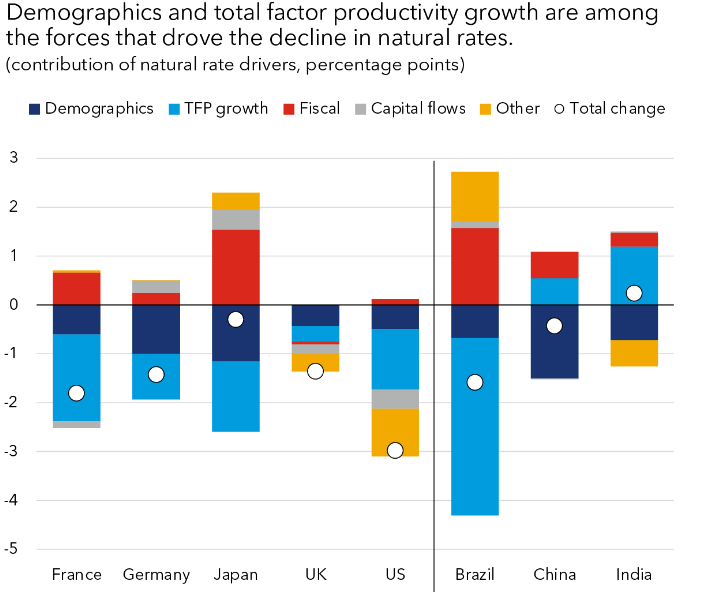
Interest rates in advanced economies are likely to fall to pre-pandemic levels when authorities succeed in bringing inflation back under control, the latest International Monetary Fund (IMF) blog post has suggested. The blog post added that the “recent increases in real interest rates are likely to be temporary.”
The return of real interest rates to levels seen before the spread of Covid-19 will also coincide with the easing of the respective countries’ monetary policy regimes. As has been reported by Bitcoin.com News, central banks from advanced economies have raised benchmark rates as they seek to tame inflation. The rising interest rates have sparked fears that the global economy may be headed for a recession.

However, in their April 10 blog post, the authors claimed a transition to a green economy may potentially lead to lower real interest rates globally:

Transitioning to a cleaner economy in a budget-neutral way would tend to push global natural rates lower in the medium term, as higher energy prices (reflecting a combination of taxes and regulations) would bring down the marginal productivity of capital. However, deficit-financing of public investment in green infrastructure and subsidies could potentially offset and even reverse this result.

The authors also suggested that so-called deglobalization forces could intensify and this may result in both “trade and financial fragmentation.” According to the authors, this outcome is likely to result in driving up the natural rate in advanced economies and down in emerging markets economies.





Lecturas Relacionadas

From Mining Pool to Mars: Why Is Wang Chun in the SpaceX Cockpit?

Title: From Mining Pool to Mars: Why Wang Chun is in the SpaceX Cockpit? When SpaceX announced that Wang Chun, co-founder of F2Pool, would command the first commercial crewed interplanetary mission, many were shocked. Why would a Bitcoin mining pool founder be on a Mars mission roster? However, understanding Wang Chun's journey over the past decade and the deepening ties between the crypto industry and SpaceX reveals this is not accidental, but an inevitable result of a new era taking shape. Today's Mars plan is no longer just a space engineering project; it is evolving into a civilization-upgrading experiment driven by global tech capital, AI, computing power, energy, and the crypto economy. Wang Chun stands precisely at the intersection of these forces. Part 1: From F2Pool to SpaceX – Wang Chun's Leap F2Pool, founded when Bitcoin was still niche, is one of the earliest large-scale mining pools and once held a significant share of global Bitcoin hash rate. Wang Chun belongs to the first generation of Chinese Bitcoin advocates and infrastructure builders—idealists and engineers who believed in a new value network independent of traditional finance. Miners like him built the hardware, energy, and computing power foundational to decentralized networks. This aligns with the long-term, high-engineering, future-oriented vision required for space civilization. Elon Musk’s space endeavors value such long-term builders over mere capital players, which explains Wang Chun's entry into the SpaceX ecosystem. Part 2: Why Crypto and SpaceX Are Growing Closer The core of global tech competition is shifting from internet applications to next-generation infrastructure. Both crypto and SpaceX are part of this. SpaceX's goal is to drastically reduce space access costs. If successful, it could enable orbital servers, space-based energy, global satellite internet, and Martian bases. These new frontiers will require new payment systems, value networks, and global financial architectures. Cryptocurrencies, inherently global and trustless, are poised to become key to off-planet economies. Moreover, crypto and SpaceX share a high-risk, long-termist ethos—believing in ambitious, world-changing goals despite early skepticism. Part 3: Human Spaceflight Enters the Commercial Era Space exploration, long dominated by state actors, is now being transformed by commercial entities like SpaceX. Wang Chun's involvement signifies that future deep-space participants may include not just career astronauts, but also entrepreneurs, engineers, and AI researchers. This mirrors the Age of Exploration, where commercial capital eventually drove global expansion. Wang Chun has emphasized that Mars colonization must not be delayed for future generations, countering a potential over-focus on nearer-term, commercial lunar projects. His presence symbolizes how new capital, technical communities, and idealists from the crypto world are now entering the interstellar age. In summary, the true significance is not an individual's journey to Mars, but the shift in the driving force of human civilization expansion from state machinery to tech companies, AI systems, and global technology capital. Wang Chun's path—from mining pool to Mars, from the Bitcoin network to starships—may be a preview of technological civilization's evolution in the coming decades.

marsbitHace 2 hora(s)

From Mining Pool to Mars: Why Is Wang Chun in the SpaceX Cockpit?

marsbitHace 2 hora(s)

Trading

Spot
Futuros
活动图片