$11.3 Billion Flows Into Bitcoin ETFs In One Month While Retail Sells At A Loss – Details

bitcoinistPublicado a 2026-03-27Actualizado a 2026-03-27

Resumen

Bitcoin is consolidating around $70,000, but significant capital flows are occurring beneath the surface. Over 30 days, Bitcoin ETFs saw net inflows of $11.3 billion, absorbing 62,986 BTC as institutional buying accelerated to 2.6 times its monthly pace. This sustained demand has pushed ETF cumulative holdings to a record 1,326,874 BTC. Meanwhile, retail investors are selling at a loss, with short-term holders sending approximately 15,500 BTC daily to exchanges at a loss, accounting for the majority of their activity. This reflects sustained stress rather than a final capitulation event. The market structure shows institutions are buying faster than retail is selling, but the key signal to watch is whether loss-side selling compresses while the market holds or rises.

Bitcoin is consolidating around $70,000. The price has gone sideways. The capital flows beneath it have not.

Analyst Axel Adler has published data that reframes the current consolidation entirely: over the 30 days ending March 25, Bitcoin ETF funds absorbed 62,986 BTC in net inflows — $11.3 billion in institutional capital entering the market while the price moved from $64,100 to $71,307. That is not a market drifting. That is a market being quietly bought.

The acceleration signal sharpens the picture further. The 7-day flow average currently stands at 3,288 BTC per day against a 30-day average of 1,256 BTC — meaning institutional buying is running at 2.6 times its own monthly pace. ETF cumulative holdings have reached 1,326,874 BTC, a record that reflects the sustained, compounding nature of this demand rather than a single episodic event.
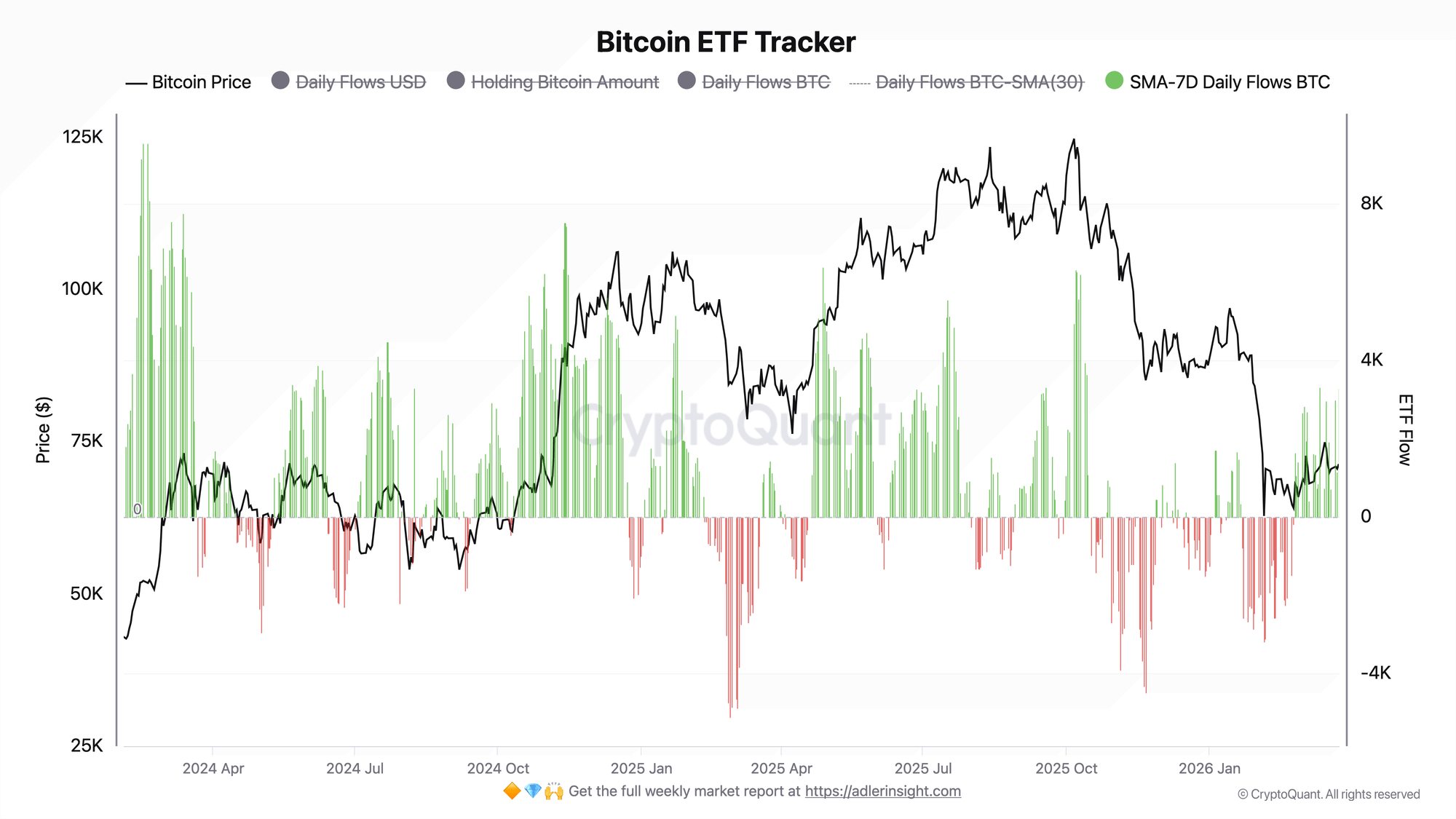
Bitcoin ETF Tracker | Source: CryptoQuant

The counterweight is real and should not be minimized. Short-term holders are consistently realizing losses on exchanges — retail participants selling into weakness, adding distribution pressure that institutional inflows are currently absorbing and overcoming.

That is the structure of this market in one sentence: institutions are buying faster than retail is selling. At $70,000, the question is how long that equation holds.

Retail Is Selling Bitcoin at a Loss

Adler’s second dataset examines the other side of the market structure equation — and it is considerably less comfortable than the ETF picture. The Short-Term Holder P&L to Exchanges metric tracks how many BTC retail participants are sending to exchanges at a loss versus a profit over any 24-hour period. Right now, that reading stands at -15,500 BTC per day flowing to exchanges at a loss, against a total STH exchange inflow of 35,200 BTC per 24 hours.
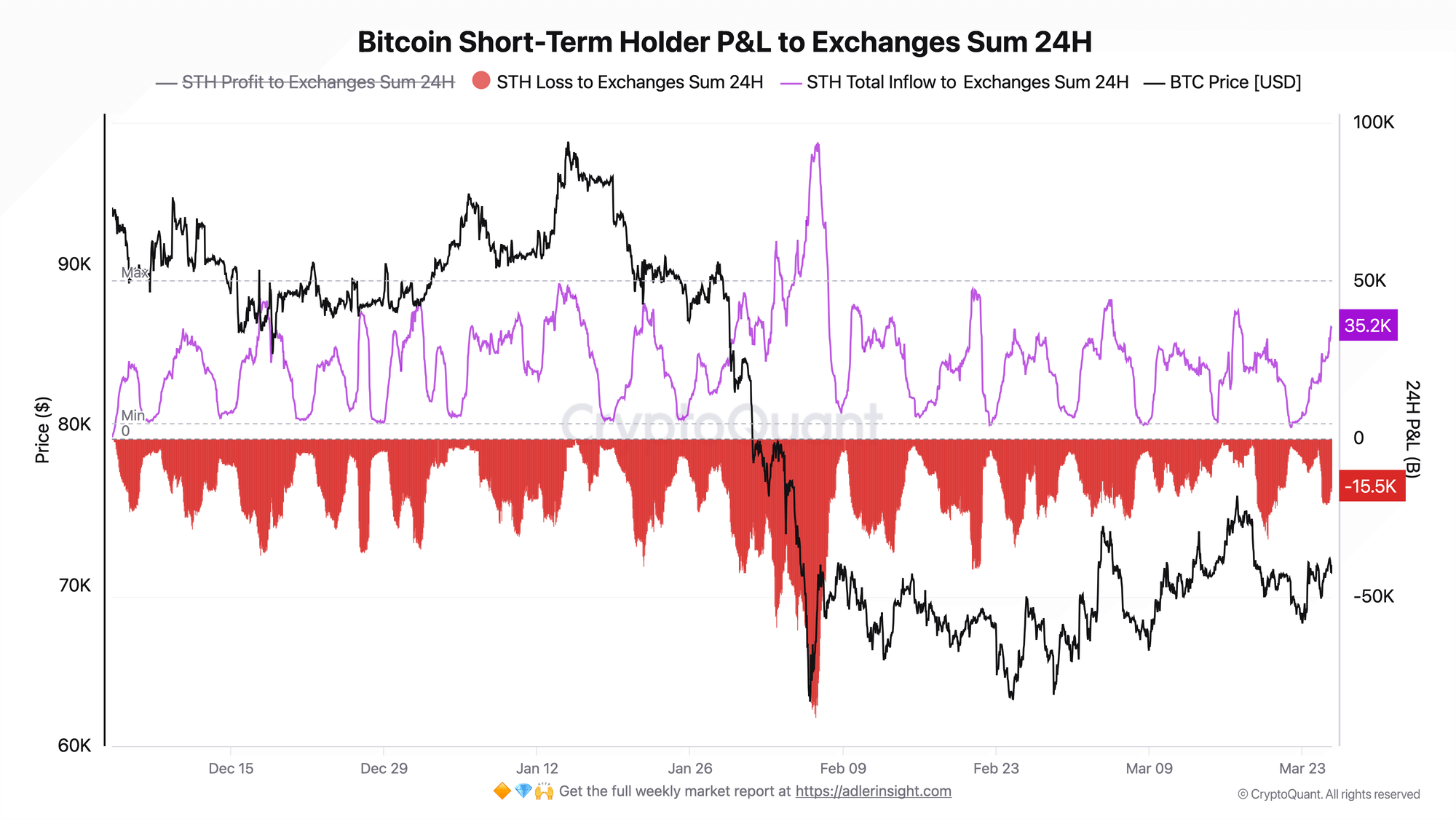
Bitcoin Short-Term Holder P&L to Exchange Sum 24H | Source: CryptoQuant

The arithmetic is unambiguous: the majority of retail activity hitting exchanges is loss-realizing. This is not a temporary anomaly. Adler identifies it as a regime shift — a structural change in behavior that began at the local price peak and has not recovered above the neutral zone since. Short-term holders are not selling opportunistically. They are selling because they are underwater, and they have been for weeks.

What the data does not show is equally important. The -15,500 BTC daily loss flow is consistent with sustained stress, but it lacks the vertical spike that historically marks final capitulation — the exhaustion event where the last forced sellers leave the market simultaneously. That spike has not arrived.

The retail segment remains weak. The institutional segment remains active. The signal that resolves the tension between them is straightforward: loss-side sends compressing while price holds or rises. Until that compression appears, the stress regime remains intact.


Preguntas relacionadas

QWhat is the total net inflow into Bitcoin ETFs over the 30 days ending March 25, and how much Bitcoin did this represent?

AThe total net inflow into Bitcoin ETFs over the 30 days ending March 25 was $11.3 billion, which represented 62,986 BTC.

QHow does the current 7-day average of institutional buying compare to the 30-day average, and what does this indicate?

AThe 7-day flow average is 3,288 BTC per day, which is 2.6 times the 30-day average of 1,256 BTC. This indicates that institutional buying is accelerating significantly.

QWhat is the behavior of short-term holders (retail participants) according to the data presented by Axel Adler?

AShort-term holders are consistently realizing losses, sending approximately 15,500 BTC to exchanges at a loss per day. This represents the majority of their total 35,200 BTC daily exchange inflows, indicating they are selling due to being underwater on their investments.

QWhat key signal is missing from the current retail selling activity that historically marks a final market capitulation?

AThe data lacks the vertical spike in loss-realizing flows that historically marks a final capitulation event, where the last forced sellers exit the market simultaneously. This spike has not yet occurred.

QWhat is the current structure of the Bitcoin market as described in the article in one sentence?

AThe structure of the market is that institutions are buying Bitcoin faster than retail investors are selling it.

Lecturas Relacionadas

Google and Amazon Simultaneously Invest Heavily in a Competitor: The Most Absurd Business Logic of the AI Era Is Becoming Reality

In a span of four days, Amazon announced an additional $25 billion investment, and Google pledged up to $40 billion—both direct competitors pouring over $65 billion into the same AI startup, Anthropic. Rather than a typical venture capital move, this signals the latest escalation in the cloud wars. The core of the deal is not equity but compute pre-orders: Anthropic must spend the majority of these funds on AWS and Google Cloud services and chips, effectively locking in massive future compute consumption. This reflects a shift in cloud market dynamics—enterprises now choose cloud providers based on which hosts the best AI models, not just price or stability. With OpenAI deeply tied to Microsoft, Anthropic’s Claude has become the only viable strategic asset for Google and Amazon to remain competitive. Anthropic’s annualized revenue has surged to $30 billion, and it is expanding into verticals like biotech, positioning itself as a cross-industry AI infrastructure layer. However, this funding comes with constraints: Anthropic’s independence is challenged as it balances two rival investors, its safety-first narrative faces pressure from regulatory scrutiny, and its path to IPO introduces new financial pressures. Globally, this accelerates a "tri-polar" closed-loop structure in AI infrastructure, with Microsoft-OpenAI, Google-Anthropic, and Amazon-Anthropic forming exclusive model-cloud alliances. In contrast, China’s landscape differs—investments like Alibaba and Tencent backing open-source model firm DeepSeek reflect a more decoupled approach, though closed-source models from major cloud providers still dominate. The $65 billion bet is ultimately about securing a seat at the table in an AI-defined future—where missing the model layer means losing the cloud war.

marsbitHace 1 hora(s)

Google and Amazon Simultaneously Invest Heavily in a Competitor: The Most Absurd Business Logic of the AI Era Is Becoming Reality

marsbitHace 1 hora(s)

Computing Power Constrained, Why Did DeepSeek-V4 Open Source?

DeepSeek-V4 has been released as a preview open-source model, featuring 1 million tokens of context length as a baseline capability—previously a premium feature locked behind enterprise paywalls by major overseas AI firms. The official announcement, however, openly acknowledges computational constraints, particularly limited service throughput for the high-end DeepSeek-V4-Pro version due to restricted high-end computing power. Rather than competing on pure scale, DeepSeek adopts a pragmatic approach that balances algorithmic innovation with hardware realities in China’s AI ecosystem. The V4-Pro model uses a highly sparse architecture with 1.6T total parameters but only activates 49B during inference. It performs strongly in agentic coding, knowledge-intensive tasks, and STEM reasoning, competing closely with top-tier closed models like Gemini Pro 3.1 and Claude Opus 4.6 in certain scenarios. A key strategic product is the Flash edition, with 284B total parameters but only 13B activated—making it cost-effective and accessible for mid- and low-tier hardware, including domestic AI chips from Huawei (Ascend), Cambricon, and Hygon. This design supports broader adoption across developers and SMEs while stimulating China's domestic semiconductor ecosystem. Despite facing talent outflow and intense competition in user traffic—with rivals like Doubao and Qianwen leading in monthly active users—DeepSeek has maintained technical momentum. The release also comes amid reports of a new funding round targeting a valuation exceeding $10 billion, potentially setting a new record in China’s LLM sector. Ultimately, DeepSeek-V4 represents a shift toward open yet realistic infrastructure development in the constrained compute landscape of Chinese AI, emphasizing engineering efficiency and domestic hardware compatibility over pure model scale.

marsbitHace 2 hora(s)

Computing Power Constrained, Why Did DeepSeek-V4 Open Source?

marsbitHace 2 hora(s)

Trading

Spot
Futuros

Artículos destacados

Cómo comprar ONE

¡Bienvenido a HTX.com! Hemos hecho que comprar Harmony (ONE) sea simple y conveniente. Sigue nuestra guía paso a paso para iniciar tu viaje de criptos.Paso 1: crea tu cuenta HTXUtiliza tu correo electrónico o número de teléfono para registrarte y obtener una cuenta gratuita en HTX. Experimenta un proceso de registro sin complicaciones y desbloquea todas las funciones.Obtener mi cuentaPaso 2: ve a Comprar cripto y elige tu método de pagoTarjeta de crédito/débito: usa tu Visa o Mastercard para comprar Harmony (ONE) al instante.Saldo: utiliza fondos del saldo de tu cuenta HTX para tradear sin problemas.Terceros: hemos agregado métodos de pago populares como Google Pay y Apple Pay para mejorar la comodidad.P2P: tradear directamente con otros usuarios en HTX.Over-the-Counter (OTC): ofrecemos servicios personalizados y tipos de cambio competitivos para los traders.Paso 3: guarda tu Harmony (ONE)Después de comprar tu Harmony (ONE), guárdalo en tu cuenta HTX. Alternativamente, puedes enviarlo a otro lugar mediante transferencia blockchain o utilizarlo para tradear otras criptomonedas.Paso 4: tradear Harmony (ONE)Tradear fácilmente con Harmony (ONE) en HTX's mercado spot. Simplemente accede a tu cuenta, selecciona tu par de trading, ejecuta tus trades y monitorea en tiempo real. Ofrecemos una experiencia fácil de usar tanto para principiantes como para traders experimentados.

225 Vistas totalesPublicado en 2024.12.12Actualizado en 2025.03.21

Cómo comprar ONE

Discusiones

Bienvenido a la comunidad de HTX. Aquí puedes mantenerte informado sobre los últimos desarrollos de la plataforma y acceder a análisis profesionales del mercado. A continuación se presentan las opiniones de los usuarios sobre el precio de ONE (ONE).

活动图片












