$11.3 Billion Flows Into Bitcoin ETFs In One Month While Retail Sells At A Loss – Details

bitcoinistPublicado a 2026-03-27Actualizado a 2026-03-27

Resumen

Bitcoin is consolidating around $70,000, but significant capital flows are occurring beneath the surface. Over 30 days, Bitcoin ETFs saw net inflows of $11.3 billion, absorbing 62,986 BTC as institutional buying accelerated to 2.6 times its monthly pace. This sustained demand has pushed ETF cumulative holdings to a record 1,326,874 BTC. Meanwhile, retail investors are selling at a loss, with short-term holders sending approximately 15,500 BTC daily to exchanges at a loss, accounting for the majority of their activity. This reflects sustained stress rather than a final capitulation event. The market structure shows institutions are buying faster than retail is selling, but the key signal to watch is whether loss-side selling compresses while the market holds or rises.

Bitcoin is consolidating around $70,000. The price has gone sideways. The capital flows beneath it have not.

Analyst Axel Adler has published data that reframes the current consolidation entirely: over the 30 days ending March 25, Bitcoin ETF funds absorbed 62,986 BTC in net inflows — $11.3 billion in institutional capital entering the market while the price moved from $64,100 to $71,307. That is not a market drifting. That is a market being quietly bought.

The acceleration signal sharpens the picture further. The 7-day flow average currently stands at 3,288 BTC per day against a 30-day average of 1,256 BTC — meaning institutional buying is running at 2.6 times its own monthly pace. ETF cumulative holdings have reached 1,326,874 BTC, a record that reflects the sustained, compounding nature of this demand rather than a single episodic event.
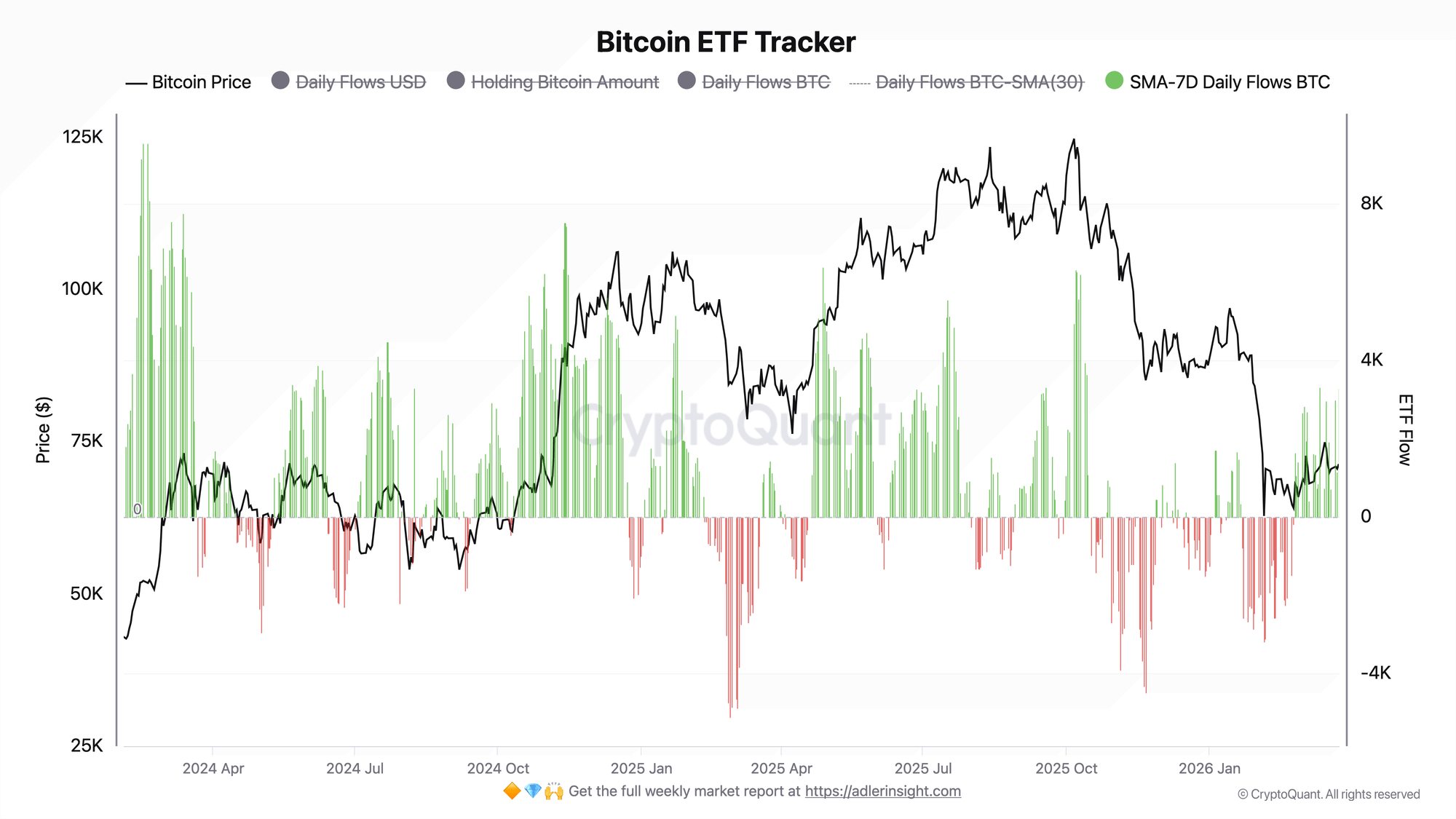
Bitcoin ETF Tracker | Source: CryptoQuant

The counterweight is real and should not be minimized. Short-term holders are consistently realizing losses on exchanges — retail participants selling into weakness, adding distribution pressure that institutional inflows are currently absorbing and overcoming.

That is the structure of this market in one sentence: institutions are buying faster than retail is selling. At $70,000, the question is how long that equation holds.

Retail Is Selling Bitcoin at a Loss

Adler’s second dataset examines the other side of the market structure equation — and it is considerably less comfortable than the ETF picture. The Short-Term Holder P&L to Exchanges metric tracks how many BTC retail participants are sending to exchanges at a loss versus a profit over any 24-hour period. Right now, that reading stands at -15,500 BTC per day flowing to exchanges at a loss, against a total STH exchange inflow of 35,200 BTC per 24 hours.
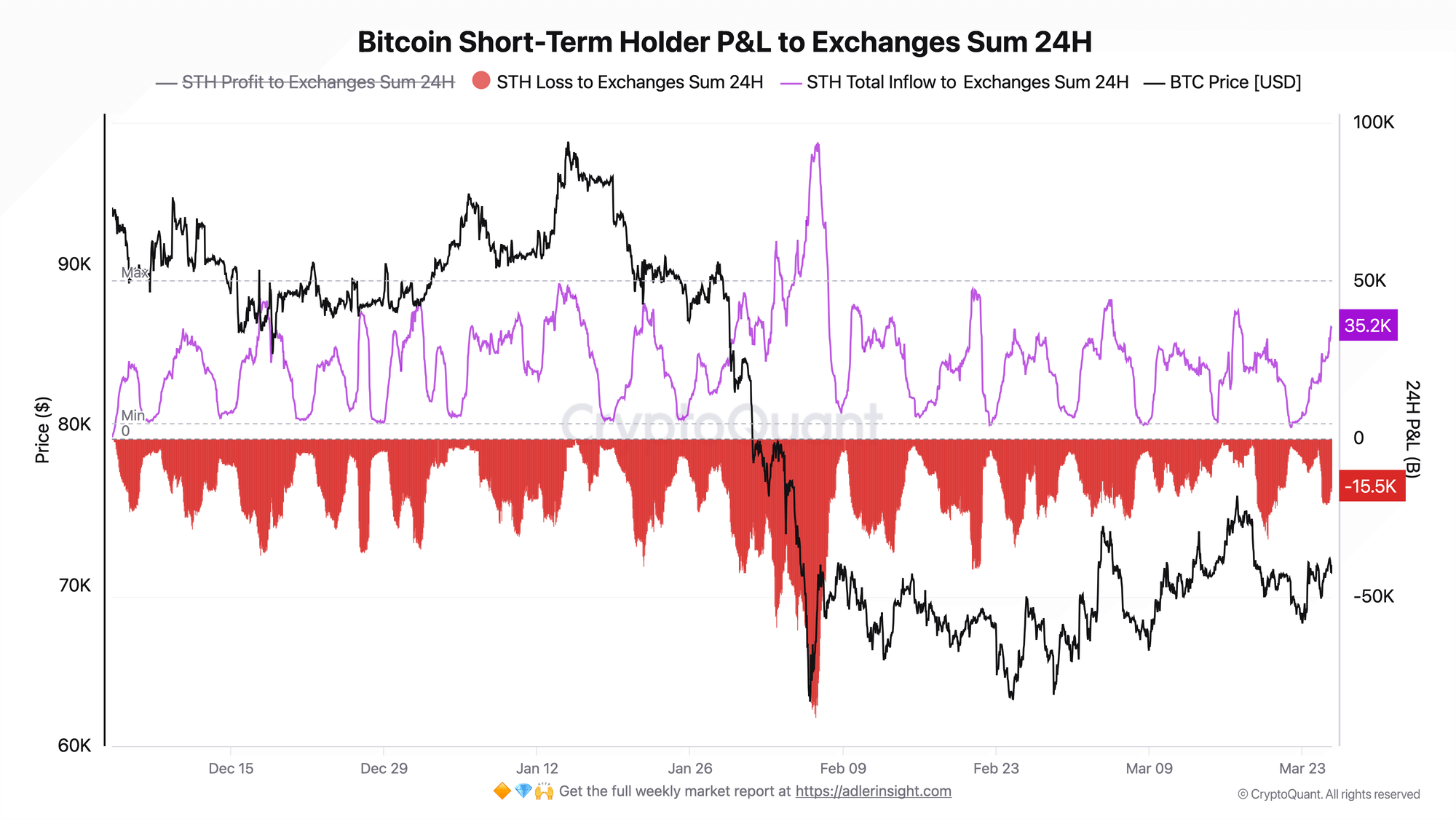
Bitcoin Short-Term Holder P&L to Exchange Sum 24H | Source: CryptoQuant

The arithmetic is unambiguous: the majority of retail activity hitting exchanges is loss-realizing. This is not a temporary anomaly. Adler identifies it as a regime shift — a structural change in behavior that began at the local price peak and has not recovered above the neutral zone since. Short-term holders are not selling opportunistically. They are selling because they are underwater, and they have been for weeks.

What the data does not show is equally important. The -15,500 BTC daily loss flow is consistent with sustained stress, but it lacks the vertical spike that historically marks final capitulation — the exhaustion event where the last forced sellers leave the market simultaneously. That spike has not arrived.

The retail segment remains weak. The institutional segment remains active. The signal that resolves the tension between them is straightforward: loss-side sends compressing while price holds or rises. Until that compression appears, the stress regime remains intact.


Preguntas relacionadas

QWhat is the total net inflow into Bitcoin ETFs over the 30 days ending March 25, and how much Bitcoin did this represent?

AThe total net inflow into Bitcoin ETFs over the 30 days ending March 25 was $11.3 billion, which represented 62,986 BTC.

QHow does the current 7-day average of institutional buying compare to the 30-day average, and what does this indicate?

AThe 7-day flow average is 3,288 BTC per day, which is 2.6 times the 30-day average of 1,256 BTC. This indicates that institutional buying is accelerating significantly.

QWhat is the behavior of short-term holders (retail participants) according to the data presented by Axel Adler?

AShort-term holders are consistently realizing losses, sending approximately 15,500 BTC to exchanges at a loss per day. This represents the majority of their total 35,200 BTC daily exchange inflows, indicating they are selling due to being underwater on their investments.

QWhat key signal is missing from the current retail selling activity that historically marks a final market capitulation?

AThe data lacks the vertical spike in loss-realizing flows that historically marks a final capitulation event, where the last forced sellers exit the market simultaneously. This spike has not yet occurred.

QWhat is the current structure of the Bitcoin market as described in the article in one sentence?

AThe structure of the market is that institutions are buying Bitcoin faster than retail investors are selling it.

Lecturas Relacionadas

Arbitrum Pretends to Be the Hacker, 'Steals' Back the Money Lost by KelpDAO

Title: Arbitrum Poses as Hacker to Recover Stolen Funds from KelpDAO Last week, KelpDAO suffered a hack resulting in nearly $300 million in losses, marking the largest DeFi security incident this year. Approximately 30,765 ETH (worth over $70 million) remained on an Arbitrum address controlled by the attacker. In an unprecedented move, Arbitrum’s Security Council utilized its emergency authority to upgrade the Inbox bridge contract, adding a function that allowed them to impersonate the hacker’s address and initiate a transfer without access to its private key. The council’s action, approved by 9 of its 12 members, moved the stolen ETH to a frozen address in a single transaction before reverting the contract to its original state. The operation was coordinated with law enforcement, which attributed the attack to North Korea’s Lazarus Group. Community reactions are divided: some praise the recovery of funds, while others question the centralization of power, as the council can upgrade core contracts without governance votes. However, such emergency mechanisms are common among major L2s. Despite the partial recovery, over $292 million was stolen in total, with more than $100 million in bad debt on Aave and remaining funds scattered across other chains. The incident highlights escalating security challenges in DeFi, with state-sponsored hackers employing advanced tactics and L2s responding with elevated countermeasures.

marsbitHace 5 min(s)

Arbitrum Pretends to Be the Hacker, 'Steals' Back the Money Lost by KelpDAO

marsbitHace 5 min(s)

iQiyi Is Too Impatient

The article "iQiyi Is Too Impatient" discusses the controversy surrounding the Chinese streaming platform IQiyi's recent announcement of an "AI Actor Library" during its 2026 World Conference. IQiyi claimed over 100 actors, including well-known names like Zhang Ruoyun and Yu Hewei, had joined the initiative. CEO Gong Yu suggested AI could enable actors to "star in 14 dramas a year instead of 4" and that "live-action filming might become a world cultural heritage." The announcement quickly sparked backlash. Multiple actors named in the list issued urgent statements denying they had signed any AI-related authorization agreements. This forced IQiyi to clarify that inclusion in the library only indicated a willingness to *consider* AI projects, with separate negotiations required for any specific role. The incident, which trended on social media with hashtags like "IQiyi is crazy," is presented as a sign of the company's growing desperation. Facing intense competition from short-video platforms like Douyin and Kuaishou, as well as Bilibili and Xiaohongshu, IQiyi's financial performance has weakened, with revenues declining for two consecutive years. The author argues that IQiyi is "too impatient" to tell a compelling AI story to reassure the market, especially as it pursues a listing on the Hong Kong stock exchange. The piece concludes by outlining three key "AI questions" IQiyi must answer: defining its role as a tool provider versus a content creator, balancing the "coldness" of AI with the human element audiences desire, and properly managing the interests of platforms, actors, and viewers. The core dilemma is that while AI can reduce costs and increase efficiency, it risks creating homogenized, formulaic content and devaluing human performers.

marsbitHace 59 min(s)

iQiyi Is Too Impatient

marsbitHace 59 min(s)

Trading

Spot
Futuros

Artículos destacados

Cómo comprar ONE

¡Bienvenido a HTX.com! Hemos hecho que comprar Harmony (ONE) sea simple y conveniente. Sigue nuestra guía paso a paso para iniciar tu viaje de criptos.Paso 1: crea tu cuenta HTXUtiliza tu correo electrónico o número de teléfono para registrarte y obtener una cuenta gratuita en HTX. Experimenta un proceso de registro sin complicaciones y desbloquea todas las funciones.Obtener mi cuentaPaso 2: ve a Comprar cripto y elige tu método de pagoTarjeta de crédito/débito: usa tu Visa o Mastercard para comprar Harmony (ONE) al instante.Saldo: utiliza fondos del saldo de tu cuenta HTX para tradear sin problemas.Terceros: hemos agregado métodos de pago populares como Google Pay y Apple Pay para mejorar la comodidad.P2P: tradear directamente con otros usuarios en HTX.Over-the-Counter (OTC): ofrecemos servicios personalizados y tipos de cambio competitivos para los traders.Paso 3: guarda tu Harmony (ONE)Después de comprar tu Harmony (ONE), guárdalo en tu cuenta HTX. Alternativamente, puedes enviarlo a otro lugar mediante transferencia blockchain o utilizarlo para tradear otras criptomonedas.Paso 4: tradear Harmony (ONE)Tradear fácilmente con Harmony (ONE) en HTX's mercado spot. Simplemente accede a tu cuenta, selecciona tu par de trading, ejecuta tus trades y monitorea en tiempo real. Ofrecemos una experiencia fácil de usar tanto para principiantes como para traders experimentados.

186 Vistas totalesPublicado en 2024.12.12Actualizado en 2025.03.21

Cómo comprar ONE

Discusiones

Bienvenido a la comunidad de HTX. Aquí puedes mantenerte informado sobre los últimos desarrollos de la plataforma y acceder a análisis profesionales del mercado. A continuación se presentan las opiniones de los usuarios sobre el precio de ONE (ONE).

活动图片