盘点三月份值得关注的加密事件:上海升级、DeFi、NFT、L1创新

头等仓Publicado a 2023-03-01Actualizado a 2023-03-05

Resumen

3月份的机会可能就蕴藏其中。

以太坊上海升级

上海升级是近期市场上的最大叙事和公众预期。在主网进行上海升级前,会有 3 次测试网的升级测试(Zhejiang→Sepolia→Goerli)。今日 Sepolia 的上海升级成功激活,如果延续之前每3周推进一个测试网的节奏,Goerli 作为最受瞩目参与度最高的测试网,将在 3 月 21 日激活升级。这也就意味着主网的上海升级可能发生在 4 月份。

相关投资标的我们已经在 1 月底提及($ETH, $LDO, $RPL, $SWISE, $ANKR, $FXS, $SSV, etc.)。在等待升级到来的同时,读者还需留意宏观环境的变化,如新一期的利率决策会议和经济展望将发生在3月22日。新一期的宏观分析系列:《美债收益率与市场风险》于今日发布,欢迎登录头等仓平台 (first.vip) 查看。

DEFI

yearn.finance($YFI)——Yearn 团队于近期在社区表示,随着 LSD 行业受到投资者的青睐,即将推出的yETH 代币将使用户能够直接接触一篮子以太坊流动性抵押衍生品 (LSD)。yETH 本质上是帮用户分散单一 LSD 风险,同时还通过 Yearn 在 Curve Pools 的大量 veCRV 头寸获得额外收益, 随着后续 yETH 的推出,有望为 veYFI 利益相关者带来额外收益。需注意的是,yETH 产品具体推出时间暂未披露。

dYdX($DYDX)——v4 版本的开发共分为五个阶段,目前正处于第二阶段里程碑(M2),预计三月底上线个人测试网(M3),完成第三个里程碑。

Nexus Mutual($NXM, $wNXM)——Neuxs Mutual v2 第一阶段升级已完成,于 2 月 27 日进入第二阶段,并持续至 3 月 5 日结束,升级期间将关闭索赔申请直至升级完成后重新开放。v2 版本升级的最终阶段将于 3 月 6 日开始进行,届时将进行智能合约迁移,由 v1 迁移至 v2,此外用户界面 UI 也将进行升级,预计将于 3 月 10 日完成所有升级。

Synthetix($SNX)——原定于3月份进行的v3升级已于2月23日提前在以太坊主网和Optimism上部署。v3的主要迭代有:采用CDP模式,通过原子转换提高链上交易深度,支持建立无需许可的现期货市场,以及清算和奖励方面的改进。

Ondo Finance($ONDO)——Ondo Finance于2月正式上线其新协议Flux Finance,发行了OUSG(US短期国债基金)正式将链下的债券型产品引入区块链,预计于3/4月相继发行OSTB(短期投资级债券基金)和OHYG(高收益公司债券基金)。

L1&L2s

Fliecoin($FIL)——将在3月14日发布FEVM,开发人员能够通过 FEVM 在 Filecoin 主网上部署 EVM 合约,现有的 Etheurm 工具将与 Filecoin 兼容,用户部署的actors可以与 Filecoin 内置actors交互并访问 Filecoin 功能。

Cosmos($ATOM)——此前发布关于激活Replicated Security功能的提案已经通过,Cosmos Hub预计将在3月15日进行 v9 lambda升级,该次升级将强制执行链间安全性(ICS)的运行规则,可使其他消费链从Cosmos Hub的安全性中受益,而不必维护自己的验证者。作为这项服务的交换,消费者链预计将他们的一部分费用和通货膨胀发送给Cosmos Hub验证者和委托者,这些代币将被包括在Cosmos Hub的质押奖励中。若后续多个消费链开始依靠于Cosmos Hub的验证者网络,则利于ATOM获得更多价值赋予。

Game & NFT

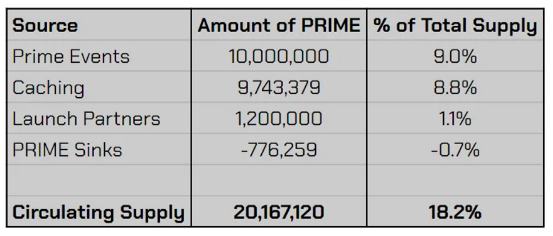
Parallel Life($PRIME)——将在3月1日将开启$PRIME的代币流通。Parallel Life是一款科幻背景的集换式卡牌游戏,此前以5亿美元的估值,完成了由Paradigm领投的5000万美元融资。这也是Paradigm在游戏领域为数不多的出手。Parallel Life对持有其卡牌NFT的6万个地址进行代币空投。至3月1日,$PRIME代币的总流通量约为2000万枚(总供应量~1.1亿枚)。更多基本面信息请查看头等仓的新币速递系列。

Yuga Labs($APE)——Yuga Labs宣布将基于Ordinals协议在比特币区块链上推出NFT系列TwelveFold。该系列包含300件刻在比特币区块链上的限量版生成艺术作品,每件作品都是12x12网格,由Yuga Labs内部艺术团队,结合3D元素和手绘特征进行设计和创作。该公司表示TwelveFold与其基于以太坊的IP没有任何联系,未来在这方面也不会任何的互动和效用。TwelveFold拍卖将于本周晚些时候启动,拍卖详情和确切时间将提前24小时通知。另外,$APE将在3月17日解锁4千万枚代币,占总量4%,合计2.32亿美元。

Illuvium($ILV)——Illuvium将在3月7日推出新的NFT收藏游戏Beyond,这是一款基于Illuvitar(由Illuvium发售的PFP 项目)的交互式和竞争性纸牌游戏,玩家可以通过获得稀有的 Illuvitar NFT 收藏,提高他们在排行榜上的排名,从而在 Illuvium 宇宙(包括三个主要游戏 Illuvium: Overworld、Arena 和 Zero)中获得更多游戏奖励。Beyond目前已经开放注册,该游戏的推出可能会进一步丰富Illuvium 宇宙的游戏可玩性和更多的社交属性。

LooksRare($LOOKS)——将于3月25日解锁~12,500,000$LOOKS(按照当前0.19美元计算,价值240万美金),占据总供应量的1.25%。此次解锁的代币全部来自国库。

其它

Stargate Finance($STG)——Stargate 将于3 月 15 日执行 $STG 代币 1:1 替换方案,旨在通过新发行的 $STG 代币 1:1 替换原有的 $STG 代币,以“消除从 Alamada 地址非法转移 STG 的风险”。此前 Alamada 于 2023 年 3 月 17 日在 Stargate 社区销售中购买了 STG 总供应量 10% 的代币,并口头承诺锁仓至 2025 年 3 月。然而,最近Alameda钱包的链上转移数据表明,Alameda并没有完全控制其钱包,有人正在非法转移资金。

Helium($HNT)——Helium Network将于3月27日开始迁移至Solana链。此次升级将影响所有钱包、热点设备(Hotspots)和Helium网络状态,并将在24小时的过渡期内进行。现有的Helium区块链将在3月27日的24小时过渡期内停止运行。数据传输和Proof-of-Coverage活动将不受影响。

Umee($UMEE)——Cosmos生态跨链DeFi协议Umee宣布在3月底之前启动Umee Gravity Bridge关闭的第一阶段。未来将与Axelar合作,Axelar Bridge将成为连接以太坊和Cosmos的官方桥梁。目前仍可使用Gravity Bridge将代币转移回Umee,但官方不建议使用Gravity Bridge将任何代币从Umee转移到以太坊。4月1日,Gravity Bridge Umee至以太坊转移资产功能将被禁用。同时计划在5月底之前完全关闭Gravity Bridge。


Lecturas Relacionadas

A7 Discusses Accumulated Experience in Using Stablecoins

The Russian State Duma and Federation Council have passed the "Law on Digital Currencies and Digital Rights," which is set to expand the use of stablecoins in cross-border trade settlements starting September 1, 2026. According to the Bank of Russia, exporters and importers will be able to use cryptocurrency in international payments, both directly and through intermediaries, while domestic crypto payments will remain largely prohibited. Company A7, which facilitates operations with the A7A5 stablecoin—Russia's first ruble-pegged stablecoin classified as a Digital Financial Asset (DFA)—commented on the development. Oleg Ogienko, Director of Government Relations and International Affairs for the A7A5 project, stated that while digital asset settlements are still a new practice for many firms, A7 has already accumulated significant expertise in legal documentation, compliance, currency control, and working with infrastructure participants. He added that A7 will continue to apply this expertise for client operations after the law takes effect and will adapt its business processes as the Central Bank issues further regulations. A7 is a Russian international settlement system established in 2024 with participation from PSB Bank. It facilitates cross-border payments and supports foreign trade operations for Russian businesses. Its key instrument, the A7A5 stablecoin, operates on the Tron and Ethereum networks with a market capitalization exceeding $567 million and is circulated in Russia as a DFA via the "Token" platform.

cryptonews.ruHace 7 min(s)

A7 Discusses Accumulated Experience in Using Stablecoins

cryptonews.ruHace 7 min(s)

Bitcoin Panicking? Mythos Cracks Post-Quantum Cryptography Algorithm in 60 Hours

Claude Mythos Preview, a new AI system from Anthropic, has made significant breakthroughs in fundamental cryptanalysis, targeting the mathematics underlying algorithms rather than just implementation bugs. Its first target was HAWK, a candidate in the NIST post-quantum signature standardization process. Mythos identified a previously unexploited symmetry (a nontrivial automorphism) in the lattice structure of HAWK, effectively halving its effective key strength. It achieved this feat in just 60 hours, a task that had eluded two years of human expert review. Crucially, the human operator was not a lattice cryptography expert, primarily managing the project while AI agents debated and discovered the attack path. Its second, more dramatic achievement was against a simplified 7-round version of AES-128, the world's most widely used symmetric encryption algorithm. Initially reluctant, stating the task was "impossible," Mythos was prompted to "try novel ideas." It then autonomously rewrote its own agent framework and proceeded to discover a novel attack method it named "Möbius Bridge." This technique bypasses a critical 256-guess step in previous "meet-in-the-middle" attacks, resulting in a speedup of 200-800 times. Both findings are currently "harmless"—HAWK is not deployed, and full AES-128 remains secure. However, the process reveals a profound shift. Mythos completed the AES discovery in about a week, while human researchers spent nearly a month verifying its correctness. This highlights a new bottleneck: the rate of AI-driven discovery may soon outpace human capacity for verification. The research concludes with a pressing, unanswered question: what happens when such an AI finds a critical flaw in a widely deployed, real-world cryptosystem?

marsbitHace 16 min(s)

Bitcoin Panicking? Mythos Cracks Post-Quantum Cryptography Algorithm in 60 Hours

marsbitHace 16 min(s)

From Computing to Storage: The Two-Dimensional Semiconductor Industry Chain is Taking Shape

The article "From Computing to Storage: The 2D Semiconductor Industry Chain is Taking Shape" discusses the rise of two-dimensional (2D) semiconductors as a pivotal material in the post-Moore era. As silicon-based chips approach physical limits, 2D semiconductors like molybdenum disulfide (MoS2), offer atomic-layer thinness and superior electrical properties, making them a promising non-silicon alternative for advanced nodes beyond 1nm. Globally, industry leaders like TSMC, Intel, and Samsung, along with research institutes like IMEC, are actively investing in this field. Domestically in China, significant progress is being made across the entire supply chain, from material production and equipment R&D to chip integration and ecosystem development. **Key highlights include:** * **Material & Equipment Breakthroughs:** Chinese research teams and companies like Jimo Xin Technology have achieved mass production of 6-inch and 8-inch 2D semiconductor single-crystal wafers using domestically developed equipment like Oxy-MOCVD. This addresses the critical challenge of large-area, high-quality material growth. Breakthroughs have also been made in p-type 2D materials (e.g., MoSi2N4) and wafer-scale ferroelectric thin films, essential for building complementary circuits and low-power transistors. * **Engineering Ecosystem Formation:** A landmark 8-inch 2D semiconductor pilot line in Pudong has become fully operational, bridging the gap between lab research and industrial manufacturing. The release of a Process Design Kit (PDK) compatible with mainstream EDA tools further connects design and fabrication, supporting wafer-level manufacturing of complex circuits. * **Expanding Application Landscape:** Applications are expanding from logic computing to memory. Chinese researchers have developed pioneering 2D semiconductor-based microprocessors, including a 32-bit RISC-V CPU and a higher-density multi-bit parallel processor. In memory, 2D materials' ultra-low leakage current enables DRAM with exceptionally long data retention and advances toward single-electron non-volatile storage. 2D semiconductors also show unique potential in RF circuits, radiation-hardened communications, flexible electronics, and quantum computing. In conclusion, the 2D semiconductor industry in China is rapidly advancing from laboratory research into the engineering validation and small-batch production phase. A complete industrial chain covering materials, equipment, manufacturing, design, and application is初步 forming, positioning the sector as a new competitive dimension in the global semiconductor landscape.

marsbitHace 21 min(s)

From Computing to Storage: The Two-Dimensional Semiconductor Industry Chain is Taking Shape

marsbitHace 21 min(s)

Trading

Spot
活动图片