[Featured Research]Why I Think Selling My #BLUR Airdrop Was a Mistake

MirrorPublicado a 2023-02-21Actualizado a 2023-02-21

Resumen

The key is product experience. Majority of their portcos prioritise this, Blur is no exception.

Over the weekend, I've been renewing my personal thesis for $BLUR, why I think selling my airdrop was a mistake, and why Blur Bidding is a game-changer for the NFT space.
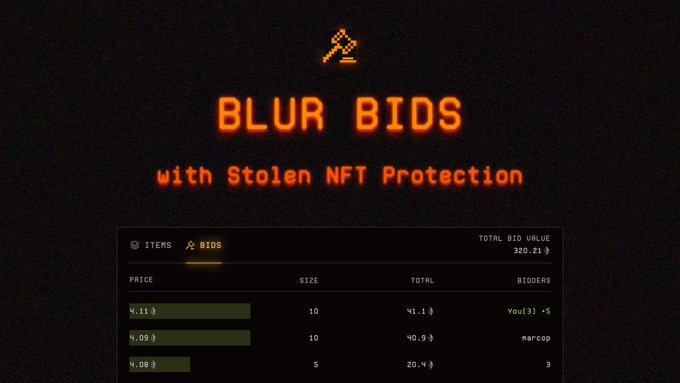
What is the most important aspect wrt product experience on NFT marketplaces? Ease of buying/selling NFTs.

ADVANTAGE OF BLUR

The majority of trading volume in the current state of the NFT market is from whales, and they want one thing: To be able to buy cheaper and sell quickly in SIZE

Compared to the DeFi space, the trading experience for NFTs is subpar. Before blur_io came along, the user experience was terrible and was not optimized for the professional, mass trading market.

NFT trading needs to (at least) attain the usability of fungible tokens in DeFi

Here comes the second (and likely the hardest) pain point: Liquidity.

While attempts have been made to solve this, including (but not limited to) NFT fragmentation, asset tokenization, and incentivization (via trading volume/listing rewards), liquidity is still extremely thin.

If I was looking to sell off 20 Doodles NFT today, it would've been impossible, likely taking days to weeks to unload fully, not to mention a downward spiraling floor price + me needing to actively re-adjust the floor price.

So what did @blur_io do? Introducing the Bid Points system.

Blur's bid mining model is essentially a liquidity pool transaction where users provide ETH (not WETH!) liquidity to a liquidity pool, a parallel comparison would be Uniswap's AMM innovation for the DeFi space.

On the other hand, opensea, LooksRare , and the_x2y2 models are pending order transactions, which makes them illiquid/inaccurate.

Blur's bidding system then incentivizes users who want the airdrop to provide liquidity and bear the risk of NFT prices once the bid is accepted.

In essence, what blur_io did right was find the right PMF (Pro NFT traders) and design a platform that focuses on the best-in-class product experience.

Users get deeper liquidity on Blur than OpenSea, allowing whales to buy/sell large amounts of NFTs frictionlessly.

GREAT AIRDROP

With $BLUR's release, the project imo is one of the most successful projects in transferring the power of protocol value distribution to the community.

The initial circulating supply of 360M tokens (12%) of supply) were distributed to the community, but what about the rest?
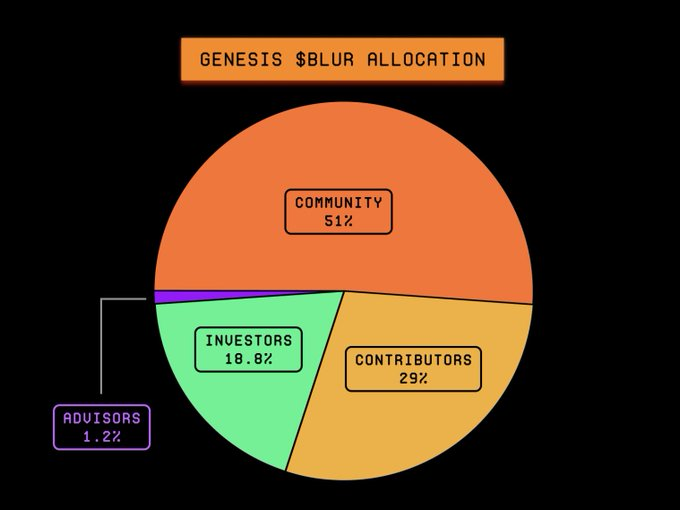
Majority of the airdrop in the first round has already been claimed, and over billions in $BLUR trading volume. Users who wanted to sell the airdrop would have already sold by now and the tokens are transferred to stronger hands.

The first year selling pressure is likely to be high, as circulating supply will increase by nearly 3x to 1 billion by the end of this year. Even so, the majority of the tokens are owned by the community. Investor/Team allocations are also subjected to a 4+ year vesting period

In my view, $BLUR is a proxy of the NFT market and a pure-play bet on the space since Blur benefits when NFT collections rise as a whole.

Assuming Blur becomes the market leader in the future, the current implied FDV of $2-3B is likely justified, given OS valuation of $13B

GREAT NEWS AHEAD

The largest exchange binance has yet to even list $BLUR, and once Blur's clear volume dominance is sustained and gains further traction, it will be inevitable.

Further, if that traction continues to gain steam, additional funding will come pouring in too.

ADVANTAGE COMPARE TO OTHER PLAYERS

Even if OS wanted to compete, they would have to reduce costs to traders and royalties (and they already did), but to really compete with Blur on liquidity, they likely have to switch to a similar model to Blur. (although that offers zero differentiation from Blur lol)

Further, building out a new product might potentially introduce bugs, which could completely destroy OS.

Wen $OS? Imo, highly unlikely, given the regulatory landscape and their desire to IPO. It also doesn't make sense from the business/investor POV; why would they give away their profits?

Also, PacmanBlur and the Blur team understand the NFT market deeply, perhaps better than OpenSea themselves. LooksRare and X2Y2 were focused on incentivizing trading volume instead of the most important thing: Liquidity.

The models used by Looksrare and X2Y2 incentivize wash trading, essentially fake volume that does nothing to improve the product experience. In other words, ponzinomics designed to attract retail who wants a dividend payout. Nothing wrong with that, btw. To each his own.

When the airdrop/token incentives end, how does Blur plan to sustain its liquidity depth? Good question, but this has been reiterated many times in multiple podcasts with @PacmanBlur, and the team is well aware of this and will be optimizing for growth long term.

Being a 2-sided marketplace, as long as user experience is top-notch and prioritized by the team, users will remain sticky to the platform. So product experience = #1

A case in point is OpenSea. Even without a token, users kept using it, of course, until Blur came along.

The Blur team is currently not making $$ themselves since marketplace fees are currently still 0%. And as everyone knows, they are @paradigm backed, but what does that even imply?

The key is product experience. Majority of their portcos prioritise this, Blur is no exception.

Lecturas Relacionadas

OpenRouter: How Did This 'AI Model Relay Station' Achieve a $10 Billion Valuation?

OpenRouter: The Model Router Building a $10B+ Company This article explores OpenRouter, a platform that aggregates access to over 400 AI models from 70+ providers (like OpenAI, Claude, Gemini) through a single API. It has grown into a unicorn with a $1.3B valuation by 2026, processing massive scale—reaching 100 trillion tokens monthly. Its core value isn't just being a "model supermarket." For developers building real-world AI applications, managing multiple models for different tasks (e.g., cheap models for titles, powerful ones for long articles) is complex. OpenRouter acts as a critical "model scheduling layer," handling routing, failover between providers, cost optimization, and enterprise features like zero-data-retention policies and budget controls. OpenRouter's business model is a "toll fee": it charges a small platform fee (5.5%) on purchased credits while passing model costs directly to users. Its revenue scales with the tokens flowing through its system, which saw explosive growth as AI apps evolved. Key growth drivers include: 1) The explosion of specialized models, increasing choice complexity; 2) AI apps shifting focus from performance to cost optimization; 3) The rise of AI agents that require more reliable, multi-step model calls. However, risks remain. Large enterprises or cloud providers (AWS, Google Cloud) could build similar internal gateways. Its position between model suppliers and developers could also create future tension over pricing and data control. To stay ahead, OpenRouter must deepen its enterprise features and prove it's more than just a request forwarder.

marsbitHace 21 min(s)

OpenRouter: How Did This 'AI Model Relay Station' Achieve a $10 Billion Valuation?

marsbitHace 21 min(s)

Bitcoin Falls Below $60,000 Again; After 20 Months, We've Reached a New Low

Bitcoin Drops Below $60,000, Hitting a 20-Month Low Bitcoin fell below the key $60,000 psychological level again, reaching a low of $59,023—its lowest point in approximately 20 months, dating back to October 2024. While it later recovered slightly to around $60,600, this marks its third significant breach of $60,000 this year. The downturn is attributed to two primary factors. First, U.S. spot Bitcoin ETFs are experiencing their longest streak of net outflows since launch, with nearly $5.94 billion withdrawn over 30 days. This creates sustained selling pressure as Authorized Participants sell Bitcoin to meet redemptions. Second, shifting macroeconomic expectations are adding pressure. Strong U.S. job data and hawkish remarks from Fed officials have increased market pricing for potential rate hikes, reversing the earlier liquidity-driven bullish sentiment and prompting a shift away from risk assets like Bitcoin. Analyst views are mixed. 21Shares maintains a bullish long-term outlook, expecting prices to recover towards $100,000, citing historical post-halving cycles and substantial ETF holdings as a base. In contrast, Arthur Hayes predicts a potential bottom around $40,000 within six months due to persistent Fed hawkishness. CryptoQuant suggests, based on on-chain data, that the market may not find a bottom until prices fall below the average investor cost basis around $53,000, potentially extending the bearish phase into late 2026 or early 2027. The immediate focus is on upcoming U.S. inflation data and Fed signals. Lower-than-expected CPI could offer relief, but confirmation of sticky inflation or continued ETF outflows may lead to further downside pressure. Bitcoin's ability to hold above $60,000 remains a critical test for the near-term market direction.

Odaily星球日报Hace 1 hora(s)

Bitcoin Falls Below $60,000 Again; After 20 Months, We've Reached a New Low

Odaily星球日报Hace 1 hora(s)

When Billions Begin to Operate Everything by Voice, How Far is ‘All Assets on Chain’?

In June 2026, WeChat began a limited rollout of "Xiaowei," its native AI assistant. This move is more than an upgrade to a smarter chatbot; it signals a crucial step from "universal internet access" toward the broader vision of "full asset tokenization." Xiaowei, powered primarily by WeChat's in-house WeLM model, demonstrates four key capabilities: 1) direct voice/web chat control of app functions, 2) automated access to mini-programs for services, 3) instant comprehension and summarization of complex documents like PDFs, and 4) generating functional mini-program prototypes from simple natural language requests. This represents a fundamental shift from GUI (Graphical User Interface) to LUI (Language User Interface), eliminating friction in human-digital interaction. The rollout is pivotal because it brings AI Agents to China's massive user base with zero friction—no new app downloads or accounts needed. This "seamless access" mirrors past platform revolutions like the App Store or WeChat Mini-Programs, potentially unlocking a global AI Agent market projected to grow from $7.92 billion in 2025 to nearly $295 billion by 2035. The article argues that China's internet evolution has moved from "connecting everyone" to "putting all services online." The next phase is "tokenizing all assets"—a concept broader than just Real World Assets (RWA) like real estate. It encompasses tokenizing personal assets like social influence, attention, and credit history. RWA tokenization itself is forecast to explode from $35 billion in 2025 to over $500 billion in 2026. The convergence of ubiquitous AI Agents and rapidly tokenizing assets points to a future paradigm for wealth management. Your AI Agent could autonomously manage a globally diversified, tokenized portfolio based on your preferences. Initiatives like EXIO Group's full-stack RWA services aim to lower investment barriers, paralleling WeChat's democratization of AI access. In conclusion, the launch of Xiaowei is not merely a technical upgrade but a historic inflection point. It marks AI Agents' transition from niche tools to essential utilities and accelerates the movement toward a future where voice commands seamlessly interact with tokenized value, redefining humanity's relationship with the digital and financial worlds.

marsbitHace 2 hora(s)

When Billions Begin to Operate Everything by Voice, How Far is ‘All Assets on Chain’?

marsbitHace 2 hora(s)

Trading

Spot
Futuros
活动图片