Meme Coin Moves: DOGE, SHIB and PEPE Spike While BONK, FARTCOIN Fall

TheCryptoTimesPublished on 2025-07-09Last updated on 2025-07-09

Leading meme coins like Dogecoin (DOGE), Shiba Inu (SHIB) and PEPE have shown solid gains in the past few days with attracting renewed interest from investors. On the other side, BONK and FARTCOIN took the plunge in the past 24 hours. 

While this shift took place, the crypto market cap stood at $3.37 trillion, rising 0.81% for the day. Notably, the daily trading volume dipped by 1.21% and stood at a volume of $98.86 billion, indicating a feeling of caution in the market.

Dogecoin (DOGE) surged by 2.59% in 24 hours. It is trading at $0.1721 at the time of writing, pushing its market cap over $25.83 billion. The 24 hour trading volume for Dogecoin reached $893 million today.

The second most popular meme coin by market cap, Shiba Inu (SHIB) also saw a rise of 1.86%, priced at $0.000012 with a market cap of $7 billion. Meanwhile, PEPE spiked most among top 5, surging by 3.50% to $0.000010, with its market cap at $4.3 billion.
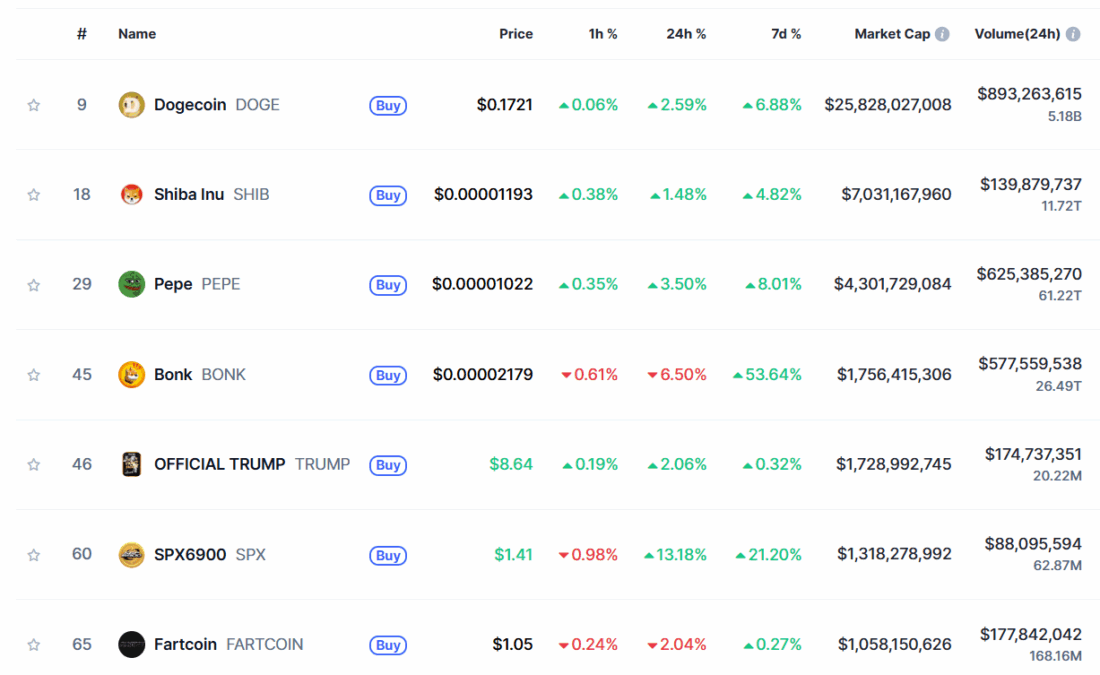
Meme Coins On Coinmarketcap
Source: CoinMarketCap

Losers in the Meme Coin Space

On the losing side, BONK took a hit after last week’s notable surge, dropping 6.50% in the past 24 hours and trading at $0.00002179 as of latest market data. Its market cap fell to $1.73 billion. 

Similarly, FARTCOIN–another Solana-based meme coin—also saw a decline of 2%, settling at $1.05. Its trading volume sits at $177 million, while its market cap decreased to $1.05 billion.

Even with these setbacks, the meme coin market is holding steady. The total meme coin market cap sits at $56.40 billion, up 1.64% in the past 24 hours.


Also Read: FARTCOIN Price Drops 8%, Will it Crash Below $1?


Related Reads

RWA Weekly: Digital Yuan Wallets Implement Interest on Balances, Ondo's Tokenized Silver Product Surges Over 155% in Market Cap in 30 Days

RWA Weekly: Digital Yuan Wallets to Earn Interest, Ondo's Tokenized Silver Surges Over 155% This weekly report covers December 27, 2025, to January 2, 2026. The on-chain RWA market cap grew steadily to $19.21 billion, with holders nearing 600,000, though growth suggests potential demand constraints. Stablecoin market cap slightly declined to $2.97 trillion, but monthly transfer volume surged 13.77%, indicating an "efficiency-driven" phase. RWA protocol TVL has surpassed DEXes to become the fifth-largest DeFi category. In China, the PBOC announced plans to enhance the digital yuan management system, with six major state-owned banks introducing interest payments (0.05% annual rate) on balances in verified digital yuan wallets starting January 1, 2026, advancing its function toward M1. Cross-border adoption accelerated, with Bank of China completing the first QR code payment between China and Laos. Globally, the US FASB plans to study whether stablecoins can be classified as cash equivalents in 2026. India's central bank urged prioritizing CBDCs over private stablecoins due to financial stability concerns. Notable project developments include BlackRock's tokenized money market fund BUIDL distributing over $100 million in dividends, and Ondo's tokenized silver product (SLVon) surging over 155% in market cap to nearly $18 million. Commodity tokenization expanded with platforms like MSX listing copper, uranium, and oil tokens. The report highlights growing interest in tokenized commodities amid rising gold and silver prices, and discusses stablecoins' evolution toward programmable money and AI-driven "agent finance," emphasizing transparency and global reach as key advantages over traditional finance.

marsbitHace 54 min(s)

RWA Weekly: Digital Yuan Wallets Implement Interest on Balances, Ondo's Tokenized Silver Product Surges Over 155% in Market Cap in 30 Days

marsbitHace 54 min(s)

2026 US Crypto Policy: Keep an Eye on These Six Key Milestones

The year 2026 is poised to be a pivotal period for US cryptocurrency policy, marked by six key dates. The policy revolution initiated under President Trump's second term is expected to continue, with major legislative and regulatory actions scheduled throughout the year. In January, the Senate is anticipated to hold hearings on the market structure bill, aiming to resolve the regulatory turf war between the SEC and CFTC. Additionally, SEC Chair Paul Atkins is expected to introduce an "innovation exemption" for new technologies. On May 15, the term of Federal Reserve Chair Jerome Powell ends. President Trump is likely to appoint a more dovish successor, whose monetary policy decisions could significantly impact crypto markets and inflation. A new crypto licensing law, the Digital Financial Assets Law, takes effect in California on July 1, potentially setting a precedent for other states. By July 18 deadline, federal and state regulators must issue supplementary rules for the recently passed stablecoin legislation (the Genius Act), covering areas like licensing and anti-money laundering. This process is already facing contention from banks and industry groups. By the end of August, two key developments are expected: the potential passage of crypto tax legislation (the Parity Act) addressing staking and small transactions, and the finalization of CFTC rules on blockchain technology applications in capital markets. The November 3 midterm elections represent the most significant variable. The current pro-industry "golden age" in Washington, facilitated by a Republican-controlled Congress, could end if Democrats regain control of either chamber, drastically reducing the likelihood of future crypto-friendly legislation. The passage of any pending bills too close to this date carries a high risk of stalling.

比推Hace 1 hora(s)

2026 US Crypto Policy: Keep an Eye on These Six Key Milestones

比推Hace 1 hora(s)

6 Key Dates for US Crypto Policy in 2026

Summary of Key US Crypto Policy Dates in 2026: 2026 is poised to be another significant year for US cryptocurrency policy. Key dates include: - **January**: The Senate is expected to hold hearings on the stalled crypto market structure bill (the "Clarity Act"), aiming to resolve the jurisdictional battle between the SEC and CFTC. Additionally, SEC Chair Paul Atkins is expected to unveil an "innovation exemption" for new technologies. - **May 15**: The term of Federal Reserve Chair Jerome Powell ends. President Trump, who has criticized Powell, is likely to appoint a more dovish successor, a move that could impact crypto markets and inflation. - **July 1**: California's Digital Financial Assets Law takes effect, requiring businesses engaging in digital asset activities with state residents to be licensed by the state’s financial regulator. - **July 18**: Regulators face a deadline to publish supplementary rules for the recently passed stablecoin legislation (the "Genius Act"), covering areas like licensing and anti-money laundering. This process is already contentious, with banks and crypto lobbyists clashing over certain provisions. - **August**: Two major developments are anticipated: the potential passage of crypto tax legislation (e.g., the "Parity Act" for de minimis exemptions) and the finalization of CFTC rules on blockchain technology applications in capital markets. - **November 3**: The US midterm elections could drastically alter the crypto policy landscape. The industry's recent successes relied on a Republican-controlled Congress; if Democrats regain control, the passage of pro-industry legislation would become far more difficult. The implementation of new laws and the political climate will be crucial in determining if the US remains a hub for crypto innovation.

marsbitHace 1 hora(s)

6 Key Dates for US Crypto Policy in 2026

marsbitHace 1 hora(s)

Trading

Spot
Futures

Discussions

Welcome to the HTX Community. Here, you can stay informed about the latest platform developments and gain access to professional market insights. Users' opinions on the price of DOGE (DOGE) are presented below.

活动图片