Bitcoin Giants Shrink: Whales Quietly Hand Off Billions To Institutions

bitcoinistPublicado a 2025-07-06Actualizado a 2025-07-06

Resumen

Bitcoin’s price has held steady around $108,100 as of Saturday afternoon after big holders shipped out a massive load of...

Trusted Editorial content, reviewed by leading industry experts and seasoned editors. Ad Disclosure

Bitcoin’s price has held steady around $108,100 as of Saturday afternoon after big holders shipped out a massive load of coins.

Based on reports, whales—those early adopters and big miners—sold over 500,000 BTC in the past 12 months. At today’s rates, that stash is worth north of $50 billion. Institutions grabbed almost every coin they let go. It’s a huge shift in who really owns Bitcoin.

Whales Pass The Torch

According to Bloomberg’s review of 10x Research data, wallets holding between 1,000–10,000 BTC saw their balances slip from over 4.5 million coins in January 2023 to about 4.47 million in July 2025.

At the same time, addresses with 100–1,000 BTC jumped from nearly 4 million to 4.77 million. That shift shows big players trimming back while medium‑size holders, often funds or wealthy clients, build their stacks. It’s happening quietly through in‑kind transfers and private deals that skip public exchanges.
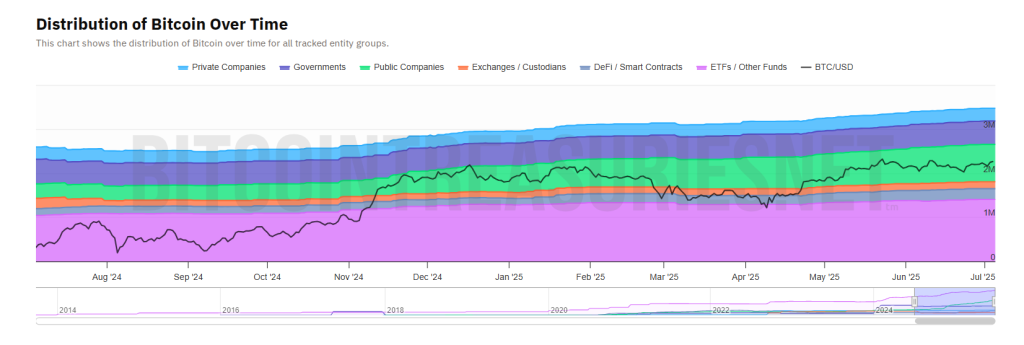
Source: Bitcoin Treasuries

Institutions Ramp Up Their Stakes

Funds, ETFs and corporate treasuries have scooped up almost every coin dropped by whales. Data from Bitcoin Treasuries shows private companies boosted their holdings from 279,374 BTC in July 2024 to 290,883 BTC today.

Public firms climbed from 325,400 BTC to 848,600 BTC. ETFs led the charge, raising their balance from 1,039,000 BTC to 1,405,480 BTC. In total, these groups added 899,198 BTC—about $96 billion—over the past year. That buying power has helped keep the market in balance as whales step back.

BTCUSD currently trading at $108,227. Chart: TradingView

Shift In On-Chain Holdings

Medium-sized wallets are growing while the largest ones shrink. That trend suggests new types of investors are moving in.

Edward Chin, co‑founder of Parataxis Capital, said in‑kind transfers let coins move from anonymous holders to regulated firms without public trades. This quiet pipeline boosts on‑chain activity and brings more oversight to big Bitcoin trades.

Volatility Hits Two-Year Low

As institutional flows rise, price swings have dulled. The Deribit 30‑day volatility gauge sits at its lowest level in two years. Jeff Dorman, CIO at Arca, compared today’s Bitcoin to a steady dividend payer that might deliver annual gains in the 10–20% range.

That’s a far cry from the 1,400% surge seen in 2017. For long‑term savers, steadier returns look more attractive than wild rallies.

Meanwhile, Fred Thiel, CEO of miner MARA Holdings, said his company still holds every coin it mines. But he warned that if whale selling picks up again and institutional appetite fades, prices could lurch lower.

Featured image from Meta, chart from TradingView

Editorial Process for bitcoinist is centered on delivering thoroughly researched, accurate, and unbiased content. We uphold strict sourcing standards, and each page undergoes diligent review by our team of top technology experts and seasoned editors. This process ensures the integrity, relevance, and value of our content for our readers.

Christian, a journalist and editor with leadership roles in Philippine and Canadian media, is fueled by his love for writing and cryptocurrency. Off-screen, he's a cook and cinephile who's constantly intrigued by the size of the universe.

Lecturas Relacionadas

From 'Word Unit' to 'Symbol Unit': The Debate Over the Chinese Translation of 'Token' and Its Underlying AI Cognitive Implications

Recent discussions have emerged regarding the official Chinese translation of the AI term "Token," which has been recommended as “词元” (Cíyuán, meaning "word unit") by the National Committee for Terminology in Science and Technology. While this translation is argued to align with historical usage in natural language processing (NLP) and is considered concise and communicable, this article presents a critical counterview advocating for “符元” (Fúyuán, meaning "symbol unit") as a more structurally accurate and future-proof alternative. The author argues that defining Token based on its origin in NLP—as a linguistic semantic unit—overlooks its evolution into a general-purpose, discrete symbolic unit used across multimodal systems (text, image, audio, etc.). Using “词元” ties the concept too narrowly to language, causing cognitive misalignment and semantic drift when applied in non-linguistic contexts. By contrast, “符元” reflects Token’s fundamental role as a symbol in information theory and computation, independent of modality. The article further critiques the reliance on metaphorical extensions (e.g., comparing image patches to “words”) as insufficient for rigorous terminology. It highlights risks including confusion with existing linguistic terms like Lemma (also translated as “词元”), poor cross-lingual reversibility (e.g., difficult back-translation to English), and systemic misunderstanding among non-expert audiences. In conclusion, the author emphasizes that terminology should align with computational essence—not historical usage or explanatory convenience—to ensure conceptual clarity and scalability in AI’s multidisciplinary future. “符元” is proposed as a more neutral, stable, and structurally coherent translation for Token.

marsbitHace 1 hora(s)

From 'Word Unit' to 'Symbol Unit': The Debate Over the Chinese Translation of 'Token' and Its Underlying AI Cognitive Implications

marsbitHace 1 hora(s)

Aave Mired in a Crisis of Confidence: Service Providers Exit En Masse, Failures in Technology, Governance, and Risk Control

Aave, a leading DeFi lending protocol, is facing a severe internal crisis marked by the departure of key service providers, raising concerns about its governance, security, and future direction. The crisis began when Chaos Labs, the protocol's long-time risk management provider, terminated its relationship with Aave. The firm cited financial losses, the exit of other major contributors, and fundamental disagreements over the risk architecture of the upcoming Aave V4. Aave Labs declined Chaos Labs' demands for a significant fee increase and exclusive control over key functions like risk management and oracle services. This exit followed the departure of two other critical partners. BGD Labs, the primary technical contributor to Aave V3, accused Aave Labs of forcing an aggressive transition to V4 by limiting V3 development and devaluing its work. Subsequently, the Aave Chan Initiative (ACI), a major governance service provider, announced its planned exit, criticizing Aave Labs for centralizing power and controlling a large portion of voting tokens. The conflict highlights a central paradox within DAOs: the tension between founder-led vision and decentralized governance, and between long-term protocol health and short-term capital interests. Aave Labs is pushing for a more integrated and efficient "Aave Will Win" model with V4, arguing it is necessary for competing at an institutional level. However, critics warn this centralization comes at the cost of the protocol's decentralized credibility and increases systemic risk. The immediate impacts include a potential security downgrade, a loss of institutional knowledge, and damaged community trust. While Aave Labs views this as a painful but necessary transition, the market is watching cautiously as the protocol navigates this period of significant internal turmoil.

marsbitHace 1 hora(s)

Aave Mired in a Crisis of Confidence: Service Providers Exit En Masse, Failures in Technology, Governance, and Risk Control

marsbitHace 1 hora(s)

Trading

Spot
Futuros
活动图片