Tether, Kazakhstan cenbank mull tenge stablecoin and asset tokenization

cointelegraphPublished on 2026-10-08Last updated on 2026-10-08

Abstract

Tether has signed a memorandum of understanding with Kazakhstan's central bank and the Alatau City Authority to explore the issuance of a tenge-pegged stablecoin and the tokenization of real-world assets. The parties will study stablecoin models, identify use cases, and develop a pilot for a Kazakh tenge-backed stablecoin, while also creating a framework for asset tokenization potentially using Tether's Hadron platform. Workshops on stablecoin issuance and tokenization are also planned. Kazakhstan's central bank emphasized that financial stability and investor protection are priorities in this exploration. This move is part of Kazakhstan's broader push into digital assets, which includes a government-approved development plan covering tokenization, digital payments, and crypto mining. The country ranks seventh among governments for Bitcoin holdings, with its National Strategic Crypto Reserve valued at $700 million.

Tether has signed an agreement with Kazakhstan’s central bank and the Alatau City Authority to explore a tenge-pegged stablecoin and the tokenization of real-world assets.

Under the memorandum of understanding, the parties will study international stablecoin issuance models, identify potential use cases and develop a proposal for a tenge-backed stablecoin pilot, according to Tether.

The agreement also calls for the development of an asset tokenization framework, including identifying assets for potential tokenization and launching a pilot project in Alatau that could use Tether’s Hadron platform.

Tether, the National Bank of Kazakhstan and the Alatau City Authority will also hold workshops and training programs covering stablecoin issuance, reserve management and real-world asset tokenization.

National Bank of Kazakhstan Deputy Governor Binur Zhalenov said the central bank plans to study international approaches to stablecoin issuance and tokenization while prioritizing financial stability, transaction transparency and investor protection.

Related: Balaji’s Network School turns to Kazakhstan amid Malaysia setback

Kazakhstan expands digital asset push

Kazakhstan, the world’s largest landlocked country, has accelerated its push into digital assets this year, rolling out initiatives including stablecoins, tokenization, crypto payments and mining.

In September, the government approved a 65-measure plan across 10 areas aimed at developing the country’s digital asset industry. The plan includes measures to expand real-world asset tokenization, digital payments, international settlements and crypto mining.

The government also instructed the Energy and Digital ministries to develop a mechanism for using gas- and coal-fired power generation to supply mining centers. Kazakhstan ranked among the world’s top 10 countries for Bitcoin production in 2025, according to the government.

Kazakhstan’s National Strategic Crypto Reserve, meanwhile, has reached $700 million, while 34 digital asset projects have completed testing in the central bank’s regulatory sandbox, according to the announcement.

BitcoinTreasuries.net ranks Kazakhstan seventh among governments in its database for Bitcoin holdings, with an estimated 3,544 BTC worth about $294 million.
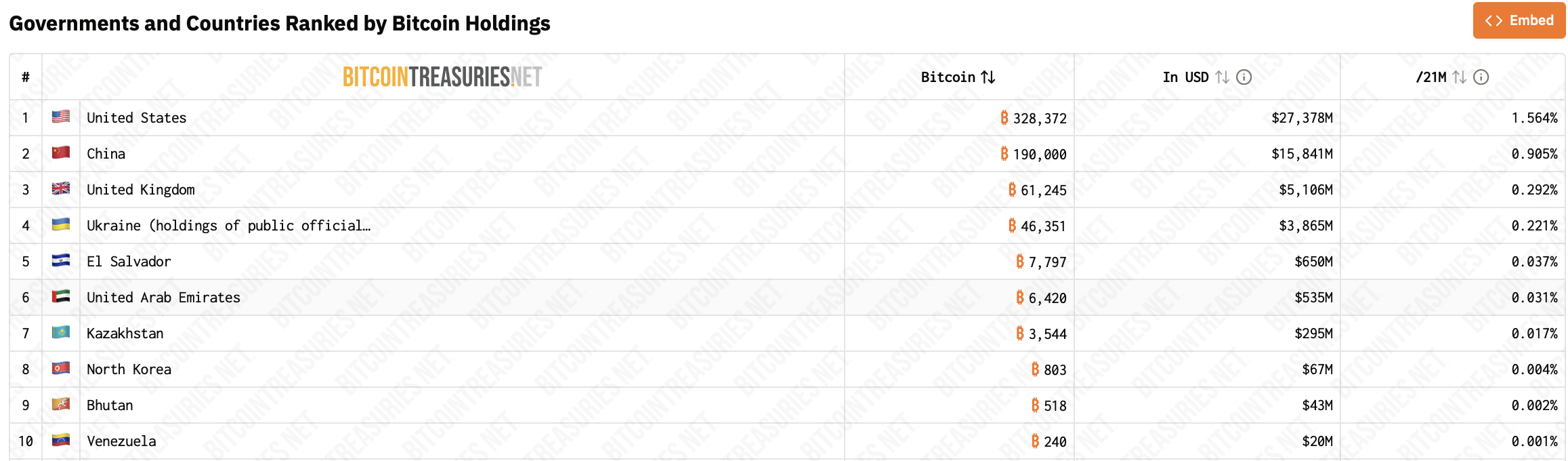
Source: BitcoinTreasuries.NET

Magazine: Capital starting to rotate back to crypto from AI: Raoul Pal

Related Questions

QWhat is the main purpose of the agreement signed between Tether and Kazakhstan's central bank?

AThe main purpose is to explore the development of a tenge-pegged stablecoin and the tokenization of real-world assets.

QBesides stablecoin issuance, what other key area will the partnership study and develop?

AThe partnership will also study and develop an asset tokenization framework, potentially using Tether's Hadron platform for a pilot project in Alatau.

QWhat are the National Bank of Kazakhstan's priorities in its study of stablecoins and tokenization?

AThe priorities are financial stability, transaction transparency, and investor protection.

QAccording to the article, how does Kazakhstan rank globally in Bitcoin production?

AKazakhstan ranks among the world's top 10 countries for Bitcoin production.

QWhat is the estimated value of Bitcoin held by the Kazakh government according to BitcoinTreasuries.net?

AThe Kazakh government is estimated to hold about 3,544 BTC worth approximately $294 million.

Related Reads

The Art of the Trade: How They Made Money Arbitraging USDE Stock

Starkiller Capital outlines a arbitrage trade on StablecoinX (Nasdaq: USDE), a crypto treasury company holding about 20% of ENA tokens. At Friday's close, USDE traded at $6.43 per share, with each share backed by 125.48 ENA worth $20.10—meaning investors pay 32 cents per $1 of ENA, or $155M for $485M in tokens. The firm's approach: buy USDE stock while shorting an equal dollar amount of ENA, so if both fall but the stock falls less, short gains offset stock losses. Starkiller first entered in August at 0.18x mNAV, took profits as the discount narrowed to 0.60x, and has rebuilt a larger position at 0.32x. The key new catalyst: Ethena's foundation waived all token lockups effective October 5, letting the company sell ENA to fund an approved share buyback. At current prices, every $1 of ENA sold repurchases shares representing $3.13 of token assets, strongly accretionary to NAV per share. The discount widened recently not because of company fundamentals but because crypto market beta fell—ENA dropped 29% and比特币 7% in October—and because USDE holders exiting ENA exposure sold the illiquid stock; short interest rose 78% to ~15% of float. Risks include: no redemption mechanism forcing convergence (GBTC traded at a discount for two years), the foundation controls the exit path and must approve token sales, a resale S-1 covers over half the A-shares, mNAV has ranged from 0.13x to 0.61x, warrants at $11.50 and $15 strike could dilute upside, and a crypto crash could push mNAV back to lows. Catalysts to watch: the Q3 10-Q filing (due by Nov 16) for buyback details. Starkiller argues the stock should eventually trade around 0.7x mNAV, implying roughly 56% upside on the long leg just from a return to the October 5 level.

marsbit4m ago

The Art of the Trade: How They Made Money Arbitraging USDE Stock

marsbit4m ago

Embedded chip vendors are starting to sell modules directly?

On November 5, Texas Instruments (TI) announced the TICS100MOD, a multi-protocol industrial communication System-on-Module (SoM) supporting EtherCAT, PROFINET, and EtherNet/IP, with volume availability expected by the end of 2026. The module integrates TI's AM2612 real-time MCU—featuring dual Arm Cortex-R5F cores and PRU-ICSS—along with two DP83826AI 100Mbps Ethernet PHYs, protocol stacks, SDK, and development tools in a 30mm × 18mm package. It connects to an external host MCU or MPU via SPI or QSPI, handling industrial Ethernet protocol processing while the host runs device control and applications. The article notes that while MPU-based SoMs are common, MCU-based SoMs are relatively rare, and TI's MCU is powerful and complex enough to justify a module. TI is not the first chip vendor to offer its own SoM products: Microchip has offered SoMs such as the ATSAMA5D27-SOM1 and SAM9X60D1G-SOM, some suitable for surface-mount reflow soldering, while AMD offers the Kria K26 and K24 SoM series. In wireless connectivity, Espressif and Silicon Labs similarly provide chips alongside modules. In China, SoMs are typically called core boards, with vendors including Chuanglong Technology, MYIR Electronics, Forlinx, ZLG, and Alientek, covering TI, NXP, ST, Renesas, and domestic platforms such as Rockchip and Allwinner. TI continues to partner with third-party SoM vendors—including Chuanglong, MYIR, and Alientek around the AM62L processor, and internationally with Toradex, Variscite, Ezurio, and PHYTEC. TI's new TICS100MOD focuses specifically on industrial Ethernet communication, while customers needing complex computing platforms are still served through third-party partners.

marsbit14m ago

Embedded chip vendors are starting to sell modules directly?

marsbit14m ago

Morgan Stanley's "Memory Grim Reaper" Shawn Kim Warns Again: The Real Bomb Is the "2028 Profit Cliff," Broadly Cuts Memory Stock Price Targets

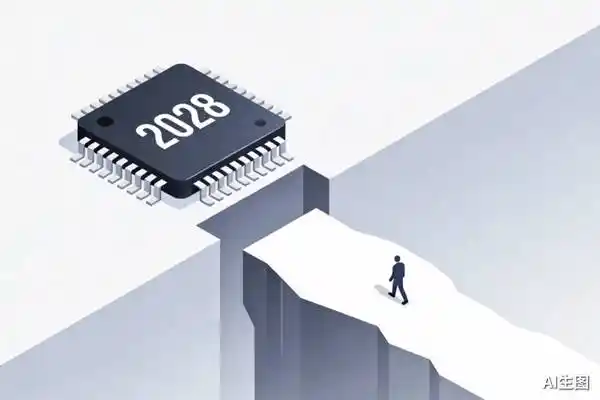
Morgan Stanley analyst Shawn Kim, dubbed Korea's "semiconductor grim reaper," has issued a new warning on the memory sector, targeting a "2028 profit cliff." In a November 9 report, he cut price targets for Samsung Electronics and SK Hynix, naming Samsung as his new top pick over SK Hynix. The core debate has shifted from near-term fundamentals to the "2028 profit cliff," driven by four pressures: (1) faster-than-expected supply response as new capacity ramps up around late 2027, with Chinese suppliers adding pricing pressure; (2) delayed 2028 data center construction—about 5GW of US projects pushed from 2028 to 2029, cutting global data center capacity growth from ~21% to 9% in 2028; (3) BOM cost constraints, with memory now ~60% of AI server costs, forcing buyers to downgrade configurations, while NAND spot prices fell ~20% in two weeks; and (4) narrowing HBM premiums as competition intensifies. Kim slashed SK Hynix's target price by 38% to 1.6 million won and Samsung's by 19% to 309,000 won, driven by lower long-term margin assumptions—SK Hynix's 2029-2035 DRAM operating margin cut to ~32% (near the 31% historical average) and Samsung's to ~39%, with HBM premiums assumed to fade to zero by 2033. Near-term 2026-2028 EPS estimates were raised on buyback-driven share reduction. Despite the warning, Kim is not fully bearish. The SOX forward P/E has halved from 26.3x to 13.4x since June, roughly matching past downturn troughs, while consensus EPS rose 24%. He argues valuation has done its job; the key variable now is earnings. Of 11 SOX downturns since 2000, nine were valuation-driven, with deep earnings cuts only in 2000-2002 and 2007-2008. AI supply chain EPS revision breadth is narrowing but still positive. Samsung is favored for its size, capital strength, and expected HBM share overtake in 2027 (~39% vs. SK Hynix's ~37%), plus diversified businesses. SK Hynix retains its HBM leadership and long-term agreement protection, though its post-2028 excess profit period is seen as shorter.

marsbit28m ago

Morgan Stanley's "Memory Grim Reaper" Shawn Kim Warns Again: The Real Bomb Is the "2028 Profit Cliff," Broadly Cuts Memory Stock Price Targets

marsbit28m ago

Trading

Spot
活动图片